Short answer: body fat percentage matters more for individuals, because it tells you what your weight is actually made of. BMI still matters, but as a free, one-number population screen rather than a personal verdict. Use BMI to flag a number worth investigating, then judge your progress on body fat, waist size and how you feel.
Reviewed on October 2026. This is general health information, not medical advice. If your weight or body composition is affecting your health, a doctor or registered dietitian can help you interpret the numbers properly.
A few things to hold onto before the detail:
- BMI uses only height and weight, so it cannot separate muscle from fat. Body fat percentage tries to.
- Neither number is a diagnosis. Cut-offs are population averages, not personal verdicts.
- The two can disagree hard. A rugby player and an office worker can land on the same BMI while living in completely different bodies.
- Waist circumference and basic blood markers add information neither number gives you.
- Home scales estimate body fat. They are good enough for trends over weeks, not for single readings.
Table of Contents
- body fat percentage vs bmi which matters more at a Glance
- What Is Body Fat Percentage?
- What counts as a healthy body fat percentage?
- What Is BMI?
- Why BMI cannot tell muscle from fat
- How Do Body Fat Percentage and BMI Differ?
- Why is my BMI high but I’m not fat?
- Visceral vs subcutaneous fat: location matters
- Why the guidance is moving away from BMI cut-offs
- Which Measure Is More Useful for Weight Loss?
- How Accurate Are These Measurements?
- body fat percentage vs bmi which matters more for Different Goals
- body fat percentage vs BMI for fat loss, muscle gain and longevity
- Which Should You Choose?
- Frequently Asked Questions
- Is body fat percentage better than BMI for weight loss?
- What is a healthy body fat percentage for women and men?
- Why can BMI be inaccurate for some people?
- Should I use body fat percentage or BMI to track progress?
- How often should I measure my body fat percentage?
- When should I ask a doctor or registered dietitian about my weight and body composition?
- Conclusion
body fat percentage vs bmi which matters more at a Glance
| Criterion | Body fat percentage | BMI |
|---|---|---|
| What it measures | The share of your total weight that is fat tissue | Weight in kilograms divided by height in metres squared |
| Main strength | Reflects body composition and where your weight sits | Free, instant, and reliable across large populations |
| Main limitation | Home estimates carry a wide error margin | Cannot tell muscle from fat, or fat location from fat mass |
| Best use | Tracking fat loss, muscle gain and body recomposition | A first screening check in a clinic or at home |
| Who finds it most useful | People who train, are over 40, or are losing weight on medication | Anyone wanting a quick population-level risk check |
| Confidence from a home device | Directional, plus or minus several points | Very high, since it is pure arithmetic |
Read that table as a division of labour rather than a scoreboard. BMI is a screening tool. Body fat percentage is a closer look at composition.
What Is Body Fat Percentage?
Body fat percentage is the proportion of your body weight that is fat. On a 70 kg person at 20%, roughly 14 kg of that weight is fat and 56 kg is everything else: muscle, bone, organs, skin and water.
Fat itself is not the problem. Some of it is essential. Your brain, spinal cord, kidneys and cell membranes all need it, and a floor of roughly 10 to 13% in women and 2 to 5% in men is considered essential fat. Stored fat is the layer that accumulates when intake exceeds need.
What counts as a healthy body fat percentage?
The accepted reference ranges shift with age and sex. Higher fat is normal later in life; lower fat is harder to sustain safely.
| Age | Men: athletic | Men: fitness | Men: average | Women: athletic | Women: fitness | Women: average |
|---|---|---|---|---|---|---|
| 20-29 | 6-13% | 14-17% | 18-24% | 14-20% | 21-24% | 25-31% |
| 30-39 | 7-14% | 15-20% | 21-27% | 15-21% | 22-25% | 26-32% |
| 40-49 | 8-15% | 16-21% | 22-29% | 16-22% | 23-26% | 27-33% |
| 50-59 | 9-16% | 17-22% | 23-30% | 17-23% | 24-27% | 28-34% |
| 60+ | 10-17% | 18-23% | 24-31% | 18-24% | 25-28% | 29-35% |
Two people can sit at the same percentage and be in completely different states of health. Someone at 30% with poor blood markers and someone at 30% who trains hard and sleeps properly are not in the same situation, and the percentage cannot tell them apart.
What Is BMI?
Body mass index divides your weight in kilograms by your height in metres, squared. At 1.70 m and 70 kg, that is 70 divided by 2.89, which gives about 24.2.
The categories come from the World Health Organization and are used by clinics, insurers and national health agencies:
- Underweight: below 18.5
- Normal weight: 18.5 to 24.9
- Overweight: 25 to 29.9
- Obesity class I: 30 to 34.9
- Obesity class II: 35 to 39.9
- Obesity class III: 40 and above
They are statistical bands drawn from large populations. They are useful for spotting who deserves a closer look. They are not a statement about your individual health.
Why BMI cannot tell muscle from fat
Muscle is roughly 18% denser than fat. Two people at the same height who weigh the same amount can be carrying very different amounts of lean tissue, so they can carry very different metabolic risk.
How Do Body Fat Percentage and BMI Differ?
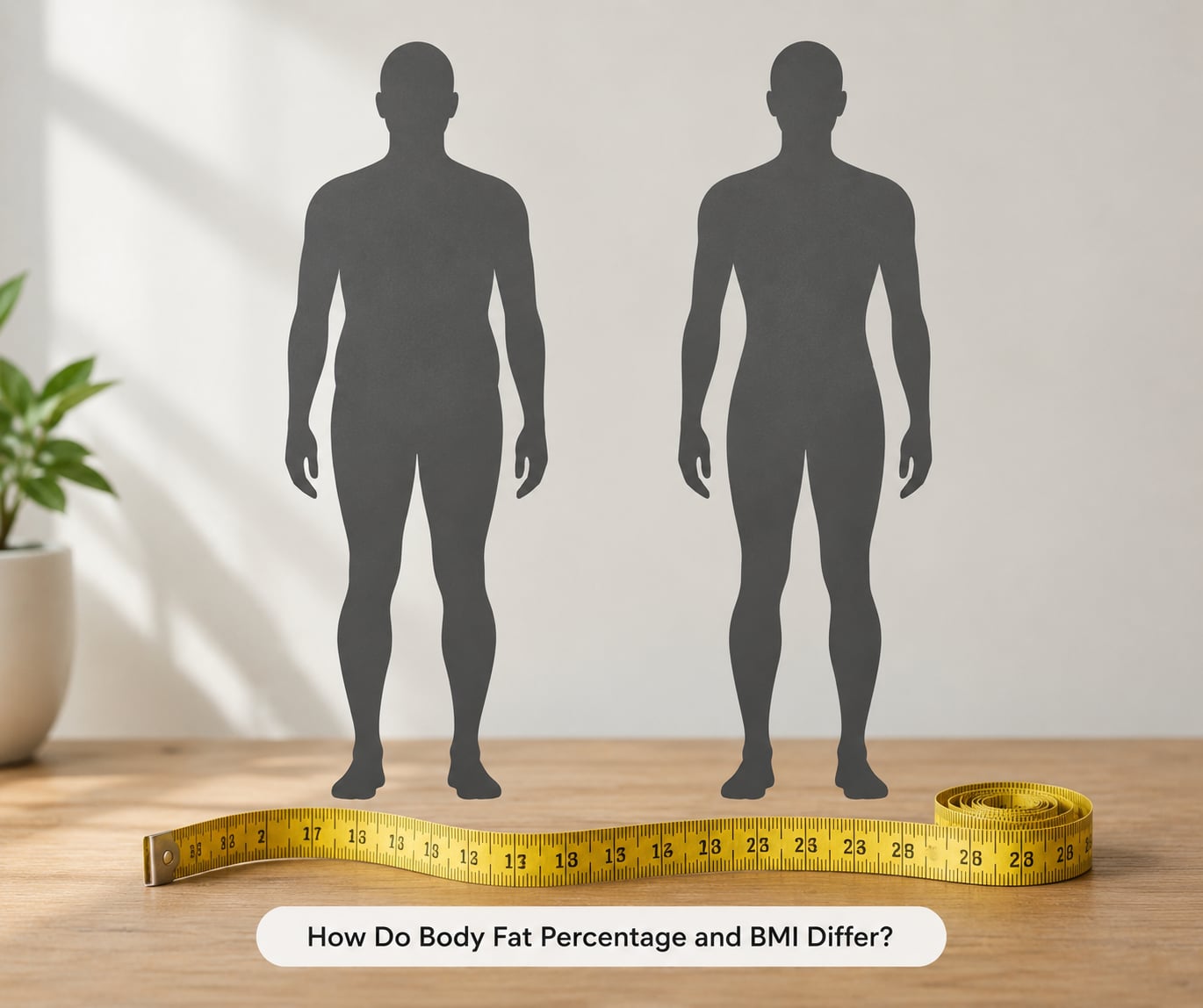
Take a rugby player at 1.83 m and 105 kg. His BMI is about 31.4, which lands in obesity class I. His body fat is closer to 12%, which sits in the athletic range. Nothing about his body composition is wrong; the scale reading simply has nothing to measure muscle with.
Now take an office worker at 1.78 m and 71 kg. His BMI is about 22.4, comfortably normal. If his body fat is above 30%, he has a high fat mass and a low lean mass, a pattern often called normal-weight obesity. Waist measurements and blood markers tend to look worse than his BMI suggests.
Those two people can be a couple of centimetres apart in BMI and sit on opposite sides of every threshold that matters. That gap is where the Reddit-versus-clinic argument comes from. Lifters point out that BMI mislabels them, and they are right. Clinicians reply that BMI still predicts risk across populations, and they are also right. Both statements are true at the same time.
Why is my BMI high but I’m not fat?
Usually because muscle is heavier than fat for its size, so weight on a scale counts it all the same. A DEXA scan, which separates bone, fat and lean soft tissue, will show the difference in a minute. This skew mostly matters at advanced strength levels, where the muscle mass is genuinely large rather than moderate.
Visceral vs subcutaneous fat: location matters
Subcutaneous fat sits under the skin, mostly around the hips, thighs and buttocks. Visceral fat sits around the organs inside the abdomen. Visceral fat is the type most strongly linked with insulin resistance, high triglycerides and cardiovascular risk, and a normal BMI offers no protection against it.
This is the argument for adding a tape measure. Waist circumference above roughly 35 inches in women or 40 inches in men, or a waist-to-height ratio above about 0.5, flags central fat in a way BMI cannot.
Why the guidance is moving away from BMI cut-offs
Clinicians are not abandoning BMI. They are pairing it with better measures. In 2023 the American Medical Association adopted policy recognising that BMI is flawed as a standalone clinical measure and can have unintended effects when used alone.
Research published in 2025 added to the argument. An analysis of a nationally representative cohort of more than 4,200 US adults reported that percent body fat predicted mortality better than BMI did, especially at the lower end of the BMI range where BMI is weakest.
Researchers have also flagged that the relationship between BMI and body fat shifts with height and with population background, which is why the same score can mean different things for different groups.
Which Measure Is More Useful for Weight Loss?
Body fat percentage, for tracking. BMI, for screening. That split answers the search question most readers arrive with.
During a cut, the scale drops but you cannot tell what came off. Body fat percentage and waist measurement can show whether fat fell while lean mass held, or whether both fell together. Waist measurement is often the more honest of the two, because it responds to central fat.
Two practical warnings. First, judge the trend over four to eight weeks, not the reading on Tuesday morning. A home estimate moving two or three points day to day is measurement noise, not fat change.
Second, there is a floor. Cutting below essential fat is not a faster route to a better body; it is a route to hormonal disruption, fatigue and lost bone density. Men pushing toward single digits are the group most likely to cross it.
If you are on GLP-1 medication or another weight-loss treatment, this matters more, because rapid loss can include meaningful lean mass. Members of the r/glp1 community point out the same tension: BMI is right more often than not at population level, but it is a poor personal dashboard during a fast-moving phase. Ask your prescriber to monitor lean mass, not just the number on the scale.
How Accurate Are These Measurements?
BMI is arithmetic, so it is exactly as accurate as your height and weight measurement. Body fat percentage depends entirely on the method you use.
| Method | Typical error | What it needs | Best used for |
|---|---|---|---|
| DEXA scan | Plus or minus 1 to 2 points | A clinic appointment | A true baseline, plus bone density |
| Hydrostatic weighing | Plus or minus 1.5 to 2.5 points | Specialist facility | Research-grade accuracy |
| US Navy tape method | Plus or minus 3 to 4 points | A flexible tape and the right formula | Free tracking at home |
| Skinfold calipers | Plus or minus 3 to 5 points | Skill and a consistent technique | Tracking when a coach shows you how |
| Smart scale (BIA) | Plus or minus 3 to 5 points | Bare feet, a hard floor | Cheap trend watching only |
A plus or minus 4 point error is the number most people should sit with. If your scale says 22% today and 25% next month, that may be nothing at all. If it says 22% and 17% over eight weeks of consistent effort, that is a real change.
To keep a home reading comparable, measure at the same time of day, on the same surface, after using the bathroom, and ideally before eating or training. Foot size, hydration and how much you drank in the last hour all shift the reading on bioelectrical impedance scales.
If you want one honest starting number, a DEXA scan gives you a baseline worth paying for. A weekly waist measurement at the navel costs nothing and will not lie to you as often.
body fat percentage vs bmi which matters more for Different Goals
body fat percentage vs BMI for fat loss, muscle gain and longevity
| Your goal | Track primarily | Why |
|---|---|---|
| Fat loss | Body fat percentage plus waist | Shows fat falling, and whether lean mass is going with it |
| Muscle gain or body recomposition | Body fat percentage plus strength logs | Weight can stay flat while composition improves |
| General health screening | BMI, then follow up | A fast first look that flags who should be assessed |
| Long-term health in later life | Waist, strength and blood markers | Sarcopenia and central fat matter more than the BMI band |
| Weight-loss medication | Waist, blood markers, lean mass | Fast weight change can hide muscle loss |
Goals change what a useful number looks like. A body fat percentage that is fine for general health is not a target for a competitive powerlifter, and a BMI that is unremarkable at 25 can be the wrong conversation for someone carrying visceral fat at 29.
Which Should You Choose?
Use BMI for a quick initial screen, because it takes no effort and catches the cases that need a closer look. Use body fat percentage when you are tracking changes in composition, with the understanding that home estimates are directional.
Use both alongside waist circumference, waist-to-hip or waist-to-height ratio, your blood pressure, and lab markers such as A1C, cholesterol and triglycerides. Those markers describe how your body is functioning, which neither of the two headline numbers can do.
And if the numbers disagree, the disagreement itself is the finding. Bring it to a doctor or registered dietitian rather than resolving it on your own. A muscular person labelled obese by BMI, and a normal-weight person with 30% body fat, are both worth a professional look.
Frequently Asked Questions
Is body fat percentage better than BMI for weight loss?
For tracking a fat-loss phase, yes. Body fat percentage, paired with waist measurement, shows whether fat is falling while lean mass holds. BMI only shows that weight went down, which could be water, muscle or fat. Keep BMI in view as a screening figure, but do not steer your day-to-day decisions from it.
What is a healthy body fat percentage for women and men?
For women, roughly 21 to 31% is commonly treated as a healthy range in early adulthood, rising to 29 to 35% in later life. For men, roughly 18 to 24% early, rising to 24 to 31% later. Athletes sit lower, and the essential fat floor is about 10 to 13% for women and 2 to 5% for men.
Why can BMI be inaccurate for some people?
BMI uses only height and weight, and muscle is about 18% denser than fat. Athletes and strength trainees can be labelled overweight while carrying very little body fat. At the other end, someone sedentary with low muscle and high fat can sit in the normal band. The score also varies in meaning with height and population background.
Should I use body fat percentage or BMI to track progress?
Track body fat percentage and waist circumference, and treat BMI as background context. Home body fat readings carry an error of three to five points, so judge the trend across four to eight weeks rather than any single number. If you are making decisions about a health condition, take those readings to a doctor or registered dietitian.
How often should I measure my body fat percentage?
Once a week is plenty for a home scale, at a consistent time of day and under the same conditions. Every day invites you to react to noise. If you use calipers or the tape method, fortnightly is usually enough. A DEXA scan twice a year, or at the start and end of a training block, gives you the most trustworthy baseline.
When should I ask a doctor or registered dietitian about my weight and body composition?
Ask when BMI and body fat percentage disagree sharply, when you have lost a lot of weight quickly, when you are over 40 and strength is dropping, or when you are taking weight-loss medication. It is also worth raising if a number has been sitting in your head for months. Blood markers and a body composition assessment settle questions a scale cannot.
Conclusion
Body fat percentage matters more for individuals; BMI matters more as a population screen. The honest answer is that the two answer different questions, and using one as a verdict on your health is where people get it wrong.
So here is the first step. Check your BMI once, note it, and stop thinking about it daily. Then measure your waist and get one trustworthy body composition reading, from a DEXA scan if you can afford it. Track the trend from there alongside your strength, sleep and how you feel. If the numbers disagree, take that disagreement to a doctor or registered dietitian, because it is the most useful thing your scale has ever told you.