Calorie deficit vs intermittent fasting: neither one wins on weight loss. Trials that put the two head to head come out close to a tie, because both push you to eat less over time. Pick a calorie deficit if you like structure and know your numbers; pick intermittent fasting if counting food feels like a chore.
That is the honest answer, and it frustrates people who want one clear winner. The useful question is not which diet burns more fat but which one you will still be doing in week twelve. Adherence beats mechanism, and the research on both approaches says so repeatedly.
Table of Contents
- Calorie Deficit vs Intermittent Fasting at a Glance
- What Is a Calorie Deficit?
- How to set your own deficit in four steps
- What Is Intermittent Fasting?
- Fasting protocols compared
- Calorie Deficit vs Intermittent Fasting: Which Produces More Weight Loss?
- Which Approach Is Easier to Follow?
- Nutrition and Exercise Differences
- Which Should You Choose?
- How to choose between the two in four steps
- Frequently Asked Questions
- What works better, calorie deficit or intermittent fasting?
- Do you need a calorie deficit to lose weight while fasting?
- Can you combine a calorie deficit and intermittent fasting?
- Is a 20 hour fast better than a 16 hour fast?
- What is dirty fasting?
- I am in a 1,000 calorie deficit but not losing weight, what is causing this?
- Conclusion
Calorie Deficit vs Intermittent Fasting at a Glance
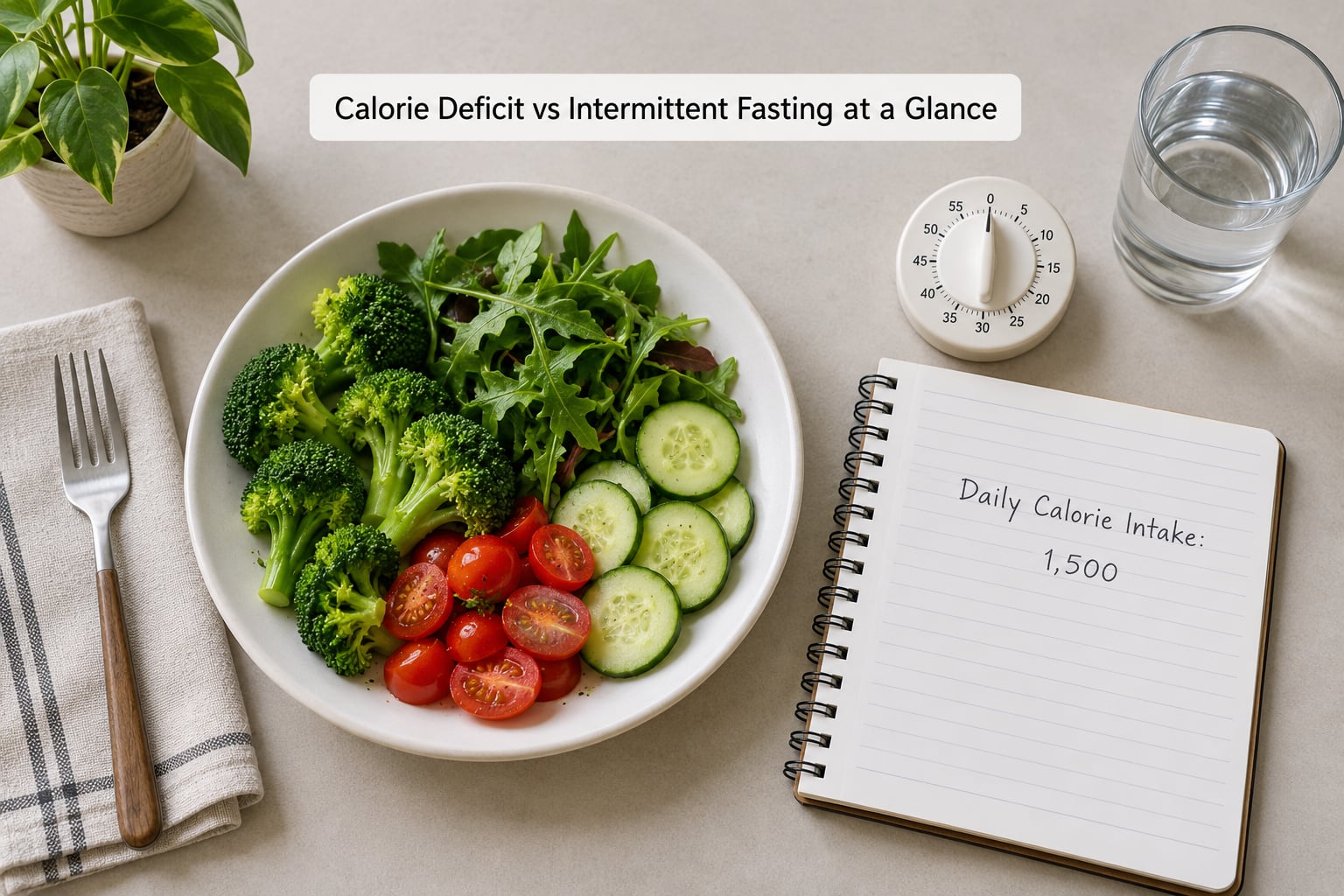
Here is the short version before the detail. One column is a rule about how many calories you take in, the other is a rule about when you take them in.
| Factor | Calorie Deficit | Intermittent Fasting |
|---|---|---|
| What it controls | How many calories you eat | When you are allowed to eat |
| Main mechanism | Energy intake below total daily energy expenditure | Compressing meals into a window, which usually cuts intake |
| Typical speed of results | About 0.5 to 1 lb per week on a moderate deficit | Similar, if the window actually reduces calories |
| Tracking required | Yes, for the first few weeks at least | Clocks, not calories, unless you add tracking |
| Daily hunger | Spread across the day, easier to manage in small doses | Front-loaded before the window, then nothing |
| Social flexibility | Eat any time, including with other people | Harder when family or work meals fall outside the window |
| Muscle risk | Higher if protein is low or the deficit is aggressive | Lower hunger means less risk, but protein still decides |
| Suits best | People who want a measurable target and flexible timing | People who hate logging food and graze by default |
Read the table twice, because the bottom two rows matter most. Whoever loses muscle is almost always the person who ate too little protein, not the person who used a particular method.
What Is a Calorie Deficit?
A calorie deficit is any day where you eat fewer calories than your body burns. Over weeks, that gap is paid out of stored fat. In plain terms, you spend from a reserve that your body refills slowly.
For weight loss, four things have to stay true:
- Your intake sits below your total daily energy expenditure (TDEE), which is roughly maintenance calories.
- The gap is big enough to matter but small enough to hold for months.
- Protein stays high, usually around 1.6 to 2.2 grams per kilogram of body weight.
- You keep lifting, walking or otherwise moving, so the muscle you have stays useful.
How to set your own deficit in four steps
First, estimate maintenance. The Mifflin-St Jeor equation is a decent starting point: for men, 10 times body weight in pounds plus 6.25 times height in inches minus 5 times age plus 5. For women, subtract 161. The result is a guess, so treat it as a starting line and adjust after three weeks of real data.
Second, pick a deficit size. A moderate one, roughly 10 to 20 percent below maintenance, keeps you functional and is far easier to defend against a bad day. The familiar 500-calorie rule lands in a similar place and predicts about half a pound a week.
Third, set a protein floor before you set a calorie number. Protein protects muscle during a cut and takes the edge off hunger, so it is the single most useful thing you can fix first.
Fourth, watch the scale for two to three weeks, then adjust. If nothing moves for a fortnight, your estimate is wrong, not your willpower.
That 3,500-calorie-per-pound figure people quote is an average, not a law. Real weight change includes water, glycogen and gut contents, so week to week you will see noise even when the plan is working.
What Is Intermittent Fasting?
Intermittent fasting is a schedule that decides when you eat, not how much. The popular version, 16:8, compresses your day into eight hours and leaves a sixteen-hour overnight fast. Most people eat nothing from the evening meal until breakfast the next morning.
The fasting window changes appetite more than it changes metabolism. Skipping the late snack and the mindless second lunch is usually where the calorie reduction quietly comes from. Eat 2,400 calories between noon and eight in the evening and you have not fasted in any meaningful sense; you have just moved your meals.
Fasting protocols compared
These are the schedules people actually use, and the trade-off in each one is the same: shorter fasts are easier to keep, longer fasts cut more without effort.
| Protocol | Daily calories | Difficulty | Best use case |
|---|---|---|---|
| 14:10 | Restricted | Low | Gentle start, late sleepers |
| 16:8 time-restricted eating | Restricted | Medium | Most beginners, weight loss |
| 18:6 or 20:4 | Restricted | Medium-high | Experienced fasters, fat loss phases |
| 5:2 | Very low two days, normal five | Medium-high | People who want structure without a daily window |
| Alternate-day fasting | Low on fast days, normal on others | High | Strong adherence history |
| 4:3 intermittent fasting | About 25 percent of maintenance on four days | High | Aggressive but supported loss |
| Eat-stop-eat, 24 hours | One full day off food a week | High | Advanced, supervised use |
Sixteen hours is popular because it fits overnight and needs no special planning, not because a cell flips a switch at hour sixteen. Claims about autophagy and longer life get repeated constantly, and in humans the evidence for meaningful cellular recycling at everyday fast lengths is thin. Do not fast longer for a benefit you cannot verify.
Calorie Deficit vs Intermittent Fasting: Which Produces More Weight Loss?
On weight, the evidence points to a tie with small differences that favour whoever stuck to the plan longer. Here is what the major trials actually found.
The 2020 New England Journal of Medicine trial by Lowe and colleagues randomised 139 people with obesity to either a 16:8 eating window or daily calorie restriction, then followed them for 12 months. Both groups lost a similar amount of body weight, about 1.8 kg, and the difference was not statistically meaningful.
The TREAT trial, published in JAMA Internal Medicine the same year, put people on a noon to eight in the evening window with instructions to eat nothing else. Weight loss matched daily calorie restriction. Insulin sensitivity improved in the early weeks of the early-dinner group, then the advantage faded as the study went on.
The Annals of Internal Medicine 4:3 trial by Catenacci and colleagues followed 165 adults for 12 months and reported about a 7.6 percent reduction in body weight in the fasting group against 5 percent in the daily calorie reduction group. It is the strongest result favouring fasting, and it is worth reading carefully: the difference came down to adherence, not a different metabolic rate.
Meta-analyses published through the early 2020s reach the same conclusion the McGill researchers summarise plainly: all diets are more or less equally effective, and differences between them are minimal.
So the honest answer to does intermittent fasting work better than a calorie deficit is no, on average. On average, you lose the weight either way.
Which Approach Is Easier to Follow?
Ease is personal, and it is the variable most likely to decide your result. Counting asks for attention several times a day. Fasting asks for it twice.
Calorie deficit suits people who eat at irregular hours anyway, who share meals with family, or who like a number to aim at. It also suits shift workers and anyone who trains early, because the timing of food never has to match the training.
Intermittent fasting suits habitual grazers, people who wake up not hungry, and anyone who finds food logging claustrophobic after a few weeks. It also removes the evening decision, which is where a lot of unplanned calories arrive.
The trade-off nobody mentions enough is social. An eight-hour window means skipping dinner with friends or eating at 3pm on a Saturday. Trackers on Reddit describe this as the single biggest reason they quit fasting, and it is a real cost, not a small one.
Hunger shapes this too. Calorie deficits let you take the edge off with small meals across the day. Fasting front-loads all that hunger into a few hours, which some people like and others find miserable.
Nutrition and Exercise Differences
Method matters less than what you eat inside it. A fasted day built from deli sandwiches and crisps will still leave you short on protein, fibre and micronutrients.
On protein, keep the same floor in both approaches: around 1.6 to 2.2 g per kilogram of body weight. In an eight-hour window that is a dense meal plan, and skipping the protein at breakfast makes it harder. With three meals you have more room to spread it.
On fibre and micronutrients, spreading intake across more meals wins quietly. Fewer, larger meals make it easier to overeat on energy-dense food while still missing the vegetables.
On hydration, fasting needs water, electrolytes and sometimes salt during longer fasts. Feeling light-headed in the fast is usually hydration or hunger, and it is a reason to shorten the window, not to push harder.
On training, calorie deficits and fasting are both awkward around hard sessions. Fasted cardio is fine for many people, but heavy lifting usually wants fuel in the tank, and the safer plan is to schedule strength work inside the eating window. This is general information, not a training prescription, so a coach can adjust it to you.
Here is the risk worth naming: the “dirty fasting” version, where people skip breakfast, work out, then eat a large, low-quality first meal. The window can hide an intake problem rather than fix one.
Which Should You Choose?
How to choose between the two in four steps
Pick calorie deficit if any of these describe you: you already think in numbers, your hunger is steady rather than sharp, you eat with other people most days, or you want the freedom to move meals whenever you like.
Pick intermittent fasting if you graze without noticing, you dislike tracking food, your mornings are naturally low on hunger, or you want a rule with less daily thinking. Start at 14:10 or 16:8 rather than 24 hours, because the first two weeks are where people quit.
Consider the hybrid if you want both. Use an eight- or ten-hour window and set a calorie target anyway. A worked example for someone maintaining around 2,200: eat 1,700 across breakfast at 9am, lunch at 1pm and dinner at 6pm, then stop until 9am. The deficit handles energy and storage, the fasting window handles the stored fat already there.
Ask a doctor or registered dietitian before starting either one if you take diabetes medication, are pregnant or breastfeeding, have a history of disordered eating, are under 18, or have kidney or liver conditions. Fasting and glucose-lowering drugs is a combination that needs supervision, not a forum thread. Anyone with a past eating disorder should not use either method as a tool without professional support.
Frequently Asked Questions
What works better, calorie deficit or intermittent fasting?
For weight loss, they perform about the same. Head-to-head trials put the two within a couple of pounds of each other after a year, and the differences that showed up were explained by who stuck to the plan rather than by a different metabolism. Choose the one you can still follow in month three.
Do you need a calorie deficit to lose weight while fasting?
No, and this is where most confusion starts. Fasting is a schedule, not a calorie rule. If you eat 2,400 calories inside your eight-hour window, you have not created a deficit no matter how many hours you went without food. Weight loss follows the energy gap, whatever created it.
Can you combine a calorie deficit and intermittent fasting?
Yes, and many people do. Set an eating window such as 8am to 6pm, then hit a daily calorie target inside it. The window handles grazing and timing while the target handles portions. The trade-off is more planning, not more restriction, so it suits people who like structure.
Is a 20 hour fast better than a 16 hour fast?
A 20-hour fast leaves a four-hour eating window, which is hard to hit your protein and fibre targets in. Longer fasts can cut calories further, but hunger and adherence usually get harder at that point, and the extra benefit over 16:8 is small. Start at 16 and only extend if the first month went well.
What is dirty fasting?
Dirty fasting means using a fasting window as an excuse to eat poorly inside it. Coffee with cream, a commute pastry, then a large processed meal at the window opening technically fits a 16:8 schedule. It can quietly erase the deficit, so the quality of food still decides results.
I am in a 1,000 calorie deficit but not losing weight, what is causing this?
Most often it is measurement rather than metabolism. Under-reporting is common, liquid calories slip through, and calories burned may be lower than your TDEE estimate. Water retention from salt, a new training block or menstrual cycle can hide a week of fat loss. Recheck intake for two weeks, then recalculate maintenance.
Conclusion
So, calorie deficit vs intermittent fasting: on the scale they land in the same place, and the deciding factor is the one you can live with. Start with a moderate deficit and a 14 or 16-hour window, run it for twelve weeks, and change the method rather than the effort if the scale stalls.
Keep protein high, lift weights, and get a doctor’s or dietitian’s advice first if you take medication, are pregnant, or have a history of disordered eating. This article is general information, not personal medical advice.