
To build a habit that lasts longer than two weeks, pick one small observable behavior, attach it to a cue you already hit every day, decide in advance what the smallest version looks like, and mark the day done when you do that smallest version. The calendar fills up and the habit survives the fortnight mark where most people quit.
Why does it collapse there? Because motivation is loud for the first ten days and quiet after that, and a habit you built only for good weeks has nothing to fall back on. I’ve restarted enough of these to know the pattern well: week one feels effortless, week two needs reminding, week three needs a decision every single time.
Quick answer
Most habits need longer than three weeks to form. In a 2010 study by Phillippa Lally and colleagues, 96 people repeated one daily behaviour and took anywhere from 18 to 254 days to reach a point where it felt automatic, with a median of 66 days. Missing one day had almost no effect on that process. Doing it in the same context mattered far more than doing it perfectly.
Here is where the popular version goes wrong, and what the research actually recorded.
| Claim | Where it comes from | What the research recorded |
|---|---|---|
| 21 days to form a habit | A 1960s book by a psychiatrist | No study supports it. The 2010 study ran well past three weeks for most people. |
| You need a perfect run | Streak culture in apps | One missed day changed nothing measurable. Missing a day or two did not materially affect habit strength. |
| Motivation drives repetition | Common sense | Repetition in the same context predicted strength far better than intention or motivation. |
| Intensity is what matters | Gym culture | A ten minute version that repeats daily builds faster than a long session that happens twice a month. |
Table of Contents
- What You Need
- Step-by-Step: How to Build a Habit That Lasts Longer Than Two Weeks
- 1. Choose One Small Behavior Instead of a Broad Goal
- 2. Attach the Habit to an Existing Routine
- 3. Set a Minimum Version for Low-Energy Days
- 4. Make the Habit Easier to Start
- 5. Track Consistency Instead of Perfection
- 6. Review and Adjust After the First Two Weeks
- 7. Plan for Missed Days and Long-Term Consistency
- Common Mistakes
- Frequently Asked Questions
- How long does it really take to form a habit?
- Is the 21-day habit rule real?
- What should I do after missing a day?
- Do I need motivation to keep a habit going?
- Should I track habit streaks?
- How do I build a habit when my schedule is unpredictable?
- Conclusion
What You Need
None of this needs equipment or an app. It needs five decisions, made once, in about fifteen minutes.
- One specific behavior. Not “get healthier” or “read more” but “read two pages of the book on my nightstand”. If you cannot tell at the end of the day whether you did it, it is not written yet.
- A reliable cue. Something that already happens at roughly the same time, every day. Brushing your teeth, closing your laptop at lunch, putting on work clothes.
- A minimum version. The floor, not the goal. Two minutes of walking instead of thirty. One prepared vegetable instead of a full meal. Five minutes of tidying instead of a whole room.
- A tracking method. A paper calendar, a habit app, or a note on your phone. It has to be somewhere you look without searching for it.
- A recovery rule. A written sentence about what you do after a miss, so the decision is made before you need it. Something like: after any missed day, I do the minimum version at the next cue.
The recovery rule matters more than people expect. Deciding what to do after a bad day while you are calm is the difference between a two-day gap and a two-month gap.
Step-by-Step: How to Build a Habit That Lasts Longer Than Two Weeks

1. Choose One Small Behavior Instead of a Broad Goal
Broad goals survive about two weeks because there is no clear finish line. “Move more often” gives you nothing to do on Tuesday. “Walk for ten minutes after dinner” gives you one.
The test is whether another person could watch your day and agree you did it. Walking counts. Going to the gym to browse the shelves does not.
Sizing is where most people overreach. Set the difficulty at the level you would manage on your worst ordinary day, not your best one. If the honest answer is five minutes of reading with a coffee, then five minutes is the target and you will climb later. Starting well under what you can do looks too small to count, which is exactly the point.
2. Attach the Habit to an Existing Routine
Habit stacking is the habit of putting a new action directly behind an action you already perform reliably. The formula is simple: After I [existing routine], I will [new minimum behavior]. Filling that sentence out loud is worth doing, because vague cues fail quietly.
A good anchor is specific in time, already habitual, and not something you ever skip. “After I finish lunch” is stronger than “sometime in the afternoon”. “After I brush my teeth at night” is stronger still, because it already has a clock on it.
Run a quick reliability test. Over three days, notice whether the anchor actually happened each time. If it skipped twice, it is not an anchor yet and you need a different one.
| Goal habit | Anchor habit | Minimum version |
|---|---|---|
| Walk for exercise | After finishing dinner | Two minutes around the block |
| Read | After brushing teeth at night | One page, lights still on |
| Write in a journal | After pouring the first coffee | Three sentences |
| Move more | After parking at work | Ten stairs instead of the lift |
| Eat a vegetable | After opening the fridge at dinner | One raw carrot while the pan heats |
| Wind down without screens | After brushing teeth | Five minutes of reading in a chair |
3. Set a Minimum Version for Low-Energy Days
The minimum version is the habit stripped to the point where skipping it requires a decision rather than an excuse. Two minutes of walking. One page. One glass of water before coffee. Ten slow mobility moves while the kettle boils.
Write it down next to the goal version. On the weeks that go sideways, the minimum version is what keeps the chain attached to the cue, and keeping the chain attached is what carries you past two weeks.
Treating the minimum as failure is the error that sinks this approach. If the bar drops, the habit did not break, it adapted. That is the design working, not a lesser version of success.
4. Make the Habit Easier to Start
Most missed days are not decisions, they are friction. The shoes are in a closet, the book is in another room, the notebook is under paperwork. Everything between the cue and the action takes ten seconds of quiet resistance, and on a tired day that is enough.
Move the object into the path. Shoes by the front door, book on the pillow, water bottle next to the kettle. The rule is simple: if you would not see it while walking past, it is not visible enough.
Decisions cost more than motion, so remove them. Decide tonight what you wear tomorrow. Prep the clothes the night before. Keep one set of kit ready rather than assembling it each morning.
You will know this worked when starting feels boring rather than brave. If you still need to talk yourself into it each morning, there is still a decision point sitting between the cue and the action.
5. Track Consistency Instead of Perfection
Mark the day when you complete the minimum version, not the goal version. That single rule is what separates tracking that helps from tracking that hurts, because it records whether the chain held rather than how good the day was.
Weekly completion rate works better than a streak counter. Six days out of seven is a strong week and it reads as one. A streak app turning 0 on a Tuesday evening produces a jolt of discouragement out of all proportion to what actually happened, and people describe losing weeks to exactly that feeling.
Keep the review light. Once a week, glance at the pattern and ask whether more or fewer than four days got marked. Do not turn it into a daily inspection of your character. The tracker is a tool for spotting a broken week, not a scoreboard.
How you build a habit that lasts longer than two weeks is decided by how honest the record is, and honest means marking the two-minute day as a yes.
6. Review and Adjust After the First Two Weeks
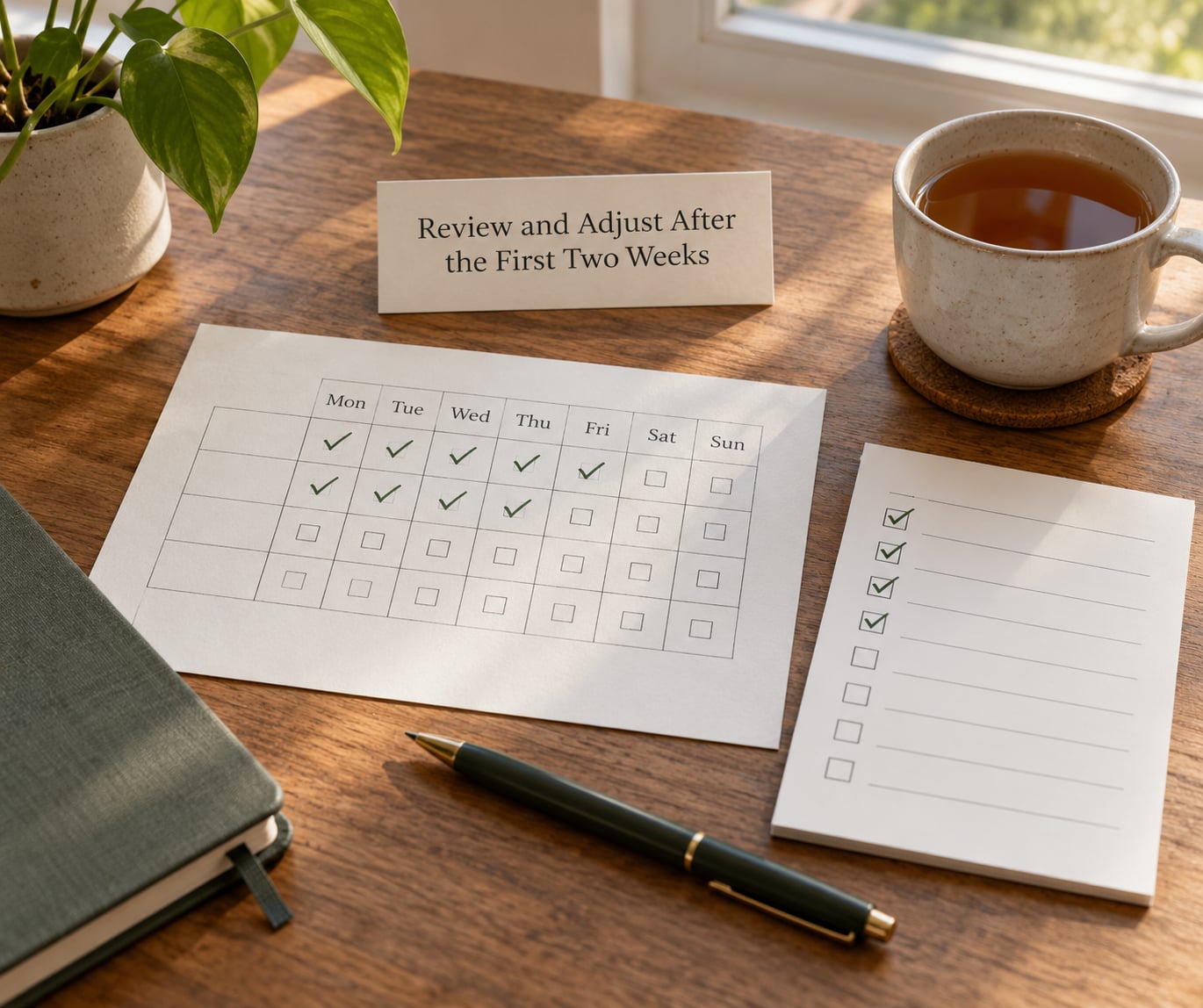
Day 14 is not a finish line, it is the first checkpoint. Here is roughly what the first month looks like, and what each week asks of you.
| Week | What usually happens | What to do |
|---|---|---|
| Week 1 | Motivation is high, novelty carries you, reminders feel unnecessary | Just execute. Do not upgrade the habit yet. |
| Week 2 | First real friction, first missed day, the first moment of doubt | Use the minimum version. Return at the next cue, not the next Monday. |
| Week 3 | Novelty fades and the habit stops feeling interesting | Adjust exactly one thing: size, timing or cue. Change nothing else. |
| Week 4 and beyond | It either feels like part of the day or it quietly stops | Once it is reliable, add difficulty in small increments. |
Week three is where most people quit, and it is not a character flaw. The novelty that carried week one is gone and the behavior has not yet become automatic, so you are doing the work with no reward for it. Expect that gap, and name it in advance.
At the review, look at three things: which days got marked, what was different about the days that did not, and whether the cue is still reliable. Then change one variable. Making three changes at once means you will never know which one worked, and you will not know which one to undo when the week goes badly.
7. Plan for Missed Days and Long-Term Consistency
Decide the return rule now, while you are calm enough to think straight. The most useful one is never miss twice: one missed day is noise, two in a row is the start of a pattern. The next scheduled session after any miss is the restart, whatever day that falls on.
Waiting for Monday or the first of the month is the most reported trap. Every day of delay makes the restart feel heavier, and the gap turns into a reason to abandon the habit entirely rather than return to it. A two-day gap costs almost nothing. A gap you decide to sit out until a clean date costs the habit.
Useful fallback versions for the predictable disruptions: travel, illness, deadlines, and shift work. Keep a short list of two-minute versions in your notes app. When a bad week arrives, the list means the decision is already made, which is the only way it gets made at all.
Common Mistakes
Starting too large. A thirty minute routine is a thirty minute obstacle on a difficult day. Fix: cut it to roughly a third and add difficulty only after two solid weeks.
Changing three habits at once. You cannot tell which one is working, and a bad day takes all three down. Fix: one habit until it is reliable, then the next.
Treating motivation as the fuel. Motivation is a launch, not an engine. It reliably covers the first ten days and no more. Fix: build the cue and the environment so the behavior still runs when the feeling is gone.
Reading a missed day as failure. One skipped day carries almost no information about whether the habit is forming. Fix: mark the day done for the minimum version, and use never miss twice as the only rule.
Tracking outcomes instead of behavior. Weight, page counts and step totals fluctuate for reasons that have nothing to do with you. Fix: record whether you did the behavior, and read the weekly completion rate instead.
Making the routine so involved that preparation becomes the barrier. If it takes twenty minutes to set up a two minute habit, the setup is the habit. Fix: strip the ritual down until starting takes under a minute.
None of these are about willpower. They are design problems, and design problems have fixes you can apply the same day.
Frequently Asked Questions
How long does it really take to form a habit?
Longer than three weeks, usually. In the 2010 study by Phillippa Lally and colleagues, 96 participants repeated one daily behaviour and reached automaticity anywhere between 18 and 254 days, with a median of 66 days. The spread was enormous, because habit length depends on the behaviour, the context, and how automatic it already is. Drinking water formed faster than a complex exercise routine.
Is the 21-day habit rule real?
No. It comes from a 1960s book and has never been supported by research. The 2010 field study ran far longer than three weeks, and its median was 66 days. If you have quit something at day 21 assuming you failed, you were on schedule. Treat two weeks as the first checkpoint rather than the finish line.
What should I do after missing a day?
Do the minimum version at your next cue. Not the day after, not on Monday, not from a fresh calendar page. A missed day changed almost nothing in the research, and the gap only becomes a problem when you start planning around it. Never miss twice is enough of a rule: one gap is noise, two in a row is the beginning of a pattern worth breaking.
Do I need motivation to keep a habit going?
No. Motivation reliably carries the first week or two and then fades, so a habit built on motivation has no fuel past that. Build the cue and the environment instead, so the behavior still runs when the feeling is gone. If starting feels boring rather than brave, the design is doing its job.
Should I track habit streaks?
Track weekly completion instead. Streak counters turn a single miss into zero, and that jolt of discouragement is what pushes people out of the habit. Six marked days out of seven reads as a strong week rather than a failure. Mark the day whenever you do the minimum version, and review the pattern once a week at most.
How do I build a habit when my schedule is unpredictable?
Anchor the behavior to a portable cue and write down two-minute fallback versions for travel, illness, shift changes and deadlines. If focus and energy swing around, fixed clock times fail while a following-anchor cue keeps working. Put the fallback list in your phone so the decision is already made when a difficult day arrives.
Conclusion
Habits that survive are the ones designed for bad weeks from the start: one specific behavior, one reliable cue, a minimum version for the days you would rather skip everything, and a record that marks the day for showing up at all.
Start today with one behavior, one cue, and fourteen days of marks. Write your recovery rule now while nothing has gone wrong yet, and treat day 15 as a checkpoint rather than a verdict.