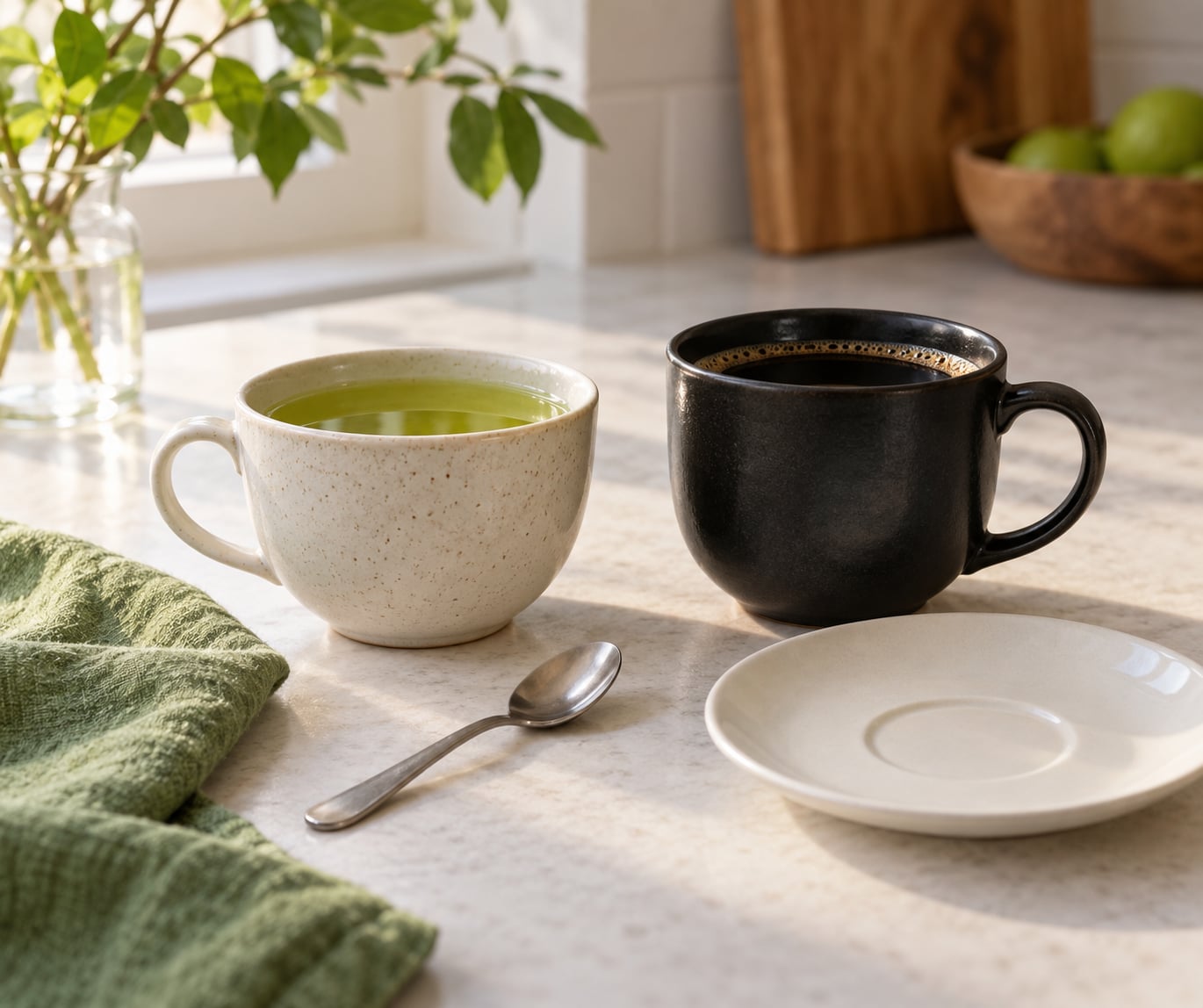
If you want the short version of green tea vs coffee for fat burning: coffee has a slight edge on total caffeine and a small measured fat-loss signal in cohort studies, while green tea adds catechins like EGCG on top of a lighter caffeine load. Neither drink burns fat on its own, and the biggest difference between them is usually what you pour into the cup, not which leaf or bean it comes from.
Both are near-zero-calorie drinks that can slide into a calorie-controlled routine without much damage. The interesting question is how each one behaves in your day: how alert you feel, whether you can drink it after lunch without wrecking your sleep, and whether it quietly replaces a snack you would otherwise eat.
Table of Contents
- Green Tea vs Coffee for Fat Burning at a Glance
- Which Drink Is More Likely to Support Fat Burning?
- Does Green Tea vs Coffee for Fat Burning Come Down to Caffeine?
- How Do Calories and Sugar Change the Comparison?
- Which Is Better for Appetite and Weight-Control Goals?
- What Are the Side Effects and Safety Considerations?
- Green Tea vs Coffee for Fat Burning: Which Should You Choose?
- Frequently Asked Questions
- Does green tea or coffee burn more fat?
- Is green tea better than coffee for weight loss?
- Should I drink green tea or coffee on an empty stomach?
- Does coffee make you burn more calories than green tea?
- Can green tea or coffee replace exercise or a healthy diet?
- Conclusion
Green Tea vs Coffee for Fat Burning at a Glance
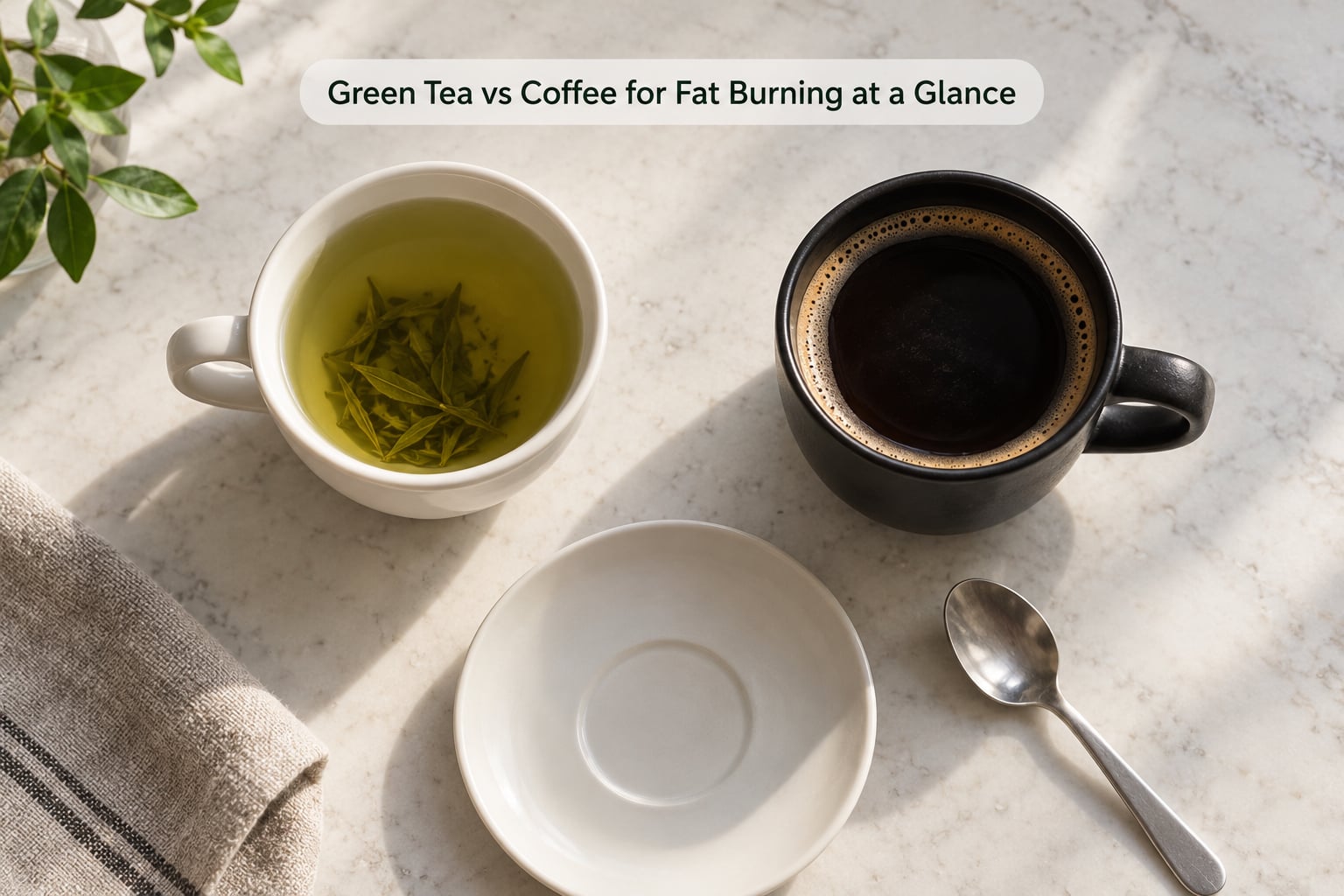
| Factor | Green tea | Coffee |
|---|---|---|
| Caffeine per 8 oz cup | About 29 mg; brewed batches range roughly 25 to 45 mg | About 95 mg; espresso-style drinks land far higher |
| Calories | Close to zero unsweetened | About 2 kcal black; sugar and milk change it completely |
| Main active compound | Catechins, especially EGCG, plus L-theanine | Caffeine, plus chlorogenic acid and other polyphenols |
| Measured fat-burning signal | Roughly 3 to 4 percent higher fat oxidation in short metabolic studies | Small reductions in body fat and visceral fat in cohort studies at modest intake |
| How it feels | Calm, steady alertness | Sharper hit, more jitter for some people |
| Sleep risk | Lower, but still real if you drink it late | Higher, especially after 2 pm |
| Best for | Caffeine-sensitive readers, afternoon use, an evening wind-down | Pre-workout energy, deep morning focus, higher caffeine needs |
| Main drawback | Low caffeine, so it can feel like it is doing nothing | Easy to overshoot caffeine, easy to overshoot calories |
Read that table as a set of trade-offs rather than a scoreboard. The rows are not all pointing the same way, and the bottom two matter as much as the top.
Which Drink Is More Likely to Support Fat Burning?
Coffee has the marginally better case, and it comes down to caffeine dose plus chlorogenic acid. Cohort analyses published in 2023 in Clinical Nutrition and the American Journal of Clinical Nutrition tracked habitual coffee drinkers and found small reductions in body fat and visceral fat, but with a dose-response curve that bent: roughly one to seven cups a week showed a benefit, higher intake did not add anything, and decaffeinated coffee showed no body-fat benefit at all.
That pattern matters more than the headline. It suggests caffeine is doing the work, and that the useful window sits below the point where you are simply drinking more.
Green tea works through a different combination: catechins, dominated by epigallocatechin gallate (EGCG), paired with a smaller caffeine load. Metabolic studies put the fat-oxidation uplift at roughly 3 to 4 percent, and the practical dose most often studied is three to four cups a day sustained for eight weeks or longer. Tea research also reports green tea drinkers losing around 2 to 4 pounds more over a ten-week window, which is a real signal but a small one.
So on the question of green tea vs coffee for fat burning, neither beverage moves the scale on its own. Total calorie balance, how much you move through the day, sleep, and overall eating patterns dominate everything a cup can do. Frame both drinks as low-calorie additions to a routine that is already working.
Does Green Tea vs Coffee for Fat Burning Come Down to Caffeine?
Mostly, yes. An 8 oz cup of drip coffee carries roughly 95 mg of caffeine, black tea about 48 mg, green tea around 29 mg, and decaf coffee near 1 mg. Caffeine raises alertness and nudges energy expenditure and fat oxidation up temporarily.
But a stronger stimulant effect is not automatically a bigger fat loss. The research above is the proof: more coffee did not mean more benefit, and removing the caffeine removed the signal. Green tea adds catechins on top of its caffeine, which is a modest bonus, not a different order of magnitude.
L-theanine is worth knowing about too. It is the amino acid in tea that softens caffeine and produces that calm-focus feeling, and it is the reason many people describe green tea as smooth rather than jittery. Coffee has almost none of it.
How Do Calories and Sugar Change the Comparison?
Calories are where the comparison actually gets decided. Plain brewed green tea is close to zero calories. Black coffee is about 2. Add sugar, flavoured syrup, cream or plant milk, and both drinks climb fast, with barista versions of either one easily landing in the hundreds of calories.
That is the practical trap most people fall into. A sweetened latte is not a fat-burning drink; it is a snack with foam. A heavily sweetened iced tea in a large cup can be the same.
For weight control, the useful move is to let either drink replace something caloric. Swap a sweetened coffee for black, or trade an afternoon pastry-and-coffee break for a brewed cup, and the savings add up across a week. Keep the ritual, lose the calories.
Milk is not the villain everyone thinks it is. A splash of unsweetened milk in either drink costs very little. Sugar in multiples does the damage.
Which Is Better for Appetite and Weight-Control Goals?
Neither drink suppresses appetite in a way that replaces a proper meal, but both can help indirectly. The mechanism is mostly ritual and habit rather than metabolism: a hot low-calorie drink in the mid-afternoon gives you something to hold, which often beats the biscuit you would otherwise reach for.
Coffee is the stronger choice here for people who find hunger hits hard in the morning. Its higher caffeine content blunts appetite a little more, and the sharp alertness gets you out of the house and moving rather than back to bed. Watch the flip side, though: for some people caffeine makes them hungrier later in the day rather than less hungry.
Green tea suits a slower, steadier approach. It works as a between-meals filler with less jitter and less likelihood of disrupting an evening. Long-term, the difference between the two on appetite is small. What decides the outcome is whether the drink fits your day and whether you keep the rest of your intake in check.
What Are the Side Effects and Safety Considerations?
Most guidance for adults sets caffeine around 400 mg per day from all sources. Stay under that and both drinks are generally fine. Push past it and the usual complaints show up: jitteriness, anxiety, heart palpitations, headache, and trouble falling asleep.
Sleep deserves its own emphasis, because poor sleep works directly against fat loss. Caffeine has a half-life of roughly five to six hours, so an afternoon coffee is still working on you at bedtime. Most people who want to protect sleep set a personal cut-off around eight to ten hours before bed and treat it as non-negotiable.
There are a few drink-specific notes worth keeping in mind. Coffee is more acidic and commonly triggers reflux in people who are prone to it. Tea tannins can reduce absorption of non-heme iron, which matters if you are watching iron levels, so drink tea between meals rather than with them. Green tea on an empty stomach can cause nausea in some people.
During pregnancy, health authorities advise keeping caffeine well below the adult daily ceiling, usually under 200 mg. Green tea on an empty stomach is also the one people ask about most, and the honest answer is that it is safe for most adults, just not comfortable for everyone.
Some medications interact with caffeine or with tea polyphenols, including certain heart and blood-pressure drugs. If you take a daily prescription, ask your pharmacist or doctor about your daily cup rather than guessing. See a clinician for palpitations, chest pain, or persistent anxiety.
Green Tea vs Coffee for Fat Burning: Which Should You Choose?
Pick coffee when you want more caffeine, sharper morning focus, or a real pre-workout lift. It is the stronger option for someone training in the morning or running on a low-calorie plan where breakfast is being skipped and you need the push.
Pick green tea when caffeine makes you anxious or wrecks your sleep, when you want a drink in the afternoon, or when you prefer calm focus over intensity. Two to three cups spread through the morning and early afternoon cover the caffeine gap most people notice when they switch.
For green tea vs coffee for fat burning, pick either one when your goal is simply a low-calorie ritual that keeps you off a snack. Unsweetened, either drink does that job equally well.
Switching between them is worth doing gradually. Cutting from three coffees a day straight to green tea is the classic route to a withdrawal headache and a flat afternoon. Overhaul one drink at a time, over about two weeks, and keep total caffeine steady while the source changes.
Frequently Asked Questions
Does green tea or coffee burn more fat?
Neither drink burns a meaningful amount of fat by itself. Green tea provides caffeine and catechins, while coffee provides caffeine and other plant compounds, but both effects are modest and temporary. The real lever is using an unsweetened cup to replace a higher-calorie drink, which can cut a meaningful number of calories from your day.
Is green tea better than coffee for weight loss?
Green tea may be a better fit for someone who wants a gentler, lower-caffeine drink or enjoys its antioxidant compounds. Coffee may suit someone who prefers stronger alertness and exercise support. Cohort research found a small advantage for coffee at modest intake, so the practical difference is small enough that your tolerance, routine and what you add to the cup matter more.
Should I drink green tea or coffee on an empty stomach?
There is no required best timing for fat burning. Some people feel discomfort, nausea, or reflux from coffee or tea without food, while others find a pre-breakfast cup easier to tolerate. If you notice stomach discomfort, take your cup after the first meal instead. Tea tannins can also reduce iron absorption, so between-meal timing suits some people better.
Does coffee make you burn more calories than green tea?
Coffee often contains more caffeine than a typical cup of green tea, so it may produce a stronger temporary alertness and energy effect. That does not translate into proportionally more fat loss. Research found higher coffee intake added no further body-fat benefit, and decaf coffee showed none at all, which points to caffeine dose rather than the drink itself as the active piece.
Can green tea or coffee replace exercise or a healthy diet?
No. Neither beverage replaces regular activity or balanced eating, and excessive intake can contribute to poor sleep, jitteriness, or unwanted calorie intake from added sugar and cream. Treat either drink as a low-calorie addition to a routine that already works, not as a substitute for the parts of fat loss that actually move the scale.
Conclusion
Neither green tea nor coffee burns fat by itself, and the green tea vs coffee for fat burning question is really decided by the rest of your day. Start with an unsweetened serving, keep caffeine in a moderate range and away from bedtime, and let the drink do the modest job it can do while your eating pattern, movement and sleep do the real work. If you are trying to lose weight, a doctor or a registered dietitian can help you build the plan that fits your health history.