Up to 400 milligrams of caffeine a day, about four 8-ounce cups of brewed coffee, is generally considered safe for most healthy adults, according to the U.S. Food and Drug Administration. That number is a ceiling, not a goal, and it changes with pregnancy, age, weight, medications and how quickly your body clears caffeine.
Medical disclaimer: this guide is general information about publicly available health guidance, not medical advice. Talk to your doctor or pharmacist about the limit that fits you, especially if you are pregnant, have a heart condition or take prescription medication. Reviewed for accuracy in 2026.
Most of the confusion around this topic comes from two places. One is serving size, because a 16-ounce coffee can hold twice the caffeine of an 8-ounce cup. The other is timing, because caffeine takes roughly five to six hours to leave your system, so a morning coffee is still partly working when you try to sleep.
This guide walks through the numbers, what changes them, how to calculate your own intake, and what to do when the amount you drink stops feeling harmless.
Table of Contents
- How Much Caffeine a Day Is Safe for Most Adults?
- What Do 200 mg and 400 mg of Caffeine Mean in Drinks?
- What Factors Can Change Your Safe Caffeine Limit?
- How Can You Calculate the Caffeine in Your Drink?
- What Signs Suggest You May Need Less Caffeine?
- Can You Improve Your Sleep Without Giving Up Coffee?
- Frequently Asked Questions
- Does decaf coffee have caffeine?
- Is tea healthier than coffee for caffeine?
- How much caffeine is in an energy drink, and is it safe?
- How long do caffeine withdrawal symptoms last?
- When should I ask a doctor or pharmacist about my caffeine intake?
- The Short Answer and What to Do First
How Much Caffeine a Day Is Safe for Most Adults?
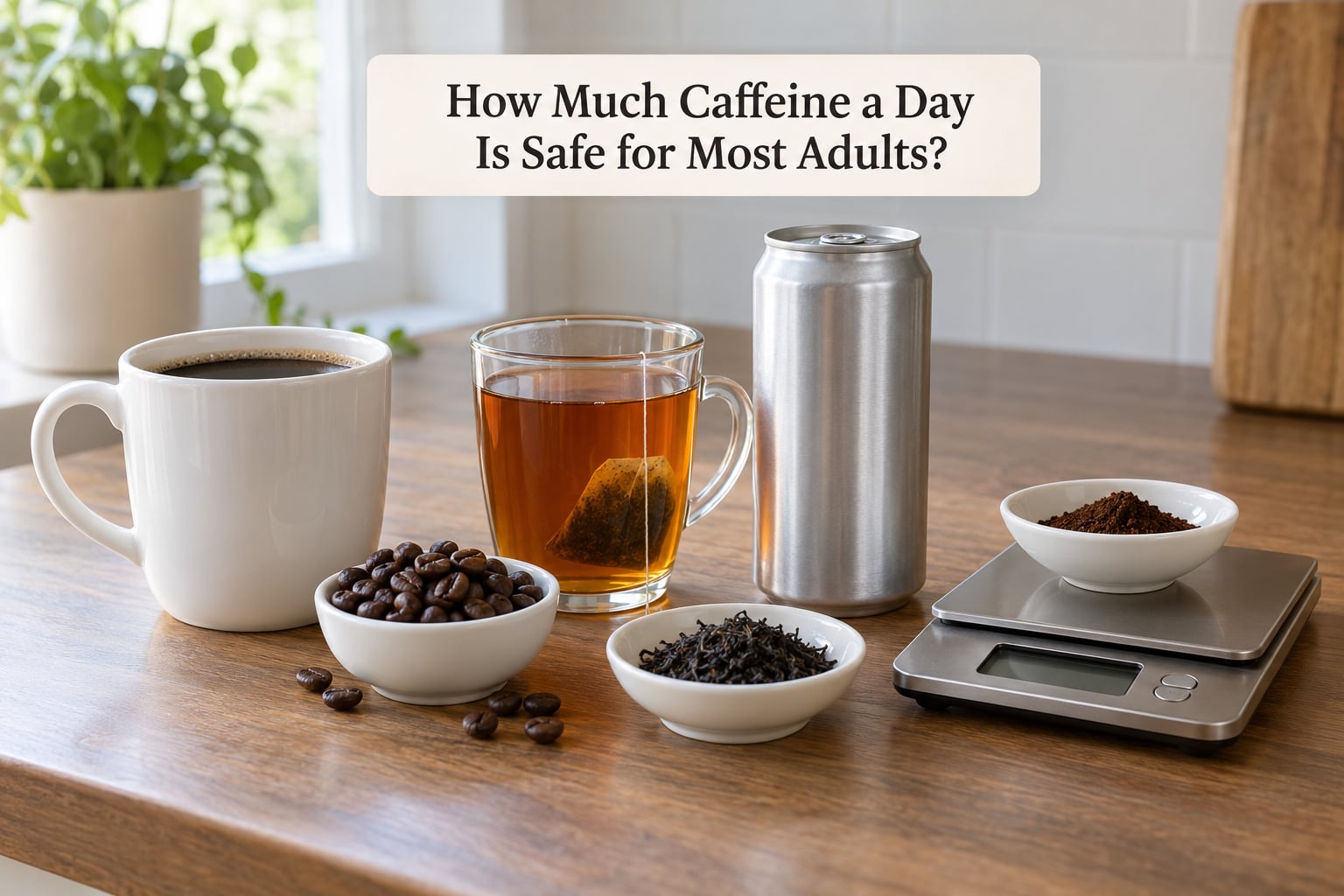
The FDA’s figure of up to 400 mg per day applies to healthy, non-pregnant adults. The European Food Safety Authority uses the same 400 mg daily ceiling and adds a separate limit of 200 mg in a single dose, roughly one large coffee, since a large hit hits harder than the same amount spread across a day.
Different groups get different numbers, and the pregnancy figure of 200 mg per day comes up constantly in searches. Here is the short version in one table.
| Group | General guidance on daily caffeine |
|---|---|
| Healthy adults | Up to about 400 mg per day, from all sources combined |
| Pregnant or breastfeeding | About 200 mg per day |
| Adolescents aged 12 to 18 | Up to about 100 mg per day |
| Children under 12 | Avoid caffeine |
| Adults sensitive to caffeine | Often 100 to 200 mg, or lower |
| People on interacting medication | Ask a pharmacist for a personal limit |
Health Canada frames teen limits by body weight at roughly 3 mg per kilogram, while the American Academy of Pediatrics uses about 2.5 mg per kilogram. That is why you will see different teen numbers in different places, and why a 15-year-old and a 17-year-old do not have the same ceiling.
One more piece of context worth having. National survey data in the United States puts the 90th percentile of adult intake at roughly 420 to 470 mg per day, which is slightly above the recommendation. In other words, a large share of adults already live above the line without noticing anything.
What Do 200 mg and 400 mg of Caffeine Mean in Drinks?
Two hundred milligrams is roughly one 12-ounce brewed coffee or one large energy drink. Four hundred milligrams is about four 8-ounce cups of brewed coffee, two espressos, eight cups of brewed black tea or ten cans of cola.
| Drink or food | Typical serving | Approximate caffeine |
|---|---|---|
| Brewed coffee | 8 oz cup | 80 to 100 mg |
| Brewed coffee | 16 oz large | 160 to 200 mg |
| Espresso | 1 shot | 60 to 80 mg |
| Instant coffee | 8 oz cup | 60 to 90 mg |
| Brewed black tea | 8 oz cup | 40 to 70 mg |
| Green tea | 8 oz cup | 20 to 45 mg |
| Cola | 12 oz can | 30 to 40 mg |
| Energy drink | 8 oz can | 80 to 160 mg |
| Energy drink | 24 oz can | 240 to 350 mg |
| Energy shot | 2 oz bottle | 100 to 200 mg |
| Pre-workout powder | 1 scoop | 150 to 300 mg |
| Dark chocolate | 1.5 oz bar | 40 to 60 mg |
| Over-the-counter headache medicine | 1 tablet | about 100 to 200 mg |
| Pure powdered caffeine | 1 teaspoon | roughly the caffeine in 28 cups of coffee |
Actual amounts vary by brand, recipe and roast, and darker roasts often carry more caffeine than lighter ones despite tasting less bitter. Sizes at coffee chains are estimates, and a free refill is not counted on the cup.
What Factors Can Change Your Safe Caffeine Limit?
Body weight is the first one, and no official table mentions it. Expressing your intake per kilogram gives a much more honest picture. At roughly 3 to 6 mg per kilogram, a 400 mg day suits a large adult but can be a lot for someone who weighs 50 kg.
Then there is how fast you clear caffeine. Most adults take five to six hours to clear half of it, but that number shifts with genetics, smoking, oral contraceptives, pregnancy, liver function and long-term caffeine use. People who clear caffeine slowly stay wired long after their last cup.
A few other factors regularly move the number:
- Sleep debt. When you are sleeping badly, caffeine feels weaker and you reach for more of it, which makes the sleep worse.
- Anxiety and panic. Caffeine raises alertness and heart rate, which can intensify existing symptoms.
- Heart rhythm and blood pressure. Stimulants can trigger palpitations in people with certain conditions.
- Pregnancy. Caffeine crosses the placenta, which is why the guidance drops to 200 mg.
- Adolescence. The brain is still developing and tolerance is usually lower.
- Medications. Theophylline, ephedrine, some antibiotics such as ciprofloxacin, and certain contraceptives interact with caffeine.
Regular use also builds tolerance. Two espressos that once woke you up may now do almost nothing, which is usually how people end up at four cups without noticing the climb.
How Can You Calculate the Caffeine in Your Drink?
The calculation is simpler than most people expect. Take the caffeine listed on the label, multiply by the number of servings, then add everything else you consumed that day.
Say a bottle lists 80 mg per 8 ounces and you drank 20 ounces. That is 80 divided by 8, which is 10 mg per ounce, then 10 times 20, so 200 mg from one bottle. Two bottles is 400 mg on its own, which is your whole daily ceiling before tea or chocolate.
Now stack a realistic day, which is how most people land over the limit without trying:
- Morning 16 oz brewed coffee: about 180 mg
- Energy drink before training, 16 oz: about 200 mg
- Pre-workout scoop: about 200 mg
- Afternoon 12 oz brewed coffee: about 140 mg
- Green tea in the evening: about 30 mg
- Dark chocolate: about 50 mg
That lands around 800 mg in a day, double the guideline, from five unremarkable decisions. Nothing on that list feels dangerous on its own.
Two caveats on accuracy. Restaurant and cafe sizes are estimates and can be off by a wide margin, and caffeine powders and concentrates are extremely concentrated, which is why health authorities warn against them outright.
What Signs Suggest You May Need Less Caffeine?
Symptoms usually show up in order of severity. The mild end is restlessness, jitteriness, shakiness, an urgent need to urinate, trouble sleeping, headache and nervousness. More noticeable signs include a fast or irregular heartbeat, anxiety, nausea, abdominal pain and tremor.
At higher intakes people report chest pain, marked restlessness, confusion, vomiting and an irregular heartbeat. Those are the ones that deserve same-day medical attention.
Cutting back produces its own set of symptoms, which usually peak on day two or three and settle within a week: headache, fatigue, poor concentration, irritability and low mood. In my experience that withdrawal dread is what stops most people from trying to cut back, which is why a slow taper works better than stopping cold.
A taper over two to three weeks looks like this:
- Week one: drop the smallest serving, or switch one coffee to decaf.
- Week two: cut the number of servings by one, keeping your earliest cup unchanged.
- Week three: reduce the strength of what remains, or stop the last cup of the day.
Talk to a doctor before making changes if you have palpitations, chest pain, high blood pressure, a history of anxiety or panic, or take regular medication. A pharmacist can check the interactions in about five minutes, which is a good deal faster than a full appointment.
Can You Improve Your Sleep Without Giving Up Coffee?
Yes, and the mechanism is worth understanding because it explains why morning-only drinkers still struggle. Caffeine works by blocking adenosine receptors, the part of the brain that registers tiredness. It does not create energy, it hides the signal. Once the caffeine clears, the tiredness arrives, which is the crash people describe.
With a five to six hour half-life, a cup at 8 a.m. is only half cleared by early afternoon and still present at bedtime. If you want caffeine to be gone before sleep, stop at least eight hours before you get into bed. A 1 p.m. cutoff works for an 11 p.m. sleeper.
A few other things that help. Taper down over two weeks rather than stopping, because withdrawal headaches wreck sleep too. Shift your last cup to earlier in the day before you cut the amount. And swap gradually: herbal tea, chicory, dandelion root drinks, or decaf roasted darker and used in small amounts so it still tastes like coffee.
Frequently Asked Questions
Does decaf coffee have caffeine?
Yes. Decaf is regular coffee with most of the caffeine removed, but typically around 2 to 15 mg per 8-ounce cup remains, and some decaf blends run higher. Research also shows decaf can carry a small amount of compounds from the decaffeination process. If caffeine affects your sleep or heart rate, count decaf as a source rather than treating it as caffeine-free.
Is tea healthier than coffee for caffeine?
Tea usually delivers less caffeine per cup than coffee, roughly 20 to 70 mg in an 8-ounce cup depending on type and steeping time, compared with about 80 to 100 mg in brewed coffee. Green tea is lower still. Both count toward the same daily total, and both can carry similar amounts if you drink large glasses of strong tea. The choice is more about total milligrams than about health.
How much caffeine is in an energy drink, and is it safe?
Energy drinks vary widely. An 8-ounce can often holds 80 to 160 mg, a 24-ounce can can reach 240 to 350 mg, and concentrated shots range from 100 to 200 mg in 2 ounces. A single large can can therefore use up most of the 400 mg adult guideline before anything else is counted. Energy drinks are also frequently mixed with alcohol or stacked with pre-workout powder, which pushes intake well past safe levels.
How long do caffeine withdrawal symptoms last?
Symptoms such as headache, fatigue, irritability and difficulty concentrating typically begin within 12 to 24 hours of your last caffeine, peak around day two or three, and fade within five to seven days for most people. A headache is the most common symptom and usually eases noticeably after a day or two. Cutting back gradually over two to three weeks produces far milder withdrawal than stopping abruptly.
When should I ask a doctor or pharmacist about my caffeine intake?
Ask a professional if you are pregnant or breastfeeding, if you are under 18, if you take regular medication, or if you have heart rhythm problems, high blood pressure, reflux, or an anxiety or panic condition. The 400 mg figure assumes a healthy adult of average weight and takes no account of your personal circumstances. A pharmacist can also check whether a specific medicine interacts with caffeine.
The Short Answer and What to Do First
Most healthy adults should stay at or below about 400 mg of caffeine per day, counted across every source, and should treat that as an upper limit rather than a target. Pregnancy and breastfeeding call for about 200 mg, adolescents about 100 mg, and children under 12 should avoid it.
Three things are worth doing this week. Write down everything you drink in a typical day, including the energy drink and the pre-workout scoop, and add up the milligrams, because most people who assume they are under 400 mg are not. Move your last caffeinated drink to at least eight hours before bed. And if you have symptoms, pregnancy, a health condition or regular medication, ask a doctor or pharmacist what your own ceiling should be, since the general number cannot account for any of that.