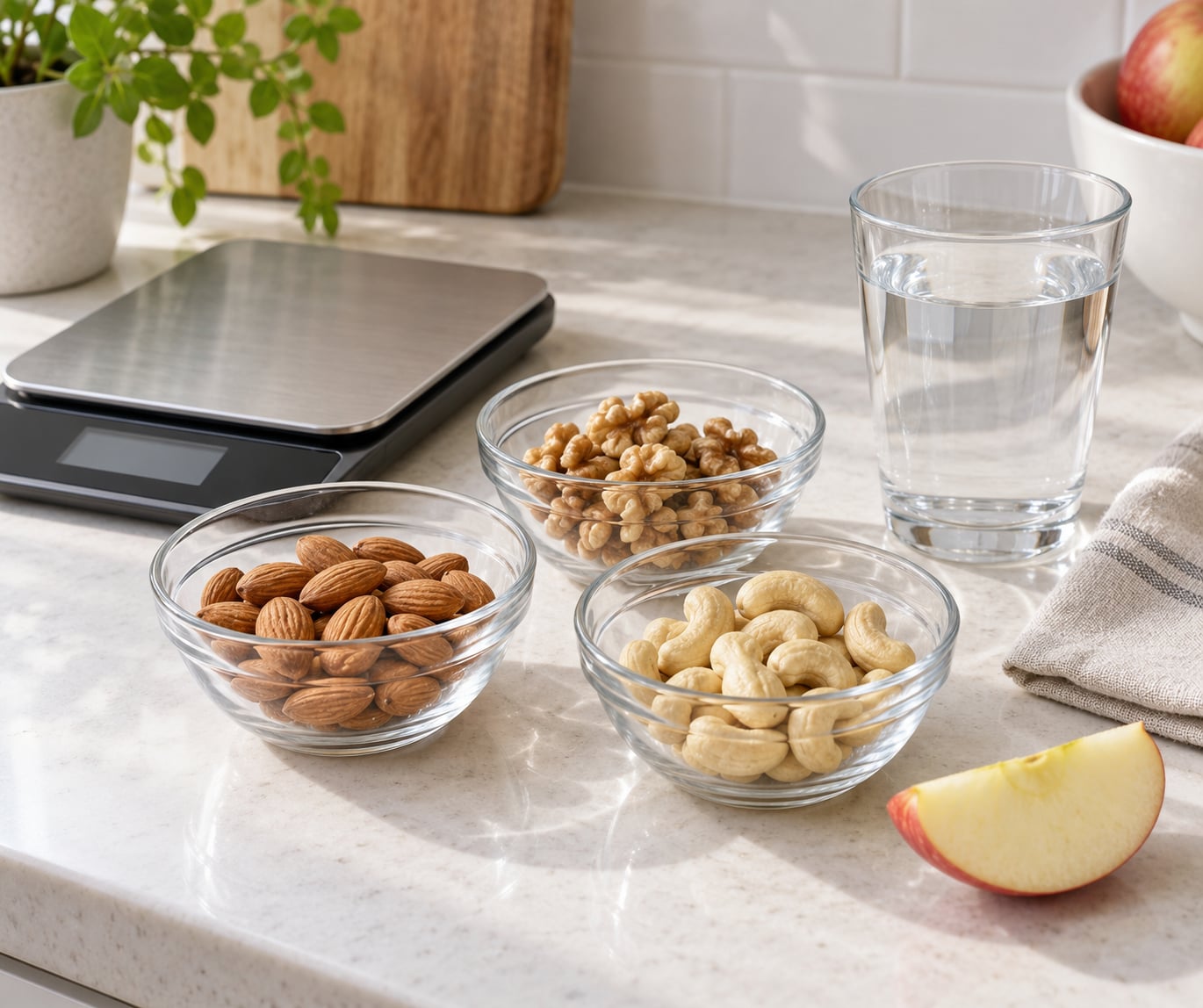
About 28 to 30 grams of nuts, roughly one small handful, is a sensible single snack. The trick to how to snack on nuts without overeating is not willpower at the bottom of the bag. It is deciding the amount before you sit down, then keeping the container out of reach for the rest of the evening.
Nuts are one of the best snacks you can pick: mostly unsaturated fat, some protein, fiber and magnesium, and they travel well. They are also easy to eat by the handful without ever registering that you have had four helpings. This guide covers the portion number, the measuring tools that make it automatic, what to pair them with, and what to do the evening after a bad one.
Last updated: October 2026
Table of Contents
- What You Need
- Step-by-Step
- Choose a Portion Before You Open the Bag
- Measure the Nuts Instead of Eating From the Bag
- Pair Nuts With Fiber or Protein
- Eat Slowly and Mindfully
- Plan Ahead for Hunger and Triggers
- Common Mistakes
- Frequently Asked Questions
- How many nuts should I eat in one snack?
- What is the best portion size for nuts?
- Are nuts good for weight loss if they are high in calories?
- Are roasted or raw nuts better for portion control?
- How can I stop eating too many nuts from the bag?
- Is 100g of nuts a day too much?
- Conclusion
What You Need
You need very little to make a nut snack behave like a real snack instead of background eating. Here is the short kit list.
- An airtight container or jar. Decant your portion into it and put the bag back in the cupboard, ideally on a high shelf or somewhere you do not see from the doorway.
- A small bowl or ramekin. Portioning straight onto a plate makes the amount obvious, which is the whole point.
- A measuring tool. A tablespoon works. A small kitchen scale works better and costs the price of a takeaway coffee. A quarter-cup measure is fine too.
- A drink. Water, sparkling water or an unsweetened drink, kept next to the bowl. Most mindless grazing is thirst plus boredom, not hunger.
- Optional pairings. Plain Greek yogurt, a piece of fruit, carrot or cucumber sticks, or a boiled egg, if you want the snack to hold you until the next meal.
Step-by-Step
Choose a Portion Before You Open the Bag
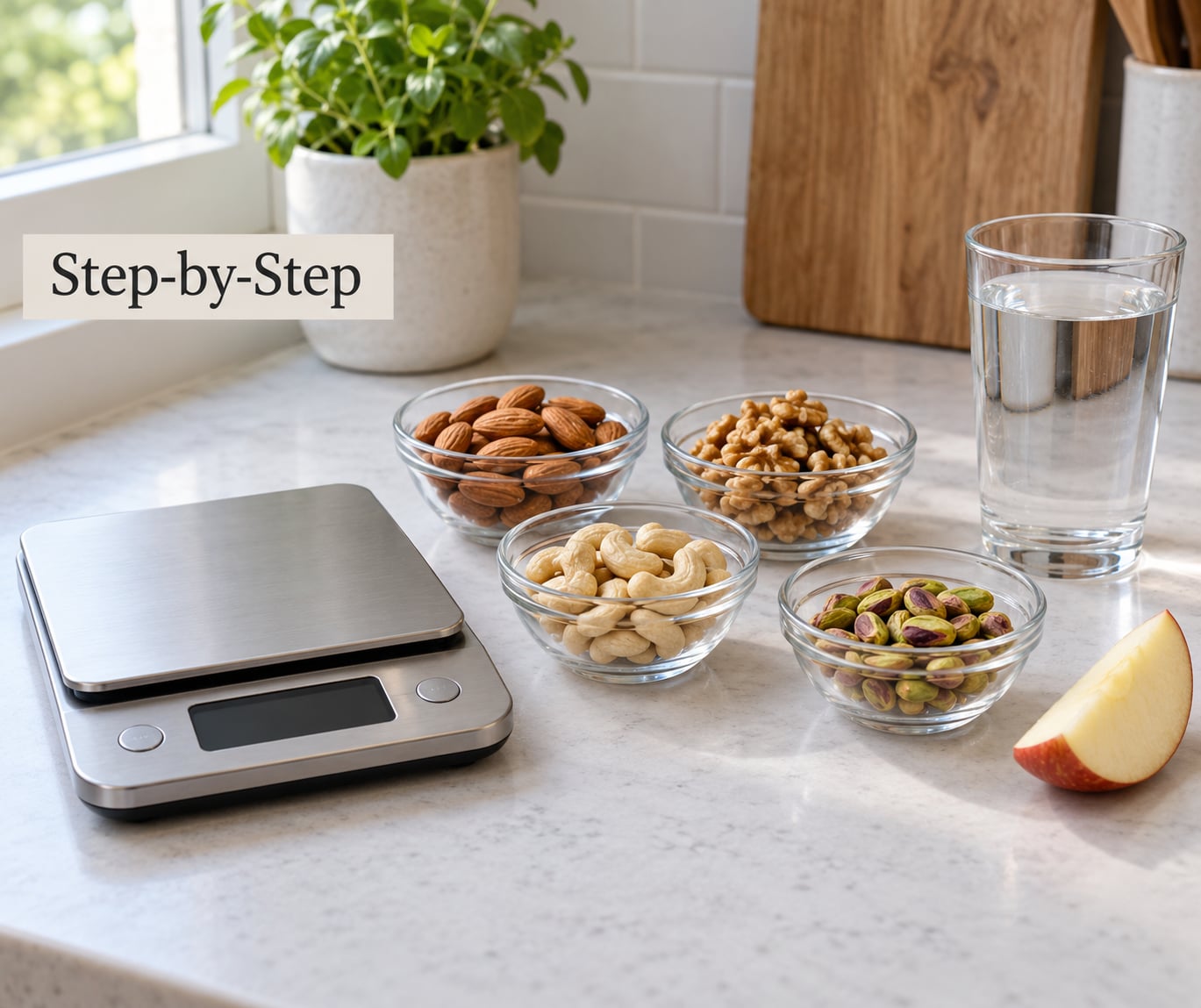
Decide how much you are having before the bag is open, not while you are eating from it. A standard serving of nuts is about 28 grams, which is roughly a third of a cup, one ounce, and what most dietitians treat as one snack.
Guidance differs a little between sources, which is part of why people get confused online. The American Heart Association suggests about 1.5 ounces, around 40 grams, of nuts or seeds a day as part of a healthy pattern. FDA serving labels usually land near one ounce. Pick one number for your household and stop re-litigating it every evening. For most people that number is somewhere between 25 and 35 grams.
Adjust from there rather than treating it as a rule. A 30 gram serving after a long run is a different decision from a 30 gram serving between two meetings, and on a training day two modest servings can be entirely reasonable. If you are pregnant, managing diabetes, or working with a doctor on your weight, ask them what fits you instead of copying a number off the internet.
Nuts vary in weight as much as they vary in flavor, so a piece count means very little on its own. A serving looks very different depending on what is in the bowl.
| Nut | One serving (grams) | About this many pieces | Calories per 30 g |
|---|---|---|---|
| Almonds | 28-30 g | 22-24 nuts | 170-175 |
| Walnuts | 28-30 g | 6 halves | 190-200 |
| Cashews | 28-30 g | 16-18 nuts | 160-170 |
| Pistachios | 28-30 g | 40-45 kernels | 155-165 |
| Peanuts | 28-30 g | 22-26 nuts | 165-175 |
| Pecans | 28-30 g | 16-18 halves | 190-200 |
| Macadamias | 28-30 g | 10-12 nuts | 210-220 |
Measure the Nuts Instead of Eating From the Bag
Transfer the planned amount into your bowl or container, then close the bag and move it. A handful is a genuinely poor measuring device: nobody weighs one, and every handful is different. Weighing once or twice a week fixes the problem permanently because you start recognising what 30 grams actually looks like.
Pick whatever tool suits how you snack. Accuracy matters less than consistency, because a portion you can repeat on a bad Tuesday is worth more than a perfect one you abandon by Friday. If you are working out how to snack on nuts without overeating, this one habit does more work than any rule on this page.
| Method | Accuracy | Effort | Best for |
|---|---|---|---|
| Kitchen scale | Highest | 30 seconds | People who like numbers and want the last gram |
| Tablespoon, level | Good | Very low | Nut butter and quick portions mid-afternoon |
| Quarter-cup measure | Good, nut-dependent | Low | Blended nut snacks at home |
| Pre-portion jars filled once a week | High | Low daily | Anyone who loses control of the bag mid-week |
| Single-serve packs | High | None | Travel, the office, and car snacks |
| Hand gauge | Rough | None | A portion you have already calibrated on a scale |
Here is why portioning works better than resolution. Nuts sit right at the edge of what your body registers as food. They are dry, crunchy, salty and easy to eat fast, so a portion of 30 grams can disappear in under two minutes with almost no sense of having eaten. Meanwhile 100 grams of the same nuts runs to roughly 550 to 600 calories, which is most of an afternoon snack’s budget before you have started on the next thing.
Add the health halo and the problem gets worse. Nuts are marketed as healthy, and they are, so eating the whole bowl never registers as overeating. Nobody feels they broke a rule. It is the single most common reason people report they cannot stop eating nuts, and it is a labeling problem more than a hunger problem.
One other line you will see online is that you do not absorb all the calories from nuts. Some calories do pass through undigested, but the amount is nowhere near enough to cancel a portion three or four times larger than planned. Use it as an excuse and the number goes up, not down.
Pair Nuts With Fiber or Protein
Nuts eaten on their own have fiber and fat but limited protein, so they can pass through your awareness quickly. Adding a protein or fiber source usually makes the snack feel complete and buys you another hour or two before you think about food again.
Worked examples from an ordinary day:
- Nuts plus plain Greek yogurt. About 170 grams of plain yogurt alongside a 30 gram nut portion. Roughly 100 calories, with enough protein to matter.
- Nuts plus fruit. An apple or a pear with a small portion of almonds. The skin and flesh add fiber that nuts alone lack.
- Nuts plus vegetables. Carrot or cucumber sticks with a 25 gram portion. This is the version that disappears fastest at a party.
- Nuts plus a boiled egg. A compact, portable combination that travels well and holds hunger down into dinner.
Nut butter is a useful alternative because it is pre-portioned by the spoon: one tablespoon is about 16 grams and roughly 95 calories, close to a small nut serving. Two tablespoons and you have quietly doubled it. Spoon it onto an apple slice, stir it into plain oatmeal, or thin it with a little hot water and drink it alongside fruit rather than straight from the jar.
Trail mix is where portion control usually collapses, because the dried fruit, chocolate and sweets ride along on the nuts. A 30 gram portion of plain nuts runs about 170 calories. The same weight of chocolate-coated trail mix runs closer to 200, and half a cup served casually can pass 280. If you want mix, build your own: two parts nuts to one part raisins or dried cranberries, and skip the chocolate.
Eat Slowly and Mindfully
Eat the snack sitting down, not standing at the counter or lying on the couch. You do not need a ritual, just three small changes to how the handful happens.
Put the container down between bites. Setting it on the table rather than holding it cuts the rate down without any effort on your part. Eat one piece at a time rather than tipping the bowl, and give yourself something to drink between handfuls. That is often enough to let fullness catch up with the portion.
Then stop when the portion is gone, and put the remainder away in the same motion you opened it. Do not tip the leftovers onto a second plate and do not use the bottom of the bowl as an invitation for another round. When your plan was 30 grams, 30 grams is the finish line, even when the snack is good enough that finishing feels like stopping early.
Nobody gets this perfect. A snack eaten while scrolling is not a moral failure, but noticing it is what makes the next one better.
Plan Ahead for Hunger and Triggers
Overeating usually happens at predictable times: the last ninety minutes before dinner, the commute home, or the hour after work when cooking has not started. Portioning only works if the portion exists before the trigger arrives.
A five-minute Sunday reset covers most cases. Pour five or six small jars, fill one container for each day you know will be difficult, and put the big bag back in a high cupboard or out of the house entirely. If you do not want a bag on the counter, single-serve packs sized at one serving take the decision out of the whole week. Several regular nut eaters say the bag size, not the nuts, was the actual problem.
Think about which nuts you buy. Salted and roasted varieties are engineered to be hard to stop eating, and honey-roasted, chocolate-coated and candied nuts have added sugar on top of the calorie density. Plain, dry-roasted or raw nuts in small packages are the better choice for a portion-controlled snack. A note for anyone with a nut allergy, or with young children in the house: whole nuts are a choking risk for small children, and allergy advice belongs with your doctor.
Timing helps too. An afternoon portion before a larger meal can blunt how much you eat at dinner, and nuts eaten separately rather than folded into a meal tend to be noticed as a snack instead of disappearing into the plate. Some people find that the honest answer is not moderation but removal: if you already know nuts in the house are the problem, taking them out of the pantry is a valid plan and not a failure.
Common Mistakes
Almost every nut overeating problem comes down to one of these, and each has a straightforward fix.
- Eating straight from the bulk bag. Nobody finishes a bag they never opened. Fix: decant a portion into a small container every time and close the original.
- Trusting an oversized handful. What looks like a serving in the shop is often two. Fix: measure once with a scale until your eye learns the weight.
- Choosing candied or chocolate-coated nuts. Sugar and fat together make the portion impossible to notice. Fix: plain, dry-roasted or raw.
- Skipping meals, then grazing all evening. Arriving at a snack genuinely starving makes any portion advice irrelevant. Fix: eat enough at lunch and keep a planned portion ready for the hungry window.
- Eating nuts as the only snack. Fat and fiber without protein is not very filling. Fix: pair with yogurt, fruit or vegetables.
- Treating nuts as free food. The health halo lets a 600 calorie bowl feel like nothing. Fix: count the portion like any other snack.
- Letting the container live on the coffee table. Out of sight matters more than willpower. Fix: no bowl in the living room, and the jar goes back to the cupboard when you are done.
If you have already blown past your portion today, do not compensate. Skipping the next meal or trying to burn it off sets up the same cycle tomorrow, which is exactly what the people asking about this online have found. Eat your next meal as planned, drink some water, and go back to a measured portion at the next snack. One bad evening is noise; a habit of skipping meals after one is what actually makes the pattern stick.
Frequently Asked Questions
How many nuts should I eat in one snack?
One snack is about 28 to 30 grams of nuts, which is roughly one ounce or a small handful, and works out to about 170 calories for most nuts. Larger heart-health guidance from the American Heart Association sits nearer 1.5 ounces, around 40 grams, a day in total. On training days two modest servings can be reasonable. There is no single correct number for everyone, so use the number you can repeat rather than the strictest one you found.
What is the best portion size for nuts?
The best portion size is the one that is measured rather than estimated. Weigh 28 to 30 grams once or twice a week so your eye learns what that looks like in a bowl, then judge portions by eye the rest of the time. A quarter cup of most nuts lands close to a serving, though macadamias and cashews fill more of the cup per calorie than almonds or pistachios.
Are nuts good for weight loss if they are high in calories?
Yes, in practice, because of how they behave in a diet. Nuts are calorie-dense but rich in unsaturated fat, protein and fiber, and research published in the American Journal of Clinical Nutrition has found that eating nuts tends to reduce total daily calorie intake rather than raise it. The portion still decides the outcome. A measured 30 gram snack rarely causes weight gain; an unmeasured bowl often does.
Are roasted or raw nuts better for portion control?
Plain, dry-roasted or raw nuts are the easier choice for portion control, mainly because there is no added sugar pulling you back for more. Candied, honey-roasted and chocolate-coated varieties are much easier to overeat, and heavily salted ones are hard to put down. Roasted does not meaningfully change the calorie content of a nut; the coating is what changes the math, not the roasting.
How can I stop eating too many nuts from the bag?
Move the decision away from the moment of hunger. Portion into a small container before you sit down, put the bag back in a high cupboard or another room, and buy single-serve packs or smaller bags so nothing large is left within reach. If that is not working, remove nuts from the house for a few weeks rather than trying to moderate them, and ask a doctor or registered dietitian about a plan that fits your own situation.
Is 100g of nuts a day too much?
For most people, yes: 100 grams of nuts runs to roughly 550 to 600 calories, which is close to three or four full servings eaten in one sitting without noticing. It is not dangerous once, but it is a large amount to eat daily without a reason. If your goal is a calorie deficit, a measured 28 to 40 gram serving is a more useful daily target.
Conclusion
Start with one action tonight: weigh 30 grams, tip them into a small bowl, put the bag back in the cupboard, and eat them sitting down with a glass of water. Add yogurt or a piece of fruit if you want the snack to last until dinner.
That is the whole system. The number matters less than making it automatic, and automatic beats perfect every time. You will still finish a jar now and then. What changes is how quickly you get back to a measured portion the next day.