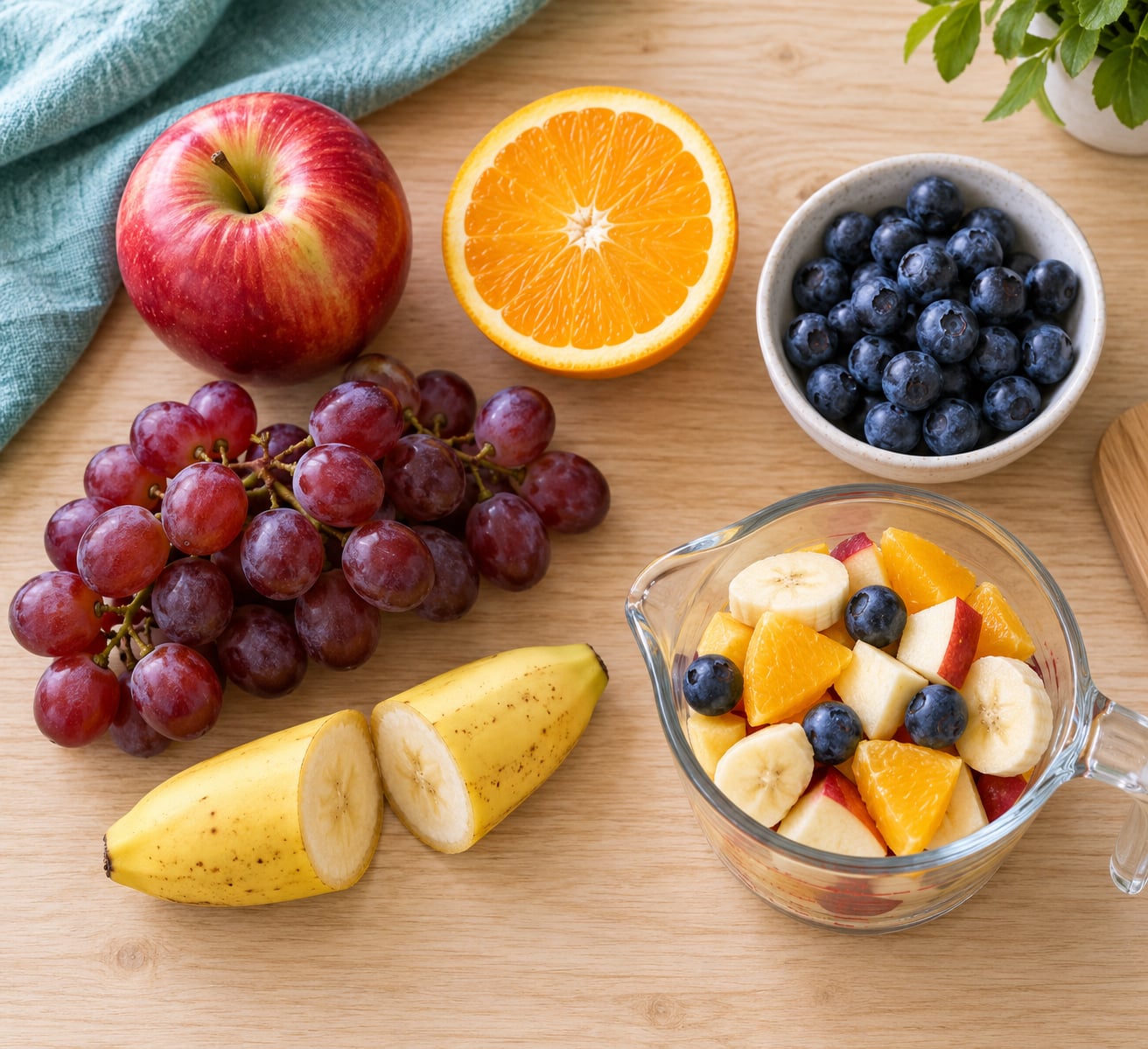
Short answer: for most healthy adults, how much fruit a day is too much is not really a fixed number, because whole fruit is hard to overeat. The practical target sits around 1.5 to 2.5 cups a day, roughly 400 g, or about a quarter of your daily calories.
This guide was updated in October 2026 and reviewed for accuracy. It is general nutrition information, not individual medical advice. If you have diabetes, kidney disease, pancreatitis, an intestinal condition or persistent digestive symptoms, talk to your doctor or a registered dietitian about your own limits.
Most Americans fall short of the guideline, not over it. The interesting question is not whether fruit is dangerous in large amounts, but which forms of fruit add up quickly and which nutrients get crowded out when fruit takes over the plate.
Table of Contents
- How Much Fruit a Day Is Too Much?
- Recommended Fruit Serving Ranges for Adults
- Can Eating Too Much Fruit Cause Weight Gain?
- Whole Fruit vs. Fruit Juice, Dried Fruit, and Smoothies
- Signs You May Need More or Less Fruit
- How to Keep Fruit Portions Balanced
- Frequently Asked Questions
- How many servings of fruit should an adult eat per day?
- Is 5 or 6 servings of fruit too much?
- Are bananas or mangoes more likely to make you gain weight?
- Is fruit juice as healthy as whole fruit?
- Can too much fruit cause diarrhea or bloating?
- Should people with diabetes limit fruit?
- Conclusion
How Much Fruit a Day Is Too Much?
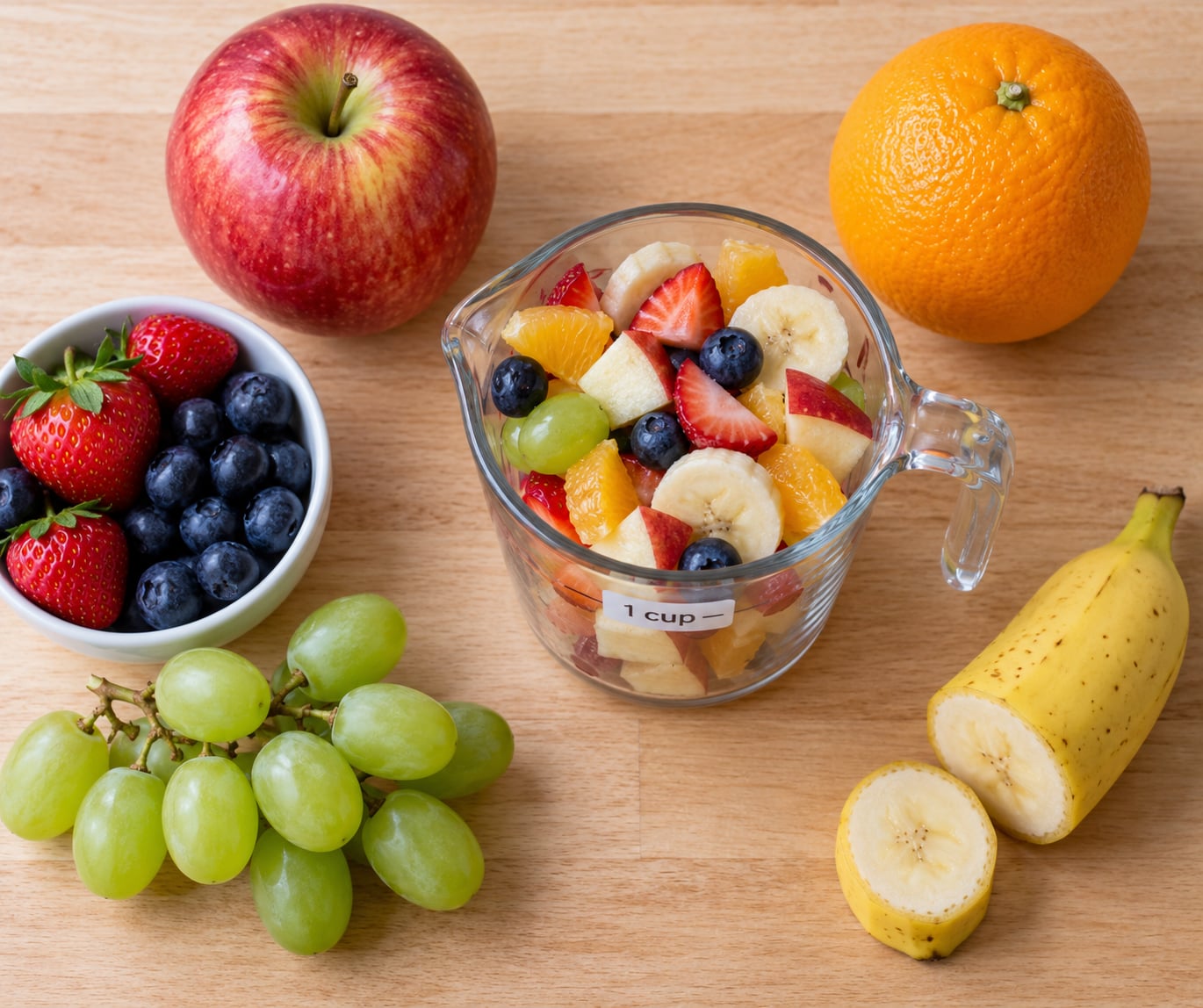
There is no hard ceiling on whole fruit for a healthy adult. The US Department of Agriculture’s Dietary Guidelines for Americans put the target at 1.5 to 2.5 cups of fruit per day on a 2000-calorie eating pattern, the American Heart Association frames it as 4 to 5 servings, and the World Health Organization recommends at least 400 g of fruit and vegetables combined. Those numbers sound contradictory, and the reason is that they measure different things: cups of whole fruit, servings that include vegetables, and total weight across both categories.
What changes the answer is the form. A person eating five apples is not in the same situation as a person drinking five glasses of juice, because the fiber, water and chewing volume are gone. Whole fruit carries roughly 80 to 90 percent water, plus fiber that slows absorption, and both blunt how fast sugar arrives. Fruit has never been easy to overeat, which is why most dietary surveys still find most people under-eating it.
Where intake does cross the line, it usually shows up in three places: calories quietly stacking up during weight loss, blood sugar climbing faster than expected, or fruit displacing protein, iron, calcium and vitamin B12 in the overall diet.
Recommended Fruit Serving Ranges for Adults
A standard serving is about 1 cup of raw fruit, or half a cup of sliced, cooked or canned fruit, or one piece about the size of a tennis ball. That definition comes from the USDA and is what makes cup counts comparable between foods.
| Portion | Everyday examples | Approx. cups of fruit |
|---|---|---|
| Standard serving | 1 medium apple or orange, 1 cup of berries, half a cup of sliced melon | 1 cup |
| Small portion | Half a banana, a handful of grapes, one clementine | About 0.5 cup |
| Large portion | Two apples, a full mango, a large bowl of cherries | 2 to 3 cups |
| Typical day within guidance | Breakfast apple, handful of berries at lunch, pear as a snack | 2.5 cups |
| Day that starts to crowd out other foods | Smoothie at breakfast, juice mid-morning, two pieces at every meal | 4 cups or more |
Needs vary by body size, activity level, calorie target and dietary pattern. Someone running 60 km a week and eating 3000 calories a day has more room than someone sedentary on 1600. Fruitarian-style eaters and people with type 2 diabetes sit at the other end. Within the 2-to-4-cup zone, the deciding factor is rarely the fruit itself. It is what the rest of the day looks like.
Can Eating Too Much Fruit Cause Weight Gain?
Fruit is nutrient-dense and low in calories per bite, but a calorie is still a calorie when you are losing weight. On r/loseit, the recurring frustration is exactly this: an apple is about 95 calories, and a large mango is around 200, so fruit can quietly use up a chunk of a daily budget without feeling like a big meal. Counting fruit toward total calories, rather than treating it as free food, is the fix most people in those threads land on.
Fruit is not inherently fattening. The mechanism is arithmetic. If total intake stays at or below maintenance, the composition of those calories barely matters for weight. When fruit is added on top of an unchanged diet rather than substituted for something else, calories rise and weight follows.
Two forms are the usual troublemakers. Dried fruit is the clearest example: a cup of fresh strawberries is about 50 calories, while a cup of raisins carries roughly 500, because the water is gone and the portion looks small. Fruit smoothies are the second. Blending does not remove fiber entirely, but it does remove the chewing and the volume, and a 16-ounce smoothie can carry 300 calories or more with no sense of having eaten anything.
A workable rule for a 2000-calorie day: aim for fruit to be roughly 400 to 500 calories a day, which lands around the 25 to 30 percent share of total calories that some mainstream nutrition guidance uses for fruit. That budget covers everything: fresh, frozen, dried, and juice. If your fruit is coming from a smoothie most mornings and dried fruit most afternoons, you are spending the whole budget on concentrated sources and getting very little fiber and almost no chewing for it.
Whole Fruit vs. Fruit Juice, Dried Fruit, and Smoothies
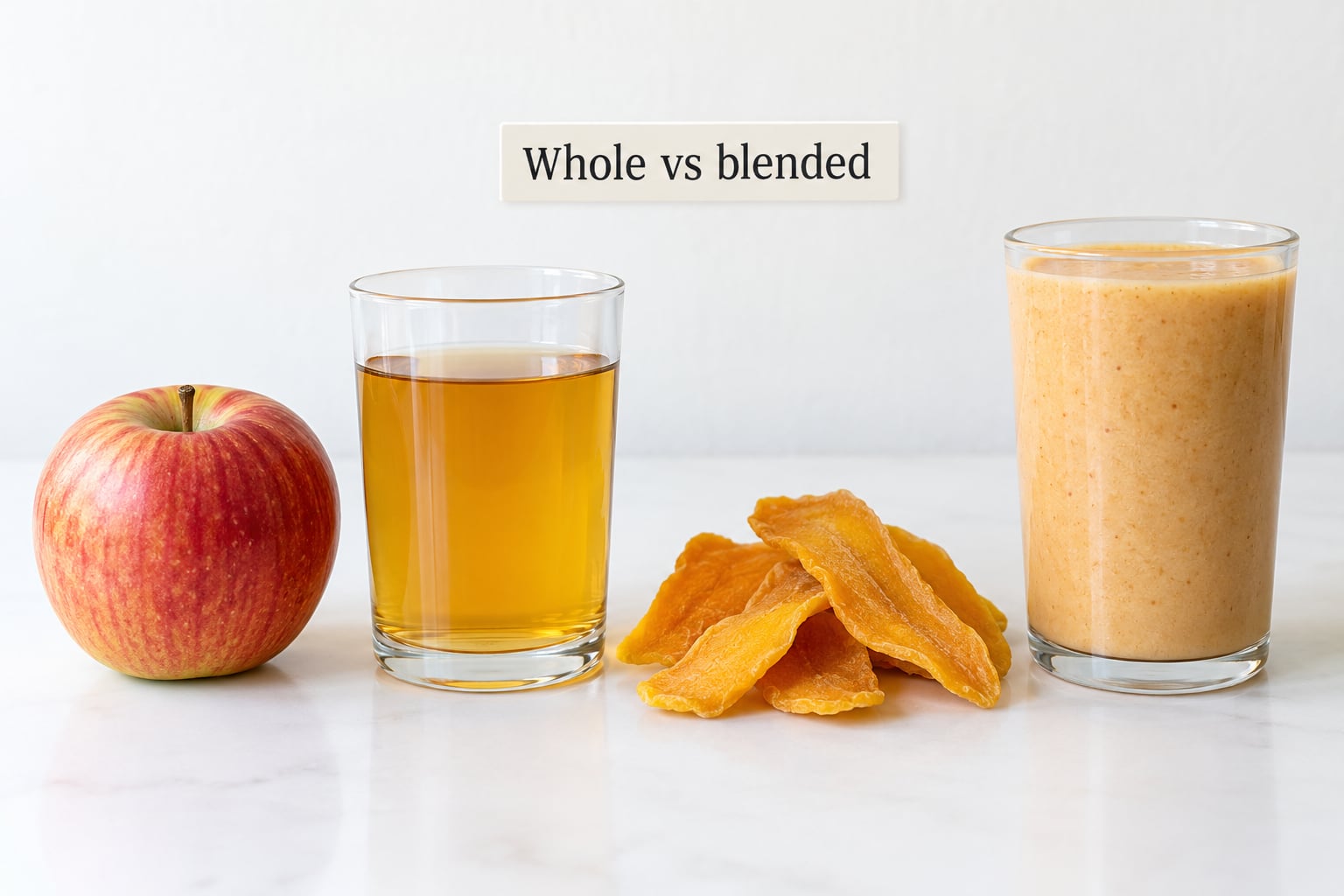
Every form of fruit carries the same vitamins. They differ enormously in fiber, water, sweetness and how much volume you get per calorie, and those four things decide how easily you eat too much.
| Form | Fiber retained | Typical portion | What changes |
|---|---|---|---|
| Whole fruit | Full | 1 apple, 1 cup berries | Slowest sugar absorption, most filling per calorie |
| Frozen fruit | Full | 1 to 1.5 cups | Nearly identical to fresh, cheapest per cup |
| 100% juice | Almost none | 8 to 12 ounces | Concentrated sugar, drinks fast, rarely filling |
| Smoothie | Partial, unless you keep the pulp | 12 to 20 ounces | Easy to add oats, nut butter or sweeteners you did not plan |
| Dried fruit | Concentrated | About 1/4 cup | Dense calories, small volume, easy to keep eating |
| Fruit sauce or spread | Low | 2 tablespoons | Often added sugar on top of fruit sugar |
A good practical test is how long the portion lasts. If you sit down with an apple, you eat it and stop. If a bottle of juice and a bag of dried cranberries disappear in twenty minutes while reading, the forms are doing the work that fullness would normally do.
Signs You May Need More or Less Fruit
These are context clues, not a diagnosis. If one of them is happening consistently, it is worth a conversation with a clinician rather than a stricter diet on your own.
- Loose stools or frequent bathroom trips. A large amount of fruit, especially pears, apples, mango and stone fruit, brings water and sorbitol with it. Parents on r/toddlers and r/BabyLedWeaning describe this constantly with young children eating three or more servings a day.
- Bloating and gas after fruit. Some people have fructose malabsorption, where the gut cannot absorb fructose efficiently. Apples, pears and watermelon are common triggers; a low-FODMAP approach with a dietitian usually sorts it out.
- Feeling full before the meal is over. On parents’ forums, the most common version of “too much fruit” is not calories, it is a toddler filling up on fruit and refusing iron-rich and iron-fortified foods. That pattern deserves attention, especially in kids under three.
- Blood sugar that climbs faster than expected. People managing type 2 diabetes or insulin resistance often find that large fruit portions spike their glucose. Portion, pairing and timing matter more than cutting fruit out.
- Protein, iron or calcium disappearing from the plate. Extreme fruit-only patterns, sometimes called fruitarian diets, are associated with deficiencies in vitamin B12, calcium, vitamin D and omega-3 fats, plus tooth erosion from constant acidic and sugary contact.
- Fruit has quietly replaced vegetables, protein or grains. This is the least visible problem and the one that lasts longest. Variety matters too: on r/nutrition the consensus is that five servings of only one fruit is less useful than a mixed handful.
Occasional bloating after a big piece of watermelon is not a medical problem. Constant diarrhea, unexplained fullness or recurring blood sugar spikes are the kind of thing that needs a proper look, not a stricter plan invented at the kitchen table.
How to Keep Fruit Portions Balanced
Most people do not need to reduce fruit. They need to shift where it comes from and stop treating it as unlimited. Six steps that work without turning fruit into homework.
- Set a fruit calorie figure, not a piece count. On a 2000-calorie day, 400 to 500 calories of fruit is a workable budget. Once you have the number, two apples and a cup of berries is a normal day, and a mango plus a smoothie is a big day.
- Measure the concentrated forms. Put juice, dried fruit and smoothies into the same budget as fresh fruit. A quarter cup of raisins is the useful reference for dried fruit; most people pour double that without noticing.
- Eat whole fruit before meals, not during them. A piece of fruit 20 minutes ahead of lunch often reduces how much you eat at the table. Fruit eaten at the end of a meal adds calories after you were already full.
- Build meals around lower-calorie fruits. Berries, apples, oranges, pears, kiwi and grapefruit pack water and fiber into very few calories. Bananas, mangoes, grapes and dried fruits are denser, which makes them great, just easier to overshoot.
- Pair dried fruit and smoothies with protein or fat. Plain yogurt, nuts, nut butter or seeds slow the absorption of the sugar and turn a snack into something you stay full through. Berries with plain yogurt is the simplest version.
- Spread fruit across the day. Two or three portions at different meals is easy on digestion and on blood sugar. Six pieces at one sitting is harder on both.
If weight loss is the goal, the simplest version of all of this: keep your fruit, log it, and stop pretending it does not count.
Frequently Asked Questions
How many servings of fruit should an adult eat per day?
Most adults land between 2 and 5 servings a day, where one serving is about 1 cup of raw fruit, half a cup of sliced or canned fruit, or one medium piece. The USDA frames this as 1.5 to 2.5 cups on a 2000-calorie pattern. Needs shift with body size, activity level and calorie target, so treat the range as a starting point rather than a quota.
Is 5 or 6 servings of fruit too much?
Not for most healthy adults. Five or six servings of whole fruit is well within a normal day, and trials of people eating far more than that reported no adverse effects on weight, blood pressure or lipids. It becomes a problem when fruit replaces protein, iron, calcium or vegetables, or when most of those servings are juice, smoothies or dried fruit rather than intact pieces.
Are bananas or mangoes more likely to make you gain weight?
They are more calorie-dense than berries or apples, so they are easier to overeat in large portions, but they are not fattening on their own. A medium banana is about 105 calories and a cup of diced mango is roughly 100. Weight depends on your total daily intake. Measure these denser fruits rather than eating them straight from the bowl.
Is fruit juice as healthy as whole fruit?
Not quite. Juice keeps the vitamins but loses almost all the fiber and the water that makes whole fruit filling, so the sugar arrives faster and the serving disappears quickly. Count juice as a separate item from your whole-fruit cups, keep it to about 8 ounces, and choose whole fruit whenever the choice exists.
Can too much fruit cause diarrhea or bloating?
Yes. Large amounts of fruit can cause gas, bloating and loose stools, especially in young children and in people with fructose malabsorption or IBS. Apples, pears, mangoes, watermelon and stone fruit are frequent triggers because of their sorbitol and fiber load. Occasional discomfort after a large serving is normal; persistent diarrhea or pain should be discussed with a doctor.
Should people with diabetes limit fruit?
Usually not completely. Fruit can be eaten, but portions, timing and pairing matter more than avoidance, and guidance should come from your own doctor or a registered dietitian. Pairing fruit with protein or fat, choosing whole fruit over juice, and spreading servings across the day all help flatten the glucose response.
Conclusion
For most healthy adults there is no such thing as too much whole fruit, and the target of 1.5 to 2.5 cups or roughly a quarter of daily calories is a reasonable place to land. The trouble almost always sits in concentrated forms and in what fruit displaces, not in the fruit itself.
Start with one step: compare a typical day’s fruit against the serving examples above, then adjust the largest, least filling sources first. Usually that means measuring dried fruit and smoothies, or cutting juice down to a small daily glass. If any of the signs in this guide are showing up regularly, that is a doctor or registered dietitian conversation rather than a stricter plan.