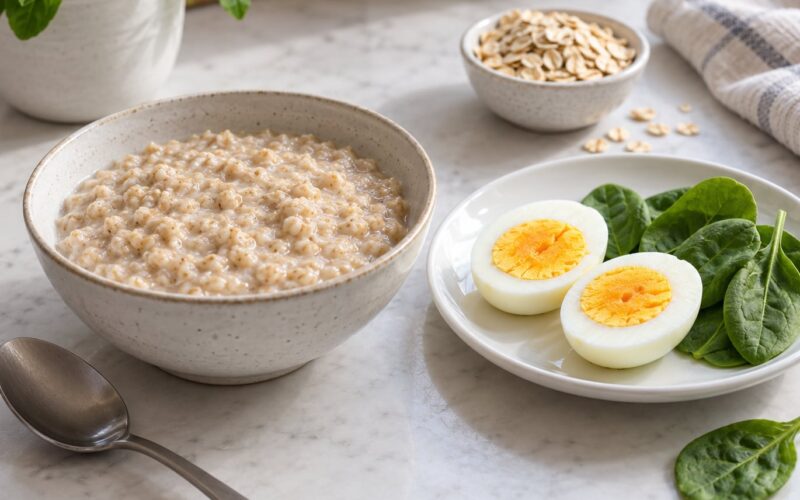
To make eggs filling without frying them, cook the egg gently — boil, poach, steam, or bake — then build the filling from protein, fiber, and volume rather than fat. One large egg gives you roughly 6 grams of complete protein but almost no fiber, which is why a plain egg on its own rarely carries you to lunch.
The good news is that almost nothing here needs a frying pan. Boiling, poaching, baking in ramekins, and slow scrambling all work, and each one takes about 15 minutes of active time at most.
Below is the method I actually use on busy mornings, plus what to add so the egg fills you up.
Table of Contents
- What You Need
- Step-by-Step: How to Make Eggs Filling Without Frying Them
- How to Boil an Egg and Fill It for a Filling Meal
- How to Bake a Filling Egg Without Frying
- How to Poach or Steam an Egg for Extra Filling
- Common Mistakes
- Frequently Asked Questions
- What is the easiest way to make eggs filling without frying them?
- Are boiled eggs filling enough on their own?
- What can I add to eggs to make them more filling?
- Can I make non-fried egg cups ahead of time?
- How should I store filled eggs, and how long do they last?
- Can I reheat a filled baked or poached egg safely?
- Conclusion
What You Need
You do not need much. Most of the work is in what you mix into or alongside the egg.
- Eggs — two per person for a proper meal, one if you are pairing with other protein.
- A protein add-in — cottage cheese, Greek yogurt, canned tuna, mashed chickpea, or leftover beans.
- A fiber add-in — spinach, black beans, avocado, roasted vegetables, or a scoop of leftover rice.
- Seasoning — salt, black pepper, and one of lime juice, hot sauce, or a fermented vegetable like sauerkraut.
- Equipment — a pot, a baking dish with ramekins or a muffin pan, a bowl, and a slotted spoon.
No skillet, no oil, no butter. A kitchen with one burner and an oven is enough.
Step-by-Step: How to Make Eggs Filling Without Frying Them
Four levers decide whether an egg is a snack or a meal: cooking method, protein, fiber, and portion. Change any one of them and the result shifts.
How to Boil an Egg and Fill It for a Filling Meal
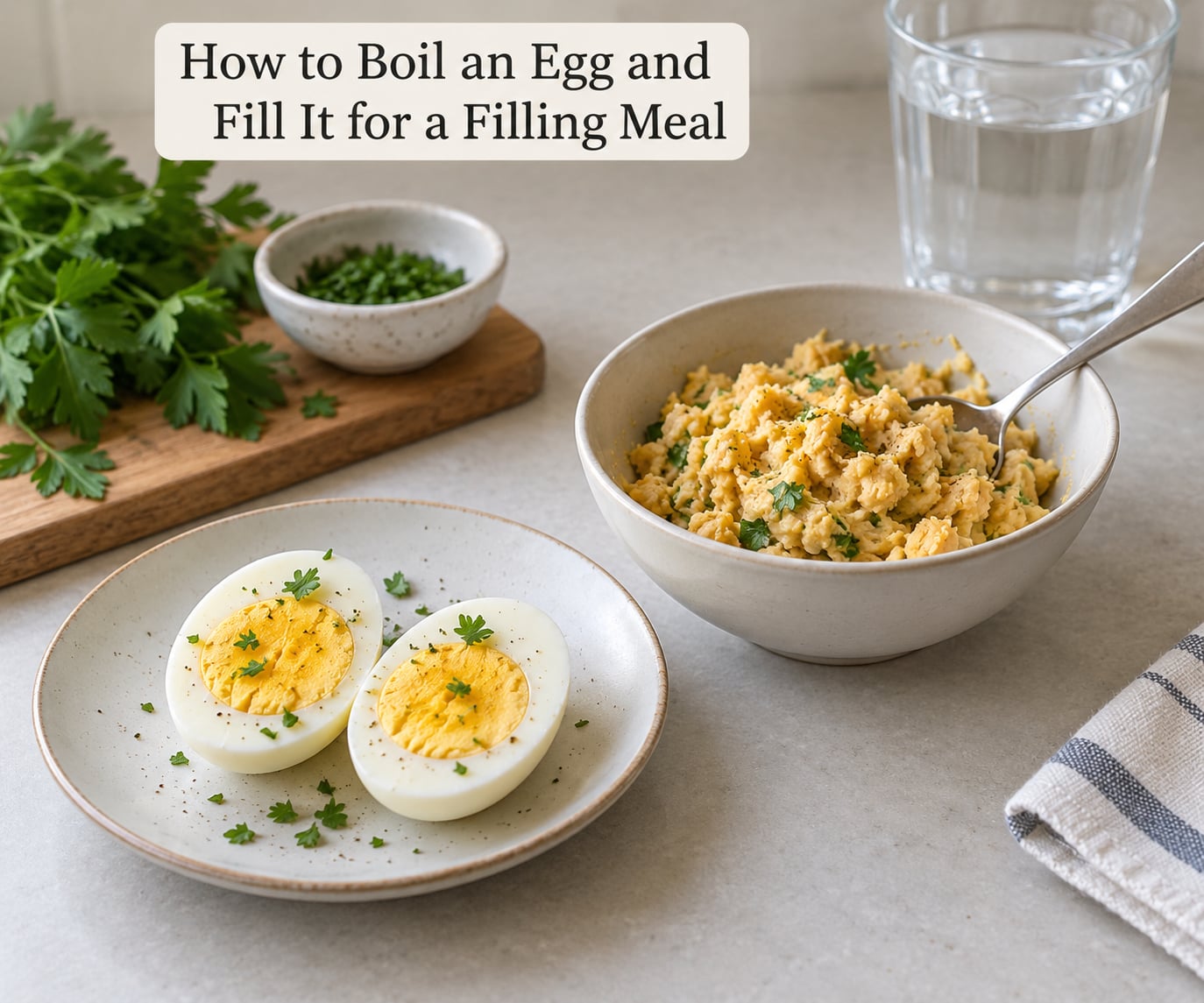
Put the eggs in a pot, cover them with cold water by an inch, and bring to a rolling boil. Turn the heat off, cover the lid, and leave them for 12 minutes for a firm yolk, or 9 minutes if you want it still slightly soft in the middle.
Move them straight to ice water for 5 minutes. The shock stops the cooking, firms up the whites, and makes peeling far easier — roll each egg between your palms and the shell comes off in sheets.
Now the filling. Mash half a cup of chickpeas with a fork, a spoon of plain yogurt or tahini, salt, pepper, and a squeeze of lemon until it holds together. Slice the boiled egg in half, spoon the mixture over the yolk side, and finish with herbs or a few hot drops of sauce.
If you are batching this for the week, keep the eggs in their shells in the fridge and do the filling the morning you eat them, so nothing gets soggy.
How to Bake a Filling Egg Without Frying
Heat the oven to 350°F / 175°C. Grease two small ramekins or the wells of a muffin pan with a little oil so you can get them out later.
Chop half an onion, a handful of spinach, and a quarter of a bell pepper, then soften them in a small saucepan with a splash of water until the liquid cooks off — roughly 4 minutes. That drying step matters, because watery vegetables make a loose, watery egg cup.
Crack one egg into each cup, spoon the vegetables over it, and finish with cheese or a spoonful of white beans. Add a few tablespoons of hot water around the ramekins in the baking dish if you want the French en cocotte style, which steams the egg gently and keeps the yolk soft.
Bake 14 to 18 minutes until the whites are no longer liquid and the center still jiggles slightly. Any dish containing eggs should reach 160°F / 71°C internally, according to USDA guidance.
These take about 25 minutes from cold oven to plate and hold well as leftovers.
How to Poach or Steam an Egg for Extra Filling
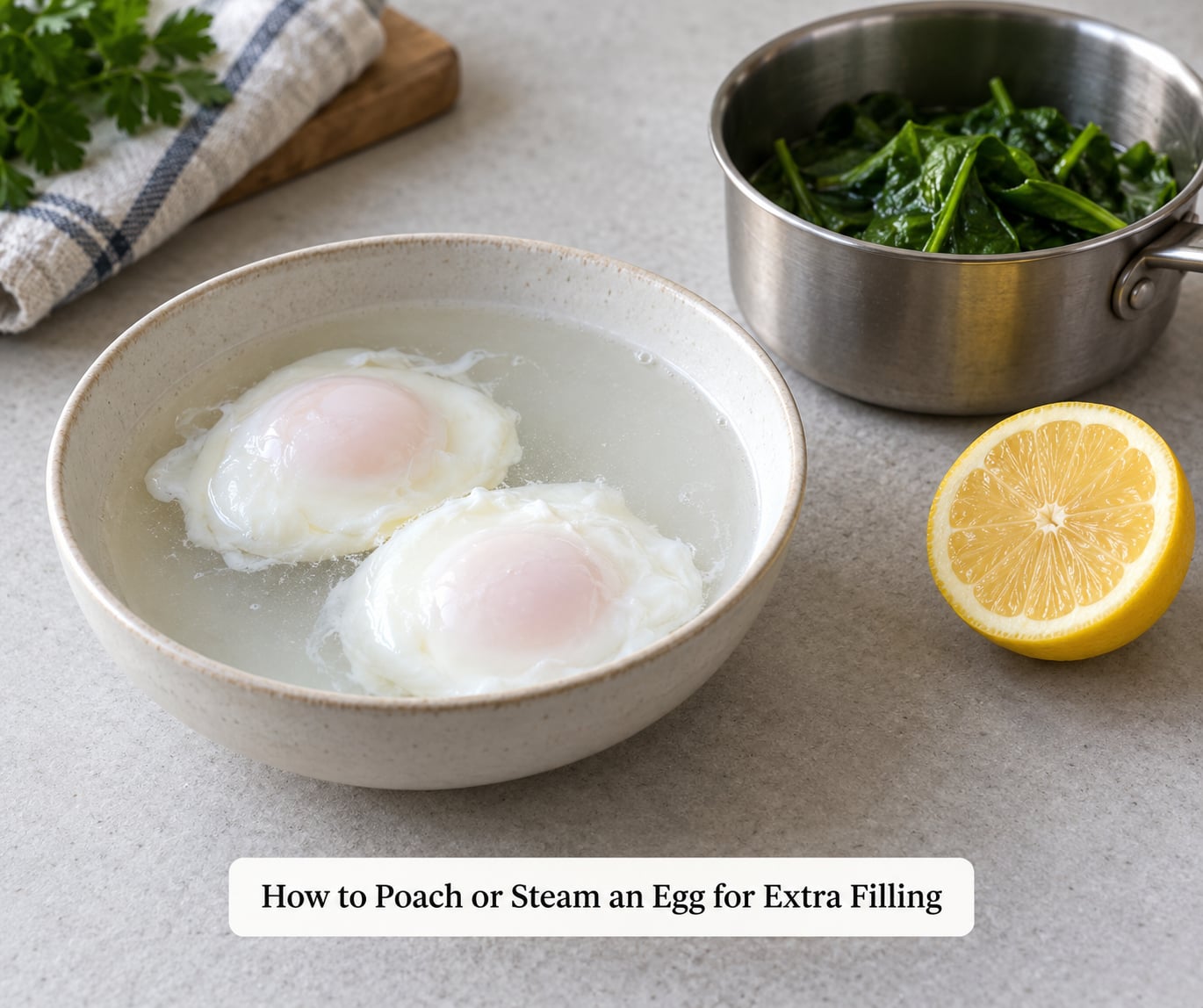
For poaching, bring 3 inches of water to a bare simmer — no bubbles at the surface. Crack the egg into a cup first, then let it slide in. Cook 3 minutes for a runny yolk, 4 for a jammy one.
A teaspoon of vinegar in the water keeps the white from feathering apart. You can leave it out, but the egg will look looser and less neat.
Steaming needs less precision. Put the eggs in a steamer basket over simmering water, cover, and time 9 minutes for a set yolk, 7 for a soft one. No thermometer, no hovering over the pot.
Poached eggs on their own are light, so pair them with something with weight: wilted spinach and feta, black beans and salsa, smoked salmon and capers, or two poached eggs over leftover rice with soy sauce.
There is a microwave version too. Put 4 tablespoons of water and a teaspoon of vinegar in a mug or small bowl, crack in an egg, cover loosely, and microwave in 20-second bursts until the white sets. It is less pretty than stovetop poaching but reliably fast at 7:00 in the morning.
Common Mistakes
Overcooking the egg. A chalky, grey-ringed yolk signals too long in the hot water. It also digests more slowly, which works against the very fullness you are chasing. Pull it five minutes earlier next time.
Stopping at the egg. Six grams of protein with zero fiber is a snack. Add a filling with actual bulk and the same breakfast behaves like a different meal.
Overfilling. Loading a single egg with everything on the counter makes it awkward to eat and hard to chew. Two moderate halves beat one overloaded one.
Ignoring fiber. Protein alone gets you part of the way. Beans, oats, avocado, berries, and leafy greens supply the fiber that slows digestion and keeps hunger away.
Skipping texture contrast. Soft eggs with soft toppings feel bland and go fast. Something crisp — toasted seeds, chopped herbs, a bit of olive oil and flaky salt — forces slower chewing and adds satisfaction.
Underseasoning. Non-fried eggs have no fat carrying flavor, so they taste flatter than a fried one. Salt early and lean on acid: lemon, lime, vinegar, pickle brine.
Frequently Asked Questions
What is the easiest way to make eggs filling without frying them?
Boil two eggs for 12 minutes, cool them in ice water, then fill the halves with mashed chickpeas or canned tuna mixed with Greek yogurt, salt and pepper. The eggs need one pot and about 17 minutes total, and the filled halves travel well to work. Baked egg cups take slightly longer but need almost no attention once they are in the oven.
Are boiled eggs filling enough on their own?
On their own, usually not for very long. A large egg delivers about 6 grams of complete protein and almost no fiber, so hunger tends to return within the hour for many people. Pair the egg with a filling that adds both protein and fiber, such as half a cup of beans, a spoonful of cottage cheese, or a few handfuls of spinach. Two eggs plus a proper side keeps most people full until lunch.
What can I add to eggs to make them more filling?
The best additions deliver protein, fiber or both. Cottage cheese and Greek yogurt add creaminess and protein, canned beans or chickpeas add protein plus fiber, and spinach, avocado or leftover cooked rice add fiber and volume. Cheese contributes protein and fat, tofu works for a plant-based version, and sauerkraut or kimchi adds flavor with very few calories. Crunchy toppings like seeds or chopped nuts help it feel more satisfying.
Can I make non-fried egg cups ahead of time?
Yes, and they are one of the easiest make-ahead breakfasts. Egg bites — egg plus cottage cheese or chopped spinach baked in a muffin pan — keep in the fridge for up to four days and reheat in about 30 seconds. Hold the ramekins or the muffin pan back until the day you cook so you are not baking a sheet of cups you will not eat. Cover tightly and cool before refrigerating.
How should I store filled eggs, and how long do they last?
Keep hard-boiled eggs in their shells in the fridge for up to one week, per USDA guidance. Once you fill them, the egg is exposed to air and handling, so refrigerate the finished halves and eat them within one to two days. Store them in a sealed container, not on a plate, and keep them below 40°F / 4°C. If they have been sitting out for more than two hours, discard them.
Can I reheat a filled baked or poached egg safely?
Yes. Warm a baked egg cup or a poached-egg bowl in the microwave in short bursts until the center reaches 160°F / 71°C, the USDA safe minimum internal temperature for egg dishes. Reheat boiled egg halves in the same way, though many people prefer them cold. Be careful with a runny yolk, since it can go hot before the white does and burn your mouth.
Conclusion
Start with the easiest version: cook one egg without frying it, add a filling that brings protein and fiber, and eat it with something crunchy on top. Boiled and filled halves take about 17 minutes and need one pot.
From there, adjust the portion to your appetite. One egg with a generous filling suits many mornings, two eggs plus a side works if you are hungry or training hard, and baked egg cups scale up cleanly for a family or a week’s worth of breakfasts. If you have a medical condition or a specific nutrition goal, a registered dietitian can help you size this properly.