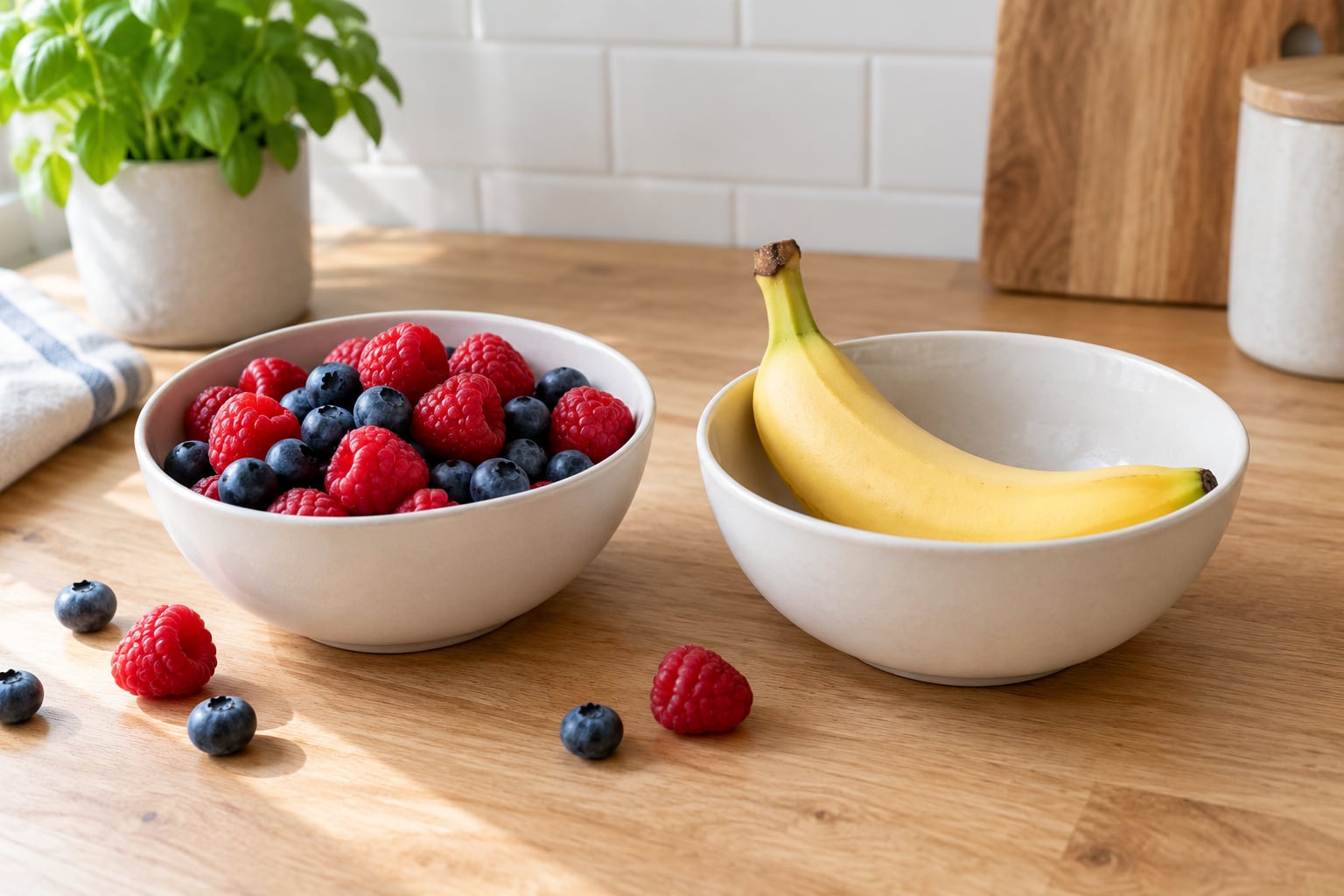
Berries are the lower-sugar choice by weight. A cup of raspberries lands around 5g of sugar, while a medium banana carries roughly 14g, and most berries sit near half the sugar per 100g. The banana still wins on convenience, potassium and calories per serving.
That is the whole argument for berries vs bananas for a lower sugar snack, and it takes about four minutes to settle if you normalize both fruits the same way. The catch is that most online comparisons mix per-100g figures with actual serving sizes, which is how a 118g banana ends up judged against a 100g berry and everybody draws the wrong conclusion.
So here is the fair version, using USDA FoodData Central figures. Everything below is general nutrition information, not medical advice, and if you are managing diabetes or another condition your targets should come from your own doctor or a registered dietitian.
Key takeaways:
- Berries run roughly 4.4g to 10g of sugar per 100g. A banana runs roughly 12g to 15g per 100g, depending on ripeness.
- A cup of raspberries is about 5g of sugar. A medium banana is about 14g. Half a banana is about 7g.
- Ripe bananas are higher in glycemic index than any common berry.
- A whole banana is only about 105 calories, often fewer than a cup of berries with added yogurt or nut butter.
- Pairing either fruit with protein or fat flattens the glucose response.
Table of Contents
- Berries vs Bananas for a Lower Sugar Snack at a Glance
- Which Fruit Has Less Sugar?
- How Does Ripeness Change the Answer?
- Which Fruit Gives You More Fiber and Satiety?
- Portion Size and Total Sugar Matter
- Berries vs Bananas for Weight Loss Snacking
- Which Fruit Is Easier to Use?
- Health Considerations and Practical Tips
- Can you eat berries and bananas together?
- How to blunt the glucose response
- Four lower sugar snack builds
- Individual response varies more than tables say
- Other things worth knowing
- Frequently Asked Questions
- Are berries lower in sugar than bananas?
- Are bananas bad for weight loss?
- What is the lowest-sugar fruit snack?
- Is a banana a good snack for losing weight?
- How many calories are in a banana compared with a cup of berries?
- Should I eat berries or bananas if I am concerned about blood sugar?
- Conclusion
Berries vs Bananas for a Lower Sugar Snack at a Glance
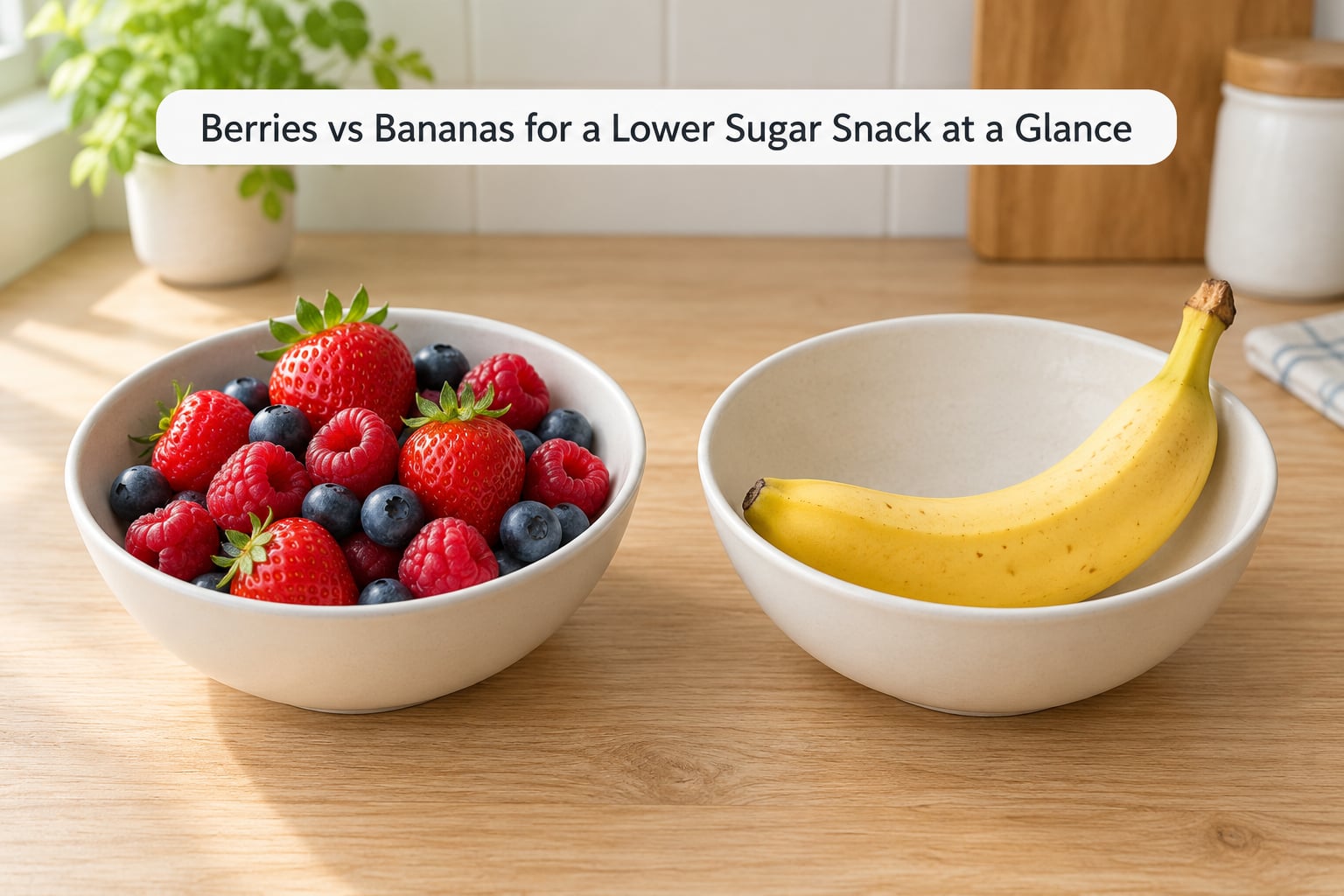
Here is the same eight criteria most people care about, measured for each fruit. Values are typical and shift with variety, ripeness and serving size.
| Criterion | Berries | Banana |
|---|---|---|
| Sugar per 100g | About 4.4g to 10g | About 12g to 15g |
| Sugar per typical serving | About 5g to 7g per cup | About 14g per medium banana |
| Fiber per serving | About 3g to 8g per cup | About 3g per medium banana |
| Calories per serving | About 50 to 85 per cup | About 105 per medium banana |
| Glycemic index | Low, roughly 30 to 53 | Medium, roughly 51 to 62 when ripe |
| Typical portion size | 1 cup, about 140g | 1 medium fruit, about 118g |
| Portability | Needs a container, spoils fast | Fits in a pocket, no prep |
| Best use | Lower sugar load, higher volume | Pre-workout fuel, potassium, quick energy |
One correction to a very common belief: a banana is not higher in calories than a cup of berries. A medium banana sits near 105 calories, and a cup of blueberries is about 84, a cup of strawberries closer to 50. The banana looks like the heavier snack because it is one dense object rather than a pile of small ones.
Which Fruit Has Less Sugar?
Berries have less sugar. Per 100g, raspberries run about 4.4g, strawberries about 4.9g and blueberries about 10g, against roughly 12g to 15g for a banana that ranges from green to spotted.
The table below shows what that looks like once you use servings people actually eat. Half a banana and a cup of blueberries come out remarkably close, which is exactly why the per-100g framing alone misleads people.
| Fruit and serving | Sugar | Fiber | Calories |
|---|---|---|---|
| Raspberries, 1 cup | About 5.4g | About 8g | About 64 |
| Strawberries, 1 cup halved | About 7.4g | About 3g | About 49 |
| Blueberries, 1 cup | About 14g | About 3.6g | About 84 |
| Blackberries, 1 cup | About 6g | About 8g | About 74 |
| Banana, half a medium | About 7g | About 1.5g | About 52 |
| Banana, 1 medium | About 14g | About 3g | About 105 |
Form matters as much as fruit. Fresh berries are roughly half water, which is part of why a cup feels like a lot of food for so few calories. Frozen berries keep essentially the same nutrition per 100g, since freezing pauses ripening rather than removing sugar. Dried berries are a different food entirely: the water is gone, so a small handful can carry as much sugar as a full banana, and they are far easier to overeat. Blending changes the response again, because the structure that slows digestion is destroyed.
Smoothie is the case worth flagging. A blended berry and banana drink delivers the same sugar as the whole fruit, but without the fiber matrix and chew that slow gastric emptying, so the glucose arrives faster. If blood sugar response is your concern, keep the fruit whole.
How Does Ripeness Change the Answer?
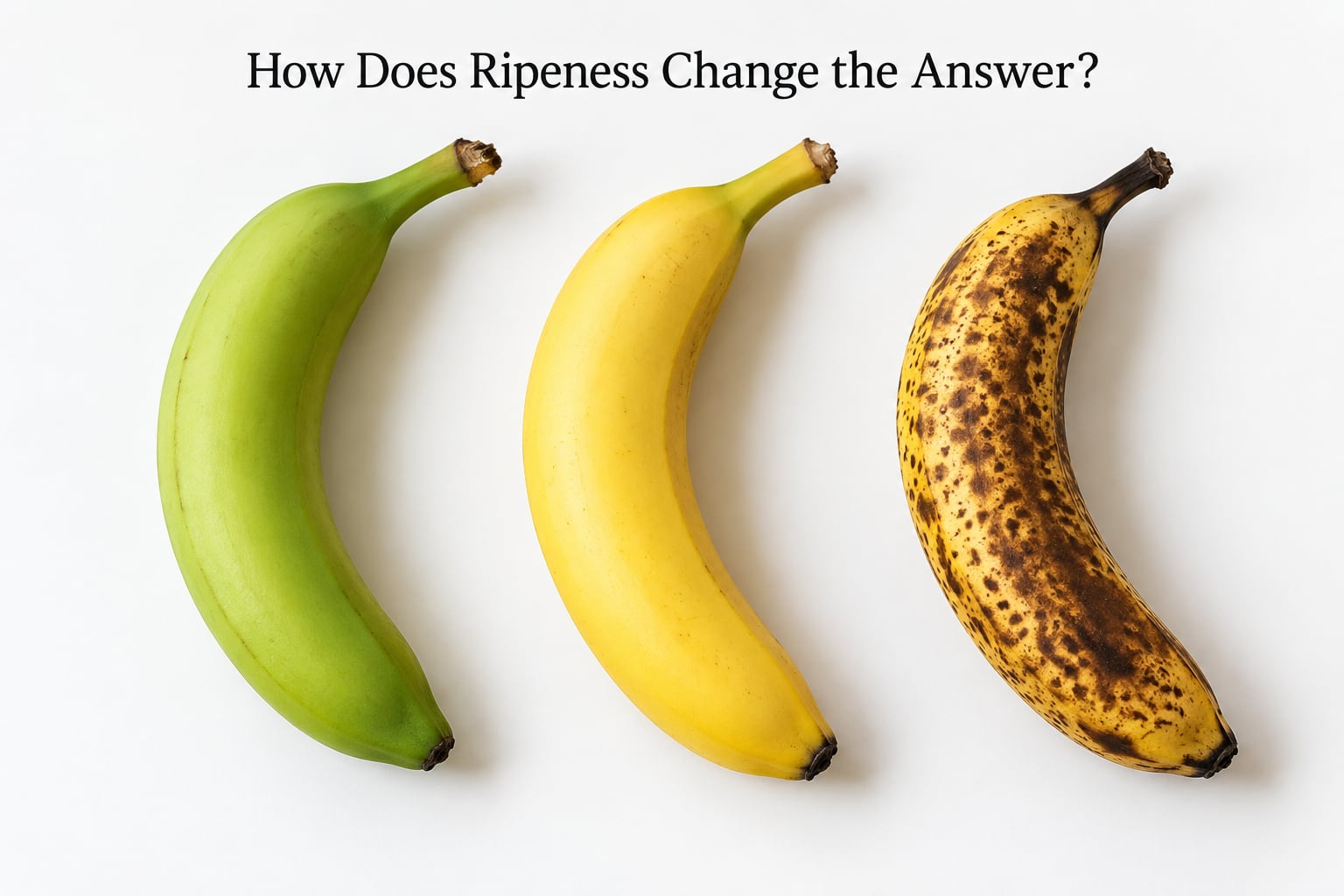
A slightly green banana is the lowest-sugar banana you will eat, and the difference is measurable. Unripe bananas hold more resistant starch, which behaves like fiber in the gut and is digested slowly. As the fruit ripens, starch converts into free sugars and the glycemic index climbs.
| Stage | Texture and taste | Approximate GI | Best use |
|---|---|---|---|
| Green | Firm, starchy, not very sweet | Low 40s | Lower sugar load, slightly more resistant starch |
| Yellow with a hint of green | Soft, mildly sweet | About 51 | The usual reference figure |
| Yellow with brown spots | Sweet, soft | About 56 to 62 | Baking, smoothies, not the lowest sugar option |
| Very brown or split | Very soft, very sweet | Highest of the four | Freeze for smoothies or baking |
Two simple cues work without a chart. Look at the peel: if it is still partly green, you have more starch than sugar. Then taste it. If it tastes flat rather than sweet, the fruit is still holding starch, and that is your lower sugar banana.
Note that ripening affects berries too, in the opposite direction and for a much smaller window. A soft, dark strawberry has lost some acid and some vitamin C, but its sugar barely moves. Bananas change more because their entire ripening job is converting starch to sugar.
Which Fruit Gives You More Fiber and Satiety?
Raspberries and blackberries give you more fiber per serving, and fiber plus water plus chew is what actually makes a snack filling. A cup of raspberries delivers about 8g of fiber, roughly a third of the daily target for an adult, in about 64 calories. A medium banana gives you about 3g, which is respectable but less dense.
Berries also spread their sugar across more volume and more structural material, so digestion is slower. That is why the glycemic index of common berries sits in the low range while a ripe banana lands in the medium range. This is the mechanism behind the “berries are better for blood sugar” advice you see repeated online, and it holds up better than the raw sugar number alone.
Where the banana wins is micronutrients. One medium banana provides about 420mg of potassium, roughly 10 percent of the daily value, plus vitamin B6 and magnesium. If potassium intake is part of what you are working on, or you are training and want quick fuel, that matters more than the sugar gap.
Portion Size and Total Sugar Matter
The biggest analytical error in this debate is comparing a whole banana to 100 grams of berries. Normalize to what people eat and the gap narrows fast. Half a banana is about 7g of sugar; a cup of blueberries is about 14g. Those two servings are effectively a tie.
Sugar load is a multiplication, not a single number. Glycemic index measures how fast glucose rises compared with pure glucose. Glycemic load takes that speed and applies it to the portion you actually ate, which is why watermelon is the classic high-index, low-load example. Using rough arithmetic, a medium banana works out to a glycemic load near 14, while a cup of strawberries lands near 5. The banana is still a moderate-load food, not a dangerous one.
For a lower sugar snack, the practical portions are one small banana, half a medium banana, or one cup of berries. Three or four large servings of berries closes the gap too, because two cups of strawberries is about 15g. Fruit has no built-in stop; portioning is the skill.
Berries vs Bananas for Weight Loss Snacking
Berries are the default choice for a lower sugar weight loss snack, and the reason is volume rather than magic. A cup of strawberries is about 49 calories and takes a while to eat. A banana is denser and easier to eat in one go without noticing, which is the main risk when a snack is framed as unlimited.
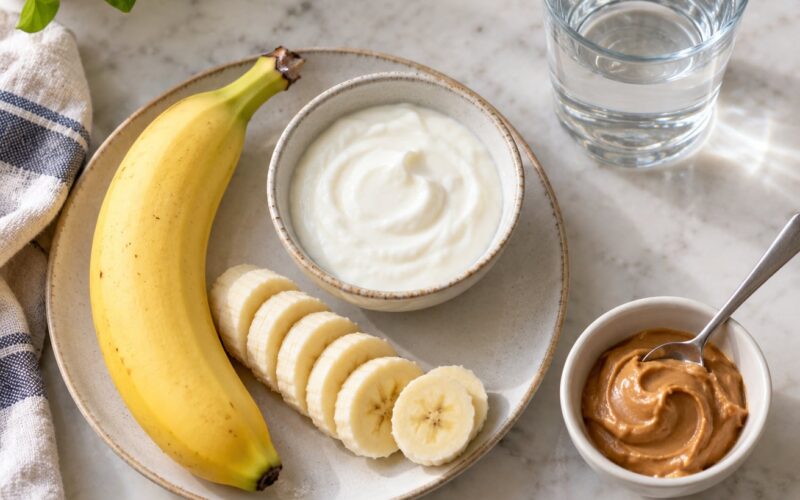
That said, a banana fits a weight loss snack comfortably if you size it. Half a banana with a tablespoon of nut butter, or a small banana with plain Greek yogurt, gives you roughly 105 to 130 calories with protein and fat included, and the fat and protein slow the glucose response. One person on r/GestationalDiabetes described exactly this pattern, pairing a banana with nut butter as a routine snack with no spikes.
Neither fruit burns fat or blocks weight gain on its own. Total intake over weeks decides that. Treat fruit as an ordinary food inside a balanced pattern rather than as something to fear or something you can eat without counting.
Which Fruit Is Easier to Use?
The banana wins on convenience in almost every situation. It travels without a container, needs no washing, ripens on the counter at its own pace, and survives a couple of days in a bag. The banana is also the cheaper option per serving once spoilage is counted, since a fresh punnet that goes off in three days is expensive in food thrown away.
Berries win on portion control and on storage if you buy them frozen. Frozen berries are picked and frozen at peak ripeness, keep their nutrients, last for months and cost a fraction of fresh. People who say frozen berries are a compromise are usually comparing them to fresh berries bought too large.
The real risk with either fruit is mindless eating, and it looks different for each. A whole banana is a bounded object that requires a decision. A bag of cherries or a bowl of blueberries is an open-ended task that is easy to keep eating past the point of wanting to. If you snack regularly, put the portion in a bowl before you sit down.
Health Considerations and Practical Tips
Can you eat berries and bananas together?
Yes, and for many people that is the better snack. Eating both in one sitting is not a mistake; it simply adds the two sugar amounts together. Half a banana plus a cup of raspberries is about 12g of sugar with a solid fiber base, which is a reasonable afternoon snack. The reason people ask is the belief that mixing fruits somehow cancels or doubles the effect, and neither is true.
How to blunt the glucose response
- Add protein: plain Greek yogurt, cottage cheese or a large handful of nuts.
- Add fat: a tablespoon of nut butter, a few walnuts, or cheese.
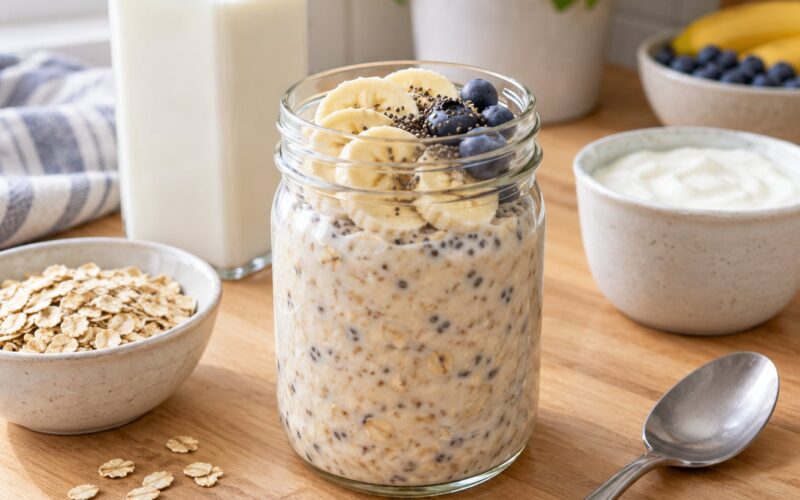
- Add more fiber: pair with oats, chia seeds or vegetables.
- Keep the fruit whole rather than blended or juiced.
- Eat it with a meal or with protein instead of alone on an empty stomach.
Four lower sugar snack builds
- Berries and yogurt: a cup of mixed berries over plain Greek yogurt with a spoonful of chopped nuts.
- Berry nut butter plate: a cup of raspberries or blueberries with two tablespoons of almond butter for dipping.
- Half banana stack: half a banana with peanut butter and a few cinnamon-flavored walnuts.
- Frozen berry “ice cream”: blended frozen berries with a splash of milk, frozen for an hour, no added sugar.
Individual response varies more than tables say
On r/Type1Diabetes, people report very different personal reactions: one person spikes on bananas and apples but not strawberries, another spikes on melons and not berries. That variance shows up constantly in forum threads and it is the honest answer to any promise that one fruit will behave the same way for everyone. If your own numbers disagree with a table, your numbers win.
Other things worth knowing
Whole fruit is the form to favor over juice, dried fruit, sweetened yogurt or fruit snacks, since none of the sugar in fresh fruit is added sugar. People with dental work or sensitivity may find sour berries uncomfortable. And the fruit-shaming should stop here: no whole fruit has to be avoided in order to manage blood sugar, and anyone who has been told otherwise has been given bad advice. Readers with diabetes, kidney conditions or a history of disordered eating should get individual guidance from a doctor or registered dietitian rather than relying on a general comparison like this one.
Frequently Asked Questions
Are berries lower in sugar than bananas?
Yes. Berries run roughly 4.4g to 10g of sugar per 100g, against about 12g to 15g per 100g for a banana, so berries carry roughly half the sugar by weight. Per serving the gap narrows: a cup of raspberries is about 5g of sugar while a medium banana is about 14g. For a lower sugar snack, berries are the default and half a banana is the banana equivalent.
Are bananas bad for weight loss?
No, but portion matters. A medium banana is about 105 calories and is easy to eat in one sitting, which is the part people underestimate. Sized and paired with protein or fat, such as half a banana with nut butter or a small banana with Greek yogurt, it fits easily into a weight loss snack. What changes results is the total pattern over weeks, not one fruit.
What is the lowest-sugar fruit snack?
Berries are the practical answer, and raspberries are the lowest of the common ones at about 4.4g of sugar per 100g and 5.4g per cup. A cup of strawberries follows at about 7.4g. Keep them whole, not juiced or blended, and add protein or fat such as yogurt or nut butter if you want the snack to hold you until the next meal.
Is a banana a good snack for losing weight?
It can be. A banana is roughly 105 calories, supplies potassium and vitamin B6, and travels without any prep, which makes it one of the easiest snacks to keep on hand. The two adjustments that matter are size and pairing: eat half to one medium banana, and combine it with protein or fat to slow the glucose response. Two bananas a day on top of your meals is where it stops being a snack.
How many calories are in a banana compared with a cup of berries?
A medium banana is about 105 calories. A cup of strawberries is about 49, a cup of blueberries about 84, raspberries about 64 and blackberries about 74. This surprises people, who assume the banana is the heavier fruit because it is larger and more calorie dense per bite. Once you add yogurt or nut butter, a berry snack catches up fast.
Should I eat berries or bananas if I am concerned about blood sugar?
Choose berries for the lower sugar load, and keep them whole. Berries sit in the low glycemic index range and their fiber and water slow absorption. A banana is still a reasonable fruit, especially less ripe, but a ripe one carries more free sugar and a higher glycemic index. Add protein or fat to either one, and ask your own doctor or dietitian about targets that apply to you.
Conclusion
Pick berries when the goal is the lowest sugar load and easy portion control. A cup of raspberries, strawberries or blackberries gives you more volume, more fiber and less sugar than a banana of comparable eating time.
Pick a banana when convenience, potassium or a more satisfying snack matters. Slightly green, half to one medium, paired with protein or fat, it is an easy everyday choice and not a problem for weight loss or blood sugar management.
Start tonight by putting one serving in a bowl and pairing your fruit with something that contains protein or fat. Then judge it by how you feel an hour later, not by the number on the label.