Most people do better with a small snack about 20 to 60 minutes before training: something with fast carbohydrates for energy, a little protein, and not much fat or fiber. Sessions under 45 minutes at easy-to-moderate intensity are the exception, where water or black coffee is often enough.
The tricky part of a morning session isn’t the food itself. It’s that you have to eat it while still half-asleep, in the dark, with no kitchen time to spare. So the options below are built around what actually works at 5am, not what’s theoretically ideal at noon.
Table of Contents
- What Should You Eat Before a Morning Workout?
- How Much Should You Eat?
- How Long Before a Morning Workout Should You Eat?
- Best Foods to Eat Before a Morning Workout
- Easy Pre-Workout Meals and Snacks
- What to Drink Before a Morning Workout
- What to Eat Before Cardio, Strength Training, or Yoga
- Can You Work Out Fasted in the Morning?
- Foods and Drinks to Avoid Before a Morning Workout
- How to Build a Pre-Workout Meal for Your Goals
- Frequently Asked Questions
- Is it OK to work out on an empty stomach?
- Are bananas good pre-workout?
- Should you eat protein before a workout?
- Can I take pre-workout on an empty stomach in the morning?
- What to eat before the gym at 5am
- What is the best pre-workout meal to eat in the early morning?
- Conclusion
What Should You Eat Before a Morning Workout?
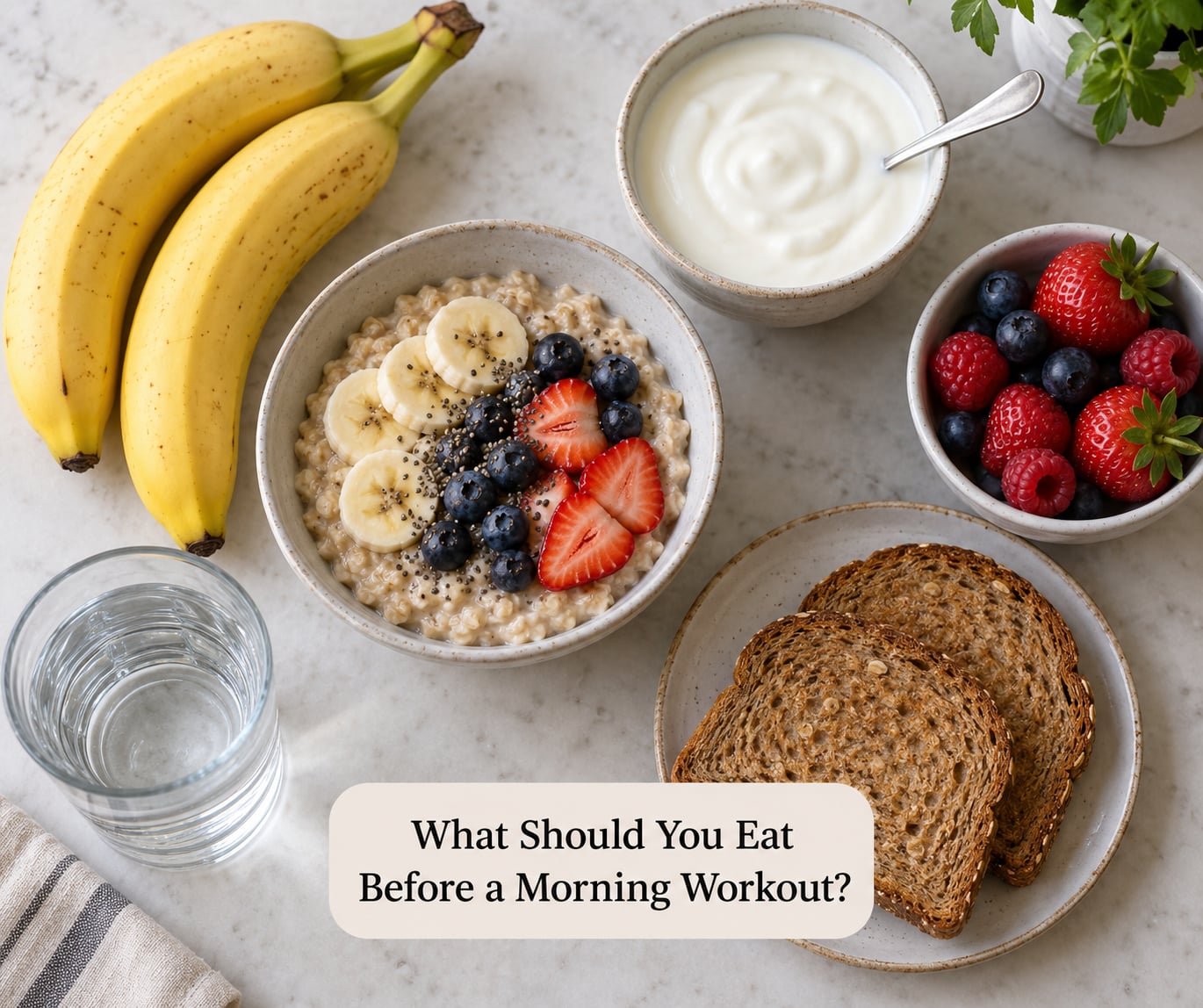
Eat a small, balanced portion that combines carbohydrates for energy with a little protein or fat for staying power. Keep it low in fat and low in fiber, because both slow down how fast food leaves your stomach and can leave you cramping mid-set.
Carbohydrates are the piece that matters most. After eight hours of sleep, your liver and muscle glycogen stores are at their lowest, which is why a fasted morning session sometimes feels flat. Carbs get digested into glucose, top those stores back up, and raise blood sugar quickly enough to matter.
Protein plays a supporting role rather than a headline one. Amino acids arriving during and shortly after training support muscle protein synthesis, and pairing carbs with protein also blunts how sharp the energy drop feels afterward.
Fat and fiber are the two things most worth trimming before an early session. Both slow gastric emptying, and at 6am, with a stomach that hasn’t woken up properly, a slow stomach is the reason people feel sick mid-workout.
How Much Should You Eat?
Match the portion to the length and intensity of the session. The usual target band is roughly 15 to 75 grams of carbohydrate before exercise, with the low end for short easy sessions and the high end for long or hard ones.
| Session | What to eat | Carbohydrate target | How long before |
|---|---|---|---|
| Yoga, walking, tai chi (under 45 min, easy) | Water and coffee, or half a banana | 0 to 15 g | 0 to 20 min |
| Spin or HIIT class (30 to 45 min, hard) | One banana, or rice cakes with honey | 25 to 40 g | 20 to 40 min |
| Steady cardio, 45 to 60 min | Toast with honey, or oatmeal made the night before | 40 to 60 g | 45 to 90 min |
| Strength training or heavy compound lifts | Toast with peanut butter, or oats with fruit and yogurt | 40 to 75 g | 60 to 120 min |
| Long run or ride over 90 min | Proper pre-workout meal, plus fuel during the session | 60 to 75 g | 2 to 3 hours |
Lifters report the most consistent range in the 100 to 200 calorie band for short sessions, and that number is worth stealing. A snack that fits in one hand and goes down in three bites usually works better than anything you’d describe as breakfast.
Large or high-fat meals sitting in your stomach are the other half of the problem. If a portion feels like a meal, give it two to three hours. If it feels like a snack, 20 to 60 minutes is plenty.
How Long Before a Morning Workout Should You Eat?
Work backward from when you plan to start training. The gap between eating and exercising is what decides whether the food fuels you or sits heavily.
Two to three hours out suits a full pre-workout meal with carbs, protein and a little fat. This is the only window with room for fiber, so it’s the right time for oatmeal with berries or a bowl of cereal with milk if your stomach handles it.
Sixty to ninety minutes out suits a moderate meal. Toast with peanut butter, or oatmeal made the night before, works well here because the carbs are releasing steadily rather than all at once.
Twenty to forty minutes out suits a light, fast-digesting snack. A banana, a few rice cakes with honey, or a handful of raisins is about the right size, and by the time you finish it the energy has started to arrive.
The practical sequence that most 5am regulars land on is simple: wake, eat, wait 20 to 30 minutes, train. That waiting period also gives fluids time to move from your gut into circulation, which is why a large glass of water the moment you arrive can feel uncomfortable.
Best Foods to Eat Before a Morning Workout
Good pre-workout foods are boring on purpose. They’re cheap, they need no cooking, they sit low in fat and fiber, and they taste acceptable when you’re barely awake. Here are the ones that come up again and again, with what each one actually does.
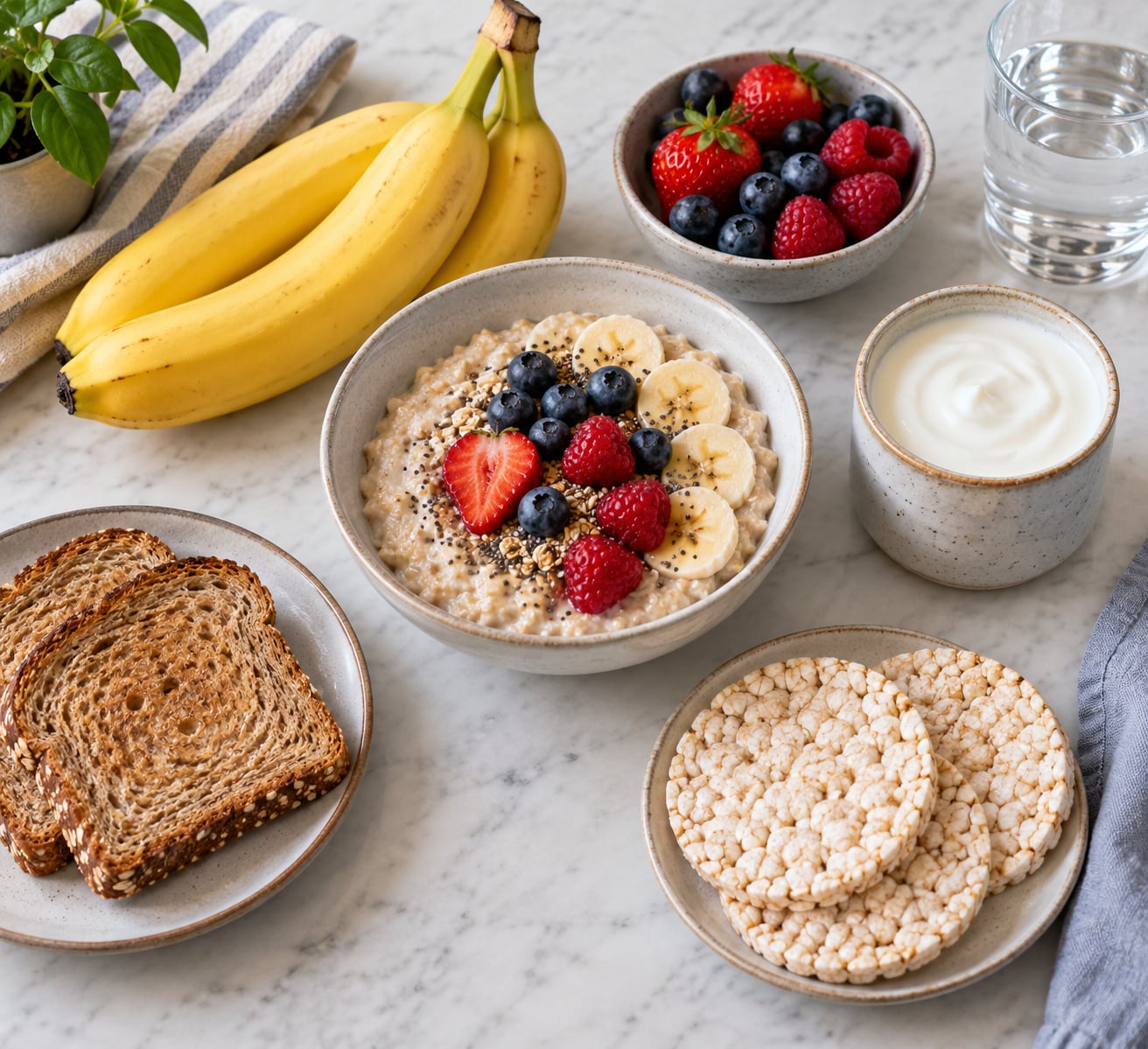
- Banana: about 27 g of carbs, almost no fat, and roughly a third of that carbohydrate is digested fast. This is the default answer for a 30-to-45-minute session, and it’s the single most common thing lifters report eating at 5am.
- Dry toast or rice cakes: low fiber, very low fat, and they travel. One slice with a thin spread of honey lands near 20 to 30 g of carbs and takes about ten seconds to assemble half-awake.
- Oatmeal made the night before: rolled oats soaked in milk or yogurt in the fridge are ready in the morning with no cooking. Roughly 30 to 40 g of carbs per cup, and the protein in the milk or yogurt is a bonus.
- Applesauce: roughly 25 g of carbs in a small pot, almost no fat, and nothing to chew. A useful swap when a solid snack feels like too much.
- Greek yogurt with fruit: around 15 to 20 g of protein plus 20 to 30 g of carbs. Better for a 60-to-90-minute gap than for 20 minutes, because the protein takes a little longer to work through.
- Peanut butter on toast: a small amount, a quarter to half a tablespoon. More than that and the fat slows digestion noticeably.
- Raisins or a few dried dates: small, concentrated, and easy to eat in the dark. A small handful is roughly 15 to 20 g of carbs.
- Blended smoothie: fruit, oats and a scoop of protein powder, drunk instead of eaten. Useful on a genuinely sensitive stomach or when there is no time to sit down.
- An orange: about 15 to 20 g of carbs with some fiber. Fine as part of a longer meal, heavier than ideal as a 20-minute-out snack.
- A small cookie or Rice Krispie treat: somewhere around 10 to 20 g of carbs. It sounds unserious because it is, and for a short class it genuinely does the job.
What you pick matters less than whether it is familiar and whether you have eaten it before a session. Novelty is a common trigger for the nausea people report, not the ingredient itself.
Easy Pre-Workout Meals and Snacks
These are the combinations that survive a real morning alarm. Each one is under two minutes of assembly.
Banana and yogurt. Half a banana with a small pot of Greek yogurt. About 35 g of carbs and 12 g of protein, no cooking, one spoon. This is the most complete option on the list for a 30-to-60-minute session.
Overnight oats with fruit. A third of a cup of rolled oats, a splash of milk, a spoonful of yogurt and chopped fruit, mixed the night before and refrigerated. Roughly 45 g of carbs, and it stays fine in a sealed container in the fridge door until you leave.
Toast with nut butter. One slice, thin spread, plus a sliced banana on top if the session runs over an hour. About 40 g of carbs with a small amount of fat to slow the release.
Rice cakes with honey. Two cakes and a teaspoon of honey. Around 25 g of carbs, close to no fat, and nothing to chew. The classic gym-floor or car-breakfast snack.
The blended smoothie. Banana, oats, milk, a scoop of protein powder, blended. Around 350 to 450 calories depending on the powder. Easiest option when your stomach rejects solids before 6am.
Overnight chia pudding. Two tablespoons of chia seeds, milk, a splash of juice, refrigerated overnight, topped with berries. Mostly fat and protein with modest carbs, so it suits a long gap rather than a 30-minute one.
For anyone who wants to keep the cost down: a banana, a handful of raisins, and dry toast are the cheapest reliable options, and they cover the same carbohydrate range as most packaged bars. A store-brand bag of dried fruit and a jar of peanut butter gets you through a training block without spending much.
What to Drink Before a Morning Workout
Hydration matters as much as the snack, and morning sessions have a specific trap: you lose fluid overnight, then drink a large glass the moment you wake. That volume sitting in your stomach while you run is a fast route to sloshing and nausea.
A workable protocol: drink roughly 16 to 20 oz of water in the two to three hours before training, adding another glass when you wake but drinking it at a normal pace rather than gulping. During sessions longer than an hour, take 3 to 8 oz every 20 minutes, and add electrolytes if you’re training hard or it’s hot out.
Coffee is fine and most people in early-morning gyms use it. Caffeine doesn’t require food to work. The trade is that caffeine plus an empty stomach raises the chance of jitteriness and stomach discomfort for some people, so if that describes you, eat the snack first.
Keep alcohol out of it entirely. And if you’re running long, water alone isn’t enough on hot days or for heavy sweaters, since sodium and potassium carry across sweat.
What to Eat Before Cardio, Strength Training, or Yoga
Carbohydrate needs scale with the demand your session places on you. The more work per minute and the longer it runs, the more carbs you want in beforehand and the further ahead you want to eat.
For short-to-moderate cardio under 45 minutes, one banana or a couple of rice cakes is enough. Your body is comfortably using stored glycogen, so you’re topping off rather than rebuilding.
For longer steady-state work over an hour, go with a proper meal two to three hours out: oatmeal, cereal with milk, or toast with peanut butter. Beyond about an hour and a half, sessions start pulling more heavily on glycogen, and going in under-fueled shortens time to exhaustion.
For HIIT and hard classes under 45 minutes, quick carbs win because the session is short and intense. Something that digests fast, like a banana, a handful of raisins, or a sports drink, keeps the energy coming without a heavy feeling.
For strength training, carbs still matter because heavy compound sets are what deplete glycogen fastest. Lifters often report that planned fasted sessions feel noticeably worse once the weight climbs, and a small carb snack beforehand is usually the fix.
For yoga, walking, or tai chi, you honestly may not need anything. Half a banana or a few sips of coffee is plenty, and a full meal at that intensity more often causes discomfort than it prevents.
Can You Work Out Fasted in the Morning?
Yes, for many people. Training on an empty stomach is a normal, accepted practice in CrossFit and Orangetheory communities, and for a session under 45 minutes at low-to-moderate intensity, most people get away with water and maybe coffee.
The common belief that eating before exercise cancels out fat loss is not supported by the evidence. What you eat across the week and your total daily intake matter far more than whether a banana happened at 6am. A pre-workout snack of 100 to 200 calories does not undo a day’s eating.
What fasting does affect is performance and comfort. Going in with empty glycogen stores tends to reduce output on high-intensity work, and it reliably feels worse toward the end of a session. If your goal is a personal best, fuel it.
There is also a short list of people who should not fast. If you have diabetes or another condition that affects blood sugar, if you’re pregnant, or if you have a history of disordered eating, talk to a doctor or registered dietitian before training without fuel.
| What you notice | Likely cause | What to change |
|---|---|---|
| Lightheaded or shaky partway through | Too little carbohydrate in, or too long a gap since the last meal | Add 30 to 40 g of carbs 30 minutes earlier, or eat part of the snack on waking and train 20 minutes later |
| Nausea or a heavy stomach | Portion too large, too much fat, or too close to training | Halve the portion and move it to 45 to 60 minutes before |
| Side stitches or cramps | High fiber, or a large volume of liquid at once | Switch to white bread or rice cakes, and sip fluids steadily instead of gulping |
| Flat energy through the whole session | Under-fueled, or carbohydrate stores low after a poor night’s eating | Move to a 60-to-90-minute meal and add a carbohydrate-rich evening meal the night before |
| Sugar crash 30 minutes in | Concentrated sugar on an empty stomach with nothing to follow | Pair it with a protein or fat source, or use a lower-sugar carb source |
The trial-and-error approach works better than any rule. Pick one change at a time, keep notes on how the session felt, and adjust from there.
Foods and Drinks to Avoid Before a Morning Workout
A few things reliably cause trouble, and the pattern is more useful than a long banned list. Anything high in fat, high in fiber, very sugary, or drunk in a large volume is more likely to sit badly.
- Heavy, fatty meals: the classic fast-food or full-breakfast breakfast. Fat slows gastric emptying the most of any macronutrient, which is a problem when your stomach is already slow at dawn.
- Large amounts of fiber: bran cereal, large bowls of oatmeal with raw vegetables, whole-grain everything, big salads. Fiber adds bulk and gas, which is uncomfortable during movement.
- Sugary drinks on an empty stomach: a large glass of juice or soda can deliver a sharp spike and an equally sharp drop. Small servings, or carbs with some protein alongside, behave better.
- Dairy for people who are sensitive to it: milk and cheese are a known cramp trigger for a lot of people before morning training. Lactose-free or plant-based versions sidestep it entirely.
- Excess caffeine: several coffees on an empty stomach often reads as jittery and nauseous. One, plus food, is the more common setup.
- Anything new: a food or a portion size you have never had before training is the most reliable way to end up with an upset stomach.
- Large volumes of water right before starting: drink steadily rather than gulping.
How to Build a Pre-Workout Meal for Your Goals
The same snack gets adjusted, not replaced, depending on what you’re training for.
For weight loss: keep the portion at the small end of the range, roughly 100 to 200 calories of mostly carbohydrate, and eat it earlier if you’re training fasted. Timing a small snack doesn’t change your total calorie balance; it just makes the session more comfortable and trainable.
For muscle gain: push the carbohydrate target toward 40 to 75 g before lifting, and include a protein source. Spreading protein across the day matters more than any single pre-workout scoop, and eating within a couple of hours after training covers the recovery window. There’s no reason a pre-workout meal has to be small when you’re adding mass.
For endurance: carbohydrate availability is the priority. Eat a real meal two to three hours before, and take fuel during sessions past about an hour.
For a sensitive stomach: go liquid or semi-liquid, cut fat to a minimum, and use white rice, white bread, or fruit instead of high-fiber whole grains. Smaller amounts eaten earlier also help.
Two workarounds come up constantly for people who genuinely aren’t hungry at 5am, and both are reasonable. The first is to shift a portion of your evening meal: eat a carbohydrate-rich dinner a few hours before bed instead of nothing, so you’re partly fueled before you ever open your eyes. The second is to skip the wait and train first, then eat a full breakfast immediately afterward, which works well if you’re training before breakfast anyway.
Whichever route you pick, give it three to four weeks before judging it. Morning appetite usually improves once the body knows the session is coming.
Frequently Asked Questions
Is it OK to work out on an empty stomach?
Yes, for most people. Sessions under about 45 minutes at low-to-moderate intensity are fine with water and coffee, and many lifters train this way by choice. Going in under-fueled tends to hurt high-intensity or long sessions more than short ones, because depleted muscle glycogen limits output and time to exhaustion. If you notice lightheadedness, shaking or flat energy, add 30 to 40 g of carbs 30 minutes earlier.
Are bananas good pre-workout?
A banana is probably the most popular pre-workout food there is, and the reason is the composition. One medium banana has roughly 27 g of carbohydrate, almost no fat, and a portion of carbs that digests quickly, which makes it useful 20 to 40 minutes before training. It travels, needs no preparation, and is easy to eat half-awake. For longer sessions over an hour, pair it with toast or oatmeal for more carbohydrate.
Should you eat protein before a workout?
Protein before training helps, but it is the supporting act rather than the headline. Carbohydrates drive energy, and amino acids arriving during and shortly after training support muscle protein synthesis. A small amount alongside your carbs, like Greek yogurt or a splash of protein powder in a smoothie, is plenty. Distributing protein across the day, roughly 1.4 to 2.0 g per kilogram of body weight for most people training regularly, matters more than one large serving beforehand.
Can I take pre-workout on an empty stomach in the morning?
Most pre-workout powders contain caffeine, which does not require food to work. That said, a small snack beforehand usually reduces jitteriness and stomach discomfort, and it gives you carbohydrates for the session itself. If you take one on an empty stomach and feel nauseated or shaky, try a banana or a few rice cakes first, and lower the caffeine dose. For supplements generally, ask a doctor or pharmacist about anything you take regularly or that interacts with medication.
What to eat before the gym at 5am
Keep it to one or two things you can eat in under two minutes: a banana, a dry slice of toast, rice cakes with honey, or oatmeal made the night before. Most lifters land around 100 to 200 calories of mostly carbohydrate. Drink water at a normal pace rather than gulping it, then wait 20 to 30 minutes before you start. If you are not hungry at that hour, move some carbohydrate into your evening meal instead and train first.
What is the best pre-workout meal to eat in the early morning?
The best early-morning pre-workout meal is a small portion of easy-to-digest carbohydrate with a little protein, eaten 20 to 90 minutes before you start. Concretely: banana with Greek yogurt, overnight oats with fruit, toast with a thin spread of peanut butter, or rice cakes with honey. The right choice depends on your session length and your stomach. Keep it familiar, keep fat low, and adjust the portion rather than changing to something new.
Conclusion
Start with one small, familiar carbohydrate snack 20 to 60 minutes before your next morning session. Pick the portion to match how long and how hard you’re training, keep fat and fiber low, and give it three or four weeks before you judge whether it works.
Then adjust from what you notice. Flat energy calls for more carbs and an earlier meal, stomach discomfort calls for a smaller and simpler one, and sessions under 45 minutes may not need anything at all. If you have diabetes, are pregnant, or have a history of disordered eating, get individual guidance from a doctor or registered dietitian before experimenting with fasted training.