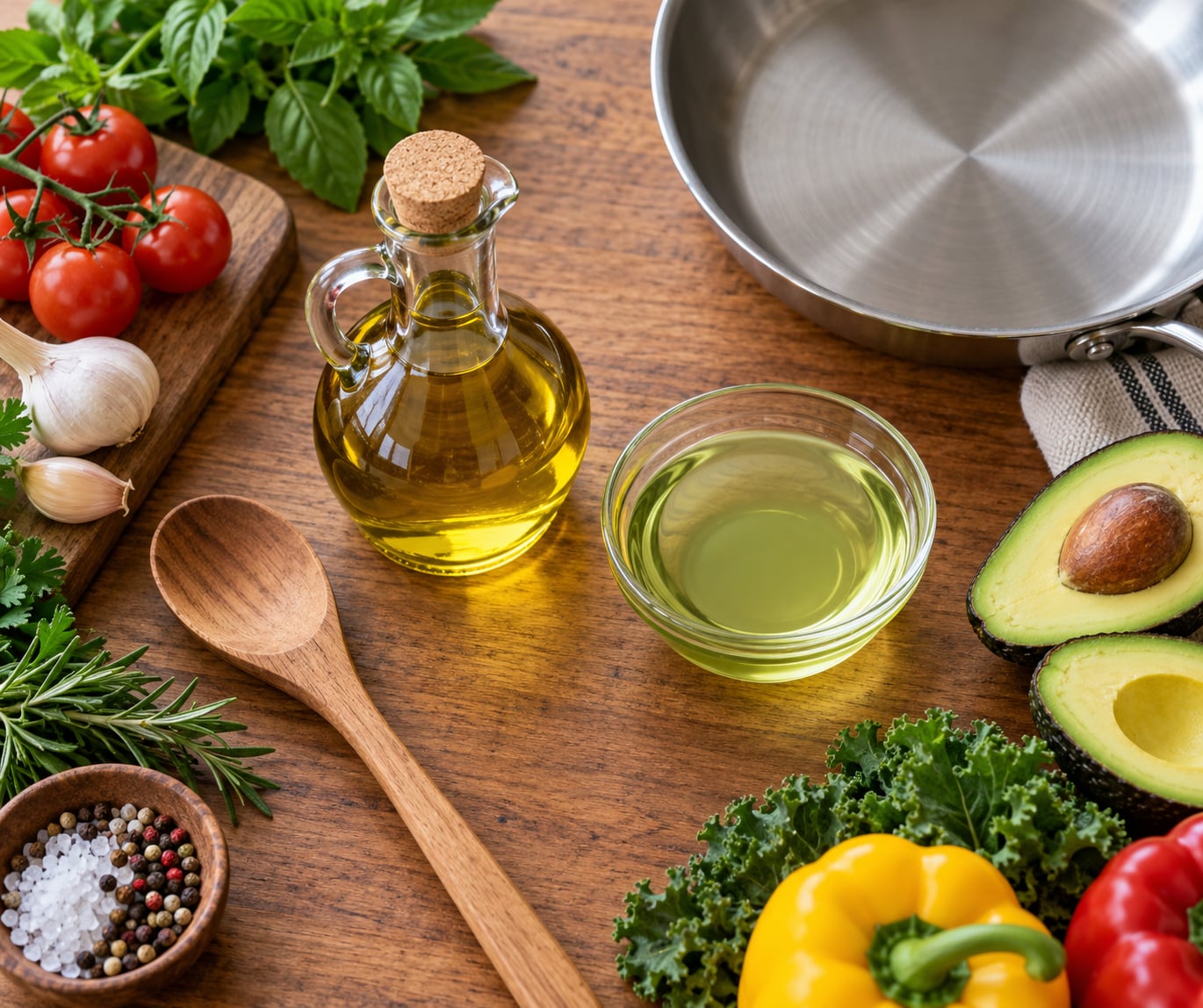
Short answer: keep an extra virgin olive oil for dressings, finishing and low-to-medium heat, and add a refined avocado oil for searing, frying and baking when you want the oil to disappear into the food. Most kitchens are better off owning both than swapping one for the other.
When people ask about olive oil vs avocado oil for everyday cooking, they are usually trying to settle one of three smaller questions: which one tastes better, which one survives a hot pan, and which one is worth the money. Answer those three and the rest is packaging.
The catch is that “avocado oil” and “olive oil” each cover several very different products. A cold-pressed bottle and a refined bottle from the same crop can behave nothing alike. I will flag the label words as I go, because that is where most of the confusion actually lives.
Table of Contents
- Olive Oil vs Avocado Oil for Everyday Cooking at a Glance
- What Is the Difference Between Olive Oil and Avocado Oil?
- Which Oil Has the Better Flavor?
- Which Oil Is Better for High-Heat Cooking?
- How Do the Fat Profiles Compare?
- Which Oil Is Better for Everyday Health Goals?
- Which One Is More Affordable?
- Which Should You Choose?
- Frequently Asked Questions
- Is avocado oil healthier than olive oil?
- Which oil is best for everyday frying?
- Is olive oil or avocado oil better for weight loss?
- Does avocado oil have a higher smoke point than olive oil?
- Can I use extra-virgin olive oil for cooking?
- How should I store olive oil and avocado oil?
- Conclusion: Choose by the Job You Need the Oil to Do
Olive Oil vs Avocado Oil for Everyday Cooking at a Glance
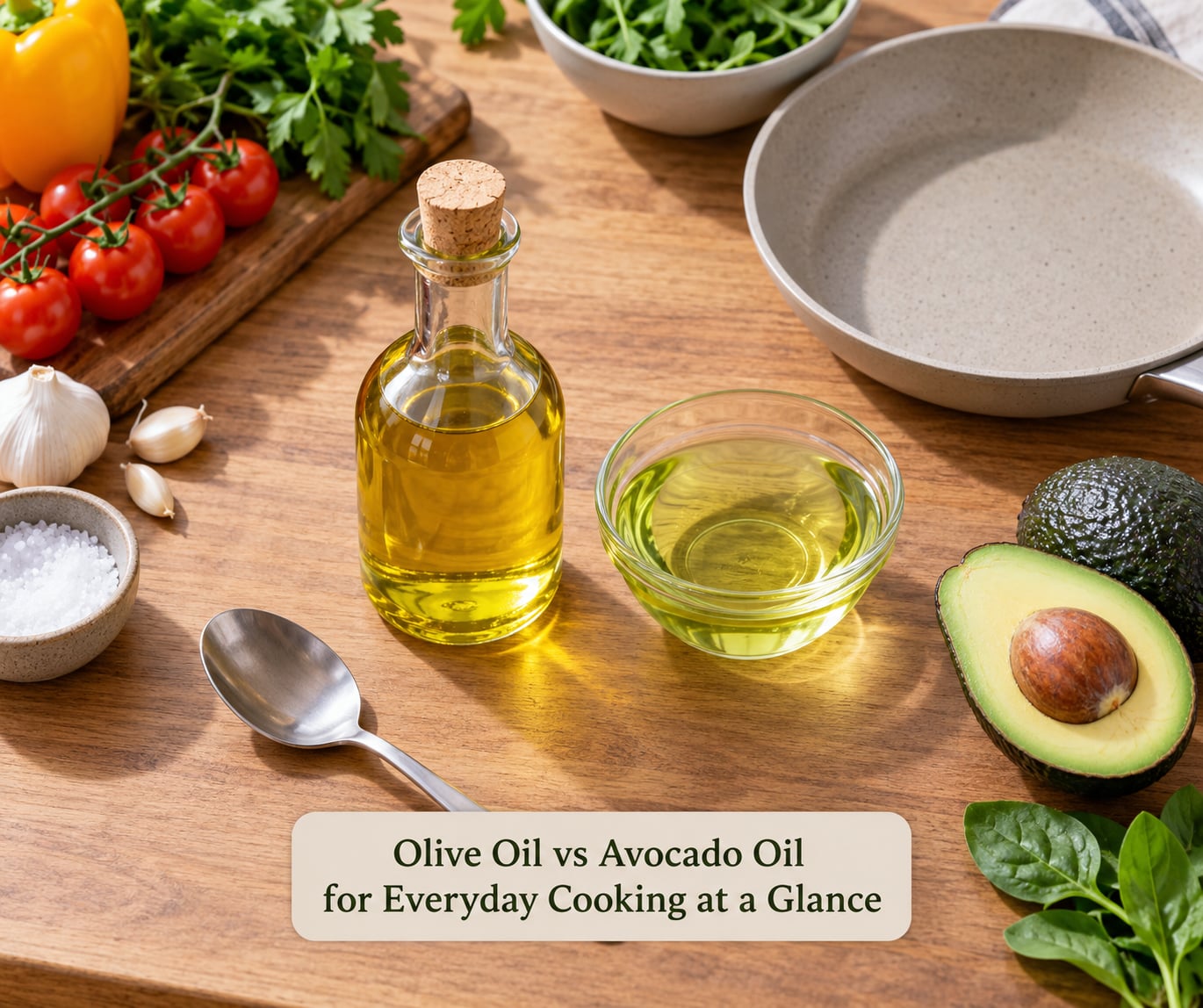
| Criterion | Olive oil (extra virgin) | Avocado oil (refined) |
|---|---|---|
| Smoke point | About 375 to 410 F (190 to 210 C) | About 480 to 520 F (250 to 270 C) |
| Unrefined version | Same as extra virgin; olive pomace oil runs hotter, around 465 F | Much lower, roughly 250 to 350 F (120 to 175 C) |
| Flavor | Grassy, peppery, fruity, sometimes bitter | Mild, buttery, close to neutral |
| Main fatty acid | Oleic acid, monounsaturated, about 70 to 75 percent | Oleic acid, monounsaturated, about 65 to 70 percent |
| Saturated fat per tbsp | Roughly 2 g | Roughly 1.5 to 2 g |
| Vitamin E per tbsp | About 10 to 15 percent daily value | About 10 to 15 percent daily value |
| Compounds beyond fat | Polyphenols, tied to olive harvest and variety | Vitamin E and carotenoids; few polyphenols |
| Refining | Usually unrefined at extra virgin grade | Usually refined, which is why it tastes neutral |
| Best for | Salads, finishing, low-to-medium heat, Mediterranean-style cooking | Searing, frying, roasting, stir-frying, baking, picky eaters |
| Relative cost | Moderate; premium bottles climb quickly | Usually higher for the same bottle volume |
One thing that jumps out: on fat, the two oils are nearly twins. The rows where they genuinely differ are flavor, heat tolerance and what the research has actually studied.
What Is the Difference Between Olive Oil and Avocado Oil?
Olive oil is pressed from the fruit of the olive tree, and like wine it carries the flavor of the variety, the soil and how long the fruit sat before pressing. The top grade, extra virgin, is made from mechanically extracted juice and nothing else: no refining, no solvents, no blending with a cheaper oil. That is why a good extra virgin bottle costs what it does, and why a fresh one can taste peppery enough to make you cough.
Avocado oil comes from the flesh of the avocado. There is only one real variety used for oil, Hass, and the industry faces a problem olives do not have: fruit arrives at the processing plant already oxidized, and an oil extracted gently from it tastes muddy. So nearly all commercial avocado oil is refined, which strips out color and flavor and leaves something that reads as neutral on a cereal bar. Cold-pressed or unrefined avocado oil exists and tastes much more like the fruit, but it is a small share of what you will find on a shelf.
Refining is the hinge. Refined olive oil, sometimes sold simply as “olive oil,” is gentler in flavor and more heat tolerant than extra virgin, and it is perfectly good for cooking. Refined avocado oil behaves the same way relative to unrefined. When a blog post says “olive oil has a low smoke point,” it is usually talking about extra virgin, and when it says “avocado oil handles high heat,” it is usually talking about refined.
Which Oil Has the Better Flavor?
There is no contest here, and the winner depends on the dish. Extra virgin olive oil tastes like something: green olive, cut grass, tomato leaf, a peppery catch at the back of the throat, and a bitterness in a very young oil that some people love and some kids push to the far side of the plate. Refined avocado oil tastes like almost nothing, with a soft buttery note that some people describe as a hint of avocado and others never notice at all.
Flavor changes what you can cook. A green, peppery oil is the whole point of a tomato and basil pasta, a grilled fish with lemon, a soup finished at the table, or a bowl of beans with good bread. Drizzle it and the dish is better for having it. The same oil over a child’s macaroni and cheese is a losing argument, and a neutral oil wins it comfortably.
A useful rule: if the dish has herbs, garlic, citrus or chili in it, the olive oil is already seasoning the food and you can afford a bold pour. If the flavor of the food itself is the point, as with a simple piece of fish, sourdough toast or steamed green beans, choose whichever oil lets you taste the ingredient. For most families, that is one bottle of each.
Which Oil Is Better for High-Heat Cooking?
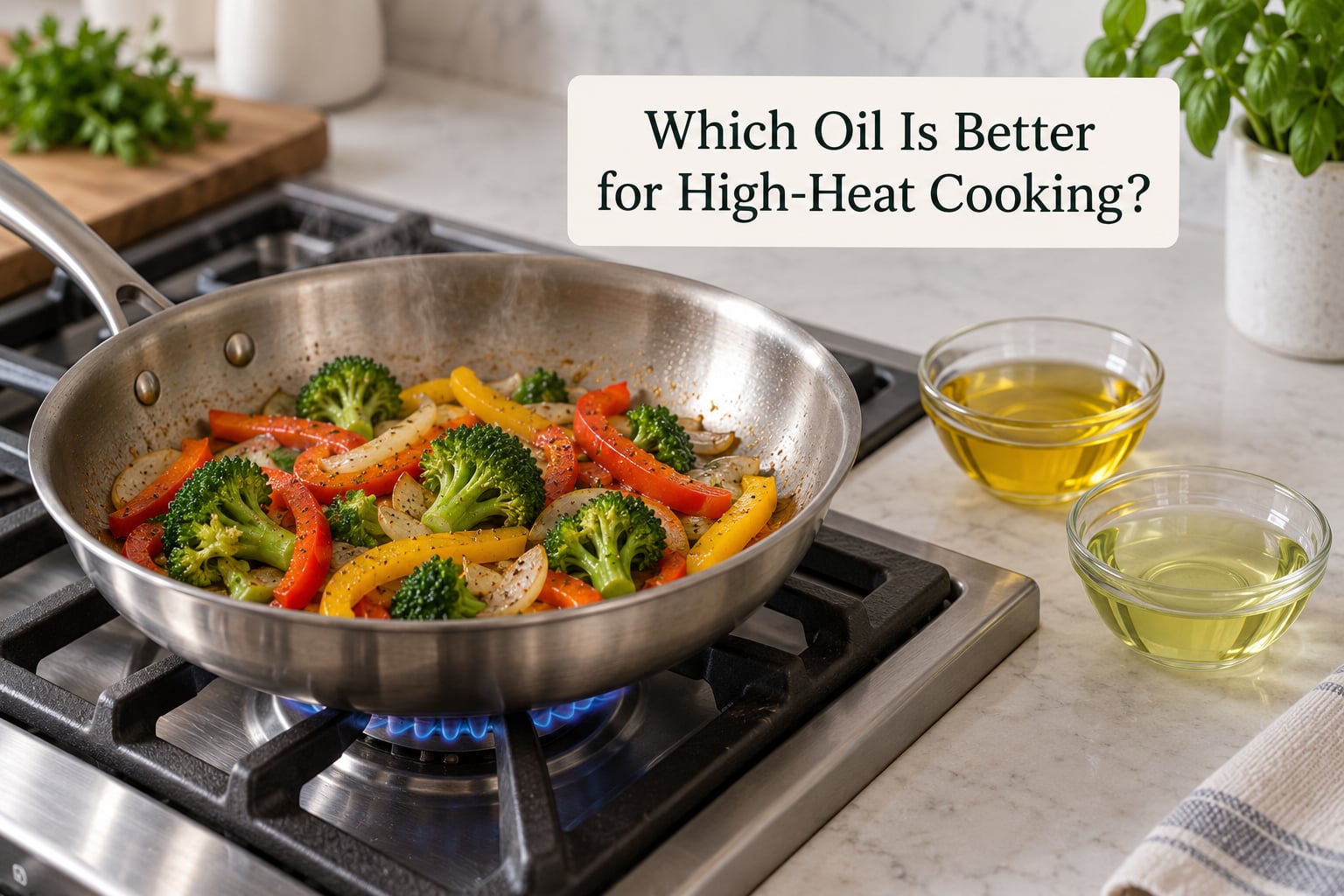
Refined avocado oil is the clear pick for a hot pan. It holds roughly 480 to 520 F (250 to 270 C) before it visibly smokes, against about 375 to 410 F (190 to 210 C) for extra virgin olive oil. Home sautéing and roasting usually sit somewhere in the 300 to 400 F range, which leaves extra virgin comfortable for most of them and refined avocado oil comfortable plus a large margin.
Here is the part most articles get wrong. A high smoke point is not a health score. Smoke point measures the temperature at which an oil starts producing visible smoke, which is really a measure of how much heat it can take before flavor compounds break down and it starts to taste stale. It says nothing by itself about what that breakdown leaves behind, and the oil that matters for health is the one you keep in the pan, not the one you discard down the drain. A 2018 study in ACTA Scientific Nutritional Health found extra virgin olive oil held up well under sustained high-heat cooking, even above its nominal smoke point, which is why the phrase “olive oil turns carcinogenic above 400 F” has never held up to scrutiny even though it keeps circulating.
That is not a reason to ignore smoke point. Repeatedly overheating any oil, including olive oil, costs you flavor and eventually leaves oxidation byproducts in the food. The honest framing is oxidative stability rather than a magic temperature. Both of these oils are more stable than a commodity soybean or canola oil, and refined avocado oil is more stable still. Choose it for a searing pan or a stir-fry at high volume; choose extra virgin when you want the oil to be part of the dish.
One trap to know about: a cold-pressed avocado oil is not the high-heat bottle. Home cooks generally place it closer to the gap between extra virgin and light olive oil, and they are right, because it is the same refining story in reverse.
How Do the Fat Profiles Compare?
Both oils are built on oleic acid, a monounsaturated fat, and both deliver about 120 calories and 14 g of total fat per tablespoon. The difference between them is a couple of percentage points, not a different kind of fat.
Take a typical tablespoon. Extra virgin olive oil lands near 9 to 10 g monounsaturated, about 1.5 g polyunsaturated and roughly 2 g saturated. Refined avocado oil runs about 10 g monounsaturated, 2 g polyunsaturated and 1.5 to 2 g saturated. Vitamin E sits in the same 10 to 15 percent of daily value range for both, and both carry a small amount of the carotenoids that make unrefined avocado oil yellow-green.
So no, avocado oil is not the low-fat option, and olive oil is not automatically the clean one. On a nutrition label they are practically interchangeable, which is a relief because the choice then comes down to taste, heat and cost, where the differences are much easier to taste than to measure.
Which Oil Is Better for Everyday Health Goals?
If your goal is to eat better without changing the way your family eats, both work, and the swap that matters is butter or shortening for any unsaturated oil. That is the finding nutrition guidance keeps landing on: what you replace is more important than what you replace it with.
Where the evidence is not even is olive oil’s research base. Large cohort work, including the Harvard TH Chan School of Public Health and PREDIMED, has linked higher extra virgin olive oil intake in a Mediterranean-style diet with lower rates of heart disease. Avocado oil has a much thinner human record, with small trials on cholesterol markers and most of the excitement coming from its fatty acid and vitamin E content, which is close enough to olive oil’s anyway.
For weight-conscious cooking, neither oil is the lever. A tablespoon is 120 calories whether it is olive or avocado, and both pour more easily than people expect. Measuring a tablespoon instead of free-pouring is worth more than any brand decision. If you have a specific condition, are pregnant, or are working with an intake target, ask your doctor or a registered dietitian rather than taking advice from a search result, including this one.
One age note is worth adding. Fat is essential for infants and young children, who need generous dietary fat in their first two years, so the usual “cut the fat” advice does not apply to them. Any oil is a poor substitute for breast milk or formula in that window; talk to your pediatrician before adding anything.
Which One Is More Affordable?
Avocado oil is normally the more expensive of the two, and the gap is usually not small. For a household cooking five nights a week, that difference adds up, so it is worth understanding what drives it.
Four things set the price. First, refining and bottling costs, plus the fact that avocados are a labor-intensive crop and roughly three quarters of the fruit is water and flesh the oil industry does not use. Second, bottle size: avocado oil is frequently sold in smaller bottles, which quietly raises the cost per tablespoon even when the sticker looks modest. Third, quality grade, where a single-origin, cold-pressed olive oil sits far above a store-brand blend. Fourth, the brand, which is the one factor that has almost nothing to do with what is in the bottle.
To compare them honestly, divide the shelf cost by the fluid ounces, then multiply by 16 for a tablespoon. A household using two tablespoons a day is where the per-ounce number starts to bite. If that math makes avocado oil a stretch, refined olive oil or a good store-brand extra virgin will do most of the same jobs for less.
Prices move around by region and season, so treat any number you see as a snapshot and check the shelf yourself.
Which Should You Choose?
Pick by the job, not by the label on the front. This is the swap table I use when deciding what to reach for mid-week.
| Cooking job | Reach for | Why |
|---|---|---|
| Sautéing onions and garlic for a sauce | Extra virgin olive oil | Medium heat only, and the flavor becomes the sauce |
| Searing a steak or a thick fish fillet | Refined avocado oil | Very high pan temperature with no flavor interference |
| Roasting vegetables at 425 F | Either, your call | Both are stable here; olive oil adds a savory note |
| Stir-frying a large batch | Refined avocado oil | Repeated high heat over a long cooking time |
| Salad dressing | Extra virgin olive oil | Uncooked, so you taste every drop of it |
| Drizzling over a finished dish | Extra virgin olive oil | Peppery freshness is the entire point |
| Baking a cake or muffins | Refined avocado oil | Neutral flavor, higher smoke point in the oven |
| Homemade mayonnaise | Either, olive for taste | Both emulsify; olive gives you the classic flavor |
| Marinating meat or vegetables | Either | Depends on whether you want the olive flavor to come through |
| Cooking for someone who dislikes olive oil | Refined avocado oil | Neutral enough to be invisible |
If you can only buy one bottle, choose based on how you actually cook. Mostly sautéing, roasting and dressing salads in a Mediterranean style? Extra virgin olive oil is the better single bottle. Mostly searing, frying and baking, or feeding people with strong preferences? Refined avocado oil is the better single bottle.
There are a couple of jobs where neither is the answer. Deep frying at home, done more than once a week, is hard on any oil, and neither of these is the right choice. Very high-volume stir-frying, where the wok is genuinely screaming, is a case where a dedicated high-oleic frying oil costs less per tablespoon and does the job better.
Frequently Asked Questions
Is avocado oil healthier than olive oil?
Not in any way the evidence supports. The two oils are nearly identical on fat: about 120 calories, 14 g total fat and 9 to 10 g monounsaturated per tablespoon. Olive oil has far more large-scale human research behind it, including Mediterranean cohort studies linking extra virgin olive oil to lower heart disease risk. Avocado oil’s human evidence is thin. Choose based on flavor and heat, and replace butter or shortening with either one.
Which oil is best for everyday frying?
Refined avocado oil. It holds roughly 480 to 520 F before smoking, against about 375 to 410 F for extra virgin olive oil, and its neutral flavor does not fight the food. For shallow frying and pan searing at home, that headroom is comfortable rather than critical. If you mostly sauté and roast below 400 F, extra virgin olive oil works well and tastes better.
Is olive oil or avocado oil better for weight loss?
Neither, on its own. A tablespoon of either is about 120 calories, and the meaningful change is swapping them in for butter, ghee, shortening or coconut oil rather than adding oil to a dish that had none. For weight goals, watch the total portion and the overall pattern, and get individual advice from a doctor or registered dietitian if you are managing a specific condition.
Does avocado oil have a higher smoke point than olive oil?
Refined avocado oil does, roughly 480 to 520 F against 375 to 410 F for extra virgin. Two caveats matter. Cold-pressed or unrefined avocado oil is much lower, closer to 250 to 350 F, and high smoke point is not a health score, it is a measure of when flavor compounds break down. Both oils are more heat stable than commodity seed oils, and studies show extra virgin olive oil holds up well above its nominal smoke point.
Can I use extra-virgin olive oil for cooking?
Yes, for most of it. Sautéing, roasting, braising and pan cooking at or below about 400 F are all well within extra virgin olive oil’s range, and research indicates it stays stable and preserves its beneficial compounds under sustained heat. You will lose some flavor quality at very high temperatures, which is the real reason chefs use refined oil for deep frying rather than a health argument. The claim that it becomes carcinogenic above 400 F is not supported.
How should I store olive oil and avocado oil?
Both want the same treatment: dark, cool, and sealed. Keep the cap on, store the bottle away from the stove and out of direct sunlight, and avoid leaving it open for weeks. Heat, light and air all accelerate oxidation, which dulls flavor first. Olive oil generally keeps about a year sealed and a few months once opened, and refined avocado oil keeps considerably longer. Buy the size you will finish in a few months.
Conclusion: Choose by the Job You Need the Oil to Do
Olive oil versus avocado oil is not a fight with one right answer, and treating it as one is how people end up with a bottle they never enjoy using. Extra virgin olive oil wins on flavor and on the depth of the research behind it. Refined avocado oil wins on heat tolerance and on being invisible in a dish.
Start with what you cooked most last week. If it was vegetables in a pan and a salad at dinner, buy the extra virgin olive oil and put it on the counter. If it was a hot skillet most nights, or you are cooking for people who find olive oil flavor too strong, buy the refined avocado oil instead. When you get tired of one, add the other, and keep the expensive bottle for the dishes where the flavor actually lands.