
A food allergy is an immune reaction to a food protein that can start within minutes and, in severe cases, be life-threatening. A food intolerance is a digestion problem, usually a missing enzyme such as lactase, that causes uncomfortable symptoms but never an anaphylactic reaction. Telling them apart matters, because getting it wrong in one direction can leave a real danger untreated.
This guide explains how to tell food intolerance from food allergy using timing, symptoms, dose and severity, plus what a clinician may recommend next. It is general information, not a diagnosis. If you have ever had trouble breathing, throat or tongue swelling, faintness, or a reaction that came on suddenly after a known trigger, treat that as an emergency rather than reading further.
Table of Contents
- How to Tell Food Intolerance From Food Allergy at a Glance
- What Is a Food Intolerance?
- What Is a Food Allergy?
- How Do the Symptoms Differ?
- Digestive symptoms
- Skin and swelling
- Breathing and circulation
- Reactions to many different foods
- How to Tell Food Intolerance From Food Allergy by Timing
- How to Tell Food Intolerance From Food Allergy by Severity
- Which Foods Commonly Cause Each Reaction?
- What Tests or Medical Advice May Help?
- For suspected intolerance
- For suspected allergy
- What to be careful of
- Which Should You Choose?
- Frequently Asked Questions
- Can a food intolerance cause a rash or breathing problem?
- How soon after eating does a food allergy usually start?
- Is lactose intolerance the same as a milk allergy?
- Can an allergy happen after eating a very small amount?
- Should I stop eating a food after one reaction?
- When do I need emergency care for a food reaction?
- A Clear First Step Is Better Than Guessing
How to Tell Food Intolerance From Food Allergy at a Glance
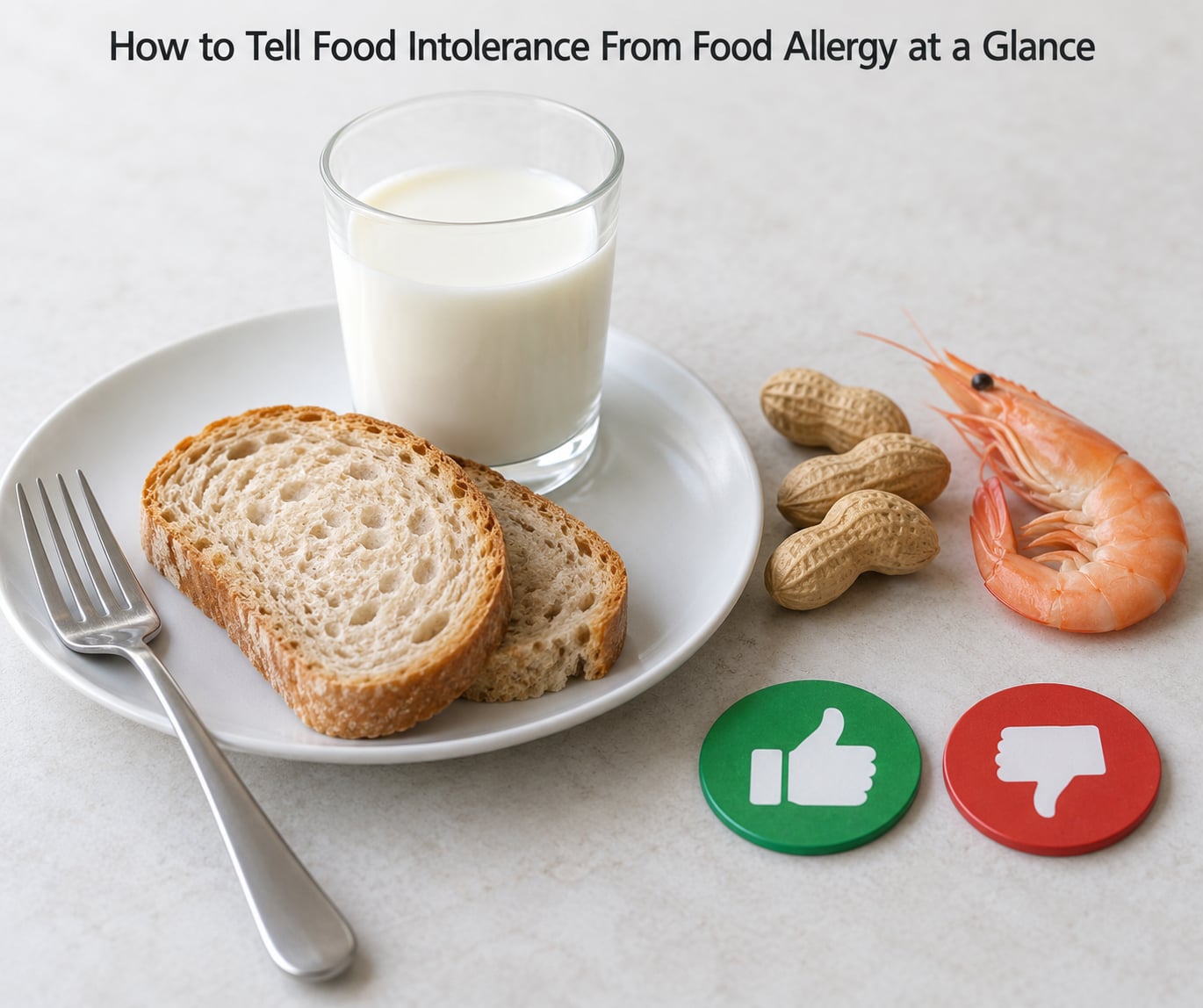
| What to compare | Food intolerance | Food allergy |
|---|---|---|
| What is happening | The digestive system struggles to process the food or part of it | The immune system treats a food protein as a threat |
| Typical onset | During digestion or a few hours later | Usually within minutes; some reactions are delayed by days |
| Main symptoms | Bloating, gas, cramps, diarrhoea, nausea | Hives, swelling, wheeze, throat tightness, faintness, vomiting |
| Body systems involved | Mostly the gut | Often more than one: skin, airway, gut, circulation |
| Dose relationship | More usually means more symptoms; a small amount may be fine | A trace can be enough; amount is often not the issue |
| Repeatability | Reproducible at similar portions, though thresholds shift | Reproducible every time once sensitised |
| Severity | Uncomfortable, disruptive, rarely dangerous | Can escalate from mild to anaphylaxis without warning |
| Emergency risk | None | Yes. Anaphylaxis is a medical emergency |
| Examples | Lactose, fermentable carbohydrates, some additives | Peanut, tree nuts, milk, egg, shellfish, sesame, wheat, soy |
| Next step | Food diary, then clinical advice or a registered dietitian | Allergy assessment; carry prescribed adrenaline if advised |
Read the table as a pattern rather than a checklist. Plenty of people sit across several rows at once, and the same person can have both an allergy and an intolerance to different foods.
What Is a Food Intolerance?
A food intolerance happens when the digestive system cannot handle a food or a component of it properly. The immune system is not involved. Something stays in the gut, ferments or draws water, and that process produces gas, bloating, cramps and changes in bowel habit.
The most familiar example is lactose intolerance. Lactose is the sugar in milk, and breaking it down needs an enzyme called lactase. When lactase production falls, lactose reaches the large gut undigested and bacteria ferment it, which draws fluid into the bowel and produces wind and discomfort. Many people notice this changes with age as lactase output shifts.
The term is also used broadly for reactions that are digestive but not enzyme-based, such as symptoms after fermentable carbohydrates. Wheat and gluten reactions are a good example of why the label gets stretched. Coeliac disease is an autoimmune condition, not an intolerance, and it is diagnosed and managed differently.
The practical point is that an intolerance is about quantity. A teaspoon in coffee may do nothing while a milkshake is a problem, and the threshold can move with stress, illness, sleep or how much you ate beforehand.
What Is a Food Allergy?
A food allergy is a reaction by the immune system to a food protein. The immune system wrongly tags that protein as dangerous and makes antibodies called IgE against it. On the next exposure, those antibodies sit on mast cells and trigger a release of histamine and other mediators, which cause swelling, hives and airway narrowing.
An IgE-mediated allergy usually begins within minutes and can affect several body systems at once. The most serious form, anaphylaxis, is a rapid reaction that includes airway or breathing problems, a drop in blood pressure, or both. It is treated with adrenaline, and adrenaline is the only first-line treatment.
Not all food allergy is immediate. Non-IgE mediated reactions, including cow’s milk protein allergy in babies and some cases of eosinophilic oesophagitis, are driven by different immune pathways and can appear hours or even days after the food. Because these can look like an intolerance, delayed reactions get mislabelled more often than immediate ones.
Two features matter most for safety. An allergic reaction can follow a trace exposure that was never intended as a real portion, and a person who has had one mild reaction can have a worse one next time.
How Do the Symptoms Differ?
Symptoms overlap far more than most pages admit, so weight the pattern rather than any single sign.
Digestive symptoms
Bloating, wind, cramping, loose stools, diarrhoea and nausea point toward intolerance. Vomiting happens in both, and a rapid onset of vomiting after a food can be a warning sign rather than a settling one.
Skin and swelling
Itchy hives, flushing, an eczema flare and swelling of the lips, tongue, throat or eyelids point toward allergy. Intolerances rarely cause hives, and swelling without any gut symptoms deserves attention whatever the cause.
Breathing and circulation
Wheezing, a tight chest, hoarse voice, difficulty breathing, dizziness, a weak pulse or feeling faint sit on the allergy side of the line. Intolerance does not produce these. If they appear after eating, that is anaphylaxis until proven otherwise.
Reactions to many different foods
Reacting to a long list of unrelated foods is far more consistent with intolerance or irritable bowel syndrome than with allergy. Allergy tends to be specific to particular proteins.
One thing no symptom can do is confirm or rule out either condition on its own. Coeliac disease, infection, medication, anxiety and menstrual cycle changes all get mistaken for food reactions, which is why testing has a role.
How to Tell Food Intolerance From Food Allergy by Timing
Timing is the most useful clue a layperson has. An IgE-mediated allergy typically starts within minutes of the food reaching your mouth, often in under ten. The faster the onset, the more reason to treat it as an allergic reaction.
Intolerance symptoms usually build during digestion or appear a few hours later, and they follow the size of the portion. A larger meal produces more symptoms, and a small amount produces few or none.
The grey area is delayed onset. Non-IgE mediated reactions can take hours to several days to appear, which overlaps with the upper end of an intolerance timeline. If a symptom arrives the next morning, timing alone will not separate the two, and a diary over several weeks becomes the practical tool.
A common rule people ask about is watching for symptoms over a few days after one exposure. That helps build the overall picture, but it does not identify a cause, and it is not a test. If timing is unclear, repeat exposures and a written record carry more weight than memory.
How to Tell Food Intolerance From Food Allergy by Severity
Typical intolerance symptoms are uncomfortable and disruptive rather than dangerous: cramps, bloating, urgency, an unpleasant reaction to a large portion. They can ruin a day and they deserve attention, but they do not threaten life.
Warning signs of anaphylaxis are different in kind, not just degree. Look for swelling of the lips, tongue or throat, difficulty breathing, wheeze, hoarse voice, a widespread rash, faintness, collapse, or symptoms occurring together across two or more body systems after a food. Rapid progression matters too: symptoms getting worse over minutes is itself a red flag.
If any of those are present, use prescribed adrenaline if you have it, call emergency services, and lie down with your legs raised unless breathing is difficult, in which case sit up. Do not stand or walk. Tell the responders what was eaten and when. People sometimes use an adrenaline auto-injector and improve; that is not a reason to skip the call.
What not to do: do not drive yourself, do not lie flat if you are struggling to breathe, and do not wait to see whether it settles on its own.
Which Foods Commonly Cause Each Reaction?
About eight foods account for the large majority of allergic reactions: peanuts, tree nuts, milk, egg, fish, shellfish, sesame and soy, with wheat and lupin also commonly reported. Neither list is exhaustive and reactions to any food are possible.
Common intolerance triggers include lactose, fermentable carbohydrates such as onion, garlic and wheat fructans, caffeine, alcohol, certain preservatives and sweeteners, and histamine-rich foods in people who struggle to clear histamine.
The difference in how triggers behave is more useful than the list itself. An intolerance usually scales with the portion, so a trace is not a problem. An allergy does not scale neatly, so a crumb baked into a loaf, a shared fryer or a labelling mistake can matter.
One warning: a food you blame is not a confirmed trigger. People cut out wheat, dairy and nuts for months on the strength of an anecdote and end up worse off. A suspected trigger is a starting point for a diary, not a diagnosis.
What Tests or Medical Advice May Help?
A clinician works through your history first: what you ate, how much, how quickly symptoms started, how long they lasted, whether they repeat, and whether anyone in your family has allergy, eczema or hay fever. A written food and symptom diary is the single most useful thing you can bring.
For suspected intolerance
Breath tests can help with lactose and with fermentable carbohydrates by measuring hydrogen and methane after a drink of the sugar in question. A dietitian can run an elimination and reintroduction diet safely, which is more reliable than guessing. Stool and blood tests for other enzyme issues are sometimes used.
For suspected allergy
Skin prick testing and blood tests for specific IgE both look for sensitisation, and neither alone confirms a clinical allergy. Component-resolved testing can help in tricky cases. Where the history and the tests disagree, the gold standard is a supervised oral food challenge, carried out in a clinic with the equipment to treat a reaction.
What to be careful of
Commercial IgG food panels, hair analysis, breath tests sold to find sensitivities in general, and online intolerance quizzes are not clinically validated for diagnosing food reactions. A positive IgG result is common in people who eat a food with no problem at all, so these panels often produce long, alarming food lists without a cause.
Unsupervised elimination diets carry their own risk: nutritional gaps, weight loss, anxiety about food, and the loss of the foods that were never a problem. Do not start one on your own, and never reintroduce a food unsupervised if you have had a serious reaction.
Which Should You Choose?
Start from your symptom pattern rather than how alarming it feels.
- Possible allergy, medical assessment first: symptoms within minutes, hives, swelling, wheeze or throat symptoms, reactions across several body systems, reactions to trace amounts, or reactions every single time you eat that food.
- Possible intolerance, digestion-focused guidance: symptoms that arrive hours later, scale with portion size, stay in the gut, and appear across a range of foods.
- Neither fits, keep investigating: many foods at once, reactions without a repeatable pattern, or symptoms alongside eczema, hay fever, asthma or existing coeliac disease or IBS.
- Severe breathing, throat or circulation symptoms, or rapidly progressing reactions: emergency services now, not a routine appointment.
Who you see depends on where you live. In the UK, a GP can refer to an allergy clinic and NICE guidance on food allergy covers how assessment should be structured. In the US, an allergist is the usual first stop. A gastroenterologist or IBS-focused dietitian becomes relevant when gut symptoms dominate.
Bring three things to any appointment: a two to four week food and symptom diary, a list of every medicine and supplement you take, and your family history of allergy, eczema and hay fever. Ask directly which diagnosis you are being ruled in or out, and what would change the answer.
Frequently Asked Questions
Can a food intolerance cause a rash or breathing problem?
Not as part of the intolerance itself. Rashes, hives, swelling, wheeze and throat symptoms come from an immune reaction, not from poor digestion, so they should be treated as possible allergy signs. Reactions involving breathing or circulation need urgent medical attention. A dietitian or doctor can help work out whether a rash appeared at the same time as gut symptoms by chance, or as part of a wider immune reaction.
How soon after eating does a food allergy usually start?
An IgE-mediated food allergy typically starts within minutes, often inside ten, and can affect skin, airway, gut and circulation in the same episode. Some reactions are non-IgE mediated and appear hours or days later, which is why timing alone cannot settle the question. If you react to the same food repeatedly with hives, swelling or breathing symptoms, book an allergy assessment rather than repeating the exposure to test it.
Is lactose intolerance the same as a milk allergy?
No. Lactose intolerance is a digestion problem: too little lactase enzyme, so lactose ferments in the gut and causes gas, bloating and diarrhoea, usually scaling with the portion. Milk protein allergy is an immune reaction that can include hives, swelling and breathing problems, and can follow a tiny amount. One is managed by adjusting intake, the other by avoiding the protein and carrying prescribed adrenaline.
Can an allergy happen after eating a very small amount?
Yes. Once someone is sensitised, a trace exposure can be enough to trigger a reaction, which is why shared equipment, fryers, bulk bins and labelling errors matter so much for people with an allergy. Intolerance usually works the other way round, where a small portion produces few or no symptoms. Trace reactions are one of the strongest practical signals that you are dealing with allergy rather than intolerance.
Should I stop eating a food after one reaction?
Stop eating it until you have spoken to a clinician, but do not build a long-term avoidance plan around a single episode on your own. Cutting foods out without a diagnosis can lead to nutritional gaps and anxiety, and it removes the evidence a clinician needs. If the reaction involved breathing, swelling or faintness, or came on within minutes, treat it as a possible allergy and get assessed promptly rather than experimenting.
When do I need emergency care for a food reaction?
Call emergency services if symptoms involve swelling of the lips, tongue or throat, difficulty breathing, wheezing, hoarse voice, widespread rash, faintness or collapse, or if symptoms are getting worse quickly and involve more than one body system. Use prescribed adrenaline if you have it, and lie down with your legs raised unless breathing is difficult, in which case sit up. Do not drive yourself, even if you start to feel better.
A Clear First Step Is Better Than Guessing
Start with a record, not a conclusion. For two to four weeks, note what you ate, roughly how much, when symptoms started, what they were and how long they lasted. Patterns that never showed up in memory usually show up on paper.
Then take the two patterns to someone qualified: your GP, an allergist or a registered dietitian. Bring the diary, your medication list and your family history, and ask which diagnosis is being ruled in or out. Suspected intolerance that affects your day deserves proper support; suspected allergy deserves assessment before it costs you anything.
And if symptoms ever involve breathing, throat or tongue swelling, faintness, or a reaction that spreads quickly across your body, get emergency help straight away. Working out how to tell food intolerance from food allergy should never be something you do alone while waiting.
Last reviewed for 2026. This article is general health information, not medical advice, and is not a substitute for a consultation with a qualified clinician. Sources referenced include NICE clinical guidance on food allergy, AAAAI patient resources, Allergy UK and CDC food allergy materials.