For weight loss, eggs usually win on protein and fullness, while oatmeal wins on fiber and how filling it is per calorie. That is the short version of the oatmeal vs eggs for breakfast question, and the honest answer depends on which number matters most to you on a given morning.
Everything below rests on standard USDA reference values and a small pile of published breakfast studies, including a 2017 crossover trial in the journal Nutrients and a 2016 study of children in Eating Behaviors. Where the research is thin or the samples are small, I say so rather than dressing it up.
Table of Contents
- Oatmeal vs Eggs for Breakfast at a Glance
- Protein and Satiety
- Oatmeal vs eggs for breakfast: which keeps you full longer?
- Calories and Weight Loss
- Fiber and Key Nutrients
- Heart Health and Cholesterol
- Blood Sugar Balance
- Convenience, Cost, and Portion Control
- Which Should You Choose?
- Frequently Asked Questions
- Can I eat oatmeal and eggs at the same breakfast?
- Is oatmeal or eggs better before a workout?
- Which breakfast is more portable for commuting?
- How can I make either breakfast more filling without adding many calories?
- Are eggs bad for you if I am trying to lose weight?
- Conclusion
Oatmeal vs Eggs for Breakfast at a Glance
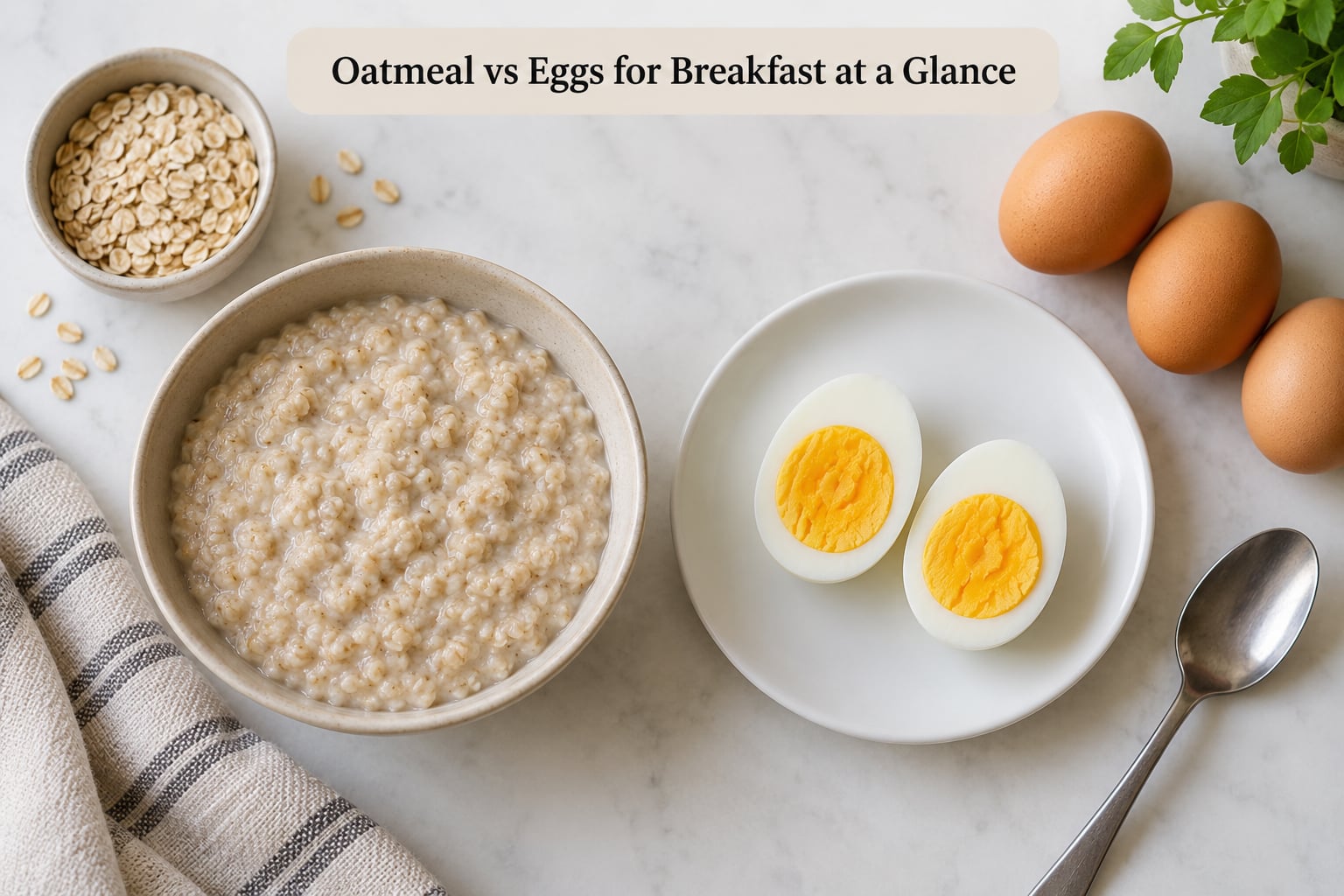
Here is the head-to-head version. Values are typical per serving: two large eggs, and one cup of cooked oatmeal made from about half a cup of dry oats with nothing added.
| Factor | Two large eggs | One cup cooked oatmeal |
|---|---|---|
| Calories | 140 to 150 | 150 to 160 |
| Protein | 12 to 13 g | 5 to 6 g |
| Carbohydrate | about 1 g | 27 to 30 g |
| Fat | 9 to 11 g | 3 g |
| Fiber | 0 g | 4 g |
| Cholesterol | about 370 mg | 0 mg |
| Blood sugar effect | Minimal | Moderate, depends on oat form |
| Best at | Satiety, protein, blood sugar control | Fiber, cholesterol, gut regularity |
| Prep time | 10 minutes, or batch it | 5 minutes, or overnight |
| Portability | Excellent, travels cold | Good in a thermos, poor once soggy |
Two things jump out immediately. The calories are nearly identical, which is why the choice really comes down to what those calories do in your body. And the protein gap is roughly double, which is the single biggest reason egg breakfasts tend to win on fullness.
Protein and Satiety
Eggs deliver roughly 6 g of complete protein each, and complete is doing real work in that sentence: egg protein contains all nine essential amino acids in proportions your body can use, with leucine high enough to matter for preserving muscle. A cup of plain oatmeal lands around 5 to 6 g, and that protein is spread thinner across fewer total grams.
Protein matters for fullness through two mechanisms. It slows gastric emptying, so food sits in your stomach longer, and it cuts production of ghrelin, the hormone that drives hunger before meals. Fat does some of the same slowing. That is the reason a two-egg breakfast leaves most people comfortable past mid-morning while plain oats often do not.
Oatmeal vs eggs for breakfast: which keeps you full longer?
In the studies that actually tested the two head to head, eggs kept people fuller. A 2017 crossover study published in Nutrients fed adults with overweight or obesity an egg breakfast or an oatmeal breakfast on alternating days and measured hunger ratings and ghrelin through the following day. The egg breakfast produced greater fullness across the day and lower plasma ghrelin. A 2016 study in Eating Behaviors ran something similar with 40 children aged 8 to 10 eating three 350-calorie breakfasts; after the egg breakfast they ate about 70 fewer calories at lunch, though they did not report feeling more satisfied at the time.
Read those results carefully rather than taking them as a knockout. Both trials were small, both used short interventions, and the egg breakfasts were built to deliver around 25 g of protein against roughly 5 g in the oatmeal. So the honest reading is that a high-protein egg breakfast beat a modest oatmeal breakfast on hunger, not that eggs defeat oatmeal in principle.
Oatmeal holds its own on fullness too, just through a different lever. Its 4 g of soluble fiber holds water in the gut and slows carbohydrate absorption, which flattens the blood sugar curve and delays the rebound hunger that follows a sharp spike. A 2016 teen study led by David Ludwig at Boston Children’s Hospital, which compared three 300-calorie breakfasts in 107 adolescents, also found that the egg breakfast cut total daily energy intake, though the effect was smaller than many headlines claimed and the sample was adolescents rather than adults.
If your experience is that oatmeal leaves you hungry within ninety minutes, the fix is usually not to abandon oats. Add protein and fat, as in the next section, and the equation changes.
Calories and Weight Loss
Plain oatmeal and two eggs sit within about fifteen calories of each other, roughly 150 per serving. That is why per-serving calories are a poor way to choose, and why anyone who tells you one food is automatically better for weight loss is oversimplifying.
Weight loss responds to total energy intake across the whole day and week, not to a single breakfast. What a breakfast actually changes is how much you eat later. If the egg breakfast removes the 10 a.m. vending machine run and the oatmeal bowl sends you to the biscuit tin at 11, the higher-calorie option wins that day.
Then the toppings take over. Oatmeal with a spoon of nut butter, a drizzle of honey and a handful of dried fruit can reach 400 calories without feeling like much. An omelette cooked in butter with cheese and bacon is a different animal from two boiled eggs. Cooking method matters as much as quantity: a tablespoon of oil adds 120 calories, and that is easy to pour twice without noticing.
Portion control is easier with eggs than most people expect. Two eggs is a fixed, weighable unit you can eyeball, whereas a cup of dry oats looks like a small scoop and rarely is. Measure oats with a cup or a scale for the first week or two, then your eye will recalibrate.
Our answer to which is better for losing weight, eggs or oatmeal: pick whichever keeps you eating steadily through the day, then keep the rest of your plate consistent. Both foods support weight loss in sensible portions, and neither one moves the scale on its own.
Fiber and Key Nutrients
Here oatmeal takes the round without a close call. A cup of cooked whole-grain oats delivers about 4 g of fiber, roughly a seventh of the daily target for women, and almost all of it is soluble. The star molecule is beta-glucan, a thick, sticky fiber that binds bile acids in the gut and nudges the liver to pull more cholesterol out of the blood to replace them.
Eggs contribute almost nothing to fiber, which is why egg-heavy diets tend to run short on fiber unless other meals make up for it. That gap shows up in regularity, and in the diversity of gut bacteria that ferment whole grains. Some people with sensitive guts find oats cause bloating or discomfort, which is a real individual response rather than a rule about oats being bad for digestion.
The micronutrient split runs the other way. Eggs are unusually rich in choline, which most people fall short of, plus lutein and zeaxanthin for eye health, vitamin B12, selenium, riboflavin and vitamin D. Oats contribute manganese, magnesium, phosphorus, iron and, in small amounts, the antioxidant compounds called avenanthramides.
The honest summary is that neither food wins on nutrients overall. Eggs lean protein and vitamins, oats lean minerals and fiber, and a day’s eating will usually cover both without effort.
Heart Health and Cholesterol
Eggs have carried a bad reputation since the 1970s, when a few studies in rabbits suggested dietary cholesterol hardened arteries fast. Human data pointed somewhere else, and current mainstream guidance treats dietary cholesterol as a factor that matters far less than saturated fat for most people.
Two large eggs provide about 370 mg of cholesterol, and they are low in saturated fat, around 3 g, provided you skip buttery extras. A meaningful minority of people are hyperresponders: for them, eating several eggs a day measurably raises LDL. If you have high LDL, a family history of early heart disease, or you are on a statin, bring a two-week egg trial and your readings to your clinician rather than relying on general advice.
Oatmeal has the better evidence base here. Regular oat intake is consistently associated with modest LDL reduction, and the beta-glucan mechanism is the reason. A couple of servings a day is more realistic than a single heroic bowl.
Both foods fit a heart-healthy pattern built around vegetables, whole grains, fish, legumes and unsaturated fats. Neither one, eaten inside that pattern, makes it worse.
Blood Sugar Balance
Eggs contain almost no carbohydrate, so they produce a small glucose and insulin response and leave blood sugar essentially flat. Oatmeal is carbohydrate by nature and will raise both, by an amount that depends heavily on which oats you buy.
Oat form changes the glycemic index, the measure of how fast a food raises blood sugar relative to pure glucose. Steel-cut and rolled oats tend to land in the mid-50s, considered low, while flaked instant oatmeal often runs closer to 80. Thickening the porridge with nut butter, adding a boiled egg alongside it, or choosing oats with intact structure all flatten the curve.
The spike-and-crash mechanism explains the mid-morning hunger many people report. A rapid glucose rise triggers a large insulin response, which drives glucose back down fast and can dip below your baseline. Ghrelin rises in response, and you feel hungry again before lunch. Adding protein and fat to the bowl slows absorption enough to soften that pattern.
On a low-carb or keto approach, eggs win by a wide margin. For blood sugar control specifically, people managing type 2 diabetes, prediabetes, insulin resistance or gestational diabetes should get individual advice from their clinician or a registered dietitian, especially if you plan to add oats to an existing plan or adjust any medication.
One extra note for celiac and gluten sensitivity: oats are naturally gluten-free but are frequently milled alongside wheat, so buy certified gluten-free oats if that matters to you.
Convenience, Cost, and Portion Control
Prep time is close. Boiling eggs takes about ten minutes and several pans can be batched on a Sunday; oatmeal takes five minutes on the stove or two in a microwave, or none at all if you soak oats overnight in the fridge. Scrambled eggs on a weekday morning are the slowest option and the messiest.
Cleanup separates the two. A bowl and a spoon are the whole of it for oatmeal. A frying pan, a spatula, a cutting board and a plate cover eggs, unless you cook them in the shell and eat them over the sink, which many weekday mornings honestly prefer.
Portability is a genuine egg advantage. A hard-boiled egg survives a bag and a commute intact. Oatmeal travels fine in a thermos within an hour or two and turns to paste if it sits overnight, which is why overnight oats in a jar work and a pre-made bowl in the fridge does not.
Cost per serving is the one area where geography decides the answer. Eggs are almost always the cheaper of the two per serving in most markets, and oats stay inexpensive at any store. If you are watching the budget closely, this is a genuine tiebreaker rather than a rounding error.
Readers on calorie-tracking forums, where per-serving macros decide everything, usually land on the same conclusion: two eggs is the easier number to log, and oats are the easier number to measure once you own a scale.
Which Should You Choose?
Choose eggs when protein is the priority. That covers muscle maintenance, muscle building, low-carb and keto eating, diabetes and insulin resistance, mornings you need to stay full until lunch, and any day your last meal was light.
Choose oatmeal when fiber is the priority. It suits cholesterol management, gut regularity, high-volume low-cost eating, and anyone who wants a carbohydrate base before a long morning of activity. A cup of cooked oats with berries, a tablespoon of chia and a scoop of Greek yogurt gets you to roughly 20 g of protein and 8 g of fiber.
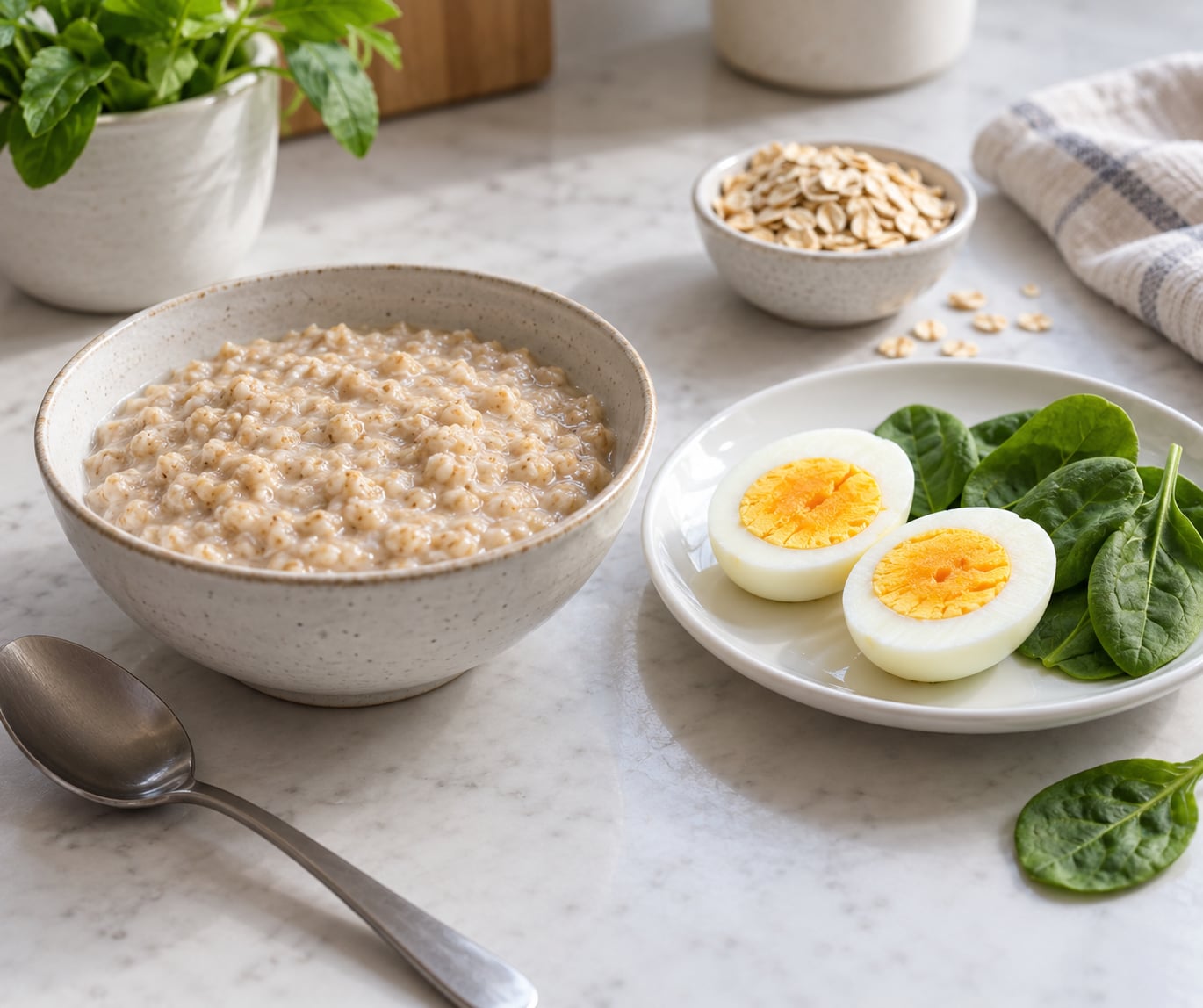
Choose both when satiety and weight control are the goals, which is what the research above most often points to. Two boiled eggs with a small bowl of oats, or savory oats topped with a poached egg and spinach, will beat either food alone at a similar calorie total.
If you want a repeatable structure, here is the short version. Two eggs plus a cup of cooked oats on days you are training hard or fasting the night before. Oats plus protein powder, nut butter and fruit on days you want volume and fiber. Eggs plus vegetables on the days a carb breakfast makes you hungry by ten.
A practical rule I keep coming back to: if your current breakfast leaves you snacking before lunch, it is not a discipline problem, it is a composition problem. Change the composition before you cut portions.
Frequently Asked Questions
Can I eat oatmeal and eggs at the same breakfast?
Yes, and it is one of the better combinations available. Eggs supply 12 g of protein and almost no carbohydrate, while oats supply soluble fiber that slows absorption. Together they blunt the blood sugar rise and reduce hunger more than either food on its own. Cook the oats, top them with a poached or fried egg, or just eat both side by side.
Is oatmeal or eggs better before a workout?
It depends on the training. For a morning session on an empty stomach, eggs sit lighter and cause almost no blood sugar rise. For a long endurance ride or run, oatmeal gives you 25 to 30 g of carbohydrate to work from, ideally an hour or two before. For strength work in the morning, one of each is the practical answer.
Which breakfast is more portable for commuting?
Eggs win clearly. A hard-boiled egg needs no container, survives hours at room temperature in a bag and eats in under a minute. Oatmeal only travels well in a thermos and within a couple of hours, because it thickens into paste as it cools. Overnight oats in a jar hold up much better, provided they stay chilled until you eat them.
How can I make either breakfast more filling without adding many calories?
Add protein and fiber rather than more carbohydrate or fat. A tablespoon of chia or ground flax adds 2 g of fiber for about 60 calories. Half a cup of Greek yogurt, a scoop of protein powder, or two more eggs pushes protein past 25 g. On the egg side, bulk the volume with spinach, tomato, peppers and mushrooms, which are nearly calorie-free.
Are eggs bad for you if I am trying to lose weight?
No. Two large eggs are about 140 calories with 12 g of protein, so they are one of the higher-protein foods per calorie available. They are also low in saturated fat at roughly 3 g when cooked without butter. The only caveats are if you are one of the people whose LDL rises noticeably with eggs, or if you fry them in a lot of oil, which adds 120 calories per tablespoon.
Conclusion
The direct answer to oatmeal vs eggs for breakfast depends on the goal you are chasing. Pick eggs when you want protein, a flat blood sugar curve and fewer calories per bite of protein. Pick oatmeal when you want fiber, cholesterol support and a cheap, filling carbohydrate base.
Start with one change tomorrow morning. If you currently eat plain oatmeal and feel hungry by ten, add two eggs or a scoop of protein powder rather than shrinking the bowl, and see what happens at your 10 a.m. snack.
Anyone managing diabetes, high LDL cholesterol, celiac disease, an egg allergy or a digestive condition should take individual advice from a doctor or registered dietitian rather than a general food comparison, because those situations change the arithmetic completely.