
If you have to pick one number, most adults do well with 3 to 5 cardio days a week. So how many days a week should you do cardio? Three days of moderate aerobic work clears the widely used guideline of 150 minutes a week, and five lighter sessions spread that same total out so your body has time to recover between them. Most people land somewhere in that range and adjust from there.
Table of Contents
- How Many Days a Week Should You Do Cardio?
- How Much Cardio Should You Do Each Week?
- How Many Days a Week Should You Do Cardio for Weight Loss?
- What are the 12-3-30 and 3-3-3 rules?
- What Counts as Cardio?
- Moderate or Vigorous Cardio: Which Should You Choose?
- How Do You Build a Cardio Routine That Sticks?
- Should You Do Cardio Every Day?
- What are the signs you are doing too much cardio?
- How Do You Know When to Increase Your Cardio?
- Frequently Asked Questions
- Is three days of cardio a week enough?
- Should I do cardio every day to lose weight?
- How long should a cardio session be?
- Do I need rest days between cardio workouts?
- Can I combine cardio with strength training?
- Conclusion: Start With a Schedule You Can Repeat
How Many Days a Week Should You Do Cardio?
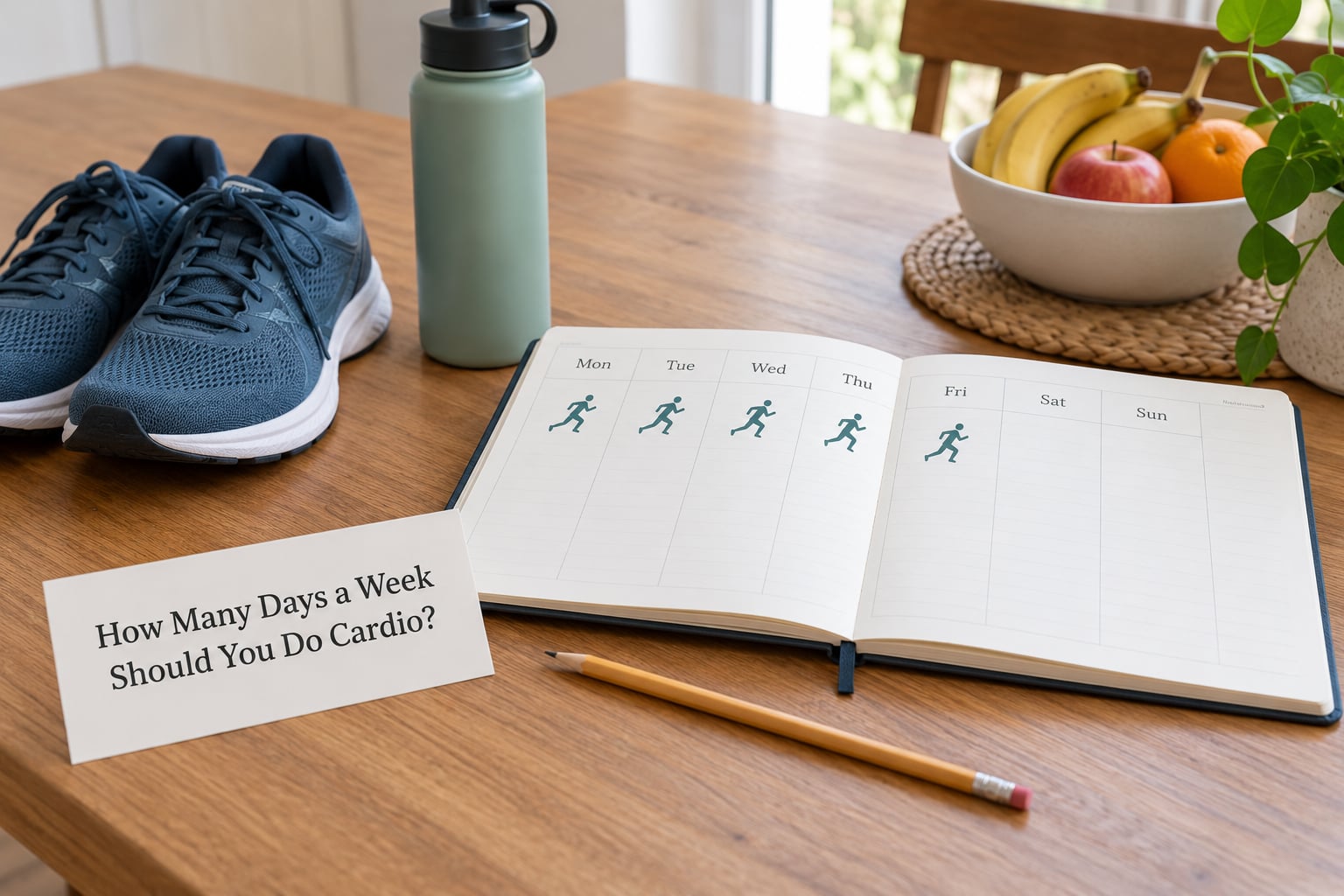
The short answer is 3 to 5 days for most adults. The number shifts with your goal, your current fitness level and how hard each session is, which is why a rigid “five days” rule frustrates so many beginners. Two 30-minute walks on a work break and lunch are cardio days. So is a 25-minute swim and a 20-minute bike ride.
Think of it as three tiers:
- 2 days is a sensible starting point for someone who is completely sedentary, or a maintenance floor once you are already fit.
- 3 to 5 days covers the standard health targets for most adults.
- 6 to 7 days only makes sense when the extra sessions are genuinely light, like a daily walk, or when you are training for an endurance event.
Here is how the day count usually breaks down by goal and level.
| Goal or level | Cardio days per week | Typical session | Intensity mix |
|---|---|---|---|
| Beginner starting out | 2 to 3 | 15 to 30 minutes | Mostly moderate |
| General health | 3 to 5 | 30 minutes | Mostly moderate |
| Fat loss | 4 to 6 | 25 to 45 minutes | Mixed, mostly moderate |
| Endurance | 4 to 6 | 40 to 90 minutes | Mostly moderate with long efforts |
| Muscle gain while cutting | 2 to 3 | 20 to 30 minutes | Light to moderate |
| Returning after a long break | 2, then 3 | 15 to 25 minutes | Easy, conversational pace |
One detail worth flagging: strength work counts separately. Most guidelines also ask adults to train muscles on 2 days a week, and those days do not have to be the same as your cardio days.
How Much Cardio Should You Do Each Week?
Days are only half the equation. The real number people need is total minutes, and that depends on intensity.
The HHS Physical Activity Guidelines for Americans, which the CDC and American Heart Association build on, recommend 150 to 300 minutes of moderate-intensity aerobic activity per week, or 75 to 150 minutes of vigorous-intensity activity, plus 2 days of muscle strengthening. A mixed week counts too: 2 days of moderate and 1 day of vigorous clears the minimum guideline.
So if you are answering the question by how many days a week should you do cardio, run the minutes backwards. Three sessions of 30 to 40 minutes at a moderate pace gets you to the 150-minute floor. Three harder sessions of about 25 minutes gets you to 75 vigorous minutes, which is the same target expressed differently.
- Frequency means how many days you train.
- Session length means how long each one runs.
- Intensity means how hard the work feels.
- Weekly total is the only number the guidelines actually track.
This is why someone doing three 60-minute walks clears 150 minutes easily, while someone doing 7 short sessions at a real effort clears it too, just differently. Check your total, not your calendar.
How Many Days a Week Should You Do Cardio for Weight Loss?
Four to 6 days is common for fat loss, but more days does not mean faster results if your food intake does not change. Weight loss still comes down to a calorie deficit, and cardio helps you spend more and fits a life that otherwise has you sitting.
Cardio also has effects that do not show up on the scale: post-meal blood sugar handling, sleep quality, mood, and how much you can eat without feeling sluggish. In weight loss forums, the most common mistake is not too little cardio but too much cardio paired with too little food, which reads as stubbornness rather than progress.
Keep sessions moderate and leave room for strength training. Muscle is what keeps your body burning calories after you sit down, and two lifting days cost you almost nothing on the cardio calendar.
What are the 12-3-30 and 3-3-3 rules?
Two popular rules come up constantly in searches about cardio frequency, and they are worth decoding because neither is an official guideline.
12-3-30 is 12 minutes of walking, 3 times a week, at about 30 percent faster than your usual pace. It is a friendly entry point for sedentary adults, and it lands near 36 brisk minutes a week, which is a good start but well under the 150-minute target on its own. Most people who adopt it keep going and add sessions later.
3-3-3 has no consistent definition. Some use it for interval structure, some for a weekly split of three hard days, three moderate days and three rest days in a nine-day block. Treat it as a template rather than a rule of physiology.
Useful as prompts, misleading as prescriptions. The minute targets have decades behind them; these do not.
What Counts as Cardio?
Cardio means any activity that raises your heart rate and keeps it up, working your heart and lungs for a sustained period. The list is wider than most people assume.
Moderate intensity includes brisk walking, cycling at an easy pace, swimming, dancing, gardening with effort, doubles tennis, rowing at a steady stroke, and slow hiking on hilly ground. On the effort scale this sits around 5 to 6 out of 10.
Vigorous intensity means jogging, running, fast cycling, swimming laps with real effort, competitive sports, kickboxing, fast hiking with a pack, and HIIT classes. That is 7 to 8 out of 10, and you would struggle to say much more than a few words at a time.
Everyday movement counts too, just at a lower dose. Dog walks, shopping, housework, gardening and walking around the office add up over a week and they are not the same as a structured session, but they are real movement. Movement break guidance from health bodies is simply that: sit less, move more, in blocks that fit your day.
Moderate or Vigorous Cardio: Which Should You Choose?
For most adults, the answer is mostly moderate, with one or two hard sessions a week. Vigorous work builds aerobic capacity faster, but it costs more recovery and it is where injuries and burnout tend to appear.
| Moderate cardio | Vigorous cardio |
|---|---|
| Breathing noticeably faster | Breathing hard, speaking in short phrases |
| Can talk and sing | Can say a few words, then need a pause |
| Effort rating 5 to 6 out of 10 | Effort rating 7 to 8 out of 10 |
| 150 to 300 minutes for the target | 75 to 150 minutes for the target |
| Easy to repeat most days | One to three days, with recovery after |
| Examples: brisk walking, easy cycling, swimming, dancing | Examples: running, fast cycling, HIIT, singles tennis |
The talk test is the most reliable beginner tool here. If you can speak in full sentences, you are moderate. If you can only manage a few words, you are vigorous. No watch required.
Heart rate zones work the same way, if you own a monitor. Zone 2, the easy aerobic band, is where most of your weekly minutes should sit if you are training for endurance. HIIT sits at the top, and the useful pattern most coaches recommend is one hard day for every two or three easy ones.
How Do You Build a Cardio Routine That Sticks?
The plans that survive contact with a real calendar are boring and specific. Pick the same activity, the same time slot, and a session length you could do on a bad day.
A workable progression runs like this:
- Start at 2 days a week of 20 minutes at an easy-to-moderate pace. Give it two weeks before changing anything.
- Add 5 minutes per session, not an extra day, for the next two weeks.
- Once sessions reach 30 minutes, add a third day rather than making sessions longer.
- Build toward 4 to 5 days only when the current schedule feels routine and your legs are not wrecked.
- Increase duration before intensity. Going harder first is how beginners end up injured or bored.
- Schedule two lifting days alongside, keeping hard lifting and hard cardio on separate days where you can.
Three sample weeks you can copy:
General health, 4 days
Monday 30 minutes brisk walk, Tuesday 30 minutes cycle, Thursday 25 minutes swim, Saturday 45 minutes hike or walk.
Fat loss, 5 days
Monday 30 minutes moderate, Tuesday 20 minutes HIIT, Wednesday 40 minutes walk, Friday 30 minutes cycle, Saturday 45 minutes mixed session.
Muscle gain, 3 days
Monday 25 minutes easy cycle after lifting, Wednesday 25 minutes incline walk, Saturday 20 minutes steady rowing. Keep all three easy enough to recover from lifting.
Schedule it like an appointment, not like an aspiration. People who put cardio at a fixed time, such as first thing in the morning, do far better than people who plan to fit it in “later”.
Should You Do Cardio Every Day?
Daily movement is fine. Daily hard cardio is a different question, and the answer depends on how hard you mean.
A daily 30-minute walk, ideally outdoors, is not the same as six consecutive days of running or HIIT. Walking at that volume leaves room for recovery. Training hard seven days a week generally does not, and it works against you: fatigue builds, sleep quality drops, resting heart rate climbs, and performance stalls. On a lifting-focused routine, frequent hard cardio also crowds out recovery from weight training.
The consensus in lifting communities, where people train four or five days a week, is that 2 to 3 cardio sessions is plenty alongside strength work. Pick sessions that are easy or moderate and place them away from your hardest lifting days. Endurance-focused runners obviously run more, but that is a sport-specific load with a built-in progression.
What are the signs you are doing too much cardio?
Watch for a cluster of these rather than a single bad week:
- Persistent tiredness that sleep does not fix
- Resting heart rate noticeably higher than your normal
- Sleep that has become lighter or more interrupted
- Performance plateauing or dropping across several sessions
- Irritability or low mood that came with the training load
- Joint aches that linger for days
- Getting sick more often, or feeling run down
One or two of these after a hard week is normal. All of them, persisting, means cut back a day or reduce intensity before something breaks. Chest pain, unusual shortness of breath, dizziness during exercise or a racing heart that does not settle are signs to stop and get medical advice rather than to push through.
How Do You Know When to Increase Your Cardio?
Your routine has probably become too easy when the last 10 minutes of a session feel no harder than the first 10, when your pace has crept up without you trying, when the session no longer leaves you slightly tired, or when you have held the same duration for three or four weeks with no effort to speak of.
When that happens, pick one lever and change one thing:
- Add 5 minutes to a session, or
- Add one day to the week, or
- Raise the pace slightly, keeping the talk test in mind
Doing all three at once is the most common way people end up sore, injured or off the plan entirely. The same week is also a good moment to check your total minutes, because you may already be at 150 and the best move is a new activity rather than more volume.
Before starting a new program, talk to a doctor or a qualified trainer if you have a heart condition, high blood pressure, diabetes, a recent injury, or have been inactive for a long time. General guidelines are not personalized advice, and a clinician can tell you what is safe for your specific situation.
Frequently Asked Questions
Is three days of cardio a week enough?
Yes, for most adults three days is enough to meet the standard guideline of 150 minutes of moderate-intensity aerobic activity, as long as each session runs roughly 45 to 50 minutes. Three shorter sessions at a harder pace also count if they add up to 75 vigorous minutes. What matters is your weekly total and whether the effort feels meaningful, not the number on the calendar.
Should I do cardio every day to lose weight?
You do not need daily cardio to lose weight. A calorie deficit does the work, and 4 to 6 cardio days a week is plenty for most people trying to lose fat. Daily cardio only helps if it is light enough to recover from, such as walking, and if your eating still supports the deficit. More cardio rarely means faster results when it also means more hunger and worse recovery.
How long should a cardio session be?
For moderate cardio, aim for 30 to 60 minutes. Beginners often do better with 15 to 30 minutes and can build up from there. Vigorous sessions can be shorter, around 20 to 30 minutes, because the intensity does more work. There is no minimum length. Ten minutes counts, and three ten-minute walks across a day still add to your weekly total.
Do I need rest days between cardio workouts?
Light to moderate sessions on consecutive days are usually fine for healthy adults, especially walking or easy cycling. After hard, vigorous sessions, take at least one day off so your heart rate, muscles and joints recover. A simple pattern is two easy days followed by one hard day, repeated. If you feel progressively more tired, sore or slow, add a rest day.
Can I combine cardio with strength training?
Yes, and most guidelines recommend it. Adults are advised to get cardio plus muscle-strengthening on 2 days a week. Many people keep lifting 3 to 5 days and add 2 to 3 short cardio sessions, ideally on days separate from the hardest lifting. Doing both on the same day works too, though cardio first tends to leave more energy for the weights.
Conclusion: Start With a Schedule You Can Repeat
Pick three days, 30 minutes each, at an effort where you can still talk. That clears the standard target and it is easy to repeat on a week you are tired. Once it feels normal, add a fourth day, then a fifth, keeping two lifting days and at least one recovery day in the mix. Increase duration before intensity, check your weekly minutes instead of guessing, and let your goals and how you feel decide when to add more.