If you are just starting out, a beginner workout should last 30 to 45 minutes including your warm-up and cool-down, done 3 to 4 times a week. Fifteen to twenty-five minutes is genuinely enough for a home or bodyweight session, and 45 to 60 minutes fits a full gym workout. The honest answer is that the shortest session you can repeat beats the longest one you skip.
The number matters less than you think. Beginners mostly get results from showing up consistently and adding a little difficulty week to week, not from how many minutes are on the clock. Here is how to pick a length that matches your goal, your schedule and your recovery.
Table of Contents
- How Long Should a Beginner Workout Last?
- How the minutes break down
- Work out your length with time-math, not guesswork
- Why longer is not better
- Beginner Workout Length by Training Type
- How Long Should a Beginner Workout Last for Weight Loss?
- What Affects the Right Workout Length?
- Should Beginners Work Out Every Day?
- How to Increase Workout Duration Safely
- How to Tell When a Workout Is Too Long
- Frequently Asked Questions
- Is a 20-minute workout enough for beginners?
- Should I do a 30-minute workout every day?
- Is a 45-minute beginner workout too long?
- How do I know when to increase my workout duration?
- What is the best workout length for losing weight?
- Should beginners include a warm-up and cool-down?
- What to Do in Your First Two Weeks
How Long Should a Beginner Workout Last?
A beginner workout should last between 30 and 60 minutes, performed 3 to 4 times per week. That range includes a warm-up, your main work and a cool-down, so your actual lifting or cardio time is roughly half of it.
Most people land closer to 30 to 45 minutes for the first few weeks. Sixty minutes is fine when you are learning new movements, training heavier or working through a longer program. Anything past 90 minutes is usually wasted time for someone in their first few months.
How the minutes break down
| Phase | Minutes | What it is for |
|---|---|---|
| Warm-up | 5 to 10 | Easy movement to raise body temperature and rehearse the patterns you are about to load |
| Main work | 15 to 35 | Your working sets, intervals or continuous cardio |
| Cool-down | 5 | Slow movement or light stretching to come down gradually |
| Total | 30 to 50 | A session you can repeat without dreading it |
Work out your length with time-math, not guesswork
Session length is an output, not something you pick first. It is decided by how many exercises you do, how many sets each one gets, and how long you rest between sets. Do the arithmetic once and the number stops being a mystery.
Here is a typical beginner full-body workout: 6 exercises, 3 sets each, about 40 seconds of work per set and 75 seconds of rest. That is 18 working sets at roughly 2 minutes each, which is about 36 minutes of work and rest combined. Add a 7-minute warm-up and a 5-minute cool-down and you land at 48 minutes. Drop to 5 exercises and you are at 40.
That is why rest between sets drives length more than anything else. Shortening your rest from 75 seconds to 45 seconds can cut 9 minutes off the same workout with barely any change in how hard it feels. Long rests belong on heavy squat and deadlift days, where you need the recovery to keep your bar speed honest.
Why longer is not better
Past about 60 minutes of hard lifting, most people start trading quality for quantity. Reps get shallower, bracing gets lazy, and the last two exercises turn into something you dread rather than something that works.
There is a second effect that matters just as much: attention. The last third of a long session is where phone scrolling and clock-checking creep in. On a 45-minute workout you are still present. On a 90-minute workout you spend a surprising share of it sitting between exercises.
One more practical point. Long sessions are a luxury of gyms with childcare, good equipment and a nearby shower. If your session is hard to fit into the day, you will quietly start skipping it, and no amount of extra time in a session you rarely do is worth that trade.
Beginner Workout Length by Training Type
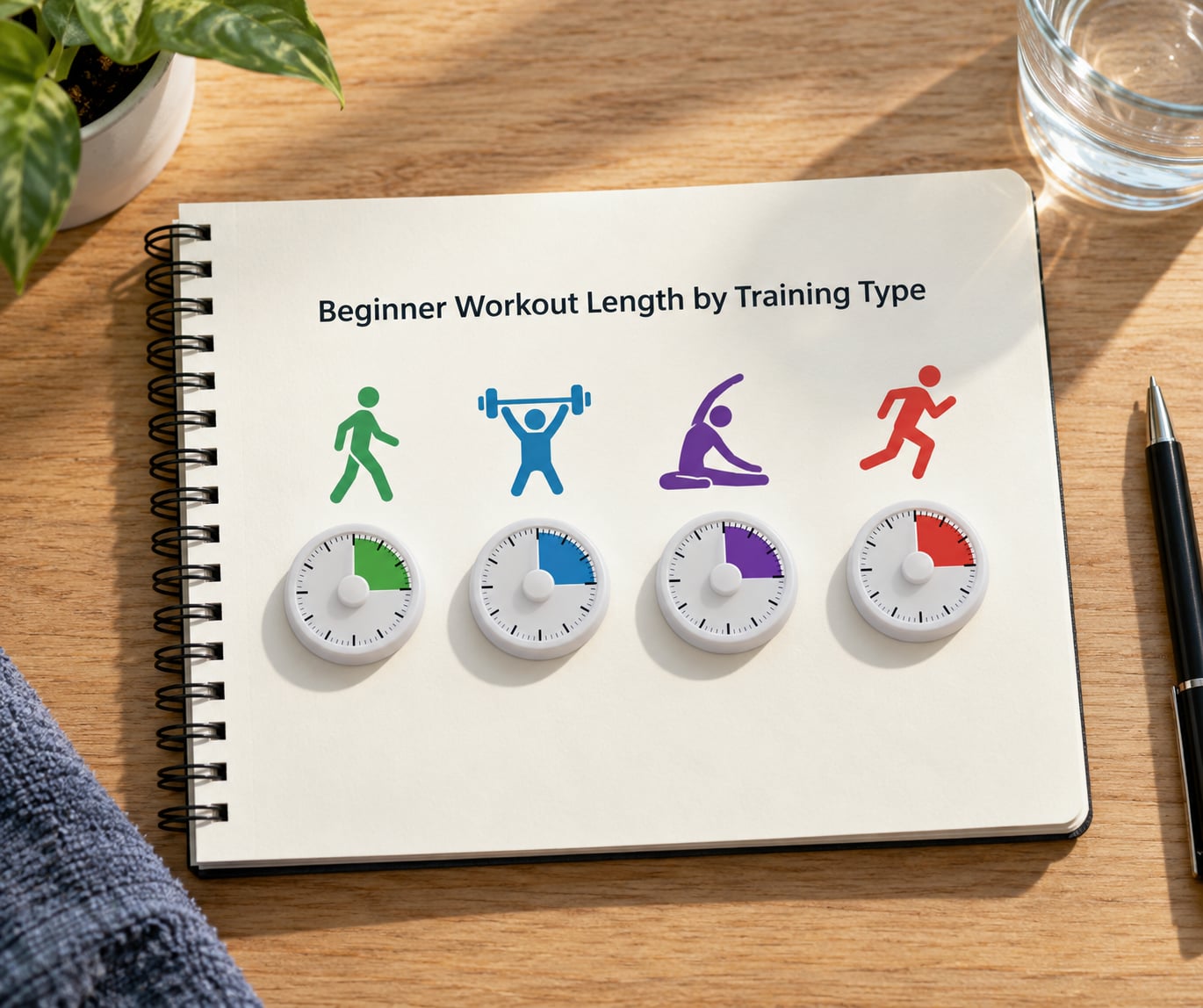
Different activities have very different time needs. A 40-minute walk is a different thing from a 40-minute barbell session, so the useful range depends on what you are doing.
| Workout type | Start here | Build toward | Times per week | Intensity |
|---|---|---|---|---|
| Walking | 15 to 20 min | 30 to 45 min | 5 to 7 days | Easy to moderate, able to talk |
| Bodyweight or home circuit | 15 to 20 min | 30 to 35 min | 3 to 4 days | Moderate, 2 to 3 rounds |
| Full-body strength | 30 to 40 min | 45 to 60 min | 3 days with rest between | Moderate, 2 to 3 reps left in reserve |
| Cardio machine or cycling | 20 min | 30 to 45 min | 2 to 4 days | Moderate to vigorous |
| Intervals or HIIT | 10 to 15 min | 20 min | 1 to 2 days | Vigorous, never your only session |
| Yoga or mobility | 15 min | 30 to 45 min | 3 to 6 days | Light, controlled range of motion |
| Steady-state cardio for fat loss | 20 min | 30 to 40 min | 3 to 5 days | Moderate, conversational |
Two rules pull across that table. Give yourself two to three reps in reserve on strength work while you’re learning, and keep moderate and vigorous sessions apart, because mixing them every day leaves you tired rather than fit.
How Long Should a Beginner Workout Last for Weight Loss?
For weight loss, session length is the least interesting variable. What moves the scale is a calorie deficit you can hold for months, and fat loss is closer to a nutrition result than a cardio result.
A 20 to 40 minute workout works well. It is short enough to repeat often and long enough to raise your heart rate and protect muscle with some resistance work. The CDC recommends at least 150 minutes of moderate activity a week, which works out to three 50-minute sessions or five 30-minute ones.
The bigger risk is the belief that a longer session burns more and therefore gets you further. Sessions past an hour often come with more eating afterwards, and the next day’s session gets skipped. Two sessions a week of 45 minutes will beat one 90-minute session followed by a quiet week, every time.
Keep resistance training in the mix even when fat loss is the goal. Weight loss takes off both fat and some muscle, and lifting is the best defence you have against losing the wrong tissue.
What Affects the Right Workout Length?
Thirty to 45 minutes is the average answer, and averages hide a lot. These are the factors that actually move your number.
Fitness level. Someone training for the first time recovers slowly and learns movement patterns fast, so short sessions work better. A regular gym-goer can handle 60 minutes without much trouble.
Workout type. Strength sessions with compound lifts take longer because of the rest and the setup between exercises. Steady cardio can be almost any length because there is no setup cost.
Intensity. Hard sessions are short by design. If you are near your limit, stop the set. Stretching a hard session to fill the clock is a good way to teach yourself to dread training.
Exercise order. Compound lifts first, isolation work later. That ordering means the important work happens when you are fresh, and it lets you cut from the end when time runs short.
Your schedule. A 20-minute session three times a week beats a 60-minute session you find excuses to skip. Design for the week you actually have, not the one you wish you had.
Sleep, stress and age. Recovery capacity drops when you are sleeping five hours or running on a high-stress week, and it drops with age. Anyone over 40 starting out, or coming back after an injury, should plan for shorter sessions and at least a day between demanding ones.
Previous inactivity. Coming back after a long layoff means you are a beginner again, whatever your fitness used to look like. Start at the beginner end of every range, not where you left off.
Medications and health conditions. Some blood pressure and heart medications affect heart rate response and exercise tolerance. That is a conversation with your doctor or pharmacist, not something to work out from a general article.
If you have an existing condition, an injury, or symptoms during exercise, get medical advice before changing your routine. Nothing here is medical advice.
Should Beginners Work Out Every Day?
No, and the distinction matters. Daily movement is a good goal. Daily structured training for most beginners is a fast route to feeling wrecked by week three.
A workable week looks like this: 3 sessions of 30 to 45 minutes on days that are not back to back, plus ordinary movement in between. Walking the dog, taking the stairs and a 10-minute stretch do not count as sessions, and nobody is pretending they are the same thing.
Leave at least one full day between demanding strength sessions. Muscles and connective tissue adapt during recovery, not during the session, and soreness that knocks out your next planned workout costs you more than the missed day it takes to recover.
On the days between sessions, easy movement for 20 to 30 minutes is plenty. That is what fills the gap between training and doing nothing, and it keeps the habit alive on a bad week.
How to Increase Workout Duration Safely
Add time in small steps and let your performance tell you when you are ready. The ramp below is what most beginners can follow without any special program.
| Week | Minutes per session | Sessions per week | Focus |
|---|---|---|---|
| Week 1 | 10 to 15 | 3 | Learn the movements, finish every set |
| Week 2 | 15 to 20 | 3 | Same exercises, slightly more weight or reps |
| Week 3 | 20 to 25 | 3 to 4 | Add a sixth exercise or a fourth set |
| Week 4 onward | 30 to 45 | 3 to 4 | Build toward your goal range |
Add two to five minutes a week, not fifteen. A session that creeps up from 30 to 60 over three months is easy to live with; one that jumps from 20 to 75 overnight usually ends with a sore back and a cancelled week.
Four checks tell you when to add time. The talk test: at moderate effort you should be able to talk in short sentences, and if you cannot, the session is too long or too hard. Perceived effort: rate the session 1 to 10 and keep most weeks at 6 or 7. Soreness: mild muscle soreness that fades within a day or two is normal, pain that changes your movement is a signal to back off. Performance: if the same weight and reps felt easier this week than last, you have room to add.
Raise frequency before intensity. One more short session per week beats trying to work harder inside a session that is already at your limit.
How to Tell When a Workout Is Too Long
Normal fatigue looks like breathing hard at the end of a set, legs that feel worked, and wanting the last two minutes to be over. That is what a good session feels like.
Signs your session has run too long are more specific. Form breaks down and your last reps turn into half-reps. Rest periods drift from 60 seconds to three minutes and you are scrolling between sets. You finish and feel nothing like you trained, just tired. Or you feel fine in the session and sore for four days, which usually means too much volume rather than too much time.
If you are short on time, cut from the end and never skip the multi-joint movements you came for. Isolation exercises at the tail of the workout are the first thing to drop, and the cool-down is the second.
Stop immediately and get medical help for chest pain, sharp or joint pain, severe shortness of breath, dizziness, faintness, confusion or loss of coordination. Those are not fitness signals, and no amount of progression advice overrides them.
Frequently Asked Questions
Is a 20-minute workout enough for beginners?
Yes, for most beginners a 20-minute session done 3 to 4 times a week is a solid start. Keep the intensity moderate, cover the main movement patterns, and finish feeling like you worked rather than wiped out. On r/beginnerfitness people routinely build muscle on 15 to 20 minute full-body sessions. The habit matters more than the length early on.
Should I do a 30-minute workout every day?
Every day is fine for walking, mobility and easy yoga. For strength training, three or four days a week is the better target, with at least one full day between demanding sessions. Muscles and connective tissue adapt while you recover, not while you train. Daily hard sessions tend to end with soreness that cancels your next workout.
Is a 45-minute beginner workout too long?
No. Forty-five minutes is right in the middle of the recommended beginner range and covers a full warm-up, a complete full-body workout and a cool-down. It becomes too long only if your form breaks down, your rest periods drift, or you skip sessions because the session itself is hard to fit in.
How do I know when to increase my workout duration?
Add two to five minutes a week when you finish your sets with good form, soreness has faded within a day or two, and the same weight and reps felt easier than the week before. Add frequency before intensity, and repeat the week you just completed if any of those conditions are not met. The ramp should be boring.
What is the best workout length for losing weight?
Twenty to forty minutes works well, three to five times a week. Weight loss depends mainly on a calorie deficit you can sustain, not on session length, and the CDC recommends at least 150 minutes of moderate activity weekly. Keep some resistance training in your week to protect muscle while you lose fat.
Should beginners include a warm-up and cool-down?
Yes, and they are part of the session length rather than extra time on top of it. Five to ten minutes of easy movement raises your body temperature and lets you rehearse the patterns you are about to load. Five minutes of slow movement to come down after is enough. Skip the long stretching routines and save them for later.
What to Do in Your First Two Weeks
Pick a 25-minute full-body workout and do it three times this week. Write it down or set a repeating calendar reminder, because the reason most people fail is not effort, it is forgetting.
If you are starting from nothing at all, drop to 15 minutes and add two exercises a week until you reach 30. When you get there, add a fourth session, not a longer one. That is how long a beginner workout should last, and how long it should take to get there.