Yes, stretching after a workout is worth doing, but not by dropping straight into a toe touch while your heart rate is still high. The right way is simple: cool down with easy movement for two to five minutes first, then hold gentle static stretches for 20 to 30 seconds each, two or three times per muscle group, without bouncing. A full session takes about 10 minutes; a useful one takes five.
That is the whole method. Everything below is just the detail — which muscles to hit, how to hold them, what to do when your balance is not great, and how to tell the difference between a healthy stretch and a sign you have gone too far.
Table of Contents
- What You Need
- Step-by-Step
- 1. Settle Your Breathing and Check Your Body
- 2. Start with Gentle Lower-Body Movement
- 3. Stretch the Main Muscle Groups
- 4. Hold Each Stretch Without Bouncing
- 5. Use Support When Balance Is Limited
- 6. Finish with a Light Full-Body Cooldown
- 7. Know When to Stop
- Mistakes that cost you the most
- How to stretch after a workout the right way in five minutes
- Common Mistakes
- Frequently Asked Questions
- How long should I wait after a workout before stretching?
- Is it good to stretch when muscles are sore after exercising?
- Should I stretch after strength training or only after cardio?
- How long should I hold a post-workout stretch?
- Does stretching after a workout prevent injury?
- Is it better to do dynamic stretches or static stretches after exercise?
- Conclusion
What You Need
Nothing. No special equipment, no membership, no fancy clothing. Post-workout stretching is bodyweight work done on the floor or standing, and the only equipment you might want is optional.
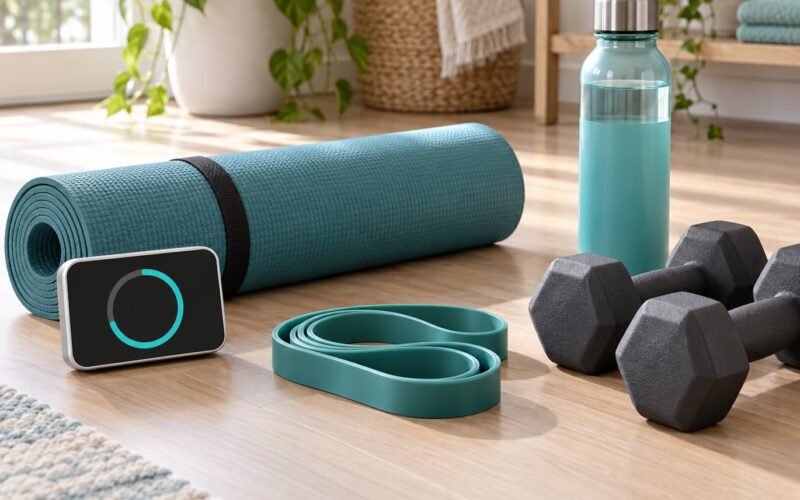
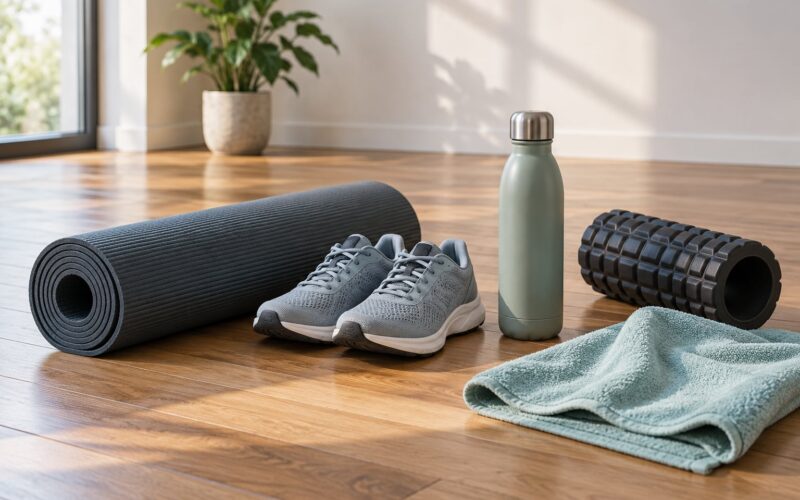
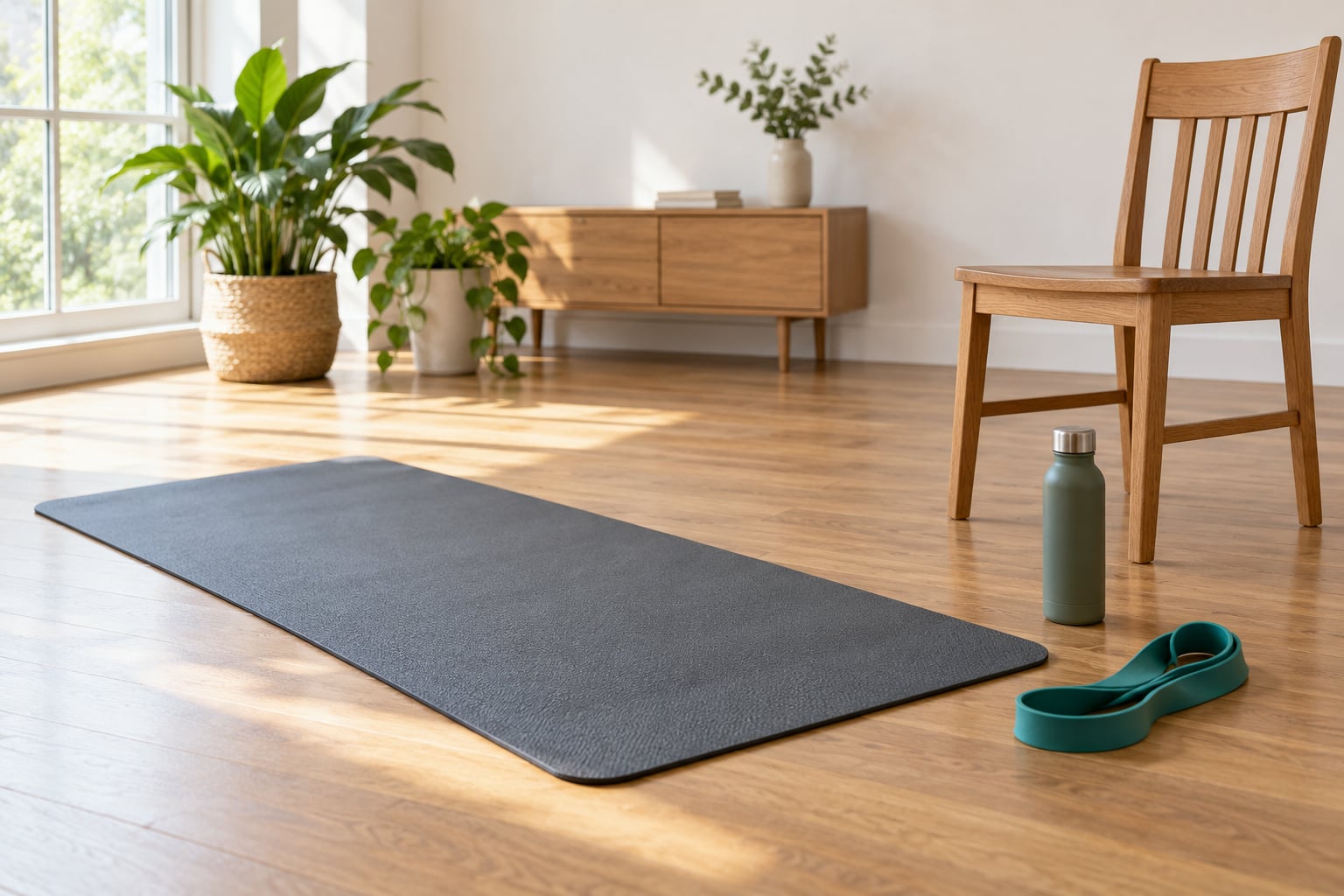
A non-slip exercise mat makes floor positions easier on hardwood and carpet. A resistance band gives you reach when your hands cannot get to your foot, which happens to everybody eventually. A sturdy wall or a chair with a solid back handles balance work, and a bottle of water sits within arm’s reach so you are not wandering off halfway through.
Pick a spot with enough room to lie flat with your arms out and nothing to trip over. Ten minutes is a realistic window; twenty is what a thorough routine takes if you are not tired. This is general information rather than medical advice, so if you are recovering from an injury or managing a condition, check with a doctor or physical therapist before changing what you do after training.
Step-by-Step
1. Settle Your Breathing and Check Your Body
Stand or lie down and slow your breath before you touch a single muscle. Long exhale out, easy inhale in, five or six cycles. It is the least impressive part of the routine and the one that does the most for how the rest of it feels.
Then take inventory. Any sharp pain, dizziness, or a joint that grinds or catches gets skipped entirely. Tightness that has a warm, stretching quality is fair game. Also decide what you are working towards: if you just ran, your calves, hip flexors and hamstrings matter most. After upper-body lifting, the chest, lats, shoulders and forearms are the priority.
2. Start with Gentle Lower-Body Movement
Do not jump straight from intervals to a hamstring fold. Walk for two to five minutes, or march on the spot, until your breathing is close to normal and you can talk without sentences falling apart.
This matters because a raised heart rate keeps muscles working and mildly contracted, which is exactly the state you do not want to lengthen. Skipping the cool-down is why so many people end up with that lower-back ache after forward folds. Gradual is faster here, oddly.
3. Stretch the Main Muscle Groups
Work one side at a time and move from the biggest areas to the smaller ones. The usual post-workout order runs calves, hamstrings, quadriceps and hip flexors, then glutes, then chest and shoulders, lats, and triceps, finishing with the lower back.
Here are the positions that matter most, with the cues that keep them honest:
- Calves: step one foot back, heel down, hips forward, back leg straight. You should feel the pull above the heel, not in the Achilles tendon.
- Hamstrings: one heel on the floor with the leg straight, hinge from the hip and rest your hands on the front thigh or a chair. Bend the knee slightly if the stretch refuses to happen with a straight leg.
- Quadriceps: hold an ankle behind you, pull the heel toward your seat, and squeeze the glute on that side. Knees together keeps it balanced.
- Hip flexors: half-kneel with the front foot flat, tuck the tailbone and lean forward an inch. Most people need this more than they expect after sitting.
- Glutes: figure-four on a chair, or a cross-legged forward lean in a figure-four seat. Hinge, keep the spine long, and stop short of anything sharp.
- Chest and lats: a doorway or wall press with the forearm at roughly shoulder height, or a clasp-hands shoulder stretch behind the back. Breathe into the front of the shoulder.
- Triceps and shoulders: overhead elbow bend, or a band pull-apart held at chest height.
- Lower back: child’s pose with the hips toward the heels, or a cat-cow to finish. Forward folds with rounded backs tend to be where people feel the lower back, and that is usually hamstring and back mobility combined rather than a back problem.
Stretch what you trained. A full-body pass is fine on days when nothing much happened, but running does not need a shoulder routine and a shoulder session does not need a pigeon stretch.
4. Hold Each Stretch Without Bouncing
Settle into a position where you feel a clear stretch and a mild pulling sensation, then stay there for 20 to 30 seconds. Two or three holds per side is the widely used guideline, and going past about 60 seconds on a single hold adds very little for most people.
Keep breathing. A slow exhale into the position usually relaxes the muscle more than holding your breath does, which is why forcing a stretch while braced tends to stall. No bouncing, no swinging into the end range, no pushing further every few seconds.
Bouncing triggers a stretch reflex that shortens the muscle rather than lengthening it, and it turns a calm cool-down into a small cardio hit right at the end. If you feel the urge to push deeper as you go, the range was already too far in.
5. Use Support When Balance Is Limited
Hand on a chair back, forearm on a wall, or a foot looped in a resistance band. Support is not a cop-out; it takes wobble out of the picture so you can hold a real range instead of balancing on one leg and calling it core work.
Anyone with limited balance, joint hypermobility, or a recent injury benefits from support. It is also the single easiest upgrade for consistency, and consistency is what actually changes flexibility over weeks rather than one session.
6. Finish with a Light Full-Body Cooldown
End with two or three minutes of easy walking or relaxed movement until your breathing and heart rate are back near resting. Ending a session standing still while still breathing hard is its own small shock.
Follow it with water, a few minutes off your feet, and the rest of your day. Stretching is one part of recovery, and a patient one; sleep, protein, hydration and easy movement do more for tomorrow’s performance than any hold time.
7. Know When to Stop
Pulling tension that stays at a steady level is fine. These are not:
- Sharp, sudden, or stinging pain
- Joint pain, especially in a knee, shoulder or elbow
- Numbness, tingling, or a limb going to sleep
- Pain that is worse the next morning than during the session
- Dizziness or a light-headed feeling
- A stretch that suddenly feels much deeper than it did ten seconds earlier
Stop and back out of the position for anything on that list. Persistent pain, an injury, or anything that does not settle is a question for a doctor or a qualified physical therapist, not something to work through with a longer hold.
Mistakes that cost you the most
- Going straight into deep holds. Cool down first. Two to five minutes of walking fixes what twenty minutes of forcing cannot.
- Bouncing. It shortens the muscle it targets and spikes your heart rate at the finish line.
- Chasing range of motion. Every extra centimetre past a mild pull is borrowed against tomorrow.
- Stretching one side. The tight side and the loose side both get the holds. Imbalance is how it stays imbalanced.
- Holding for minutes. Longer is not better. Past about 60 seconds the return on time drops sharply.
- Treating soreness as proof it worked. Delayed onset muscle soreness comes from the training, not the stretching. If a stretch makes you sore, you went too far, not that it is working.
- Doing deep hip openers straight after heavy leg work. Light holds are fine. Aggressive pigeon and deep lunges on a day your glutes are already cooked tend to make tomorrow worse.
How to stretch after a workout the right way in five minutes
For the days you genuinely cannot face ten minutes, this is the version that still counts. Roughly two minutes of walking, then five holds of 20 seconds each per side:
- Walk or march slowly for two minutes.
- Standing calf stretch, 20 seconds a side.
- Hamstring hinge with a hand on a chair, 20 seconds a side.
- Half-kneeling hip flexor, 20 seconds a side.
- Cross-body shoulder stretch, 20 seconds a side.
- Child’s pose, one long 30-second hold, breathing slowly.
Short and done beats long and skipped. The thread pattern in r/workout is the same one you see everywhere: people who stretch twenty minutes after every session end up cutting it to five and wondering if they have lost something. They have not, because holding times below about 30 seconds capture most of the available benefit.
Common Mistakes
Most of the above is not a technique failure; it is a sequencing one. A few habits cover nearly everything that goes wrong in a post-workout stretching routine.
Match the routine to the session. Runners get calves and hip flexors. Lifters get the muscles they loaded. A bad day at the desk with no workout at all still benefits from chest, hip flexors and hamstrings, which is why evening wind-down sessions work just as well as post-gym ones.
Frequency beats duration. Two or three short sessions across a week build more usable range than one long one. A ten-minute routine you actually do on Tuesdays and Fridays is worth more than a heroic Sunday effort you dread.
Use mild intensity as the ceiling. Somewhere between no feeling at all and pain sits the right zone. If you need willpower to stay in a position, it is past the point you want.
Do not chase depth with the breath. Relaxed breathing and time in the position do the work. Holding your breath to force depth is the fastest route to that next-day lower-back complaint.
People in lifting communities such as r/overcominggravity often point out that passive holds are mostly a comfort practice rather than a performance one, and they are right about the evidence being mixed for injury prevention. Stretches that feel good after training are still worth doing, for the calm as much as the range. Just do not expect them to carry your recovery on their own.
Frequently Asked Questions
How long should I wait after a workout before stretching?
Wait two to five minutes of easy walking or marching first, then start holding stretches. Your heart rate needs to come down because muscles stay partly contracted while you are still working hard, and lengthening them in that state is uncomfortable at best. Most people find the first minute of holds a little stiff and the last minute noticeably easier, which is the shift you are waiting for.
Is it good to stretch when muscles are sore after exercising?
Light movement is generally fine, and gentle stretching may ease the stiffness. Skip deep end-range holds on muscles that are sore, freshly injured or swollen, because sore tissue is already irritated and forcing it tends to make the next day worse. If the pain is sharp rather than a broad dull ache, or if it has not settled after a few days, get it checked rather than stretching through it.
Should I stretch after strength training or only after cardio?
After both. Any session that leaves your heart rate elevated benefits from a cool-down first, and any session that reduces range of motion benefits from the holds afterward. Strength sessions in particular are when you should stretch the muscles you actually loaded, rather than doing a generic full-body pass. Longer aerobic sessions tend to leave the lower body tighter, so calves, hamstrings and hip flexors deserve more time there.
How long should I hold a post-workout stretch?
Twenty to thirty seconds per hold, repeated two or three times on each side, is the guideline most coaches and exercise guidelines use. Longer holds add little for most people once you pass about a minute, which is why a 10-minute session covers a full body when you keep each hold tight and controlled. Breathe normally throughout and relax into the position with each slow exhale.
Does stretching after a workout prevent injury?
The honest answer is that the evidence is mixed. Stretching improves range of motion, and a good range of motion helps you move well, but research has not shown that stretching on its own reliably prevents injuries during exercise. Treat it as one part of training that also includes progressive loading, rest and technique, rather than as protection you are counting on. Preparation is a bigger factor than stretching alone.
Is it better to do dynamic stretches or static stretches after exercise?
After a workout, static holds are the better fit because they lower muscle tension and help you come down gradually. Dynamic stretches raise core temperature and movement demand, which is why they belong before a session rather than after one. A simple structure works well: a few minutes of dynamic movement as the cool-down, then static holds for each muscle group you trained.
Conclusion
Seven steps, and the first two do most of the work: slow your breathing down, walk for a few minutes, then start stretching the muscles you just used. From there it is 20 to 30 second holds, two or three per side, no bouncing, ending with a couple of easy minutes to bring everything back to rest.
Start with those first two steps this week. Comfortable range, steady breathing, and support from a wall or chair whenever you want it, and update the routine as your flexibility changes.