The best walking for weight loss plan for beginners is deliberately boring: three short walks a week, comfortable pace, then a slow build over four weeks. Walking burns calories steadily, keeps joints happy, and fits inside a normal day. This plan starts at 10 minutes and works up to 30, and it works alongside how you eat.
It takes about 30 minutes to read, and about four weeks to work through. If you have a health condition, are pregnant, or have had an injury, check with a doctor or physical therapist before starting.
Table of Contents
- What You Need
- Step-by-Step: Your Four-Week Walking Plan
- Step 1: Set a Safe Starting Point
- Step 2: Build a 10-Minute Walking Habit
- Step 3: Increase Duration Gradually
- Step 4: Track Progress Without Obsessing
- Step 5: Support Walking with Everyday Nutrition
- Common Mistakes
- Frequently Asked Questions
- How much should a beginner walk to start losing weight?
- What pace counts as brisk walking?
- How long does it take to see results from walking?
- Is walking better than running for fat loss?
- What should I do after missing a walking day?
- What is the 3-3-3 rule for walking?
- Conclusion
What You Need
None of this is expensive, and most of it you already own.
- Shoes that fit with a wide toe box and a firm heel. Walking shoes are built for forward motion; running shoes are built for repeated one-foot landings and can feel odd on long walks. Replace them when the midsole feels flat rather than springy.
- Socks that wick moisture and have a little cushion. Cotton holds sweat against the skin, which is how most blisters start.
- Loose clothing and a layer you can remove. You will warm up faster than you expect.
- A water bottle, especially in warm weather or on longer walks.
- Your phone or a watch for a timer and, if you want it, step count. The timer matters more than the tracker.
- A route that is flat, lit, and has somewhere to sit. A treadmill or a hallway both work fine on bad-weather days.
Step-by-Step: Your Four-Week Walking Plan
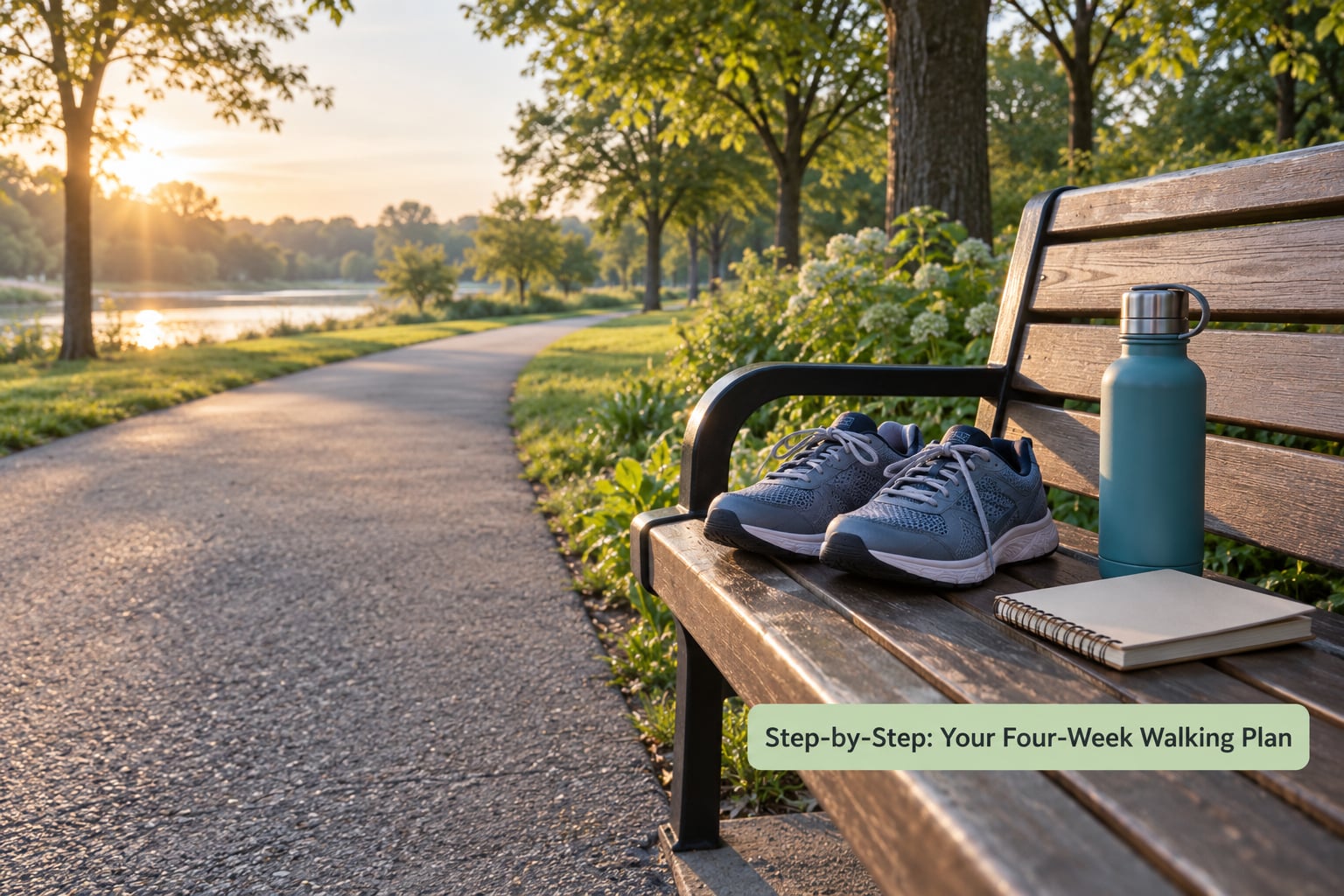
Here is the whole schedule at a glance. Each session includes a 3-minute warm-up and a 2-minute cool-down, so the walking time listed is the middle portion.
| Week | Days per week | Session length | Weekly walking time | Pace |
|---|---|---|---|---|
| Week 1 | 3 | 10 minutes | 30 minutes | Easy, full sentences |
| Week 2 | 4 | 12 to 15 minutes | About 50 minutes | Easy to comfortable |
| Week 3 | 4 to 5 | 15 to 20 minutes | About 75 minutes | Comfortable |
| Week 4 | 5 | 20 to 30 minutes | About 2 hours | Comfortable, brisk on one day |
Those weekly totals land close to the 150 minutes of moderate aerobic activity per week that health bodies such as the CDC and the American Heart Association recommend for adults. You are not behind if week one looks tiny to you. That is the point of it.
Step 1: Set a Safe Starting Point
Pick three days before you pick a speed. Two 10-minute walks during a lunch break and one 15-minute walk after work is a perfectly good week one.
Write down how long each walk actually lasted and how it felt on a 1 to 10 scale. That log becomes the baseline you build on later, and it takes ten seconds per session.
Choose a route you could walk in the dark without thinking about it. Familiarity removes a surprising amount of friction, and a route near home gets walked far more often than a beautiful one across town.
Step 2: Build a 10-Minute Walking Habit
Ten minutes, twice a week, plus one optional third walk. A conversational pace is the target here: you can speak in full sentences without pausing for breath.
Warm up with two to three minutes of slow walking before you speed up, and cool down with the same two minutes at the end. The cooldown is what stops you from feeling stiff an hour later, and beginners skip it constantly.
Anchor the habit to something that already happens. Ten minutes after the morning coffee, or a full loop before you get in the car. Habits attached to existing ones survive a bad week; ones that rely on motivation do not.
Step 3: Increase Duration Gradually
Add time, not speed. Going from 10 minutes to 30 by extending your walk is boring and effective; going from 10 minutes of easy walking to 10 minutes of sprinting is how people end up with shin splints in week two.
A simple rule: add 5 minutes per session every one to two weeks, and no more. Once you reach 30 minutes, add a fifth day rather than lengthening the walks. Frequency is easier on the body than intensity.
Keep one day genuinely easy each week. Soreness from a hard day should be gone before the next one, and if your shins ache during the walk rather than afterwards, back off and stay at the shorter duration for another week.
Step 4: Track Progress Without Obsessing
The most motivating number is walks completed. A simple tick on a calendar beats a complicated app, because the habit is what you are building.
Also note average duration, your effort score, and your energy afterward. Those three tell you far more early on than the scale does. If you want a body measurement, take it the same time each month, at the same point of the day, and then stop looking at it weekly.
Weight moves unevenly. Water, salt, and glycogen shifts can swing the scale by a couple of pounds without any change in body fat, and most people chasing a walking plan find that number more confusing than helpful.
Step 5: Support Walking with Everyday Nutrition
Walking creates a calorie deficit, but the deficit does most of the losing. If you eat back everything you burn, walking alone rarely moves the needle much.
A moderate deficit, not a crash diet. Most people do well cutting back on a few everyday extras rather than skipping meals, and sudden restriction usually ends in overeating two nights later.
Build meals around protein, vegetables or fruit, and a carbohydrate you actually enjoy. Protein matters more than most beginners expect because it helps you keep muscle while losing weight, and walking alone will not preserve muscle on its own.
Hydrate normally and eat your meals at roughly the times you always do, ideally not within the hour either side of your walk. If you are new to structured exercise, a registered dietitian is a good person to ask for specific numbers rather than guessing from articles.
Common Mistakes
Almost every problem with a beginner walking plan comes down to doing too much too soon.
- Starting with an hour. The fix is to do 10 minutes for a week before you touch anything else. Boring is correct here.
- Walking too fast to last. Sprinting on the first outing is a good way to end up sore and quit. Use the talk test: talk but do not sing.
- Skipping the warm-up. Five slow minutes at the start saves you the kind of tightness that makes people stop walking.
- Chasing a step number. Whether the target is 7,000 or 15,000, a number you have to fight for tends to break. Let the minutes accumulate instead.
- Changing your diet drastically. Cutting to a very low intake while adding exercise makes fatigue and hunger the loudest things in your day. Adjust portions modestly and keep eating enough to walk.
The most common reason plans fail is not effort. It is a missed Tuesday that turns into a missed week.
Frequently Asked Questions
How much should a beginner walk to start losing weight?
Start with 10 to 15 minutes, three days a week, at a pace where you can talk comfortably. Add about 5 minutes per session every one to two weeks and build toward 30 minutes on five days. Building toward roughly 150 minutes of moderate walking per week is the usual guideline for adults, and you reach it gradually rather than in week one.
What pace counts as brisk walking?
Brisk means you can speak in full sentences but cannot comfortably sing. On a 1 to 10 effort scale, it sits around 5 or 6. Beginners often push too hard early on, so spend your first two weeks at conversational pace and only then test the talk test on your faster days.
How long does it take to see results from walking?
Most beginners notice better energy and mood within two weeks, and clothing changes within four to six weeks of consistent walking. Scale weight is less predictable, and early changes are often water rather than fat. Steady walking plus a moderate calorie deficit is what produces change; walking alone tends to disappoint.
Is walking better than running for fat loss?
For most beginners, yes, because walking is easier to repeat consistently and carries far lower injury risk. Running burns more calories per minute, but only if you can keep doing it. Many people do better with brisk walking plus two short strength sessions a week than with running they abandon after a month.
What should I do after missing a walking day?
Just resume where you left off. Missing one session means nothing, and trying to make up lost minutes usually backfires. If you have missed a few in a row, drop back to the shorter session length for a week and rebuild from there rather than jumping straight to your previous duration.
What is the 3-3-3 rule for walking?
No major health organisation publishes a walking rule by that name, so treat it as a prompt rather than a prescription. Rules like it are useful only because they encourage a small, regular habit. The plan in this article follows the same logic: short sessions, several days a week, gradual increases.
Conclusion
Week one is three 10-minute walks. Week four is five days of 20 to 30 minutes, with pace added last, not first. Along the way you keep one easy day, a written log, and a modest food adjustment rather than a strict diet.
So pick the route, put on the shoes, and schedule three 10-minute walks this week. Do those three again next week before you change anything. That consistency is the whole plan, and it is the part almost everyone skips.