Strength training for women over 40 for fat loss works because the weight you lose comes off as fat instead of muscle, and the muscle you keep keeps burning calories all day. Two full-body sessions a week, 30 to 40 minutes each, with a moderate calorie deficit, is the plan most women over 40 can actually keep up. It takes about three sessions a week to begin, and almost no equipment to start. This is general information, not personal medical advice, so check with a doctor or physical therapist first if you have a health condition, an injury, or are pregnant.
I have watched the same thing happen to friends in their forties and fifties. They cut cardio, they lose eight pounds, then the scale stalls and the jeans stay tight. What moved the needle was not more treadmill time. It was two sessions a week of squats, rows, push-ups and hinges, plus more protein and slightly less food than they were eating.
What follows is the plan I hand them. It is deliberately ordinary: six movement patterns, two or three days a week, and progressions that take eight weeks rather than eight days.
Table of Contents
- What You Need for Strength Training for Women Over 40
- Step-by-Step
- Start With a Baseline and Safe Movement Prep
- Perform the Six Foundational Strength Moves
- Build Your First Three Weekly Sessions of Strength Training for Women Over 40
- Progress Gradually for Fat-Loss Support
- Recover and Pair Strength With Daily Habits
- Common Mistakes
- Frequently Asked Questions
- Will strength training help a woman over 40 lose body fat?
- How often should a woman over 40 do strength training to lose fat?
- Is weightlifting too hard for women over 40?
- Should I feel sore after every strength workout?
- How much weight should I use when starting strength training?
- Can strength training spot-reduce fat from the waist?
- Conclusion
What You Need for Strength Training for Women Over 40
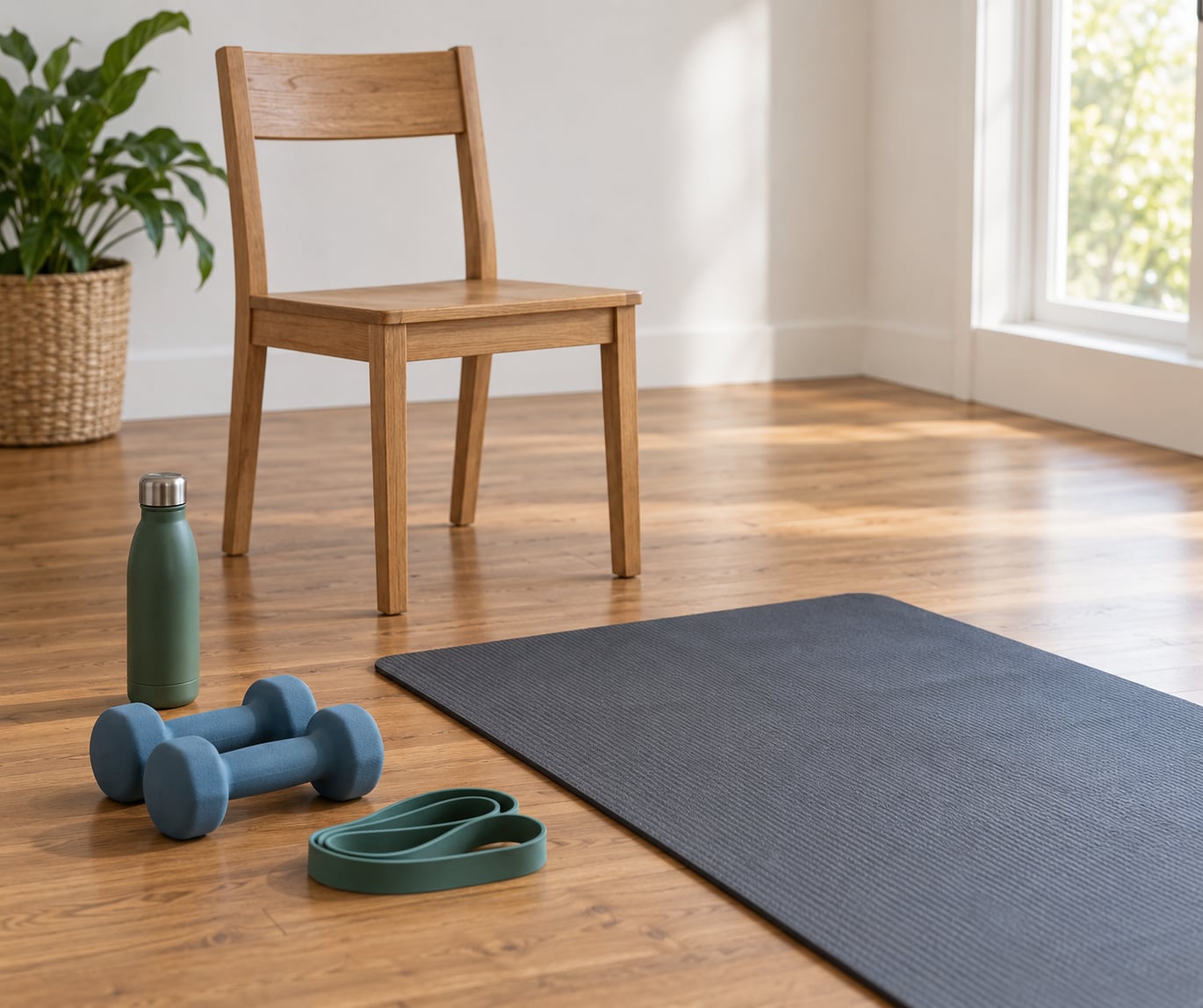
Here is the honest answer on equipment: a sturdy chair and about 30 minutes twice a week. Everything else is a nice addition, not a requirement.
- A sturdy, non-slip chair with a flat back, used for squats, seated rows and step-ups. Test it by standing on it with one foot before you commit your weight to it.
- A pair of light dumbbells, roughly 2 to 5 kg each. If five kilos feels embarrassingly easy, that is exactly right for your first month.
- A resistance band for rows, pulls and overhead work when a weight is not available. A thick cooking pot or a filled water jug per hand works nearly as well.
- A nonslip exercise mat for kneeling push-ups, hip hinges and standing balance work.
- Supportive training shoes with a stable base. Footwear does more for knee comfort than any single exercise swap, and falling during a squat is a bad way to learn.
- Water within reach, plus a small meal or snack an hour or so after you finish.
You do not need a gym membership to get the benefits. Plenty of women start with bands and a jug of water and only add dumbbells once the movements feel easy. If a gym suits you better, machines are a fine choice for leg and upper-back work because they guide the path and reduce balance demands, which matters if your balance is not what it was.
One thing worth adding is guidance. A qualified personal trainer or a physical therapist, even for two or three sessions, can watch you squat and hinge and fix what a video never will. Ask them specifically about any joint that complains. That single visit usually removes more knee and shoulder problems than any program choice you make afterwards.
Step-by-Step
Start With a Baseline and Safe Movement Prep
Before the first working set, spend five minutes finding out what your body can do comfortably today. Not what it could do twenty years ago. Today.
Stand in front of a counter, keep both hands on it, and rise onto your toes and back down ten times. Then hold a single-leg stand for twenty seconds with a fingertip near the counter. Then walk ten steps heel to toe on a clear stretch of floor. This is a mobility, balance and core control self-check, and it takes two minutes.
Three things to note from it: does a knee click, catch or grumble on the way up? Does your back round when you hinge? Is your grip solid for twenty seconds? Whatever answers yes tells you where to start easier. If balance is shaky, hold the counter for every standing exercise and skip step-ups until it improves.
Then warm up. Five to seven minutes, easy and rhythmic:
- Brisk marching or walking in place, two minutes, swinging your arms fully.
- Ten hip hinges, hands on your thighs, sending your hips back as if closing a car door.
- Ten bodyweight squats at half depth, slow on the way down.
- Ten wall push-ups, hands at chest height, elbows in.
- Five arm circles each way, then five band or bodyweight rows per side.
Pick your starting level by how the warm-up felt, not by ego. Choose an effort where the last two or three repetitions of a set feel genuinely difficult but not like a max test. This is usually described as rating the set a 6 or 7 out of 10, and it leaves room to improve without a recovery crash.
One technique rule holds across every exercise: exhale as you push or stand, inhale as you lower. Never hold your breath through a rep. Holding your breath spikes blood pressure and, for some women, brings on head-rush or dizziness. If you get light-headed, sit down and check in with a doctor before training again.
Perform the Six Foundational Strength Moves
These six patterns cover almost everything a home program needs: squat, push, pull, hinge, single-leg and overhead. Learn them well before adding anything exotic.
| Move | Sets x reps | The one cue that matters | Make it easier |
|---|---|---|---|
| Squat to chair | 2 x 8-12 | Sit your hips back to touch the chair, then stand up through your whole foot | Use a higher seat or a wall squat |
| Supported row | 2 x 8-12 | Pull the elbow past your ribs, not out to the side | Band with no weight, or towel on a door |
| Wall or counter push-up | 2 x 6-12 | Body in one straight line, elbows about 45 degrees | Push higher on the wall, narrower stance |
| Hip hinge | 2 x 8-12 | Hips go back, spine stays long, chest stays open | Hold a counter with both hands |
| Step-up | 2 x 8 each leg | Drive through the heel of the foot on top | Lower step height, hold a wall |
| Overhead press | 2 x 8-10 | Ribs stay down, squeeze your glutes as you press | Seated with back support, or press out to the sides |
How to do them, briefly:
Squat to chair. Stand with your feet hip to shoulder width, toes slightly out. Reach your hips back and down until you graze the chair, keeping your chest tall, then press through your heels and midfoot to stand. Knees track over your toes. If your heels come up, sit back further before you go down.
Supported row. Sit tall or stand braced. Pull the weight or band toward your lower ribs, leading with the elbow and finishing with your hand near your hip. Pause a beat, lower under control. This is the move that fixes the forward-head posture years of desk work cause, so it earns a place even on days you feel lazy.
Wall or counter push-up. Hands on a wall or countertop, slightly wider than your shoulders. Bend your elbows and lower your chest toward your hands, then push away. Walk your feet back and drop to the floor for a harder version once the wall version is boring. If your shoulder pinches at the bottom, narrow the stance and lower the hand angle.
Hip hinge. This is the one most women get wrong and the one that protects a lower back. Soften your knees, push your hips straight back, let your torso tip forward while your spine stays long. You should feel the backs of your thighs and your glutes working, not your lower back. A jug hanging from your hands or a band under your hips adds weight once bodyweight feels empty.
Step-up. Put one foot flat on a low step, about knee height, and drive up through that heel without hopping off the bottom foot. Lower with control. This trains single-leg strength, which is where balance goes after 40, and it counts as real work rather than a filler exercise.
Overhead press. Start seated with back support or standing with light weights at shoulder height. Squeeze your glutes to keep your ribs from flaring, then press overhead until your arms are almost straight. Stop before your lower back arches. If overhead is uncomfortable, press the weight out to the sides instead, which trains the same shoulder muscles with less range.
Build Your First Three Weekly Sessions of Strength Training for Women Over 40
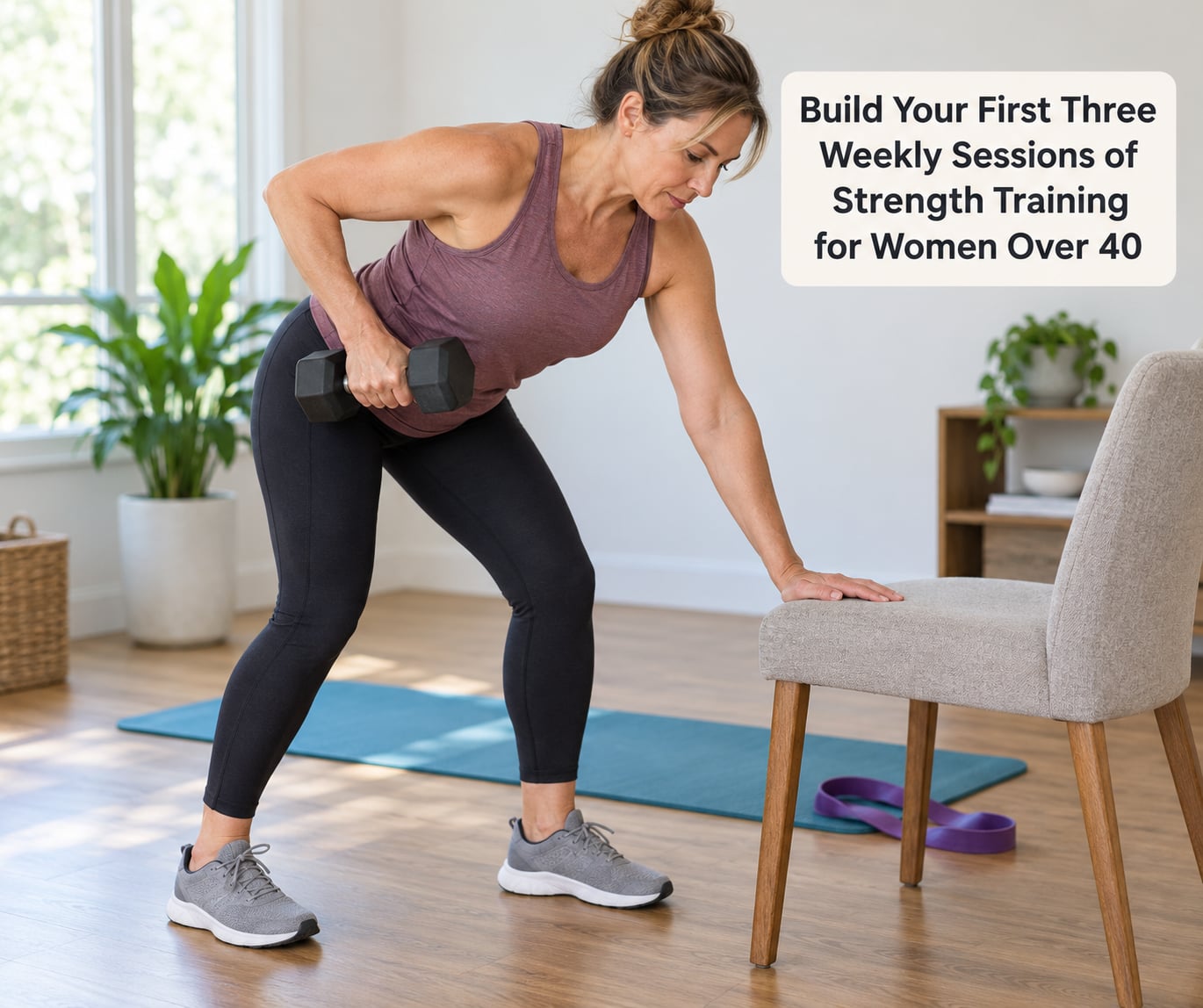
Two full-body sessions a week is the whole program. You are not underdoing it. Beginners do best on a simple frequency they can repeat for months rather than a five-day split they abandon in a fortnight.
A typical week:
| Day | Session | Length |
|---|---|---|
| Monday | Full-body strength, all six patterns | 35-40 minutes |
| Tuesday | Walk or easy cycling, recovery effort | 20-30 minutes |
| Wednesday | Mobility and a short light session | 20 minutes |
| Thursday | Rest or gentle yoga | Optional |
| Friday | Full-body strength, all six patterns | 35-40 minutes |
| Saturday | Longer walk or enjoyable cardio | 30-45 minutes |
| Sunday | Rest, meal prep, mobility | Optional |
The Wednesday session is the one people skip, then feel behind. Keep it light: five minutes of the warm-up above, two sets of 12 for the squat, the row and the hip hinge, and nothing that leaves you breathing hard. The goal is movement on a day when sleep was poor and hormones are unpredictable.
Inside a strength session, aim for two sets of 8 to 12 repetitions on each of the six moves, resting 60 to 90 seconds between sets. The rest is not wasted time. Muscles grow and recover during it, and cutting rest to 20 seconds is one reason beginners get sore for days instead of a day or two.
Order of operations matters more than most guides admit. Do your strength work first, then your walking or cycling if you plan to do both. Lifting first protects quality, and putting the cardio afterward means you burn more of the easy-fat kind of energy while your body is already warmed up.
Stay on two days a week for your first four weeks. Repeat week one for as long as you need before adding anything. A week you complete twice with decent form is worth more than a six-day program you abandon in week three.
Progress Gradually for Fat-Loss Support
Fat loss comes from a calorie deficit, not from any single exercise. What strength training does is protect the muscle that makes the deficit survivable. That is the whole argument for strength training for women over 40 for fat loss: it keeps a cutting phase workable instead of miserable.
Here is the mechanism, plainly. Skeletal muscle is metabolically active tissue, so losing it lowers your resting metabolic rate and the deficit shrinks as you lose weight. That is the plateau women describe: they cut harder, lose muscle, slow down, and cut harder again. Lifting keeps lean mass in place, so the calories you are eating still match the body you are running.
After 40 there is a second reason. Estrogen declines through perimenopause and menopause, and the drop in lean mass that follows is called sarcopenia. It happens faster without resistance training, and it shows up as lost strength, lost bone density and a shifting ratio of fat to muscle even when the scale barely moves. Training is one of the few levers you control in that process.
So progress like this:
| Weeks | What changes | Effort target |
|---|---|---|
| 1-2 | Two sets per move, light weight, learn the pattern | About 6 out of 10 at the end of a set |
| 3-4 | Add a third set, or two more reps per set | 6-7 out of 10 |
| 5-6 | Add reps first, then a small jump in weight | 7 out of 10, about 3 reps left in reserve |
| 7-8 | Add a small extra rep or 5 percent more load | 7-8 out of 10 |
Add reps before you add weight. Going from 10 to 12 at the same weight moves you forward without asking your joints to absorb a surprise.
Then use perceived effort to decide when you have earned a jump. If your last squat set at 12 reps felt like a 5 out of 10, the weight is too light. If it felt like a 10 and your form broke down in the final rep, it is too heavy. The sweet spot for most women in their forties is a set that ends with about two good repetitions left in reserve.
Heavier is not automatically better. A session that leaves you flattened for three days will be followed by a skipped session, and skipped sessions are what stop fat loss, not insufficient intensity. Working sets that leave you warm, a bit tired and able to walk upstairs are better than hero sets followed by three days of cancelled workouts.
Realistic timeline: at four weeks, strength should be noticeably better and the mirror often shows a difference before the scale does. At eight weeks, most women are losing fat while holding or gaining a little lean mass. At twelve weeks, body recomposition, meaning losing fat and building muscle at the same time, becomes visible to strangers, not just to you.
If you are taking a GLP-1 weight loss medication such as semaglutide or tirzepatide, this matters even more. Those drugs reliably reduce weight, and research using body composition scans shows a meaningful share of that loss can come from lean mass. Lifting and eating enough protein become protective rather than optional. Talk to the clinician who prescribed it before you change anything.
Recover and Pair Strength With Daily Habits
The session ends, but the fat loss happens everywhere else in your week. That is not a moral observation, just how a calorie deficit behaves.
Cool down. Two to three minutes of easy movement, then some gentle stretching if you like. It does not prevent soreness, which everyone gets wrong, but it makes the session end tidily and it helps you notice anything that felt off while you are still moving.
Protein. The most common number in the over-40 lifting community is roughly one gram per pound of bodyweight, and research in postmenopausal women supports a range around 0.7 to 1 gram. At 160 pounds that is somewhere between 112 and 160 grams a day. Spread it across three meals rather than saving it all for dinner.
A balanced post-workout meal looks like a palm of protein, a fist or two of vegetables, and a handful of carbohydrate. Greek yogurt with berries and oats, or eggs and toast with spinach, both fit. Nothing needs to be timed within thirty minutes of your session; total daily intake matters far more than any short window. Consistent eating is what keeps strength training for women over 40 for fat loss working long after the novelty wears off.
Sleep. Bad sleep raises appetite and makes training harder, which is why a rough week shows up on the scale. Most women who stall are not eating too little. They are under-sleeping and mildly overeating, which is a slow spiral. If you are getting five or six hours, fix that before you tighten your diet further.
Movement you enjoy. Two or three walks of 20 to 30 minutes, some cycling, gardening, dancing, swimming. Zone 2 effort means you can talk in full sentences but not sing, and it is where most of the aerobic benefit lives. Do strength work first, then walk.
NEAT. Non-exercise activity thermogenesis, the calories burned just by existing and moving around, often beats any workout for total fat loss. Standing, stairs, housework, a dog walk. It is the least glamorous and most reliable lever available, and it is the one most cardio-only plans ignore.
When symptoms get in the way, adjust the session instead of abandoning it:
| How you feel today | What to do |
|---|---|
| Slept four hours, hot flashes during the session | Cut sets to one per move, drop the weight by a third, train in a cool room |
| Sore legs from Tuesday | Keep the upper body, replace squats and step-ups with hip hinges and rows |
| Low energy, no soreness | Skip the gym, walk 20 minutes, resume the next session |
| Feeling strong and pain-free | Normal session, maybe one extra rep per set |
Missing a session is a single data point. Missing three is a pattern, and the fix is usually making the session shorter, not making it harder.
Common Mistakes
Most stalls I see come from one of these, and none of them are about working harder.
Starting too heavy. Everyone wants to prove something on week one. You get sore, wrecked and off the program for ten days. Fix: two weeks at an effort of 5 or 6 out of 10, no matter how silly the weight looks.
Skipping the warm-up. Five minutes is the cheapest insurance in the room. Cold joints and rushed first sets are how a good session becomes an injury. Fix: never skip it, even for a 20-minute shortened session.
Training through sharp pain. Muscle fatigue and joint pain feel different. Joint pain tends to be sharp, specific, and reproducible at a particular point in the movement. Fix: drop the range, reduce the load, or swap the exercise. Sharp pain is a stop signal, not a push-through signal.
Chasing soreness. Soreness is not a measure of effectiveness, and destroying yourself on Monday is why Friday gets skipped. Fix: judge a session by consistency, not by how wrecked you felt the next day.
Doing cardio only, or strength plus aggressive dieting. This is the biggest one. Cardio-only plus a large deficit is what produces the stalled scale and the lost muscle. Fix: train twice a week, and aim for a moderate deficit of roughly 300 to 500 calories a day rather than a crash.
Progressing too fast. Adding weight, sets, reps and volume all at once leaves nothing left to progress into. Fix: change one thing per week and keep a simple note of what you lifted.
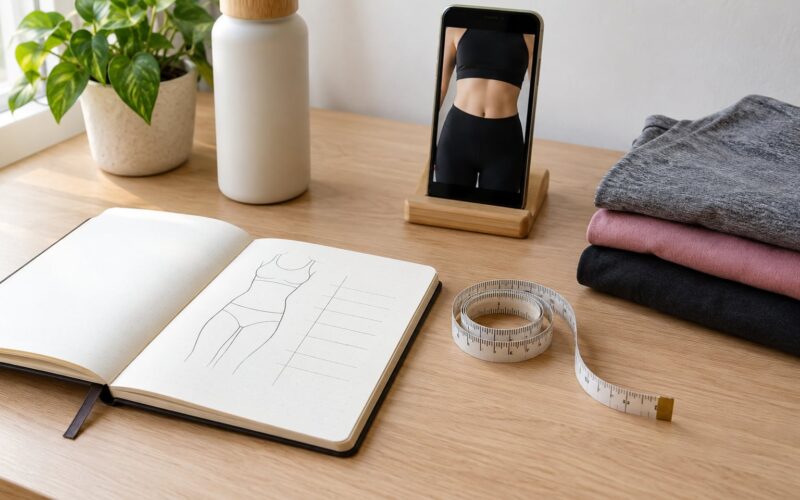
Expecting localized fat loss. You cannot choose where the fat comes off. Crunches and hip work build muscle in a specific place; they do not pull fat from there. Fix: lower the total, train the whole body, and measure with a tape measure, photos or how your clothes fit.
Two more habits worth fixing. Scheduling matters more than motivation: put the two sessions in your calendar like appointments with a dentist, because a session that has no time assigned is a session that does not happen. And know when to get guidance, because a chat with a doctor or a physical therapist is warranted before you start if you have chest pain, a diagnosed heart condition, osteoporosis, uncontrolled blood pressure, a recent joint replacement, dizziness when standing, or pain that shows up during movement.
If you are over 40 and returning to exercise after years away, an unfamiliar exercise class or a slow progression is not a cop-out. It is what other women do in your situation, and it is how they are still lifting at 60.
Frequently Asked Questions
Will strength training help a woman over 40 lose body fat?
Yes, as part of an overall calorie deficit. Lifting does not burn the most calories of any workout, but it preserves the muscle that keeps your resting metabolism high, so the fat you lose comes off your body instead of disappearing as muscle. After 40, when estrogen decline speeds up lean mass loss, that protection matters more than it did at 30.
How often should a woman over 40 do strength training to lose fat?
Two full-body sessions a week is the proven sweet spot for beginners, and three is a good goal once sessions feel easy. Leave at least one rest day between them, keep sessions to 30 or 40 minutes, and add walking on other days. Consistency over months beats three hard sessions a week for two weeks.
Is weightlifting too hard for women over 40?
No. Age does not stop anyone from building strength; untrained beginners of any age gain strength faster than trained ones do. Start with light weights, build technique for two weeks, and progress slowly. Soreness in the days after a session is normal and fades as your body adapts.
Should I feel sore after every strength workout?
No, and chasing soreness is a common mistake. Soreness usually eases after your first one or two weeks of consistent training, and mild soreness on the day after a session is fine. Sharp joint pain, pain during a movement or soreness that lasts a week are signals to change the exercise, not to push harder.
How much weight should I use when starting strength training?
Pick a load where the last two or three reps of a set feel hard, around 7 out of 10 effort, while your form stays clean. For many women that means 2 to 5 kg dumbbells. Over the first two weeks, stay lighter than you think you need to be and add reps before you add weight.
Can strength training spot-reduce fat from the waist?
No. Crunches and hip hinge work build muscle in a specific area but cannot pull fat from that area. Where fat is lost from is decided mostly by genetics, hormones and your overall calorie balance. Train your whole body, keep a moderate deficit, and judge progress with a tape measure or how your clothes fit rather than one spot on the mirror.
Conclusion
Strength training for women over 40 for fat loss is two or three full-body sessions a week, built around the squat, hinge, push, pull, step-up and press, paired with enough protein and a moderate calorie deficit. That combination is what keeps your muscle while the fat comes off, and it is repeatable for years rather than a few months.
Here is your first action, today: warm up for five minutes, then do one set each of a squat to a chair, a supported row, a wall push-up and a hip hinge, at an easy level you could repeat several more times. Book the second session for three days from now before you do anything else.
If you have a health condition, an injury, or are pregnant, talk to a doctor or a physical therapist before you start. And if a week of poor sleep or hot flashes makes the plan impossible, do the short version instead of none. The habit is the part that does the work.