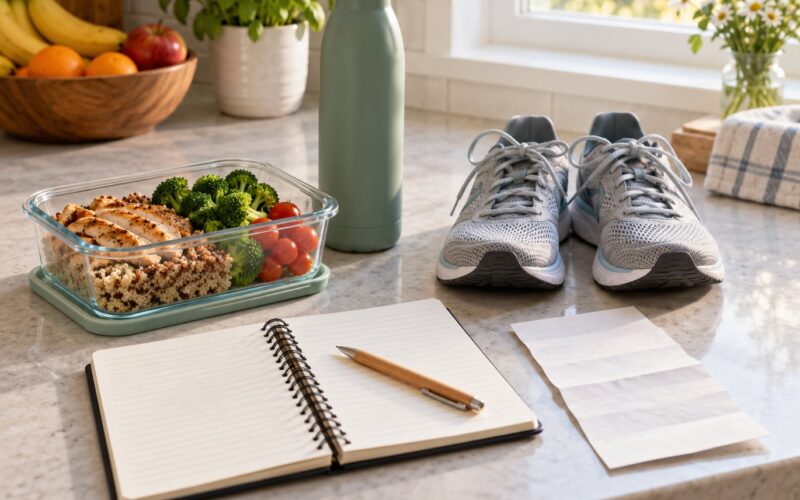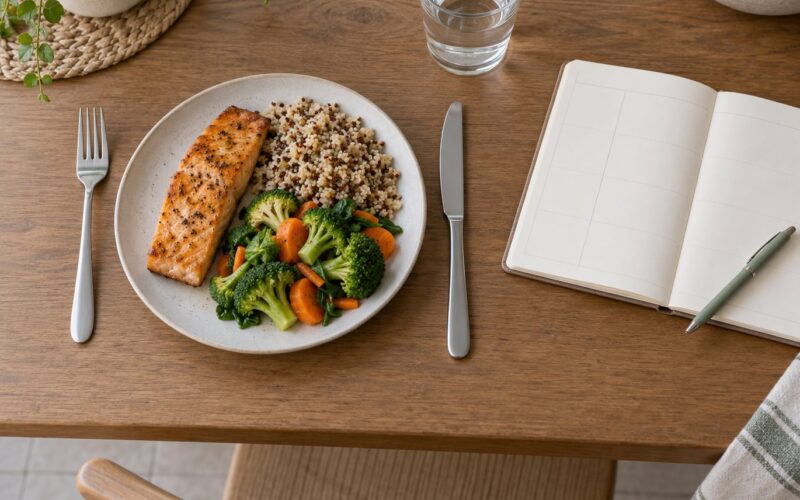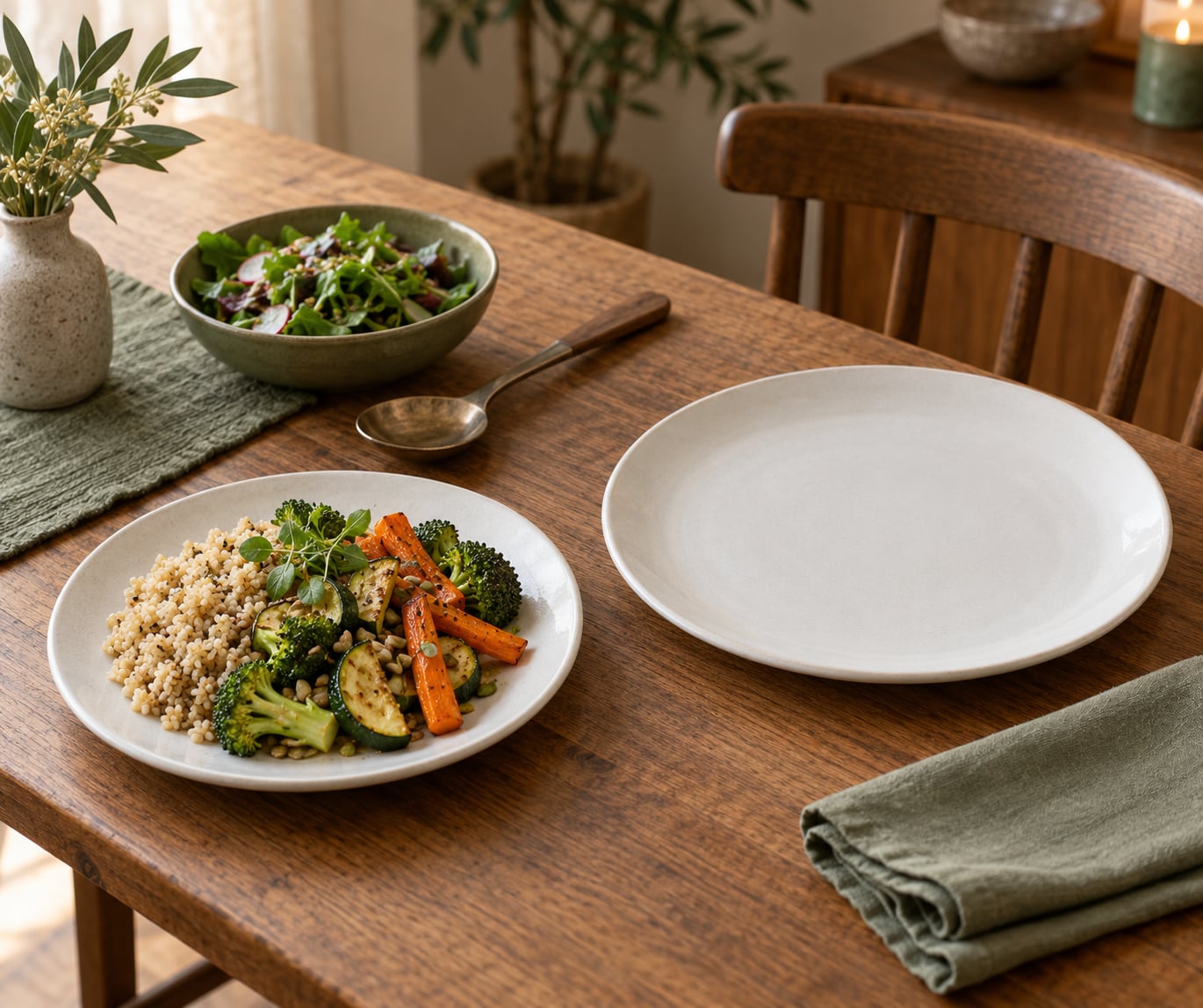
To use smaller plates to eat less, serve your food on a plate with a smaller diameter, usually 9 or 10 inches instead of a 12-inch dinner plate, and let that dish do the portioning for you. The same serving fills a smaller dish, leaves less empty space around the food, and quietly nudges you toward a slightly smaller plate and fewer second servings, with nothing to weigh and nothing to log. The effect is real in controlled studies and modest in real life, so it works best as one habit alongside vegetables and slower meals, not as a diet by itself. Setting it up takes one cupboard trip and about two weeks to feel normal.
That is the whole idea, and it is worth being precise about it. Plate size is a cue, not a rule, and it does nothing at all for you if hunger signals are ignored. The steps below keep it in that role: pick a plate that looks full, fill it with the foods you want more of, eat at a pace where you can notice fullness, and adjust once a week based on how hungry you actually feel.
Table of Contents
- What You Need
- Step-by-Step: How to Use Smaller Plates to Eat Less
- 1. Choose a modestly smaller plate
- 2. Put vegetables or salad on the smaller plate first
- 3. Portion the main food by what fits
- 4. Use a larger bowl for foods that are easy to over-serve
- 5. Eat slowly and pause halfway
- 6. Notice hunger and fullness without rigid tracking
- 7. Test the habit for one or two weeks
- Common Mistakes
- Frequently Asked Questions
- Does using smaller plates help you eat less or lose weight?
- Should I use a dessert plate instead of a regular dinner plate?
- What if I am still hungry after finishing a smaller-plate meal?
- Can smaller plates work for rice, pasta, or other large portions?
- Are small plates helpful for children, or should they be used only by adults?
- When should I ask a doctor or registered dietitian for help with portion control?
- Start With One Plate Change
What You Need
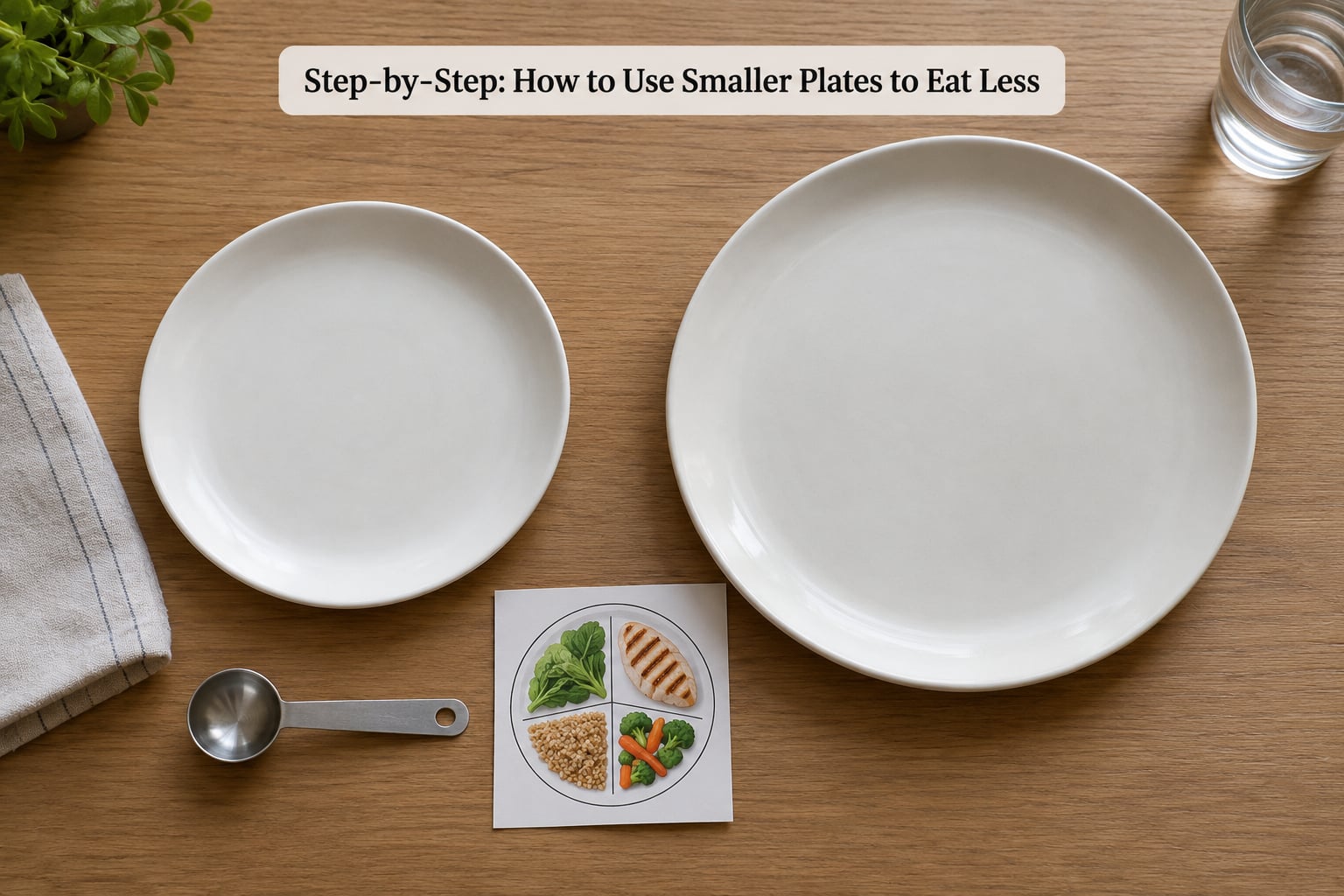
You need one dinner plate that is a little smaller than the one you use now, a serving spoon, and about two weeks of ordinary meals. That is the entire shopping list, and most people can assemble it tonight without buying anything.
Start with whatever is already in the cupboard. Dessert plates are roughly 7 inches, side and salad plates are usually 8 or 9, and a jam bowl or a saucer with a rim works for anything small. Most dinner plates now run 11 to 12 inches, so moving down to the salad plates you already own is a bigger change than it sounds. A registered dietitian quoted in 2016 news coverage put the shift plainly: dinner plates grew from about 8 or 9 inches to 11 or 12 inches over a few decades, and the same serving now looks smaller than it used to.
- A 9 or 10 inch dinner plate as your main plate. Ten inches is the easiest single swap, and nine inches is a fine second step if ten still feels huge to you.
- A serving spoon or spatula sized to the new plate, so a normal serving lands inside the rim instead of rolling over the edge.
- A high-contrast plate in a plain light colour. Light food on a white plate shows you what is actually there; a 2012 study found participants served themselves about 22% more when the plate matched the colour of the food.
- Optional: a portion guide you already have. A cupped hand and a spread hand are enough to portion rice, pasta, protein and vegetables without any kit.
What you do not need is the part most sellers would like you to buy. No food scale, no calorie app, no portion-control plate set with divided compartments, no special weighted bowls. Those tools can work, but they add friction, and the friction is exactly what makes habits collapse in week three.
Step-by-Step: How to Use Smaller Plates to Eat Less
The evidence here is mixed, and the mixed part is more useful than the headlines suggest. A 2015 review of 56 studies in the Journal of the Association for Consumer Research, co-authored by Natalina Zlatevska, linked a roughly halved plate with about 30% less food consumed, mostly when people served themselves and did not know they were being watched. A Cochrane review found moderate-quality evidence that shrinking the serving vessel lowers energy intake, with larger effects on less nutrient-dense food and weaker ones as food gets more nutrient-dense. Against that, 2018 research reported in Women’s Health Australia and Yahoo Singapore found the effect weak or absent in free-living conditions, and the Cochrane reviewers themselves say the evidence comes mostly from short, tightly controlled lab meals.
So the honest reading is that plate size nudges intake rather than dictating it. The table below is what the named sources actually reported, not a per-plate calorie promise.
| Change to the serving vessel | Reported change in intake | Where the figure comes from |
|---|---|---|
| Dinner plate reduced from 12 inches to about 10 inches | About 22% fewer calories served and eaten | Widely cited consumer research, repeated across weight-loss sources without a named study |
| Plate size roughly halved | About 30% less food consumed | 2015 review of 56 studies, Journal of the Association for Consumer Research |
| Serving vessel increased to 120-159% of normal | About 7.7% more intake | Cochrane review of serving vessel size |
| Serving vessel doubled | About 15.6% more intake | Cochrane review of serving vessel size |
| All serving dishes changed, not just dinner plates | Larger effect sizes | Cochrane review, subgroup finding |
| Real meals at home and at restaurants, people living freely | Effect weak or absent | 2018 research reported in 2018-2019 news coverage |
1. Choose a modestly smaller plate
Pick a plate that looks properly full after serving, not one that feels like a reprimand. If your dinner looks sparse and apologetic on it, you will fight the plate and go back to the big one within days, and readers in weight-loss communities describe exactly that pattern, where the trick works for a while and then quietly stops.
| Plate diameter | What it approximates | Practical use |
|---|---|---|
| 11-12 inches | About the width of both hands held side by side | The current dinner standard; your baseline |
| 10 inches | A little wider than a dinner muffin, close to a large sheet-pan side | Best single swap from a 12-inch plate |
| 9 inches | A standard salad or side plate | Comfortable full dinner; good for most adults |
| 8 inches | A typical children’s dinner plate | Works for adults; avoid pressuring children onto it |
| 7 inches | A dessert plate or bread plate | Sides, snacks and cereal rather than a full dinner |
Going below about 7 inches stops being a portion cue and starts being a small portion. If a 9-inch plate feels too small for a real dinner, that is information about the meal, not a failure of the method.
2. Put vegetables or salad on the smaller plate first
Fill the plate with vegetables first, before the starch and the protein. This does two things at once: it gives the high-volume, high-fibre food the largest share of the visual space, and it leaves less room for the foods people tend to over-serve.
In practice, take two or three ladlefuls of vegetables, a salad, or both, and let them cover roughly half the plate. Two thirds is fine too. What you want to avoid is a plate where the vegetables are a garnish in the corner and everything else needs the rest of the dish.
3. Portion the main food by what fits
Now add a normal serving of the main food, and let the remaining space on the plate define it. A cupped hand of rice or pasta and a spread hand of protein are the standard reference, and they travel with you when you eat out.
This is where the illusion does its work, and it is worth naming. The same rice spread across a wide plate with a ring of white space around it looks smaller than the same rice filling a smaller dish almost to the rim. People eat roughly in proportion to what looks proportionate, so the plate changes what looks normal rather than what your stomach asks for. If you switch from a 12-inch plate to a 9-inch one, give it three or four meals before you judge it.
4. Use a larger bowl for foods that are easy to over-serve
Some foods are not really controlled by the dinner plate at all. Cereal, nuts, pretzels, rice and pasta served from the pot are easy to keep spooning out of, because nothing marks a portion for you.
Give those foods a bowl, and the visual cue works in the opposite direction, because a larger bowl makes a small portion look bigger and makes a large one look smaller. The Cochrane subgroup finding points the same way: the effect is larger when all your serving dishes change rather than just the dinner plate. Two practical habits matter more than the bowl itself. Spoon the portion into the bowl rather than eating out of the container, and put the container out of reach when you sit down. Readers in budgeting and weight-loss forums mention snap-lid containers for the same reason, and it works without any purchase.
5. Eat slowly and pause halfway
Set your fork down about halfway through and take a ten-second look at how full you actually are. That single pause is where most of the benefit lives, because fullness takes a few minutes to register and seconds are decided before the signal arrives.
Pair the pause with a slower fork if you have one, and consider eating with your non-dominant hand, which several people in weight-loss communities mention as a way to slow the meal down. Eating in front of a screen is the single most effective way to defeat this step, because attention, not plate size, is doing the controlling.
6. Notice hunger and fullness without rigid tracking
Use the smaller plate alongside your own hunger and fullness signals, not instead of them. If you feel comfortably satisfied at the end of the meal and are not thinking about food an hour later, the portion is roughly right.
If hunger stays intense meal after meal, that is a signal to add food, usually more protein, more vegetables or a proper snack, not to shrink the plate further. Restricting harder rarely fixes an under-sized meal, and the 2016 news coverage that first made this study popular carried the strongest caution in the field: constant portion restriction breeds dissatisfaction with food, rebound eating and nutrient shortfalls.
7. Test the habit for one or two weeks
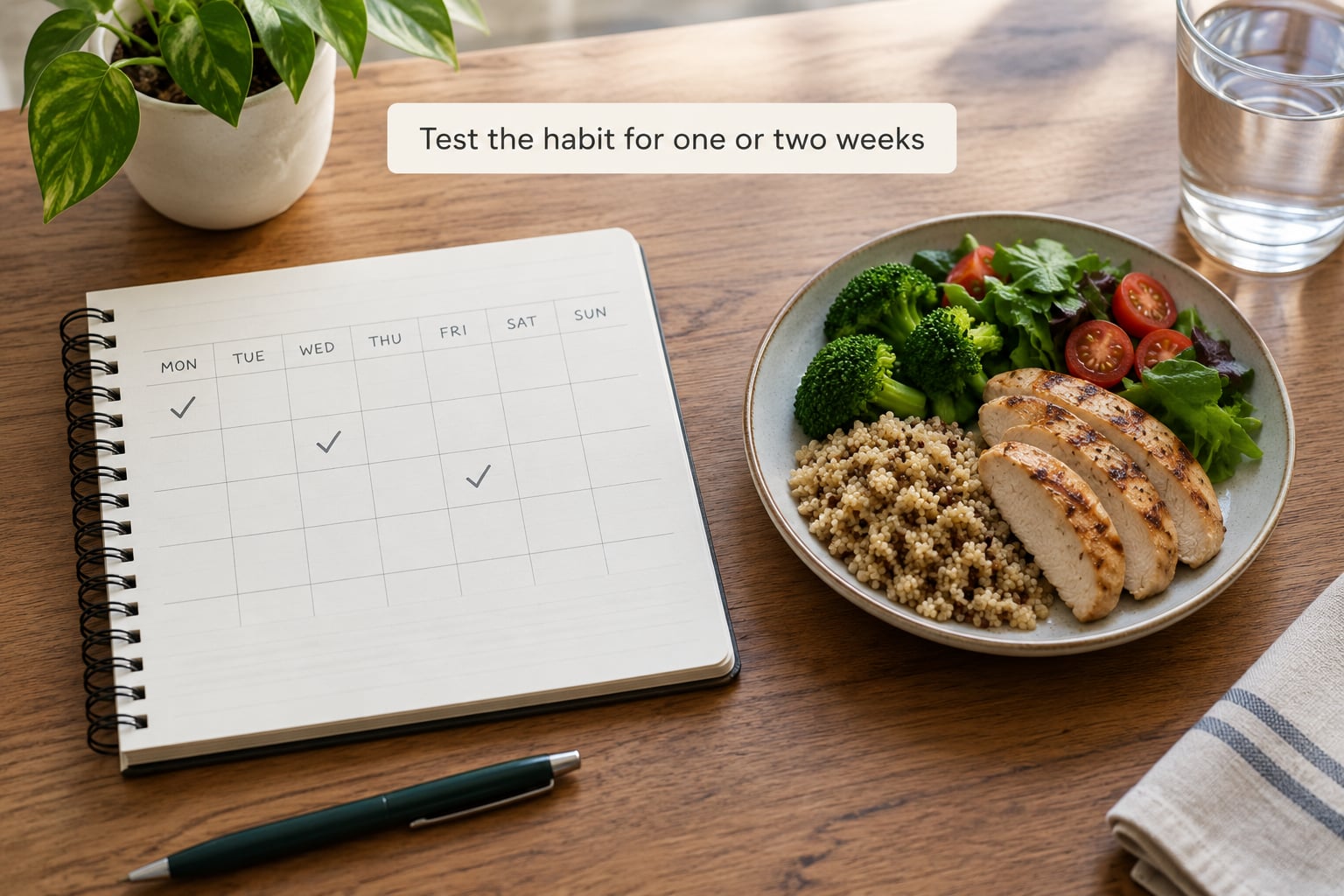
Give the new plate two weeks before you judge it, and check four things at the end: comfort at the end of meals, whether you are still hungry within the hour, your energy through the afternoon, and how much you think about food between meals. If two of those feel off, adjust the portion on the plate rather than the plate itself.
Keep the whole thing as a note with a few ticks, not a diary of calories. The point is to recalibrate what a normal portion looks like to you, and that happens in a fortnight, not a month of logging.
Common Mistakes
Going too small too fast. A 5-inch plate on the first night reads as a diet punishment, and readers describe the predictable result, a return to the big plate by week two. Fix: move one notch, from 12 inches to 10 or 10 to 9, and hold there for a fortnight before deciding anything.
Filling the plate edge to edge, then stacking. Food mounded into a heap recreates the lost volume, which is the exact signal you were trying to remove. Fix: keep the food flat, spread to the rim rather than above it, and take a second serving onto the same plate instead of enlarging the first one.
Small plate, enormous sides. A salad plate in front of a bowl of pasta and a shared bread basket has changed nothing. Fix: change every vessel in the meal at once, since the effect is stronger when bowls and cups shrink too.
Changing everything at the same time, then dropping everything at the same time. Fix: one lever for two weeks. Plate diameter first, then bowls, then cups and utensils, so you know what actually did the work.
Eating at full speed in front of the screen. Fast eating overrides the visual cue entirely, because you finish before fullness registers. Fix: put the fork down halfway, eat one course at a time, and keep the meal off the television for the first fortnight.
Using a small plate to eat less overall instead of less of some things. The goal is a different mix on the same plate, more vegetables and less of what you over-serve, not a smaller total amount of food. Fix: keep adding protein and vegetables first and treat the starch and the sides as what gets trimmed.
Blaming the method when hunger cues are ignored. Forum threads on this topic split between people it worked for and people who call it a gimmick. The difference is nearly always whether the eater was still ravenous at the end. Fix: if hunger is intense most days, the portion was too small to start with, and that is a conversation with a registered dietitian rather than a plate problem.
One claim deserves clearing up, because it keeps circulating on weight-loss supplier pages: switching plates does not shrink your stomach. Appetite does drift with consistent eating patterns, and people report eating less over time, but that is habituation to your own meals, not a physical reset of your stomach, and no study supports the stronger version.
Two groups should not lean on this trick alone. Anyone with a history of disordered eating, or who finds portion-focused thinking distressing, is better served by structured support. So is anyone managing diabetes, kidney disease or another condition where food quantities are clinically relevant, where a registered dietitian or doctor should set the targets instead of a plate diameter.
Frequently Asked Questions
Does using smaller plates help you eat less or lose weight?
They can help you eat a little less without counting anything. Serving food on a 9 or 10 inch plate makes the same portion look larger, and people tend to serve and finish less of it. Expect a modest effect, not a dramatic one, and expect better results when vegetables come first. Plate size works best as one lever alongside balanced meals and slower eating, not as a standalone diet.
Should I use a dessert plate instead of a regular dinner plate?
A dessert plate works well for sides, snacks and breakfast cereal, but a full dinner on a 7 inch plate often leaves people hungry, and many readers report stacking food higher to make it fit. A 9 or 10 inch dinner plate is the practical middle ground: full enough to look generous, small enough to change how much you serve yourself.
What if I am still hungry after finishing a smaller-plate meal?
Add a second serving onto the same plate rather than a bigger portion, and start that meal with vegetables or salad so the plate fills with volume first. If hunger stays intense day after day, your usual portions were probably too small to begin with, or you are under-eating overall. Persistent hunger is worth raising with a doctor or registered dietitian.
Can smaller plates work for rice, pasta, or other large portions?
Yes, but starches are the easiest place to lose track, so serve them with a measuring cup or a small bowl you already own rather than spooning straight from the pot. Keep one serving on the plate, eat it sitting down, and only decide about seconds once the plate is empty. Pasta and rice shrink as they cool, so a modest serving often looks small later on.
Are small plates helpful for children, or should they be used only by adults?
Use them with adults. Reviews of the evidence found the plate-size effect larger in adults than in children, and pressuring a child to finish a small plate is a quick route to a poor relationship with food. Give kids a normal plate they can fill freely, keep the food balanced, and let appetite decide how much they eat.
When should I ask a doctor or registered dietitian for help with portion control?
Ask if cutting portions makes you anxious, if you binge or feel out of control after meals, if you regularly skip meals and then overeat, or if you are managing diabetes, kidney disease or a history of an eating disorder. Restricting food without guidance is a documented route to nutrient shortfalls and rebound eating, and a registered dietitian can build portions that fit your life.
Start With One Plate Change
Replace one large dinner plate with a 9 or 10 inch one and use it for a week. Serve vegetables or salad first, portion the rest by what fits, and put your fork down halfway through the meal to see how full you are. Adjust from how hungry you feel rather than from a number, and keep it only if meals end with you satisfied. One plate, one fortnight, no tracking.