
If you ask why you get hungry at night and how to stop it, the honest answer is that evening hunger is a real appetite signal, not a character flaw. Most people land on one of seven causes: under-eating during the day, an overnight blood sugar dip, a misaligned body clock, too little sleep, stress, a conditioned habit, or an underlying health condition. Once you know which one is running your evenings, you can fix the right thing.
The fix that works most often is boring and unglamorous. Eat regular meals through the day, put protein and fiber at every sitting, move your last meal to two or three hours before bed instead of five hours before, and go to bed at a consistent hour. People who chase this with restriction usually end up hungrier at 9pm than the people who simply ate a better lunch.
Below is the full walkthrough, including a self-check that sorts real hunger from habit, boredom and emotion, and a clear line for when a doctor should take over.
Table of Contents
- What You Need
- A food and symptom journal
- A balanced evening meal
- One planned snack
- A consistent sleep routine
- Water within reach
- Step-by-Step: Why Do I Get Hungry at Night and How to Stop It
- Why Do I Get Hungry at Night?
- Cause 1: You are not eating enough during the day
- Cause 2: Blood sugar drops overnight
- Cause 3: Your body clock is off
- Cause 4: You are not sleeping enough
- Cause 5: Stress and cortisol
- Cause 6: It is habit, not hunger
- Cause 7: A medical cause
- Build a More Satisfying Daily Eating Pattern
- Put protein and fiber in every meal
- Stop skipping meals when you are trying to lose weight
- Front-load rather than restrict all day
- Improve What You Eat in the Evening
- What to reach for when the hunger is real
- What to limit instead of eliminate
- Manage Hunger Before It Becomes a Craving
- Run the 30-second self-check
- Pause ten minutes and drink water
- Move, do not eat
- Close the kitchen
- Have the planned snack
- Common Mistakes
- Skipping meals to save calories for the evening
- Relying on packaged snacks that say graham cracker or protein bar on the label
- Eating straight from the package while standing in the kitchen
- Treating every craving as a failure of discipline
- Staying up late and calling it hunger
- Fixing evening hunger only in the evening
- Waiting months before asking a doctor
- Who Needs a Different Approach
- When It Is More Than a Habit
- Frequently Asked Questions
- Is eating at night bad for you?
- What causes hunger at 3am specifically?
- How do I keep from waking up hungry?
- What should I eat when I have cravings at night?
- Can supplements stop night eating?
- What is the 3-3-3 rule for eating, and does it work?
- What is ADHD food noise?
- Conclusion
What You Need

You do not need an app, a supplement stack, or a special food. You need five ordinary things, and four of them are free.
A food and symptom journal
A notebook or note app. Write down the time, what you ate, whether you were genuinely hungry, what you were doing beforehand, and how you slept. Ten days is enough to reveal a pattern. Most people find their hunger lands within the same 20-minute window every night, usually after an early and light dinner.
A balanced evening meal
A plate with a protein source, a vegetable or fruit, and a satisfying carbohydrate. Chicken with rice and broccoli, or tofu with quinoa and peppers, works. The carbohydrate matters as much as the protein, because dropping it entirely is one of the fastest routes to 10pm hunger.
One planned snack
Decide in advance what a night snack looks like, and put it where it is easy to reach. Greek yogurt, a small handful of nuts, a boiled egg, or fruit with cheese. A planned snack is different from a free-for-all in front of an open cupboard.
A consistent sleep routine
A consistent wake time does more for appetite than any bedtime ritual. Pick one time, including weekends, and hold it within about an hour.
Water within reach
A glass of water and something savory to sip. Thirst gets reported as hunger often enough that this is the cheapest first test.
Step-by-Step: Why Do I Get Hungry at Night and How to Stop It
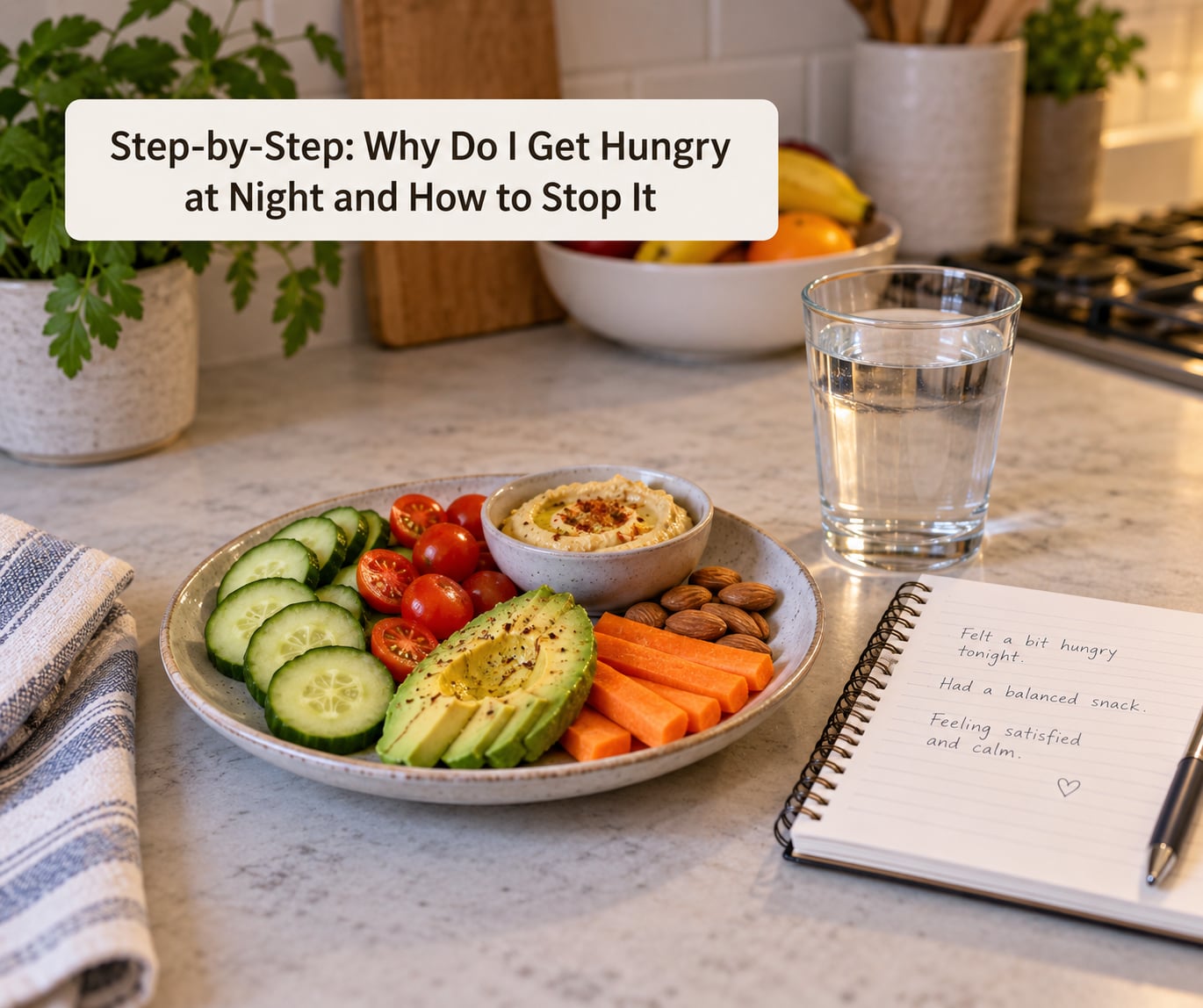
Work through this in order rather than all at once. Each step depends on the one before it: you cannot fix a blood sugar dip you have not noticed yet, and you cannot judge whether a habit change worked while your sleep is still a mess.
Why Do I Get Hungry at Night?
Evening hunger happens because your appetite hormones, blood sugar and body clock all peak on a schedule you may not be living on. The stomach releases ghrelin to signal emptiness, leptin signals fullness back, and cortisol drives carbohydrate cravings when you are stressed. When any of those systems is off schedule, hunger lands at 9pm or 2am instead of mealtimes. In most people at least one of the seven causes below is doing the work.
Cause 1: You are not eating enough during the day
A large calorie deficit, a skipped lunch, or an unusually light day all show up as evening hunger. Your body does not care that the deficit was intentional on Monday. It only registers that energy is short and pushes the strongest hunger signal into the quietest part of the day.
Cause 2: Blood sugar drops overnight
A dinner heavy in refined carbohydrates and low in protein and fiber produces a glucose spike, then a sharp fall. That fall is reactive hypoglycemia in its mild form, and it feels identical to hunger. The pattern repeats nightly, often about two to three hours after eating, which is why many people describe waking hungry around 3am.
Cause 3: Your body clock is off
Circadian rhythm governs when ghrelin and leptin peak. Shift work, a very late dinner, jet lag and a bedtime that drifts later every week can push the hunger peak into the middle of the night. On a delayed schedule, a perfectly adequate day of eating still leaves you starving at 2am.
Cause 4: You are not sleeping enough
Sleep deprivation raises ghrelin and lowers leptin, so you wake up physically hungrier than the day before. People who cut sleep to six hours or fewer tend to eat more the following evening without noticing the change. Tiredness also removes the judgement you would normally use to skip the cupboard.
Cause 5: Stress and cortisol
Cortisol rises during stress and specifically increases cravings for quick carbohydrate. The late evening is often the first quiet hour of the day, which is exactly when unresolved stress gets attention. Food becomes the fastest way to end the feeling.
Cause 6: It is habit, not hunger
Same sofa, same time, same television. Enough repetition and the cue alone starts the craving before any physical signal appears. This is a conditioned loop rather than a need for calories, and it responds to environmental change rather than to willpower.
Cause 7: A medical cause
Several conditions produce late-night hunger that no food change will fix. Hypothyroidism slows metabolism, iron deficiency anemia causes fatigue that reads as hunger, insulin resistance and diabetes change how glucose is handled, and GERD or gastritis mimic hunger as burning or gnawing in the upper abdomen. PMS, corticosteroids, and stimulants such as amphetamines also shift appetite hard in both directions. If night hunger came on suddenly, or comes with weight changes and unusual thirst, treat that as a medical question rather than a habit question.
This table is the fastest way to see which row sounds most like you:
| Cause | What is actually happening | What fixes it |
|---|---|---|
| Under-eating during the day | An energy shortfall accumulates until evening | Add a meal and a snack, and shrink any deficit you are not tracking |
| Overnight blood sugar dip | Refined carbohydrates spike, then glucose falls | Pair protein and fiber with every carbohydrate, especially at dinner |
| Misaligned circadian rhythm | Hormone peaks shift away from your meal times | Fixed wake time, bright light in the morning, steady meal timing |
| Sleep deprivation | Ghrelin rises and leptin falls | Protect a consistent sleep window before changing anything else |
| Stress and cortisol | Cortisol drives quick carbohydrate cravings | Ten minutes of downshifting activity before the kitchen opens |
| Conditioned habit | A repeated cue triggers the urge without hunger | Change the cue: close the kitchen, move rooms, brush teeth |
| Medical cause | Hormones, blood cells or metabolism are affected | See a doctor, especially with weight change or unusual thirst |
Build a More Satisfying Daily Eating Pattern
Evening hunger is usually a daytime problem that finishes at 9pm. Space meals roughly every three to four hours so the stomach is never running completely empty, and make each sitting count.
Put protein and fiber in every meal
Protein and fiber are the two components that slow digestion and blunt the ghrelin rise afterwards. Aim for something like a palm-sized protein and a fist-sized vegetable or fruit at each main meal, with beans, lentils, oats, nuts and seeds appearing somewhere in the day. A lunch of salad leaves and crackers leaves most people starving by dinner.
Stop skipping meals when you are trying to lose weight
This is where most weight-loss attempts generate their own night hunger. A deficit of a few hundred calories a day is manageable. Skipping meals to create it reliably produces evening hunger, and evening hunger produces the large, unplanned snacks that cancel out the plan.
Front-load rather than restrict all day
Putting more of your intake earlier in the day gives ghrelin and leptin the schedule they expect. If you train in the evening, eat the larger carbohydrate portion with lunch or a mid-afternoon meal rather than after 9pm. New parents and shift workers face a genuinely different version of this, covered below.
Improve What You Eat in the Evening
Dinner sets the tone for the night. A meal with all three macronutrient groups holds its shape for hours; a large high-sugar meal does not. Aim to finish eating two to three hours before you lie down, which also protects your sleep and reduces reflux.
What to reach for when the hunger is real
Keep it small and combine protein with carbohydrate or fiber. That pairing steadies blood sugar and satisfies the stomach for longer than a sweet snack of the same size, and it will not spike your blood sugar just as you are trying to fall asleep.
A few combinations that work well:
- Greek yogurt with a small handful of berries
- An apple or banana with peanut butter or almond butter
- Cottage cheese or a small bowl of cereal with milk
- Boiled eggs with a few whole-grain crackers
- Edamame with a small handful of nuts
- Rye crackers with hummus and sliced cucumber
- Warm milk, which carries tryptophan and is a low-calorie option
Turkey and cottage cheese get mentioned often because both contain tryptophan, the amino acid used to make serotonin and melatonin. The effect is modest, and it is not a sleep treatment.
What to limit instead of eliminate
| Eat before bed | Why it helps | Limit before bed | Why it works against you |
|---|---|---|---|
| Cottage cheese, Greek yogurt | Protein plus tryptophan, steady blood sugar | Large high-sugar desserts | Glucose spike then crash, and it lifts you out of sleep |
| Nuts, seeds, nut butter | Fat and protein slow gastric emptying | Refined crackers and chips | Quick carbs, low fiber, easy to overeat from the bag |
| Beans and lentils with a grain | Fiber holds satiety through the night | Caffeine after mid-afternoon | Even six hours of caffeine can delay sleep, and poor sleep drives hunger |
| Vegetables and fruit | Volume and fiber for few calories | Alcohol near bedtime | Disrupts sleep architecture, and lower sleep means more hunger next day |
| Whole grains such as oats or quinoa | Complex carbohydrate releases slowly | Very large meals close to lying down | Reflux and discomfort, which keeps you awake |
| Herbal tea, sparkling water | Warmth and volume without calories | Ultra-processed snacks from an open bag | Hard to portion, easy to eat well past hunger |
Ultra-processed and high added-sugar foods are the usual culprits. They are fine sometimes. The problem is the combination of low fiber, high glycemic load and easy portioning, which is why the same person can feel hungry again an hour after finishing a large bag.
Manage Hunger Before It Becomes a Craving
The gap between hunger and craving is where the useful work happens. Hunger is a physical signal with a slow build. Craving is fast, specific and attached to a situation. The steps below all work on that gap.
Run the 30-second self-check
Before you eat, ask four questions. They are adapted from the kinds of questions dietitians use to separate triggers.
- Physical hunger? Gradual onset, felt in the body, would be satisfied by any balanced food, and settles after eating. Yes to most of these means eat a planned snack.
- Habit? Arrives at the same minute, tied to a place or an activity, and you would not feel it if the evening were different. This one needs a cue change, not a snack.
- Emotion or boredom? Urgent, tied to a thought, and relieved by eating without being satisfied by it. Delay ten minutes and do something else first.
- Medical? Comes with unexplained weight change, extreme thirst, frequent urination, chills, palpitations, or burning upper-abdominal pain. This one belongs with a doctor.
If you answered no to the first question and yes to another, you have your answer for tonight.
Pause ten minutes and drink water
Set a timer rather than relying on intention. Drink a full glass of water during it. Thirst registers as hunger often enough that people on forum threads describe water loading before bed as the difference between quiet nights and restless ones.
Move, do not eat
Ten minutes of walking, stretching, or tidying something breaks the settled, low-energy state where cravings live. It works better when it happens before you feel hungry, so anchor it to the end of dinner.
Close the kitchen
Decide a closing time, then brush your teeth and leave the kitchen. Moving to another room works too. People on eating-disorder forums emphasise that going to bed hungry can be triggering for some, and that is a reason to plan a small snack rather than to tough it out.
Have the planned snack
If the hunger is real, eat. A small protein-based snack beats a large high-sugar meal because you will be hungry again in an hour and reach for something worse. Then finish for the night.
Common Mistakes
Most evening hunger problems are maintained by well-intentioned strategies. These are the ones I see back most often.
Skipping meals to save calories for the evening
By 9pm the deficit is large enough to override every plan. The saved calories come back in the form of a snack nobody planned and nobody counts. Eat through the day and cut portion sizes instead.
Relying on packaged snacks that say graham cracker or protein bar on the label
Many are built around refined carbohydrate, which is exactly the spike-and-crash pattern that produces more hunger. Read for protein and fiber per serving, not for the word protein on the front.
Eating straight from the package while standing in the kitchen
Portion control is not a character trait. Put a serving on a plate and put the bag away. People who do this report the same thing: the bag amount was never what they intended to eat.
Treating every craving as a failure of discipline
That framing keeps people stuck for years. A craving triggered by stress or a conditioned cue is information about a trigger, not a verdict on you. Naming the trigger is what makes it changeable.
Staying up late and calling it hunger
Some 10pm cravings are fatigue. Sleep earlier and many of them simply stop appearing, because short sleep is one of the strongest drivers of next-evening overeating.
Fixing evening hunger only in the evening
Changing dinner helps. Restructuring lunch and lunch-to-dinner spacing helps more. Treat the whole day as the intervention.
Waiting months before asking a doctor
Night hunger that started suddenly, comes with weight loss, or arrives with extreme thirst and frequent urination deserves assessment now. Thyroid problems, iron deficiency and diabetes are common, treatable, and easy to miss if you assume they are lifestyle.
Who Needs a Different Approach
Shift workers have a body clock pointing at the wrong time of day, so a fixed meal schedule built around daylight will not work. Anchor meals to your shift, keep the same composition each time, and use the first part of your sleep period as the equivalent of your night.
New parents and breastfeeding mothers describe night hunger as physiological rather than a discipline problem, and they are right. It is also genuinely hard to eat properly at 2am with a baby. Keep foods that need no preparation within reach, and accept that the goal is a small balanced snack rather than an ideal meal.
People taking stimulants or ADHD medication often describe the inverse pattern: no appetite all day, then intense hunger once the medication wears off at night. That is a medication signature rather than a willpower problem. Do not change or stop a prescribed medicine to fix it. Talk to the prescriber, and try front-loading the appetite window you do have.
Frequent travelers should keep meal times anchored to home time rather than local time, which protects the appetite pattern more than adjusting to each destination does.
When It Is More Than a Habit
Night Eating Syndrome is the clinical version of this pattern and affects an estimated one to two percent of the general population. Clinicians generally look for eating that accounts for a substantial share of daily calories after dinner, commonly described as around 25 percent or more; waking to eat at least twice a week; awareness of the eating while it happens; and distress about it, sustained across at least three months.
If you meet those marks and the pattern is distressing, that is a good reason to seek treatment. Approaches clinicians use include cognitive behavioral therapy focused on the eating pattern, structured meal timing, sleep work, and in some cases medication. Waiting for it to resolve on its own is rarely necessary.
Urgent rather than routine: seek prompt medical care for night hunger accompanied by chest pain, difficulty swallowing, vomiting blood, black stools, fainting, or severe burning stomach pain.
Frequently Asked Questions
Is eating at night bad for you?
Occasionally, no. A calorie eaten at 10pm is metabolized much like one eaten at noon. The problems come from the pattern, not the clock: repeated large late meals, high-sugar snacks that disrupt sleep, and reflux when you lie down soon after. Research on people who eat between 11pm and 5am has found they tend to consume around 500 more calories a day, which matters mainly because of the total. If you are genuinely hungry at night, a small protein-based snack is a reasonable choice.
What causes hunger at 3am specifically?
Three things usually. A dinner high in refined carbohydrates and low in fiber can leave blood sugar low two or three hours later, which feels exactly like hunger. Late or skipped meals can do the same. And a delayed circadian rhythm shifts the normal ghrelin and leptin peaks into the middle of the night. The pattern worth checking is whether you can fall back asleep after eating. If you cannot, that points toward reflux or sleep disruption rather than hunger alone.
How do I keep from waking up hungry?
Start with the evening meal and the wake time. Eat dinner two to three hours before bed with protein and fiber in it rather than a large carbohydrate-heavy meal. Then hold a consistent wake time, including at weekends, because short sleep raises ghrelin and lowers leptin. If hunger still wakes you most nights for more than a month, and eating ruins your sleep, bring that pattern to a doctor rather than continuing to adjust meals alone.
What should I eat when I have cravings at night?
Aim for something small that pairs protein with carbohydrate or fiber. Greek yogurt with berries, an apple with peanut butter, cottage cheese, boiled eggs with whole-grain crackers, or edamame with nuts all hold steady for hours. A glass of warm milk works too. What to skip is a large refined carbohydrate meal, which spikes and crashes your blood sugar and leaves you hungry again within the hour. Portion matters more than the specific food.
Can supplements stop night eating?
No supplement is proven to treat night eating. Magnesium, tryptophan, and vitamin D come up often online, but the evidence is anecdotal or indirect, and none addresses the underlying pattern of meal timing, sleep or stress. Be especially cautious with anything marketed specifically for appetite suppression, and check interactions with prescriptions and thyroid or kidney medication with a pharmacist before trying it. Behavioral changes and, where relevant, therapy have far better support behind them.
What is the 3-3-3 rule for eating, and does it work?
The 3-3-3 rule is used for more than one thing online, so check where you saw it before acting on it. The version people usually mean for blood sugar is three main meals spread through the day rather than one large evening meal. It is a reasonable idea, and it lines up with the better-supported advice of eating roughly every three to four hours. It is not a clinical standard, and it will not fix night hunger caused by sleep loss, stress or a medical condition.
What is ADHD food noise?
Food noise is intrusive, constant thinking about food that continues when you are not physically hungry. Thoughts about what to eat next, replaying meals, or scanning for the next thing to eat occupy real attention and often peak when you are tired at night. It is widely reported alongside ADHD and alongside stimulant medication, which can suppress appetite during the day and leave strong hunger as medication wears off. Do not adjust prescribed medication for this. A clinician familiar with ADHD can help with the food-noise side of things.
Conclusion
Start with the record. For ten days, note when evening hunger shows up, what you ate that day, and what you were doing just before. That log usually points at one of the seven causes above, which is what makes the rest of the work simple.
Then make two changes at once: one fix to your eating, usually a better lunch or a properly built dinner two to three hours before bed, and one fix to your evening, usually a fixed wake time or a closed kitchen. Most people notice a difference within two weeks. If hunger comes with unexplained weight change, extreme thirst, or an upper-abdominal burn, skip the self-help and book a doctor appointment.
This article is general information, not medical advice. For advice about your own situation, speak with a doctor or a registered dietitian.