There is no single magic number, but most adults do best somewhere around 7,000 to 10,000 steps a day when weight loss is the goal. Below that you may barely be moving much, above it the returns shrink. The number only matters alongside what you eat, so the honest answer is a range plus consistency, not a magic figure.
That is the short version. The long version is messier, because two people walking the same 8,000 steps get very different results. I have walked with desk workers who got more out of 6,000 steps than a neighbor who hits 14,000 and eats the difference. Let me show you how to work out the number that fits your day, and why chasing a pedometer record is often the least useful thing you can do.
Table of Contents
- How Many Steps a Day Are Needed to Lose Weight?
- Do More Steps Always Lead to More Weight Loss?
- Which Daily Step Target Is Right for You?
- A Realistic Step Goal by Starting Level
- How to Increase Your Steps Without Making It Hard
- Does Step Count Matter More Than Diet?
- How Many Calories Does Walking Burn?
- How Long Until Walking Helps Me Lose Weight?
- Safety and Recovery When Increasing Daily Steps
- Frequently Asked Questions
- Do I need to walk 10,000 steps a day to lose weight?
- Can I lose weight with 8,000 steps a day?
- Can I lose weight if I walk 5,000 steps a day?
- Can I lose weight by walking 30 minutes every day?
- How many steps a day do I need to lose 2 pounds a week?
- What is the 6-6-6 walking rule?
- Conclusion: Start With a Target You Can Repeat
How Many Steps a Day Are Needed to Lose Weight?
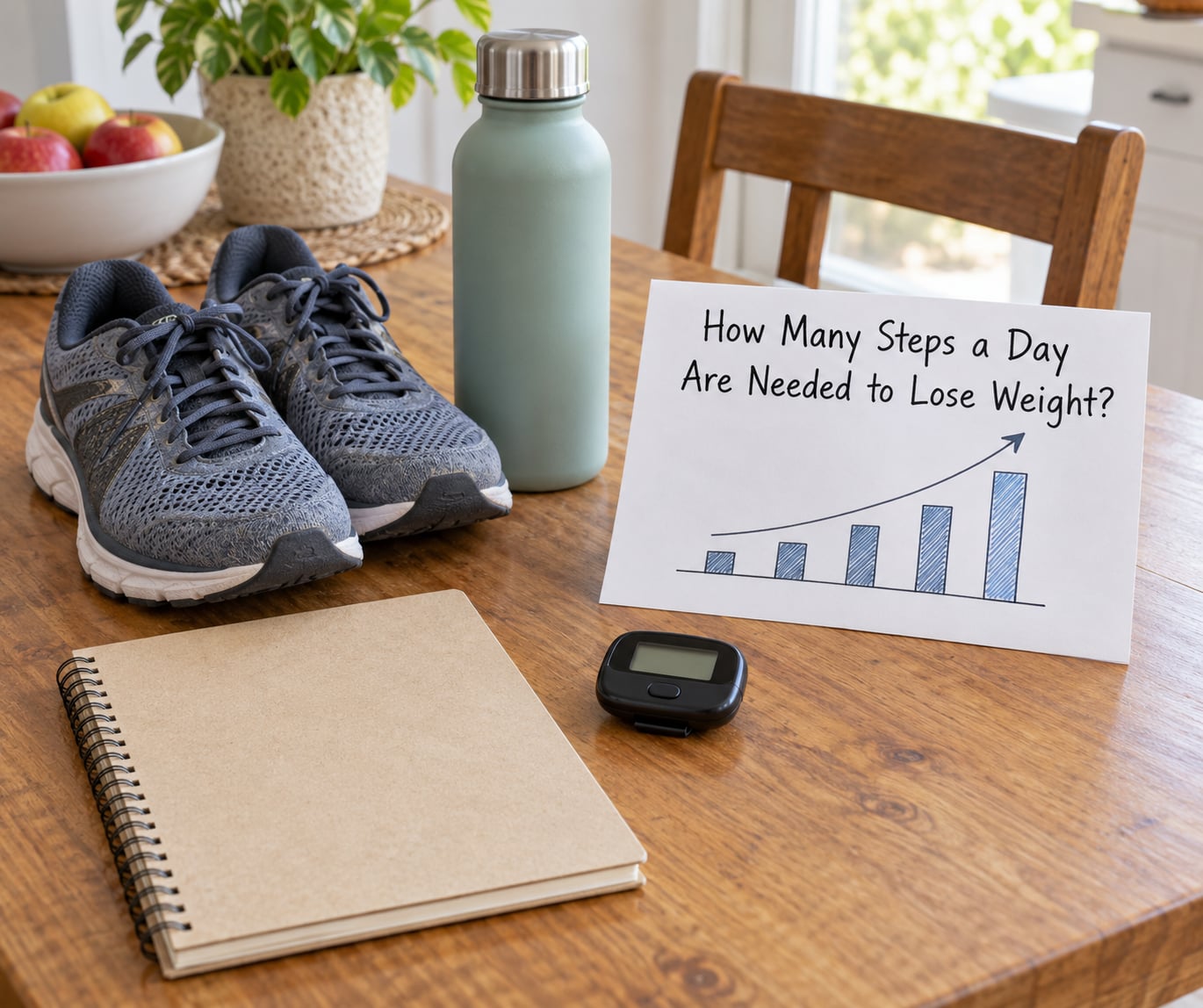
Weight comes off when you burn more energy than you take in over weeks, and a calorie deficit is the plain-English name for that gap. Walking creates a small daily surplus of expenditure, which is exactly why step counts show up in weight loss conversations at all.
- Under 5,000 steps: roughly the sedentary baseline for many desk-based adults. Useful as a starting point, rarely enough on its own for fat loss.
- 7,000 to 8,000 steps: the range where most research sees health benefits clearly separate from very low activity. A solid first target for a beginner.
- 10,000 steps: the familiar round number, and a reasonable goal for an already active adult. Plenty of people see visible change here.
- 12,000 steps and up: fine if you enjoy it and your joints agree. Additional steps past this point produce smaller returns for most people.
One thing worth knowing: 10,000 was a marketing number before it was a research number. It comes from a 1965 Japanese campaign for a pedometer called manpo-kei, whose tagline was roughly ten thousand steps a day for good health. Public health campaigns in the early 2000s adopted it, and it stuck so thoroughly that many people now treat it as a medical threshold. It is not one.
The studies people cite for step targets mostly measured something narrower than fat loss. A widely reported review found that around 7,000 steps a day was linked to a substantially lower risk of dying from any cause compared with a much lower step count. Another review found the benefits appear to level off near 6,000 to 8,000 steps for adults over 60 and around 8,000 to 10,000 for younger adults. Those are mortality and cardiometabolic findings, useful but not identical to “how much weight will I lose.”
One study did look at weight directly: researchers put people on a calorie-restricted diet and added a daily target of 10,000 steps, and found weight loss improved when roughly 3,500 of those steps were done at a higher intensity. The intensity detail matters more than the round number does.
Do More Steps Always Lead to More Weight Loss?
No. The relationship flattens out, and the reason is partly biology and partly habit. The benefit most people get from a step goal comes from getting off the sofa and moving consistently, not from the difference between 9,000 and 11,000 steps.
Several things change the result. Pace matters: the same step at a slow stroll costs less than at a brisk walk. Body size matters, because you are moving more mass. Terrain, age, fitness level and stride length all shift the cost per step. A tall person with a long stride takes fewer steps to cover the same distance.
Then there is the effect that trips people up most often. Once you start burning noticeably more, some of that gets spent before you notice, through a bigger lunch, a pastry with the coffee, an extra portion at dinner. Walkers regularly describe walking off 300 to 500 calories on a big walking day and quietly eating it back. That is not weakness, it is normal appetite regulation responding to a bigger burn, and it is the main reason a step number can rise while the scale sits still.
Basal metabolic rate, or the energy your body uses just to stay alive, also shifts over time. As weight drops, the same walk costs fewer calories than it did three months earlier. Your body adapts, and a routine that worked at 220 pounds does less at 180.
Which Daily Step Target Is Right for You?
Start from where you actually are, not from where you wish you were. The table below gives rough starting points by current activity level, the difficulty you can expect in week one, and what each level is actually useful for.
| Starting level | Daily target | How it will feel at first | What it works for |
|---|---|---|---|
| Currently inactive, desk-based day | 5,000 to 7,000 | Hard for two to three weeks, then normal | Reversing a sedentary baseline, heart health, first fat loss |
| Walks regularly but under 7,000 | 7,000 to 9,000 | Comfortable, needs planning rather than effort | Steady gradual fat loss alongside normal eating |
| Already averaging 8,000 or more | 9,000 to 11,000 | Mostly habitual | Weight loss and maintenance, calorie flexibility |
| Over 60, or returning after injury | 6,000 to 8,000 | Depends on joints and sleep quality | Health markers, blood pressure, balance, mobility |
| Very active, high-volume walker | 12,000 and up | Part of the job, not a chore | Endurance, maintenance, appetite management |
A Realistic Step Goal by Starting Level
If you currently average 3,500 steps, do not set 10,000 on Monday. Most people who quit walking quit in the first three weeks because their calves, knees or feet object, not because they lack willpower.
Raise your average by about 10 to 20 percent a week, which on a 4,000-step baseline is roughly 400 to 800 extra steps. That might be a ten-minute walk after lunch plus parking two rows further from the shop. Once the new number feels ordinary, raise it again.
Use your weekly average, not your best day. A tracker that shows 14,000 on Saturday and 2,800 on Sunday has not moved your fitness much, and a low day is data, not failure. Many people find a target they can hit on a bad day beats an ambitious one they miss half the time.
How to Increase Your Steps Without Making It Hard
You do not need an hour of dedicated walking to add meaningful steps. Most of the increase can come from ordinary errands that stop looking like a place you pass through.
- Walk after meals, even for ten to fifteen minutes. Several short walks are easier to fit and easier to repeat than one long block.
- Take the stairs instead of the lift when it is one or two flights.
- Park at the far end of the car park, or get off the bus a few stops early.
- Walk during phone calls that do not need a screen, or turn one meeting a day into a walking meeting.
- Stand or pace during phone calls instead of sitting still.
- Walk the long way round in shops and supermarkets, which is less conscious effort than a deliberate detour.
- Keep easy shoes by the door. Starting is the hard part, so remove the friction.
- Use a comfortable pace you can hold while still speaking in short sentences. Brisk beats slow for the same minutes.
- Look at your weekly trend each Sunday, and adjust the following week rather than reacting to one bad day.
- Build in a rest or easy day when your legs are sore or your sleep was poor.
Ten thousand steps is roughly 4.5 to 5 miles for most adults, and it can take anywhere from 60 to 90 minutes of walking. Spread across a day it is not a workout at all, which is the entire point. A half hour of brisk walking is roughly 3,000 to 4,000 steps on its own.
Watch your feet and shins. Soreness in the first week of a genuine increase is normal. Sharp pain in your foot arch, persistent shin pain, or a knee that aches the following morning is a signal to drop back to your previous volume for a few days, get properly fitted supportive shoes, and if it keeps happening, see a clinician.
Does Step Count Matter More Than Diet?
No, and the argument is worth settling plainly because plenty of people find this frustrating. Food decides how many calories enter your system, and walking decides how many leave it. A step goal is a way to raise the leaving side without changing the entering side at all, which is why it is often the easier half of the equation to stick to.
That said, a step count on its own rarely produces dramatic change, and anyone who can eat several hundred calories back without noticing has built a very fragile routine. The more useful combination is a step habit alongside regular meals with adequate protein, mostly minimally processed food, and plenty of water.
The quiet advantage of walking is adherence. Nobody fails at a diet because they could not find time for a ten-minute walk after dinner. Time is the resource people actually run out of, which is why the walking side of the plan usually survives longer.
How Many Calories Does Walking Burn?
Any figure you find is an estimate, because the real number depends on your body weight, your walking speed, how long you are out, your fitness level and your individual metabolism. Two people of the same age walking the same 6,000 steps at the same pace can burn noticeably different amounts.
Roughly speaking, a moderate walk burns somewhere in the region of 300 to 500 calories for a full 10,000-step day for an adult, more if you are heavier or walking briskly, less if you are small or strolling. Take those as a range, not a receipt.
The tempting move is to treat the estimate as permission. Do not. Wearable calorie figures are rough to the point of being approximate, and a 300-calorie estimate undone by a coffee and a pastry is a very common way to end a week exactly where it started. Use the number for rough comparison between days, not as a figure to eat back.
If you want numbers precise enough to plan around, a registered dietitian or doctor can help you work out your energy needs properly. That is worth doing before you attempt anything aggressive.
How Long Until Walking Helps Me Lose Weight?
Expect weeks, not days. Walkers commonly report the first noticeable changes in clothing fit and measurement around four to eight weeks in, and a modest, steady rate of roughly half a pound to a pound a week when diet is also under control.
Day-to-day weight swings are normal and mostly meaningless. Water retention, salt, a large meal, a bowel movement, the menstrual cycle, medication and poor sleep can all move the scale by several pounds in a morning. A woman in the luteal phase of her cycle, for instance, often carries a couple of extra pounds of fluid that disappears a few days later.
Look at the trend line over two to three weeks, and compare waist measurement to the scale. If weight changes are unexpected, rapid, or come with fatigue, dizziness, thirst or other symptoms, talk to a clinician rather than adjusting your walking.
Safety and Recovery When Increasing Daily Steps
This is general information about walking, not a diagnosis or a personal exercise plan. Anyone with an existing health condition, an injury, ongoing pain, or a long sedentary stretch should get medical advice before increasing daily volume.
Progress gradually, keep at least one easier day each week, and treat a step target as a weekly average rather than a daily quota. Supportive, properly fitted footwear matters more than any gadget. Stay hydrated, particularly in warm weather, and eat and drink enough that you are not trying to out-walk an inadequate diet.
Stop and seek advice if you develop chest pain, unusual shortness of breath, dizziness, palpitations, or joint pain that persists or worsens. People over 60, those living with diabetes or heart conditions, and anyone recovering from surgery or injury should ask a professional how much walking is appropriate for them. Plenty of walking plans are available through a doctor or a physical therapist, and they are worth the appointment.
Frequently Asked Questions
Do I need to walk 10,000 steps a day to lose weight?
No. 10,000 is a useful benchmark rather than a requirement, and it started as a 1965 marketing number for a Japanese pedometer rather than a research finding. Many people see fat loss in the 7,000 to 9,000 range, especially if their baseline was much lower. What matters is the size of the increase from your normal day, how consistently you hold it, and whether your eating is also in a deficit.
Can I lose weight with 8,000 steps a day?
Yes, for most people. If 8,000 steps is a real increase on what you were doing before, it burns meaningful extra energy every day and that adds up to fat loss over weeks. It will not do much if you eat back the calories, so treat the step count as the easy half of the change. A rough rate of about half a pound a week is a realistic expectation alongside sensible eating.
Can I lose weight if I walk 5,000 steps a day?
Often yes, because 5,000 can represent a large jump for someone who was sedentary, and that first increase is where most of the benefit happens. Five thousand steps on its own is unlikely to produce fast loss for someone already active. Think of it as a strong foundation to build on, raising your average by 500 to 1,000 steps a week until it feels routine.
Can I lose weight by walking 30 minutes every day?
Thirty minutes of brisk walking is roughly 3,000 to 4,000 steps and about 150 to 250 active calories, which supports a calorie deficit without being a plan on its own. It absolutely counts toward the 150 minutes of moderate activity per week that health bodies recommend, and many people sustain it far better than a shorter, harder routine.
How many steps a day do I need to lose 2 pounds a week?
Losing 2 pounds a week needs a 1,000-calorie daily deficit, so walking alone will not get you there for most people. A 10,000-step day burns roughly 300 to 500 calories, so the remainder has to come from food. Because one pound of fat holds roughly 3,500 calories, a 2-pound weekly loss also approaches the upper end of what is generally considered safe, so talk to a doctor first.
What is the 6-6-6 walking rule?
The 6-6-6 walking rule is an interval structure rather than a weight loss target: six minutes of walking, then six minutes of slightly faster or harder walking, repeated six times. It comes from a study on walking breaks in people with diabetes and is usually done for about 72 minutes. It works well for people who find one long walk boring, but it is not a substitute for a weekly step habit.
Conclusion: Start With a Target You Can Repeat
Measure your current seven-day average, then pick a target about 10 to 20 percent above it. Add the extra steps in small, boring chunks: a walk after dinner, stairs, parking further away. Watch the weekly trend rather than a single weigh-in, and hold the number long enough for it to matter.
For most adults, 7,000 to 10,000 steps a day is the working range for weight loss, and a target you hit on a bad day beats a perfect number you hit twice a week. Consistency and what you eat decide the outcome far more than the digits on the screen.