A portion is simply the amount of food you eat in one sitting, and your hand is a serviceably good ruler for it. Using portion sizes using your hand as a guide means one palm for protein, one closed fist for cooked starch, one or two cupped hands for vegetables, and one thumb for fat.
It takes no scale, no app and no arithmetic, which matters for anyone who finds weighing food tiring rather than helpful. People on weight-loss forums describe the same thing: tracking works for a while, then it becomes a chore that quietly stops. Hands are the transition tool.
Table of Contents
- How to Use Portion Sizes Using Your Hand as a Guide
- What Does Each Part of Your Hand Measure?
- Your palm and the deck of cards
- Closed fist versus cupped hand: the difference most people get wrong
- Your thumb and your fingertip
- Your handful and two fingers
- Portion Sizes Using Your Hand as a Guide for Common Foods
- How to Build a Balanced Plate with Your Hands
- How to Use Hand Portions for Snacks and Drinks
- When Hand Portions Are Useful—and When to Use a Scale
- Frequently Asked Questions
- Is the hand portion method accurate?
- How big is a palm-size portion of protein in grams?
- How much is one thumb of oil?
- Do I need a food scale if I use my hands?
- How do hand portions work for children?
- How many blueberries is a portion of 5 a day?
- Conclusion
How to Use Portion Sizes Using Your Hand as a Guide
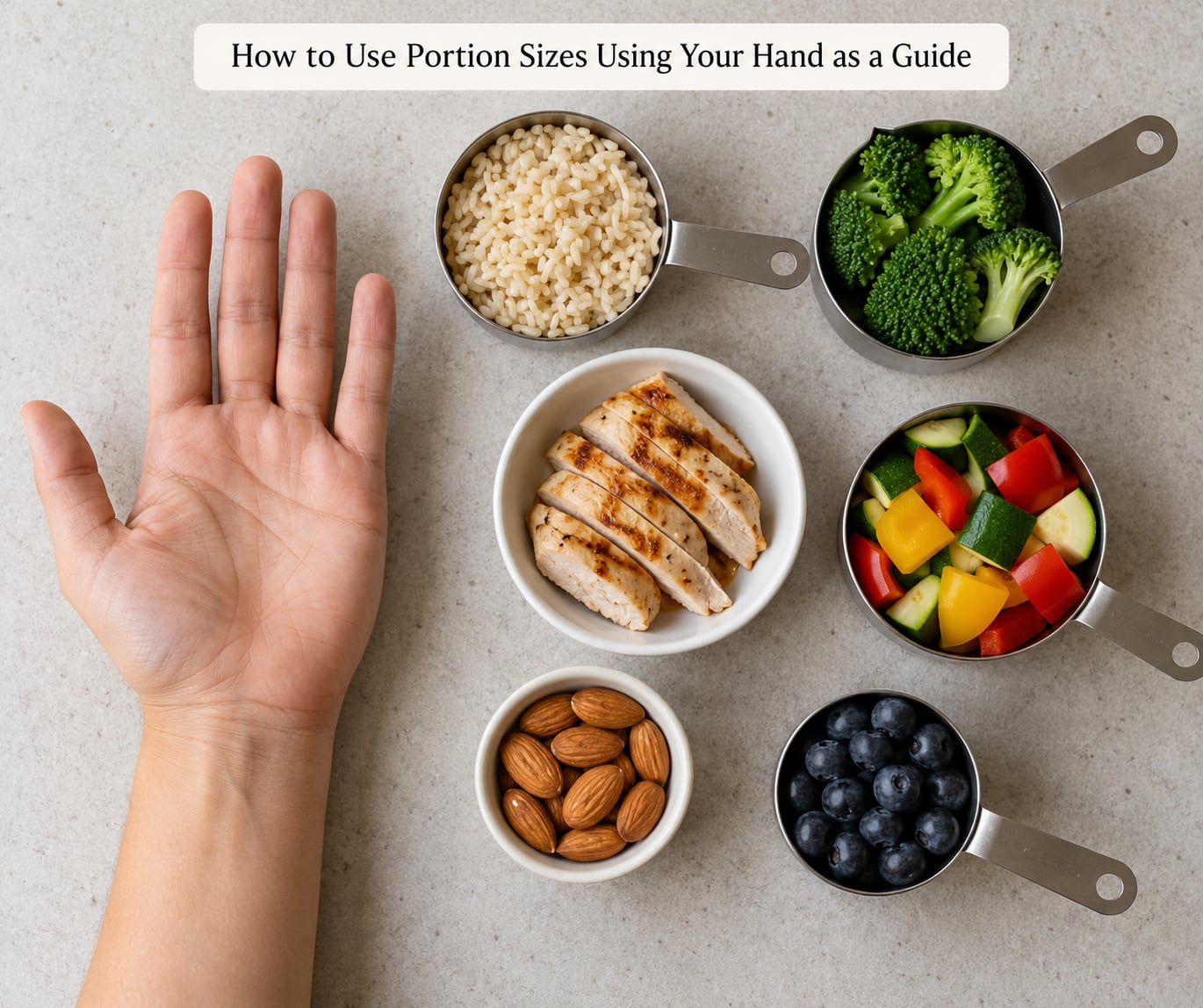
Use your own hand, compare each hand measure against something familiar once, and then trust the estimate at meals where weighing is impossible. The table below is the whole method in one place.
| Hand part | Use it for | Rough amount | Everyday examples |
|---|---|---|---|
| Palm without fingers | Protein | About 3 to 4 oz (85 to 110 g) | Chicken breast, fish fillet, steak, tofu, eggs |
| Closed fist | Cooked starches | About 1 cup | Rice, pasta, potatoes, quinoa, couscous |
| Cupped hand | Vegetables | 1 to 2 cups | Broccoli, greens, peppers, green beans |
| Cupped hand | Fruit | About 1 cup | Berries, diced fruit, salad fruit |
| Thumb, whole length | Fats and oils | About 1 tbsp | Olive oil, butter, nut butter, avocado |
| Fingertip | Small amounts of fat | About 1 tsp | Salad dressing, mayonnaise, cream cheese |
| Handful | Nuts, seeds, cheese | About 1/4 cup | Almonds, peanuts, grated cheddar |
Five habits keep the estimates honest. First, check one palm, one fist and one thumb against a scale or measuring cup a single time, so your own hand has a number attached to it. Second, serve from the kitchen and put the container back in the cupboard, because portion creep usually starts at the counter. Third, judge starches after cooking, since a cup of dry rice and a cup of cooked rice are very different amounts. Fourth, keep your usual 9-inch dinner plate rather than a wide serving platter. Fifth, adjust with hunger and activity, since the hand measure is a starting point, not a prescription.
What Does Each Part of Your Hand Measure?
Hand size scales roughly with body size, so a bigger hand gets a bigger portion. That proportionality is the reason the method works at all: the estimate grows when your calorie needs grow, without you doing any maths.
Your palm and the deck of cards
A palm without the fingers is about the size of a deck of playing cards, usually 3 to 4 oz of cooked or raw protein. Cooked chicken, fish, lean beef, tofu and tempeh all fit this shape reasonably well. Foods that are airy or spread out, like flaked tuna or a thin fillet, break the comparison, so pack the food into the shape before you judge it.
Closed fist versus cupped hand: the difference most people get wrong
A closed fist holds roughly a cup of solid, compact food such as rice or mashed potato. A cupped hand holds whatever fits in the hollow, which for loose vegetables is one to two cups. If you scoop broccoli florets into your palm, you get far more volume than the same fist full of rice. These are two different measures, and swapping them is the most common error.
Your thumb and your fingertip
The length of your thumb from knuckle to tip approximates a tablespoon, and a fingertip approximates a teaspoon. This is the measure most worth learning, because oil and butter are where portions hide. A free-poured tablespoon of oil is easy to double without noticing, while a thumb-sized amount in the pan is visible.
Your handful and two fingers
A cupped handful of nuts, seeds or grated cheese lands near a quarter cup. Two fingers held together, the way you would pinch a slice of cheese or a stack of crackers, cover a small portion of a snack. A handful is a soft measure: small handfuls for someone starting out, fuller ones for a bigger frame or an active day.
Portion Sizes Using Your Hand as a Guide for Common Foods
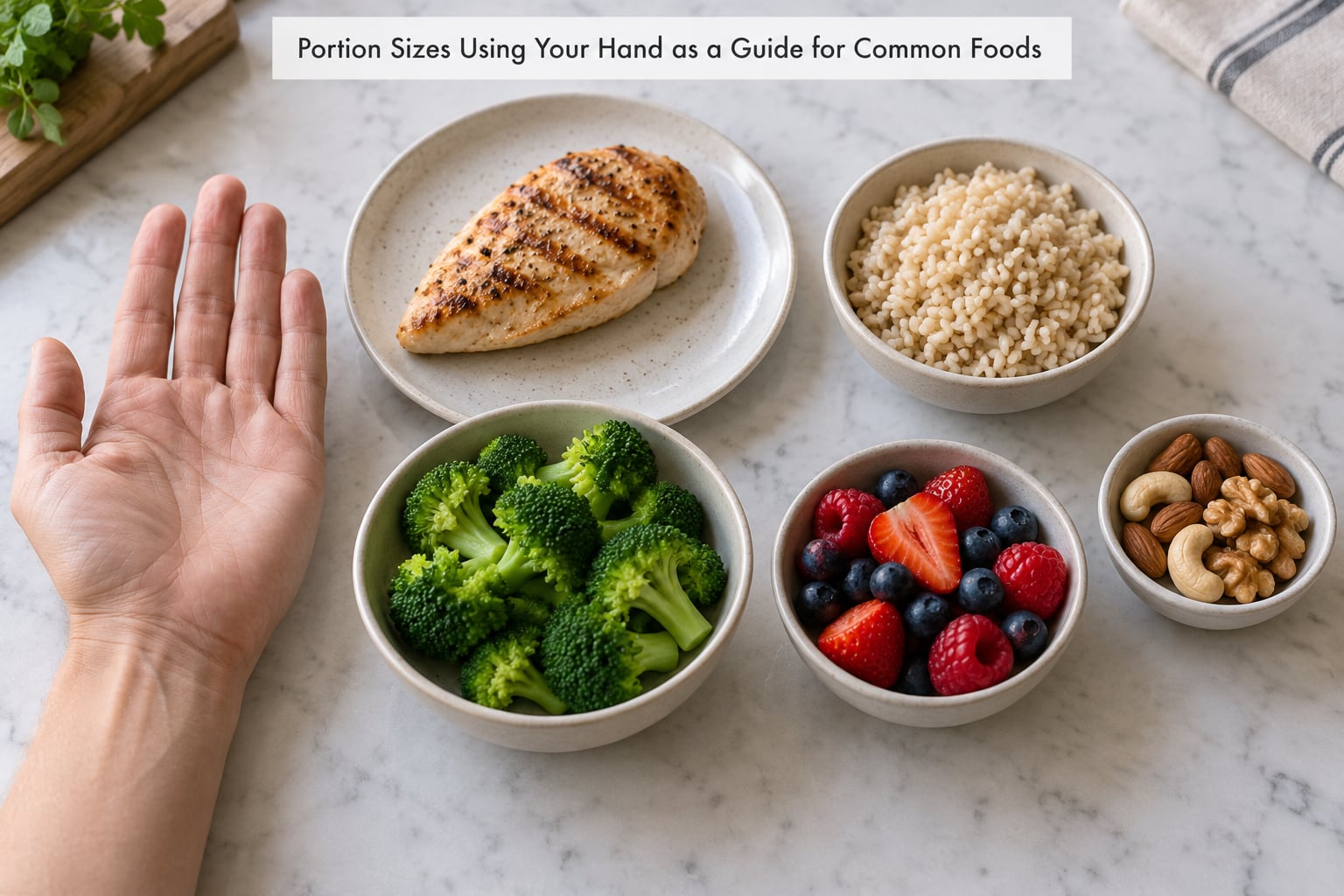
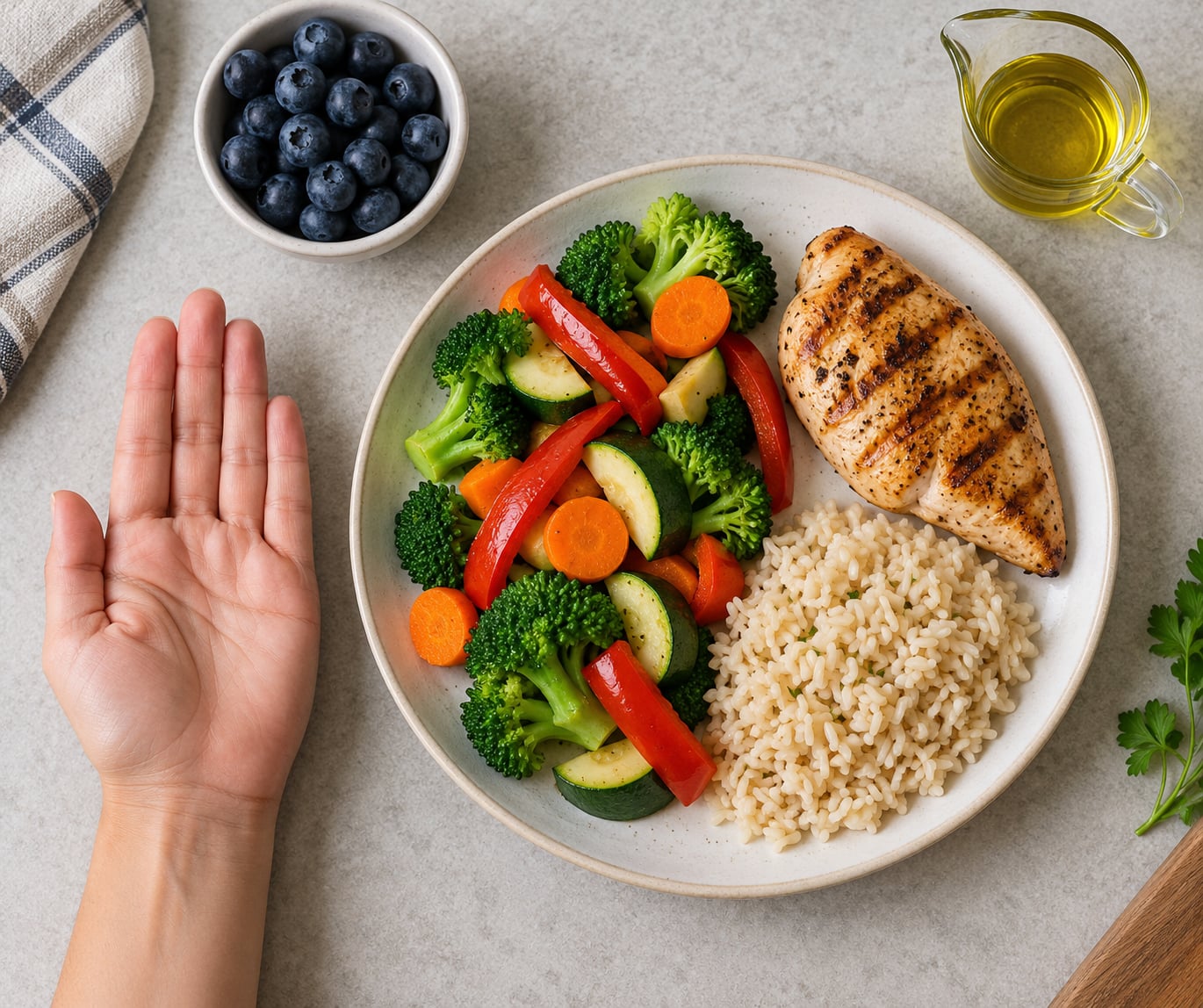
Here is what the measures look like on a real plate. Protein is one palm, cooked rice or pasta is one closed fist, vegetables fill one to two cupped hands, and a thumb of oil goes into the pan before anything hits the heat. Fruit is one cupped hand, roughly one cup. Bread is about a thumb-sized spread of nut butter on one slice, or a single slice with a fingertip of butter.
Starchy vegetables count as starch, not as the vegetable half of the plate. A fist of potatoes, corn or winter squash sits with the rice, not with the broccoli. This trips people up because potatoes feel vegetable-ish, and they change the balance of the whole meal.
Raw and cooked weights differ, so pick one and stay with it. Your fist of rice is a portion of cooked rice. If a recipe calls for a raw weight, use the measuring cup for that one step, then go back to your fist once it is plated.
Coffee drinks are where portions get sneaky. A large latte, a flavoured syrup and a splash of cream can carry more sugar than a plate of vegetables, and none of it fits neatly on a hand. Roughly a fist of milk-based drink is a generous everyday serving, and a thumb of syrup is a sensible cap on the sweetness.
How to Build a Balanced Plate with Your Hands
The hand measure and the plate method describe the same meal from two directions, and combining them is easier than either alone. Half the plate is vegetables, measured as one to two cupped hands and spread out rather than piled. One quarter is protein, one palm. The remaining quarter is starch, one closed fist, plus a thumb of fat for cooking.
Spreading food across the plate instead of stacking it changes how much you eat, mostly because it is visible. A mound of rice hides its own volume; rice covering a quarter of a plate does not.
What you are actually aiming for is protein plus fibre at every main meal, with the starch sized to how hungry you are rather than fixed in advance. Someone walking 10,000 steps a day can take a full fist of rice twice a day. Someone who barely moves can take one and feel fine. Adjusting the starch is the simplest lever you have.
How to Use Hand Portions for Snacks and Drinks
Snacks are where hand portioning earns its keep, because snack food usually arrives already portioned in a bag or a shared bowl. A handful of nuts is about a quarter cup. Two fingers make a small cheese portion. Two or three whole fingers hold roughly ten almonds, which is a handful and a half by volume but a lot fewer by calories than it looks.
For spreads, desserts and drinks: a thumb of peanut butter, a fingertip of cream cheese, a palm-sized slice of cake, and a fist of milk. If a snack comes from a package, compare the label’s serving size against your hand once, then serve the remainder into a bowl and close the bag.
That last step matters more than it sounds. Portion distortion is a documented effect: the same serving looks smaller over time as your expectations grow, and the same scoop becomes larger. Serving into a bowl and closing the bag resets that baseline more reliably than willpower does.
When Hand Portions Are Useful—and When to Use a Scale
Here is the honest part. A hand measure is an estimate, and estimates have real limits. They work reasonably well for solid, compact, single foods such as meat, rice and cheese. They get shakier with loose mixed foods, anything packed or poured, and anything you cannot see clearly. A casserole, a stir fry and a salad are where most people’s confidence drops, and they are not wrong to be unsure.
If you want to be more exact, calibrate once instead of weighing forever. Put a scale on the counter and check a few things: your palm against a piece of chicken, your fist against cooked rice, your thumb against oil in a tablespoon, your cupped handful against a measuring cup of vegetables. Write the four numbers on the inside of a kitchen cupboard door. That is enough for most people, and it is what people who want to stop tracking long term tend to land on.
Some situations need real precision rather than a good guess. If you manage diabetes or insulin, counting carbohydrates with a scale or label is more reliable than a fist. Kidney disease, heart failure and other conditions where sodium, potassium or protein are restricted need professional guidance. Athletes targeting a specific body weight or performance number need accurate data. If you have a history of disordered eating, tracking in any form can be unhelpful without support. And for children, adult hand measures do not apply: a child’s own hand is the right ruler, and growth matters more than precision.
This article is general information, not a diet or a medical plan. If you are managing a health condition, taking medication, or unsure how much you should be eating, ask your doctor or a registered dietitian. They can give you numbers that fit your body and your history.
Frequently Asked Questions
Is the hand portion method accurate?
It is accurate enough for everyday decisions and not accurate enough to be a measurement. Studies that compare hand estimates with weighed food find errors around 20 to 30 percent on average, with the best results on solid, compact foods like meat, cheese and rice, and the worst on loose or mixed foods such as salads and casseroles. Use hands for meals out and on the go, and use a scale or label when precision matters.
How big is a palm-size portion of protein in grams?
For most adults, one palm without the fingers holds about 3 to 4 oz, which is roughly 85 to 110 g of cooked chicken, fish, lean beef or tofu. It is about the size of a deck of playing cards. A larger hand gets a larger portion automatically, which is the point of the method. If your protein is flaky or spread out, pack it into a palm shape before judging it.
How much is one thumb of oil?
The length of your thumb from knuckle to tip holds roughly one tablespoon of oil, butter, nut butter or avocado. Your fingertip holds roughly one teaspoon, which suits salad dressing, mayonnaise or cream cheese. Free-pouring oil is the easiest place to double a portion by accident, so measure the first spoonful and then tilt the bottle over the pan for the rest.
Do I need a food scale if I use my hands?
For general portion control, no. A food scale is worth keeping for a few situations: carbohydrate counting for diabetes, sodium or protein restriction for kidney or heart conditions, sports nutrition targets, and the first weeks of any plan where you are establishing a baseline. Many people use a scale for a month to learn their hand measures, then put it in a drawer and keep using their hands.
How do hand portions work for children?
Use the child’s own hand rather than an adult’s, because a child’s portion needs to scale with the child’s body, not the adult serving it. A child’s palm for protein, a child’s fist for starch and a cupped handful for vegetables are reasonable starting points. Children are still growing, so appetite cues matter more than accuracy. For anything medical, ask your pediatrician rather than applying an adult chart.
How many blueberries is a portion of 5 a day?
One cupped hand of blueberries is close to a cup, which works out to roughly 80 to 100 berries and covers a typical adult’s daily fruit portion on its own. Smaller berries need more counting, which is why volume works better than counting for fruit. A handful is about a quarter cup. If you are working to five portions of fruit and vegetables a day, your other meals then need two cupped hands of vegetables and one of fruit.
Conclusion
Start with one change: check your palm, fist and thumb against a measuring cup or scale this week, write the three numbers down, and use them at every meal after that. Adjust the fist for how active you are and how hungry you actually feel.
Reach for the label and the scale when a recipe, a diary, a medical condition or a performance target makes precision matter, and ask a doctor or registered dietitian when the numbers are personal. Hands handle the rest of your meals well enough to stop weighing food for good.