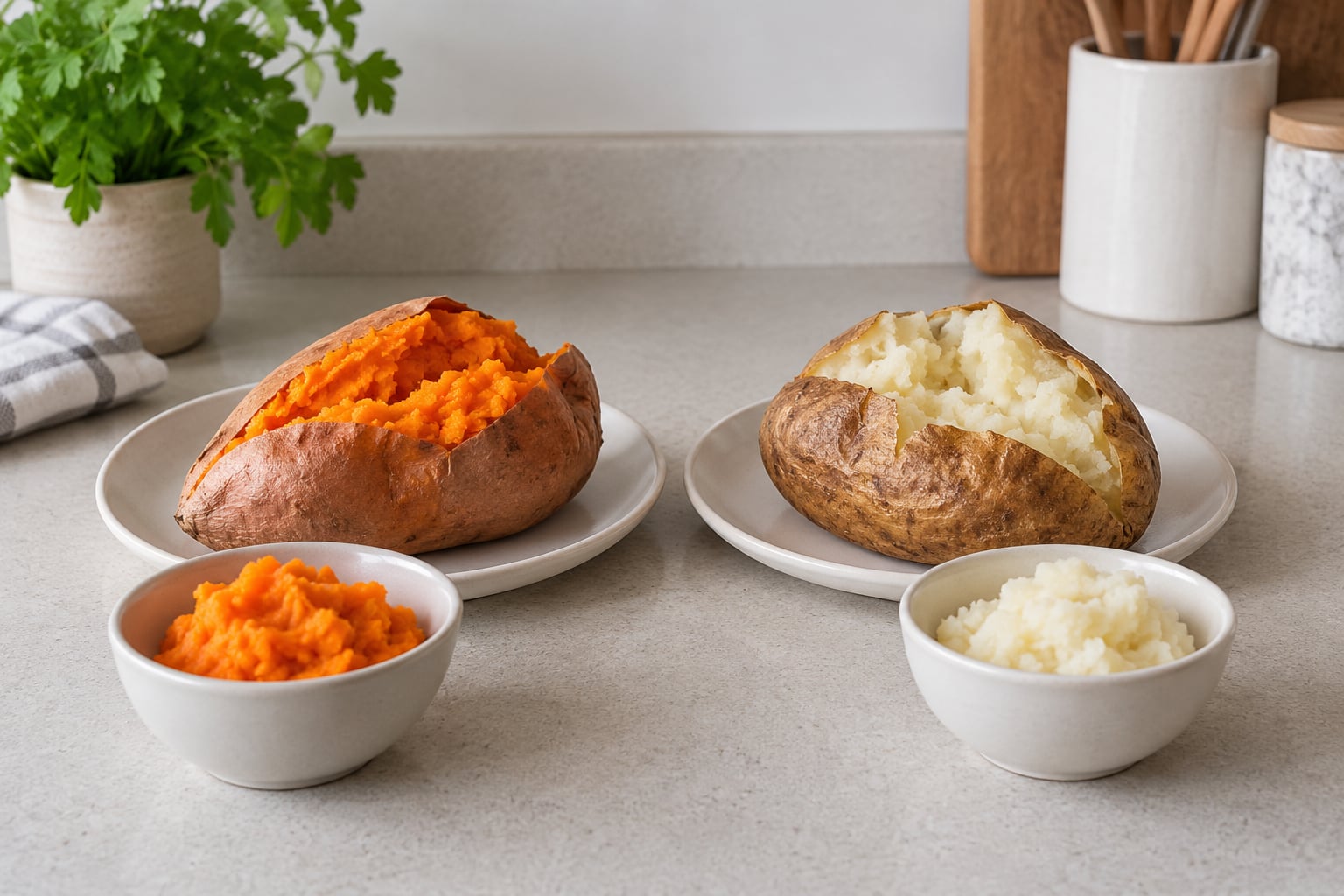
If you are weighing sweet potatoes vs white potatoes for weight loss, the honest answer is that neither tuber wins by a wide margin. Both land near 80 to 90 calories per 100 g raw, so the number that actually moves your weight is portion size, cooking method and toppings, not the color of the skin. Pick the one you will eat happily several times a week, cook it plainly, and serve yourself a fist-sized portion.
That sounds less exciting than picking a winner. But the “sweet potato is a weight-loss food, potatoes are a diet mistake” story has done a lot of damage in the other direction, pushing people off a perfectly good, cheap, filling staple. I want to put the real differences on the table and then separate them from the ones that barely matter. Updated for 2026, the numbers below are typical values for comparable plain servings.
Table of Contents
- Sweet Potatoes vs White Potatoes for Weight Loss at a Glance
- How Do Calories and Carbs Compare?
- Which Potato Helps You Feel Fuller?
- Sweet Potatoes vs White Potatoes for Weight Loss and Fullness
- How Do Vitamins and Minerals Differ?
- Which Is Better for Blood Sugar?
- Does Preparation Matter More Than the Color?
- Which Should You Choose?
- Frequently Asked Questions
- Are sweet potatoes better than white potatoes for losing weight?
- How many calories are in one sweet potato or white potato?
- Do sweet potatoes reduce belly fat?
- Are potatoes fattening?
- What is the healthiest way to eat potatoes?
- Why do bodybuilders eat sweet potatoes instead of white potatoes?
- Conclusion
Sweet Potatoes vs White Potatoes for Weight Loss at a Glance
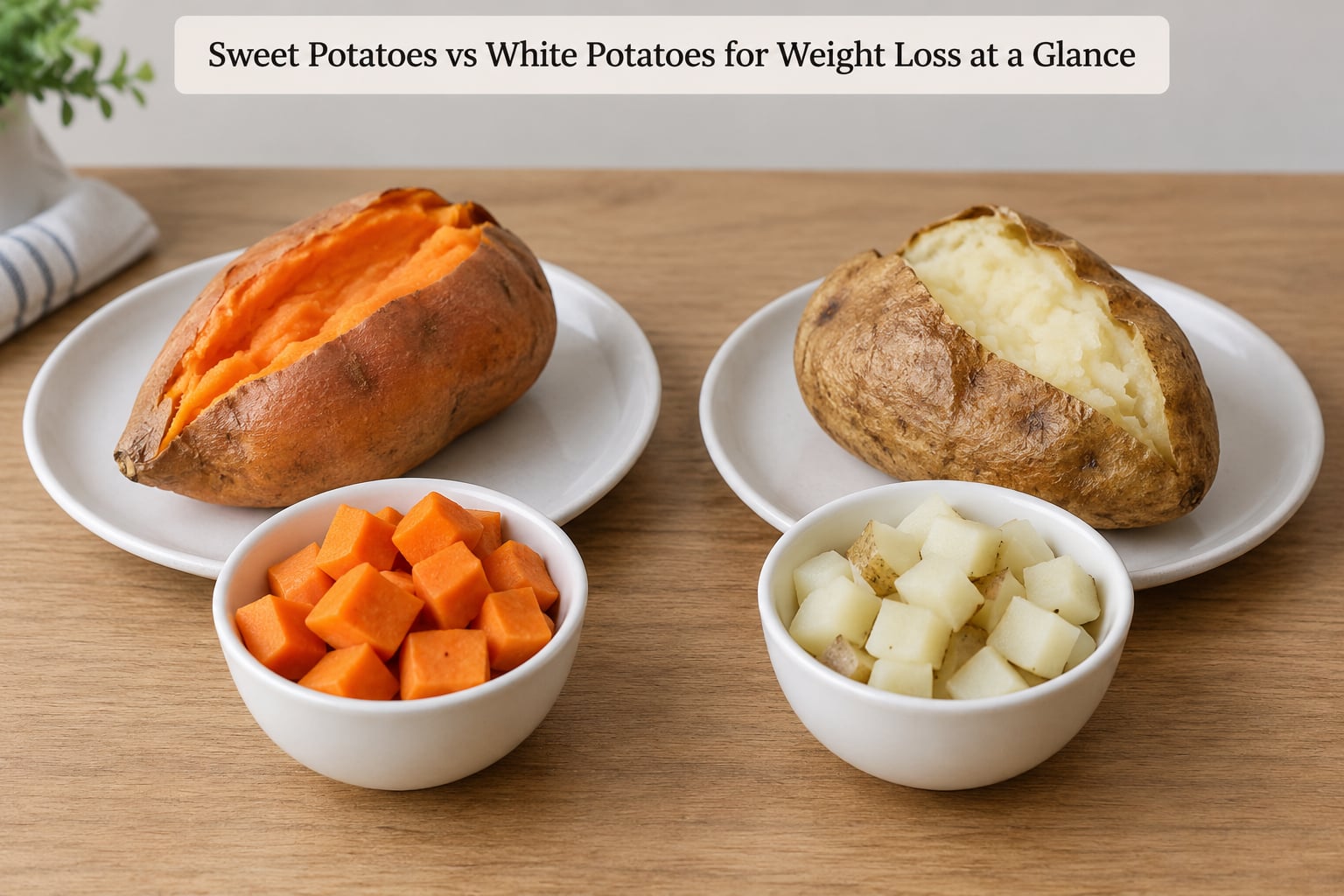
Everything in this table is for plain, unpeeled or peeled, unsalted potato. Add butter, cheese, sour cream or oil and the columns stop meaning anything.
| Measure | Sweet potato | White potato | What it means for weight loss |
|---|---|---|---|
| Calories, raw per 100 g | About 80 to 86 kcal | About 77 to 80 kcal | A dead heat; a 100 g difference is noise |
| Calories, medium baked potato | About 100 to 115 kcal | About 110 to 130 kcal | A fist-sized serving of either fits most weight-loss plans |
| Carbohydrate per 100 g | About 20 g | About 17 to 18 g | Sweet potato is slightly starchier per gram |
| Dietary fiber per 100 g | About 2 to 3 g | About 2 g | Sweet potato wins; both are modest sources |
| Protein per 100 g | About 1.2 g | About 1.9 g | White potato wins, but the gap is under 1 g |
| Fat per 100 g | Negligible | Negligible | Neither is a fat source; toppings decide the fat |
| Glycemic index, boiled | Roughly 50 to 60 | Roughly 78 | Matters for blood sugar, less so for calories |
| Nutrient standout | Beta-carotene (vitamin A), manganese | Potassium, vitamin B6, vitamin C | Nice to have, not a weight-loss lever |
| Best use | Vegetable serving, extra fiber, batch-cooked meals | Versatile base for soups, stews and bulk meals | Choose by preference and satiety |
How Do Calories and Carbs Compare?
Raw, they are within about 10 calories of each other per 100 g. Baked in their skins as medium potatoes, sweet potatoes usually land around 100 to 115 calories and white potatoes around 110 to 130.
Carbohydrate follows the same pattern: roughly 20 g per 100 g in sweet potato against 17 to 18 g in white potato. Neither figure is high in a bad way. Both are complex carbohydrates, and both are perfectly reasonable on a calorie-controlled plate.
Where the real calorie difference shows up is on the plate next to the potato. A plain baked sweet potato is a low-density, high-volume food. The same potato loaded with butter, sour cream and cheese can run past 350 calories before you touch the salt. A medium order of fries is roughly 300 to 400 calories in a way no boiled potato ever reaches.
So when someone says potatoes made them gain weight, the arithmetic almost always points at the cooking fat, not the tuber.
Which Potato Helps You Feel Fuller?
Fullness is the one place where the two genuinely diverge, and it is worth more to a calorie deficit than any micronutrient on the list. Sweet potato carries slightly more fiber per serving, which slows gastric emptying and gives you something physical to chew. White potato carries more water per calorie and a wetter, softer texture that many people find more filling per bite.
Sweet Potatoes vs White Potatoes for Weight Loss and Fullness
Sweet potato usually edges out white potato on fiber, so it may hold you a little longer on its own. But a plainly boiled white potato is not a weak substitute; it is high volume, low calorie density and easy to bulk out a meal with.
What changes the result is the rest of the plate. A potato next to a palm of protein and a large serving of non-starchy vegetables behaves very differently from a potato next to nothing, which is how a 130-calorie side quietly becomes the whole meal and gets followed by a snack an hour later.
If you have heard that sweet potato is the more filling choice, that claim usually comes from glycemic index rather than satiety research. Lower GI means a slower rise in blood glucose, which some people experience as steadier energy. It does not reliably translate into eating less later.
One detail worth knowing: boiled white potato that has been cooled and reheated contains more resistant starch, a type of carbohydrate that resists digestion in the small intestine. Meal-prep communities lean on this deliberately. The total carbohydrate is still there, but a meaningful share behaves more like fiber.
How Do Vitamins and Minerals Differ?
Sweet potato is the clear winner on beta-carotene, which your body converts to vitamin A, and on manganese. Orange-fleshed varieties are among the best everyday sources of both. White potato takes the lead on potassium, vitamin B6 and vitamin C.
None of this makes either potato a weight-loss food. A nutrient advantage matters when it displaces something less nutritious, such as swapping a buttered white potato for a baked sweet potato and getting more vitamin A plus a few fewer calories in the same seat.
If your diet is short on vegetables generally, both potatoes count toward that goal. The Academy of Nutrition and Dietetics and mainstream dietary guidance treat potatoes as vegetables, and the vegetable column in most dietary guidelines does not have a separate “avoid potatoes” line. That myth is old and it is wrong.
One practical note: vitamin C is heat-sensitive, so boiling long and draining leaches some out. Baking or steaming whole with the skin on retains more of everything, including the fiber in the skin.
Which Is Better for Blood Sugar?
Both potatoes raise blood glucose. Sweet potato generally has the lower glycemic index, commonly cited around 50 to 60 depending on cooking, while boiled white potato sits nearer 78 and baked white potato higher still.
Here is the part most get wrong: glycemic index measures the speed of the rise, not the size of it. A large portion of a low-GI food still produces a large glucose load. Cooking form, portion, fiber content and what you eat alongside the potato all shape the response.
Cooling and reheating raises resistant starch in either potato, which tends to blunt the glucose response somewhat. Adding a source of fat and protein alongside the potato also slows absorption.
If you manage diabetes, take glucose-lowering medication, or have been told to count carbohydrate, get individualized guidance from your doctor or a registered dietitian rather than picking a tuber off a list. The numbers above describe general foods, not your specific plan.
Does Preparation Matter More Than the Color?
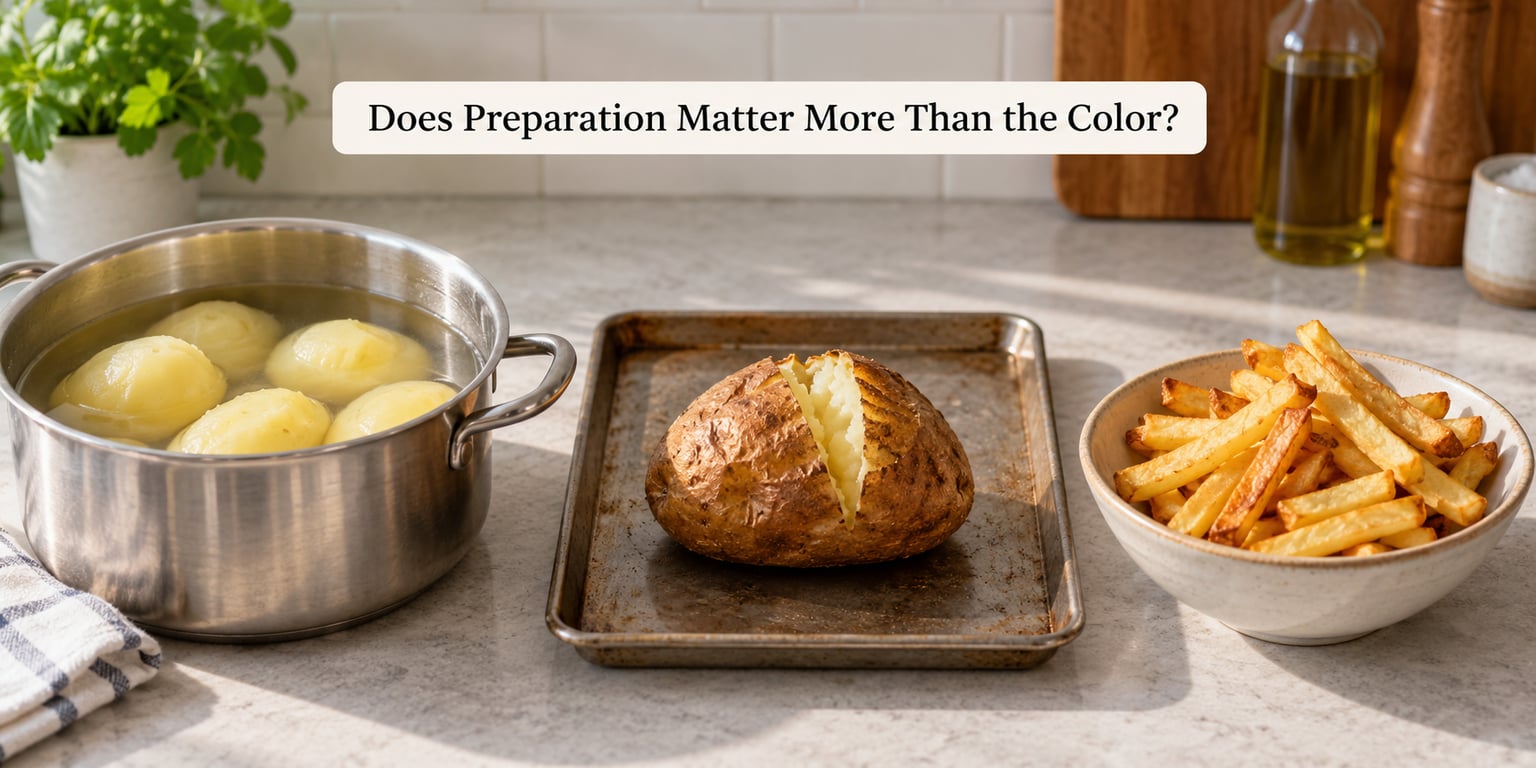
This is the section that decides your weight-loss results, and it is shorter than the nutrient section for a reason. Same potato, four methods, four very different meals.
- Boiled or steamed – the lowest calorie option per 100 g, with the skin on you also keep the fiber and some of the potassium.
- Baked or roasted – slightly more concentrated in calories because water has left, but still excellent with no added oil. A little olive oil is fine; a drizzle poured over the top is not the same thing.
- Mashed – the potato is not the problem, what you mash it with is. Milk and butter add up fast; a fork-mash with a splash of milk and plenty of pepper keeps it lean.
- Fried – fries and chips turn a 100-calorie vegetable into a 300 to 400 calorie snack, and the portion size grows with them.
Toppings deserve their own line because they are where most of the damage hides. Cheese, sour cream, gravy, bacon and sweet glazes each add calories that are easy to underestimate. A baked potato can go from 110 calories to well over 300 in under a minute of topping, and the sweet potato fries and candied versions do the same thing.
If you like the toppings, keep the potato small. That is a better trade than pretending you do not like them.
Which Should You Choose?
Choose sweet potato when you want a vegetable serving with a bit more fiber and beta-carotene, when you are building a meal-prep batch that reheats well, or simply when it is the version you look forward to eating. A baked sweet potato with black pepper, a boiled egg and a big handful of greens is a genuinely good weight-loss lunch.
Choose white potato when you want a cheap, versatile base that stretches in soups, stews and casseroles, when you are eating a larger volume of food for the same calories, or when a high-fiber diet is already handled elsewhere. A boiled white potato with a cup of broth, diced carrots and shredded cabbage turned into a soup is a filling bowl at well under 200 calories.
Choose whichever one you prefer when you are not sure. Adherence beats optimization, and a potato you look forward to eating is worth more than a marginally better nutrient profile you resent.
A simple rule that covers both: one medium potato, cooked without added fat, paired with protein and a large serving of non-starchy vegetables, most days. That combination is what the research supports for a calorie deficit, and it works with either tuber.
Frequently Asked Questions
Are sweet potatoes better than white potatoes for losing weight?
Not automatically. Sweet potatoes often provide a little more fiber, but both varieties can support weight loss in a similar portion because their calories per 100 g are nearly identical. Preparation and portion size decide the outcome far more than the type. Choose based on what you will actually eat several times a week.
How many calories are in one sweet potato or white potato?
A medium plain baked sweet potato usually runs about 100 to 115 calories, and a medium plain baked white potato about 110 to 130. Weight, size, cooking method and toppings shift these numbers a lot, so if you are tracking calories, weigh your portion once to learn what your own usual potato weighs before you estimate.
Do sweet potatoes reduce belly fat?
No single food targets belly fat. Sweet potatoes are a nutrient-dense, filling carbohydrate that fits easily into a calorie deficit, which is what supports fat loss overall. Spot reduction is not something food can do, and if your pattern works, either potato will do the same job.
Are potatoes fattening?
Potatoes are not inherently fattening in an appropriate portion. Their calorie content rises sharply when they are deep-fried or topped with butter, cheese, cream or sugary sauces. A plainly baked or boiled medium potato is roughly 100 to 130 calories, which is a reasonable side or snack within most weight-loss eating patterns.
What is the healthiest way to eat potatoes?
Boiled, steamed, baked or roasted with the skin on, and served in a moderate portion, is the healthiest everyday approach. It keeps the fiber, avoids the calorie load that frying adds, and lets you build a plate with protein and non-starchy vegetables around it. If you want toppings, add them in smaller amounts rather than skipping the potato.
Why do bodybuilders eat sweet potatoes instead of white potatoes?
Lifting communities default to sweet potato because it is widely available, batches well for meal prep, keeps a fairly steady energy release and is easy to portion by weight. White potato works equally well for the same purpose, and many lifters use both. Portion and total daily carbohydrate intake matter more for performance than the variety.
Conclusion
There is no clear winner in sweet potatoes vs white potatoes for weight loss, because the two are too close on calories to make the choice matter much. Start with one medium potato, cooked without added fat, next to protein and a large serving of vegetables. Then pick the version you will keep eating, since that is the part that actually produces results.