If you want the short answer: most adults losing weight while trying to hold on to muscle should aim for roughly 1.2 to 1.6 grams of protein per kilogram of body weight per day, then adjust from there. Here is how much protein per day to lose weight and keep muscle, worked out for real body weights, plus which foods to eat and how to spread it across the day.
The reason protein gets so much attention during a cut is simple. When you eat less than you burn, your body pulls from both fat and muscle. More protein in the diet shifts the balance toward fat, and it tends to take the edge off hunger while you are eating less.
What follows is general information, not a plan built around your medical history. If you have a health condition, are pregnant, or take regular medication, a registered dietitian is the right person to turn the numbers below into something personal.
Table of Contents
- How Much Protein Per Day to Lose Weight and Keep Muscle?
- How much protein per day to lose weight and keep muscle? The short version
- How to Calculate Your Daily Protein Target
- Do You Need More Protein to Preserve Muscle?
- Which Foods Give You the Most Protein?
- How to Spread Protein Across Your Meals
- A simple three-meal framework
- Two balanced day examples
- Does Protein Help with Fullness and Weight Loss?
- Plant-Based, Older Adult, and Higher-Weight Options
- How to Check Whether Your Intake Is Working
- Who Should Ask a Health Professional for Advice?
- Frequently Asked Questions
- Is 1.2 grams of protein per kilogram enough to keep muscle while losing weight?
- How much protein should I eat per meal?
- How can I calculate my protein intake without weighing every food?
- Do I need protein supplements to lose weight and keep muscle?
- Can eating too much protein damage healthy kidneys?
- A Simple Place to Start
How Much Protein Per Day to Lose Weight and Keep Muscle?
Most adults chasing weight loss with muscle retention can start at 1.2 to 1.6 grams of protein per kilogram of body weight per day. That works out to roughly 0.55 to 0.75 grams per pound. Your total calories, your training, and your food preferences all move the target up or down from there.
How much protein per day to lose weight and keep muscle? The short version
- Starting range: 1.2 to 1.6 grams per kilogram of body weight, per day.
- Imperial version: about 0.55 to 0.75 grams per pound of body weight.
- If you lift weights: the upper end of that range is usually the more useful target.
- Minimum to sit on the RDA: 0.8 grams per kilogram, which is a floor for general health, not a weight-loss target.
- Per meal: aim for three roughly equal servings rather than one enormous one.
Think of that range as a starting point, not a score to beat. A day at 145 grams when you aimed for 150 changes nothing, and neither does a slow week where you land a little under.
How to Calculate Your Daily Protein Target
The math is short. Take your body weight in kilograms, multiply by your chosen grams-per-kilogram figure, and you have a daily number. If you weigh in pounds, multiply by 0.55 to 0.75 for the same range.
A 70 kg person aiming at 1.4 g/kg looks for about 98 grams a day. Someone at 84 kg looks for roughly 118 grams. Both are unremarkable totals once you see how ordinary portions add up.
| Body weight | 1.2 g/kg | 1.4 g/kg | 1.6 g/kg |
|---|---|---|---|
| 50 kg / 110 lb | 60 g | 70 g | 80 g |
| 60 kg / 132 lb | 72 g | 84 g | 96 g |
| 70 kg / 154 lb | 84 g | 98 g | 112 g |
| 80 kg / 176 lb | 96 g | 112 g | 128 g |
| 90 kg / 198 lb | 108 g | 126 g | 144 g |
| 100 kg / 220 lb | 120 g | 140 g | 160 g |
Notice the RDA of 0.8 g/kg sits well below this. The Recommended Dietary Allowance was built to cover nearly all healthy adults who are not dieting or training hard, so it is a safety net rather than a weight-loss figure. A 70 kg person at the RDA is eating 56 grams, which is fine for staying well, and light for losing weight while keeping muscle.
One nuance worth knowing: if you carry extra body fat, some people calculate from a target or ideal body weight instead of total weight. That avoids inflating the target when you are trying to lose the extra weight in the first place. Either method produces a workable number, and the difference matters less than consistency.
Do You Need More Protein to Preserve Muscle?
Yes, generally, and more than the bare minimum. Muscle protein synthesis, the process your body uses to build and repair muscle tissue, rises when amino acids from dietary protein are available and you have trained. Protein is the raw material; training is the signal that tells the body to use it.
That is the part people miss. Protein on its own does not preserve muscle if you never lift anything. The same way a construction crew needs both materials and a blueprint, muscle needs amino acids plus a reason to rebuild.
Four things move your target within the range:
- Resistance training. Two or more sessions a week usually pushes you toward the higher end.
- Size of the deficit. The more calories you cut, the more your body looks to lean tissue for fuel, so the higher end protects you better.
- Age. Muscle protein synthesis runs slower as you get older, and older adults generally need more protein per kilo to trigger the same response.
- Body composition goal. Recomposition, where you lose fat and gain muscle at the same time, keeps the need for protein high even though calories are below maintenance.
Sleep sits in this list too, quietly. Recovery happens between workouts, not during them.
Which Foods Give You the Most Protein?
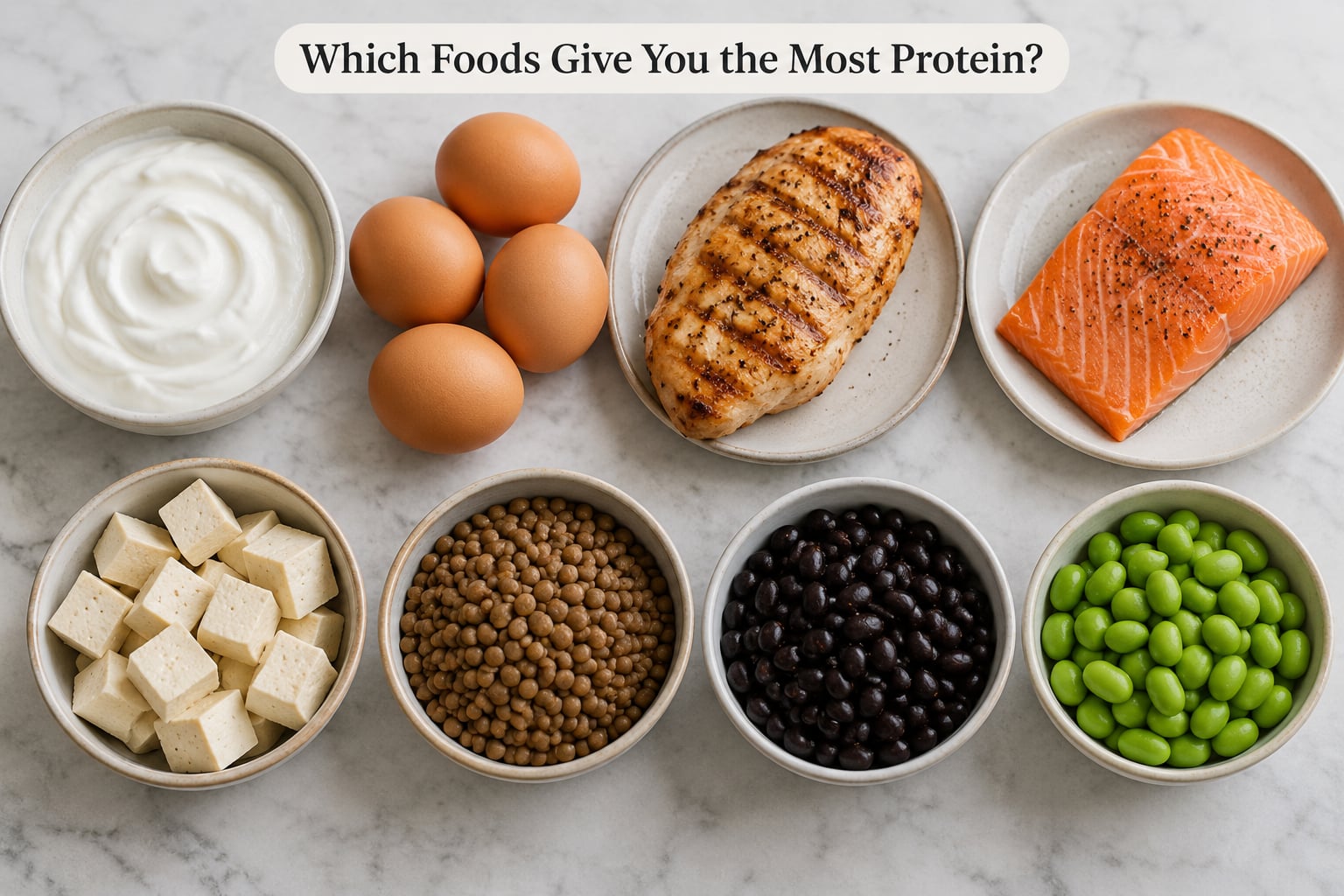
Value for money matters more than anything else. The list below covers the options that fit into a normal week, with typical amounts you can check against the label on your own brand.
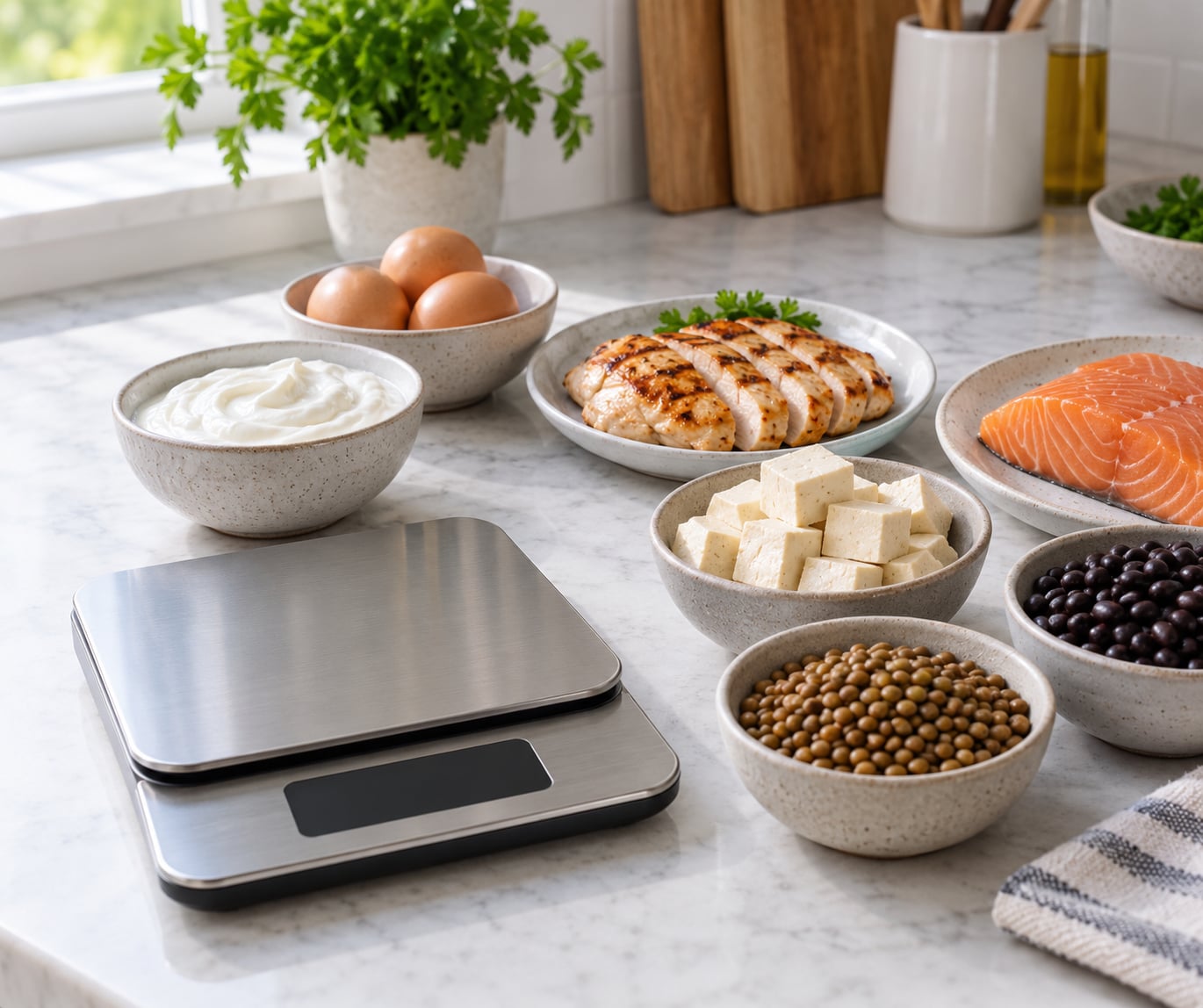
- Eggs: about 6 grams per large egg. Two eggs at breakfast is 12 grams before you add anything else.
- Greek yogurt: roughly 15 to 20 grams per plain 170 g pot. Watch for added sugar in flavoured versions.
- Cottage cheese: about 25 grams per cup. High protein, low fuss, easy to eat straight from the container.
- Chicken breast: around 30 grams per 100 g cooked. Cook a batch and use it for three meals.
- Canned tuna: about 25 grams per can. No prep, long pantry life.
- Salmon and other fatty fish: roughly 25 grams per 100 g. More calories than chicken, worth it twice a week.
- Tofu: anywhere from 8 to 20 grams per serving depending on how firm it is and whether it is set.
- Lentils and chickpeas: about 18 grams of protein per cooked cup.
- Black beans: roughly 15 grams per cooked cup.
- Edamame: about 17 grams per cup. One of the better plant options per bite.
- Protein powder: usually 20 to 25 grams per scoop. Whey isolate and casein are complete proteins; pea and soy blends are common plant options.
Frozen chicken, canned beans and plain Greek yogurt are the workhorses. They cost little, keep for months, and need almost no cooking, which matters on a week when you are tired.
How to Spread Protein Across Your Meals
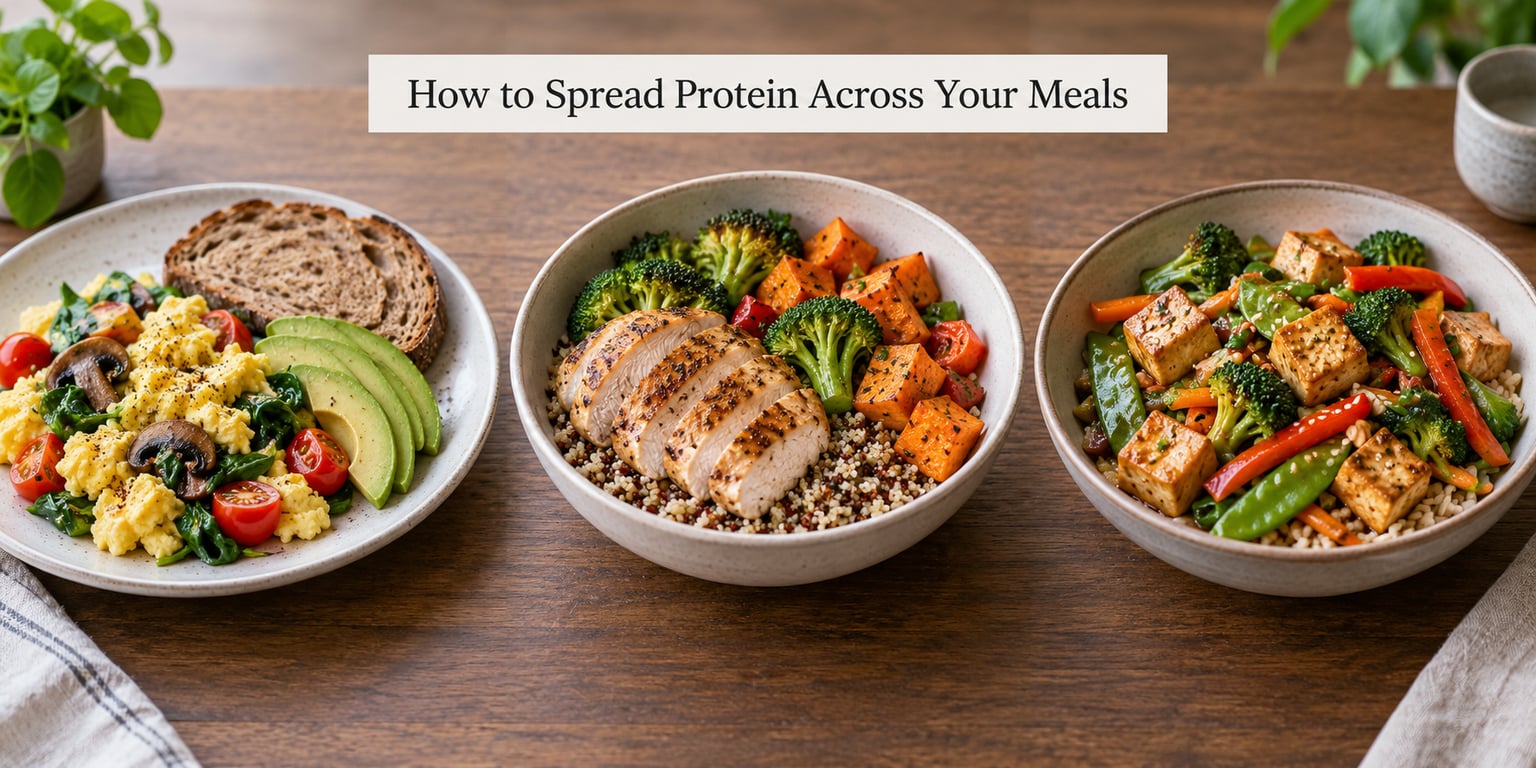
Three meals with protein in each one gets you to the target far more reliably than one huge dinner. Your body handles a 40 gram serving better than a 120 gram serving, and each meal with protein takes longer to work through than a meal without.
A simple three-meal framework
Divide your daily target by three, then by two if you want a protein snack. A 105 gram day becomes 35 grams per meal. A 140 gram day becomes about 47 grams, or 35 grams per meal plus a 12 gram snack. Most people find 30 to 45 grams per serving is a comfortable range.
Two balanced day examples
Day one, about 130 grams. Breakfast: three eggs with spinach on whole-grain toast, roughly 30 grams. Lunch: a chicken and quinoa bowl with greens, around 42 grams. Dinner: salmon, roasted vegetables and potatoes, around 40 grams. Snack: a cup of cottage cheese, about 25 grams. That lands near 137 grams without anything unusual.
Day two, about 130 grams, plant-forward. Breakfast: tofu scramble with black beans and avocado, around 28 grams. Lunch: lentil and vegetable soup with whole-grain bread, around 24 grams. Dinner: chickpea and vegetable curry over rice with a spoon of plain yogurt, around 26 grams. Snacks: Greek yogurt with edamame, about 30 grams, and a handful of roasted chickpeas, around 8 grams. Roughly 116 grams, so add a serving of tofu or a second yogurt if you want to close the gap.
Leftovers do most of the work here. Cook chicken and a tray of vegetables once and you have the base of two meals without cooking again that night.
Does Protein Help with Fullness and Weight Loss?
It does, though it is a supporting player rather than the main act. Protein is more filling than carbohydrate or fat at the same calorie weight, and it costs more energy to digest and process, which is often called the thermic effect of food.
Here is where I would temper the sales pitch. Protein does not decide your results. Total calorie intake, food quality, how consistently you behave, and how much you move still carry most of the weight. A 2,000 gram protein diet that is also 3,000 calories will not make you lose weight.
If you want one adjustment to make first, add a protein source to the meal you skip or eat badly, usually breakfast or lunch. It tends to reduce snacking later in the day without making you feel like you are on a diet.
Plant-Based, Older Adult, and Higher-Weight Options
Plant-based. You do not need to combine every single meal the way old advice suggested. Eating a varied diet across the day usually covers all nine essential amino acids, and soy is the standout complete plant protein. Pairing beans with rice, or lentils with whole-grain bread, adds variety rather than a rule you must follow precisely.
Older adults. Past 60, the body handles protein less efficiently, so the higher end of the range is usually the sensible starting point. Fortified plant milks, Greek yogurt and eggs are easy additions. Some older adults chew less well, and soft options like yogurt, cottage cheese and tofu solve that without extra effort.
Higher body weight. The gram figures above use total body weight, which keeps the calculation simple. If your goal weight is far below your current weight, a registered dietitian can help you pick a figure that fits your body composition rather than a number that overshoots.
How to Check Whether Your Intake Is Working
Nobody hits a protein target perfectly, so judge the week rather than the meal. Most people land within range across four or five days once they stop measuring.
- Read labels for a week. Protein per serving is on every packaged item. It is a fast way to find out which foods are quietly doing the work.
- Use a kitchen scale briefly. Weigh a serving of chicken or rice for three or four days. It teaches your eye, then you put it away.
- Estimate the rest. A palm-sized piece of chicken is roughly 30 grams. A cup of Greek yogurt is about 15 to 20. Three eggs is 18. Those anchors cover most meals.
- Average across the week. If Thursday looked low and Saturday looked high, you may still be exactly where you want to be.
Then look at signals other than the scale. Strength in your main lifts holding steady, hunger staying manageable, and clothes fitting differently at the waist all say more than a daily weigh-in. A scale cannot tell you whether you lost muscle or fat, no matter how many times you step on it.
Who Should Ask a Health Professional for Advice?
Talk to a doctor or registered dietitian before changing your intake if any of these apply:
- Kidney disease, kidney stones, or a history of either.
- Pregnancy, breastfeeding, or trying to conceive.
- Diabetes, or blood sugar you manage with medication.
- A history of disordered eating, or a current diagnosis of one.
- Recent surgery, major illness, or a period of recovery from injury.
- Weight changes you cannot explain, whether up or down.
The concern about very high protein intakes is not imaginary for people with reduced kidney function, and high-protein diets can carry risks for anyone with certain conditions. That is a conversation to have with a clinician, not something to settle by reading an article.
Frequently Asked Questions
Is 1.2 grams of protein per kilogram enough to keep muscle while losing weight?
For most adults starting out, yes. It sits above the 0.8 g/kg RDA and gives your body enough amino acids to protect lean tissue during a deficit. The higher end of the range, around 1.6 g/kg, tends to help more if you lift weights, are in a larger deficit, or are over 40.
How much protein should I eat per meal?
Roughly 30 to 45 grams per serving works well for most people, spread across three or four eating occasions. Your body handles a moderate serving more efficiently than one enormous plate, and a protein source at each meal keeps hunger steadier through the afternoon than a day of small snacks and no real meal.
How can I calculate my protein intake without weighing every food?
Learn five or six anchor portions and use them as a mental map. Three eggs is about 18 grams, a palm-sized piece of chicken about 30, a pot of Greek yogurt 15 to 20, and a cup of cooked lentils about 18. Reading the label on packaged foods for a week makes the rest much easier to estimate.
Do I need protein supplements to lose weight and keep muscle?
No, supplements are convenience, not necessity. Whole foods such as eggs, Greek yogurt, chicken, fish, tofu, lentils and edamame will hit most targets. A powder helps when you are short on time, dislike the foods you would need, or keep missing the target otherwise. Check for third-party testing if you buy one regularly.
Can eating too much protein damage healthy kidneys?
Research in healthy adults has not shown that high protein intakes within normal ranges harm kidney function. People with existing kidney disease are a different case, and high intakes may not suit them at all. If you have any kidney condition or history of kidney stones, ask your doctor before increasing protein.
A Simple Place to Start
Pick your body weight, multiply by 1.2 to 1.6, and write the number somewhere you will see it. Divide it by three for your per-meal figure, then choose two protein foods you already like and buy them on your next shop.
Give it one to two weeks before you judge anything. Track your strength in your main lifts, how hungry you feel between meals, how you recover, and the weekly trend rather than daily swings. That is the honest answer to how much protein per day to lose weight and keep muscle for your body, and it costs you nothing but attention.
This article was reviewed for accuracy on 2026. It is general information, so check with a doctor or registered dietitian before making big changes to how you eat.