If you are asking why am I not losing weight in a calorie deficit, the honest answer is that the scale is not measuring fat loss. It measures everything you are made of, including water, glycogen, gut contents and whatever you ate yesterday. Most stalled deficits come down to untracked calories, water retention, or a calorie need that has quietly fallen as you got smaller. That is good news, because each of those has a fix you can test this week.
This guide walks through the nine causes that come up most often, shows you how to audit three weeks of your own data, and tells you when a stall is worth handing to a doctor or registered dietitian instead.
Table of Contents
- Why Am I Not Losing Weight in a Calorie Deficit?
- How Can You Tell Whether You Are Really in a Calorie Deficit?
- What 9 Common Causes Can Make Weight Loss Seem to Stall?
- 1. You are eating more than you logged
- 2. Your calorie needs were overestimated
- 3. Portion and label numbers do not match reality
- 4. Drinks, oils and condiments slip in untracked
- 5. Your daily movement quietly dropped
- 6. Water weight is hiding fat loss
- 7. Your menstrual cycle is moving the scale
- 8. A medical or medication factor is changing the picture
- 9. Measurement noise is larger than the signal
- How Do Underestimated Calories and Maintenance Needs Cause a Stall?
- Why am I not losing weight in a calorie deficit when your tracking looks accurate?
- Why Can Water Weight Hide Fat Loss?
- How Can You Check Progress When the Scale Stalls?
- Weight, averaged weekly
- Waist circumference, monthly
- Clothing fit and photographs
- Training performance
- How long to wait before changing anything
- When Should You Ask a Doctor or Registered Dietitian for Help?
- What Simple Adjustments Should You Make First?
- Frequently Asked Questions
- How much weight should I lose per week in a calorie deficit?
- Can eating zero-calorie foods stop weight loss?
- Will exercise fix a calorie deficit that is not working?
- Does my BMI determine whether I need a calorie deficit?
- How long does a weight-loss plateau usually last?
- Conclusion
Why Am I Not Losing Weight in a Calorie Deficit?
A stalled scale usually means fat loss is being masked, not that fat loss stopped. Water alone can swing two to five pounds in a few days, and a cycle-related fluid shift can do the same thing over a fortnight.
The bigger question is whether the deficit is real. A calorie deficit is a difference between two numbers, and one of those numbers, your food intake, comes from a log you typed in. The other, your calorie needs, comes from a formula built on averages. Neither is a measurement.
So before you cut anything else, it is worth checking whether your deficit exists at all, whether it is being hidden, or whether it has quietly become a maintenance intake.
How Can You Tell Whether You Are Really in a Calorie Deficit?
You cannot read a deficit directly. You can only compare your weekly averages against each other and look at signals that do not depend on the scale.
A practical audit takes about three weeks. For that period, weigh portions instead of eyeballing them, log drinks and cooking fat, and weigh in every morning under the same conditions. At the end, compare week one with week three rather than looking at any single morning.
| Signal | What to record | What a working deficit looks like |
|---|---|---|
| Food intake | Daily calorie total from weighed portions | Consistently below your estimated maintenance |
| Maintenance calories | What a calculator estimated, and when | Recalculated after every 10 to 15 pounds lost |
| Weekly weight trend | Average of seven morning weigh-ins | That average lower than the previous week’s |
| Waist measurement | Same point, same time of day, monthly | A slow reduction over several months |
| Training performance | Loads, reps or pace | Steady or improving while weight flattens |
| Hunger and energy | A rough daily rating out of five | Manageable, not a constant crash |
Anything sitting in the right-hand column tells you the deficit is working even when the scale is unhelpful. Rows in the other column are your to-do list.
What 9 Common Causes Can Make Weight Loss Seem to Stall?
These are ordered roughly by how often they turn out to be the answer.
1. You are eating more than you logged
Tracking apps reward you for the entries you remember making. Oil used in cooking, dressings, nut butter, a second helping and anything picked at from a package are the usual gaps.
What to check: recount three ordinary days by hand, including every drop of oil and every drink.
2. Your calorie needs were overestimated
Maintenance calculators start from a formula and an activity level you chose yourself. Most people pick a level one step too high, then the number keeps drifting out of date as body weight falls.
What to check: your activity level assumption, and whether you recalculated after losing 10 to 15 pounds.
3. Portion and label numbers do not match reality
Package labels describe an average serving and round to the nearest ten or five calories. Home portions are usually larger than the ones in the app’s default entries.
What to check: weigh one portion of a food you eat daily and compare it with what you logged.
4. Drinks, oils and condiments slip in untracked
Liquid calories are the easiest to miss because they arrive without a portion to weigh. A large café latte can carry several hundred calories, and a tablespoon of oil used twice in one meal adds up faster than most people expect.
What to check: every beverage for a full week, including milk, juice and alcohol.
5. Your daily movement quietly dropped
Planned exercise often stays constant while everything else fades. Sitting more at a desk job, shorter walks, a dropped commute and fewer stairs can quietly erase a chunk of your daily expenditure without changing anything in your log.
What to check: your average daily steps this week versus four weeks ago.
6. Water weight is hiding fat loss
Carbohydrate stores hold roughly three to four grams of water per gram of glycogen, so a lower-carb week and a higher-carb week can move the scale in opposite directions while fat loss continues underneath.
What to check: the weekly average, not the reading on Tuesday morning.
7. Your menstrual cycle is moving the scale
Fluid shifts across the cycle are normal and often large. Comparing your weight in the week before your period with the week after gives you a swing that has nothing to do with body fat.
What to check: compare like with like, roughly the same point in each cycle.
8. A medical or medication factor is changing the picture
Thyroid problems, insulin resistance, PCOS and some prescriptions alter appetite or expenditure. People on weight-loss injections can also stall, because appetite drops so far that intake falls to a new normal.
What to check: anything new in your prescriptions, and whether other symptoms have appeared alongside the stall.
9. Measurement noise is larger than the signal
Day-to-day readings move several pounds without anything changing. Chasing individual numbers makes a real trend look like a series of failures.
What to check: your rolling seven-day average, and only that, week over week.
How Do Underestimated Calories and Maintenance Needs Cause a Stall?
A deficit of 300 calories a day sounds comfortable and is easy to lose. A single large coffee, a spoon of dressing on a salad and a restaurant meal can quietly add that back, leaving you at maintenance while your log still reads 1,700 calories.
Restaurants are the hardest case because portion sizes are invisible until the plate arrives. Food cooked by other people is the second hardest, since a homemade recipe logged from a database is only as accurate as that database’s assumption about oil and sugar.
Nut butter, cheese, oils, alcohol and creamy sauces carry the highest energy density per spoonful, and they are the ones that get skipped in logs. Rounded label values are the quietest source of error, because ten calories here and there reads as zero across a week.
On the expenditure side, the problem is arithmetic. A calculator multiplies your weight by an activity factor, and that factor was designed for populations averaging more daily movement than most desk workers manage. The result drifts higher than reality, often by 200 to 300 calories.
Then it drifts again as you lose weight. A smaller body burns fewer calories doing the same things, which is why a deficit that worked at the start can hold steady weight a few months later without any change in behaviour.
Weight flat while measurements and training keep improving is common enough to be worth naming on its own. It is the pattern that most often gets misread as failure.
Why am I not losing weight in a calorie deficit when your tracking looks accurate?
Tracking can be accurate and the deficit can still fail, because accuracy on the intake side does nothing about an inflated expenditure estimate. If your intake logging holds up under a fortnight of weighing, move your attention to maintenance calories and daily movement instead of shaving more food.
Why Can Water Weight Hide Fat Loss?
Body weight is a sum, and water is the fastest-moving part of it. Salt pulls water into the tissues to balance the extra sodium in the bloodstream, heavier carbohydrate intake restores glycogen and the water that travels with it, and constipation adds weight that is literally still inside you.
New training causes its own temporary gain. A first week of lifting or longer runs leaves muscles holding fluid for repair, which reads on the scale for several days. Hot weather, a long flight and a high-salt weekend do the same thing at a larger scale.
| What you see | More likely to be | What to do |
|---|---|---|
| Weekly average falling slowly, waist steady | Fat loss with recompensation | Keep going, add resistance training |
| Two-pound jump after salty meals or travel | Water retention | Return to your normal pattern and recheck in a week |
| Scale up after a higher-carb week | Glycogen and its water | Compare averages, not days |
| Scale up alongside rising waist and steady calories | Worth a medical review | Book an appointment rather than cutting harder |
| Weekly average flat for four or more weeks | Probably not a deficit, or needs have fallen | Recalculate maintenance and re-audit intake |
Fat loss at a realistic pace is slow enough that water moves outweigh it week to week. A pound of fat holds a few thousand calories of energy, so a genuine deficit can show up as half a pound a week and still be partly hidden by a two-pound swing.
How Can You Check Progress When the Scale Stalls?
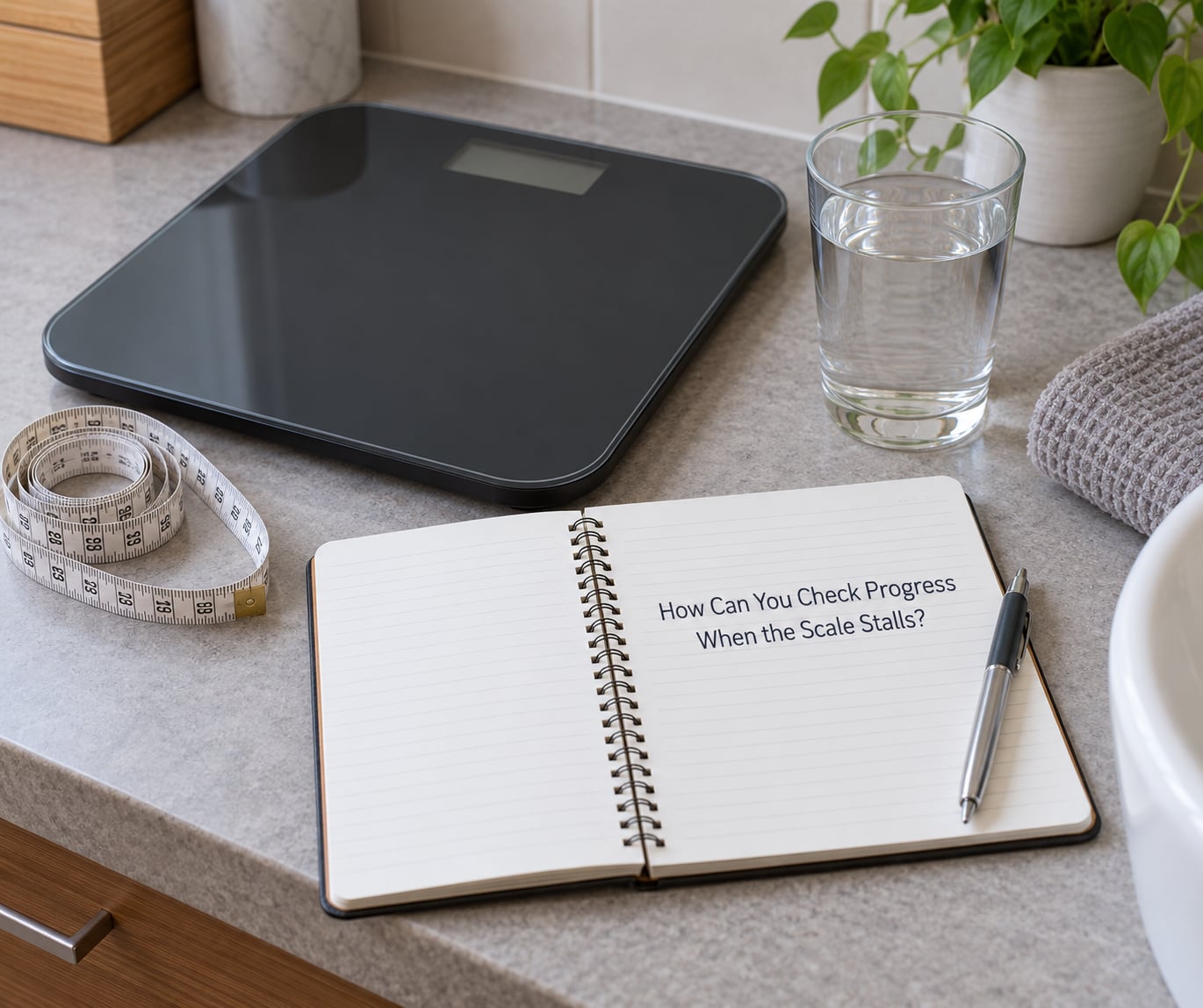
Use the same six measurements on a fixed schedule and stop looking at anything else.
Weight, averaged weekly
Weigh in each morning after using the bathroom and before eating, in the same clothes. Write the number down and never compute anything from a single reading. At the end of each week, average the seven days and compare that average with the one before it.
Waist circumference, monthly
Measure at the navel, at the end of a normal exhale, with the tape snug but not tight. Two or three centimeters is often visible in clothing long before the scale confirms it, and waist tends to fall where weight stalls during recompensation.
Clothing fit and photographs
Photograph the front, side and back in the same spot, same lighting, same time of day. Take the second set four to six weeks later. A waistband that buttons easier is a real measurement even when the number is not.
Training performance
Record the weight and reps for two lifts, or the pace and duration for one cardio session, each week. Holding or improving while weight is flat usually means muscle gain is offsetting fat loss.
How long to wait before changing anything
Give any adjustment three to four weeks of consistent data before you judge it. A single unflattering week carries almost no information. Judge the trend, and change one or two things at a time so you know what worked.
One warning sign to watch: a waist measurement that rises steadily while your calorie intake genuinely falls, or any of the symptoms in the next section.
When Should You Ask a Doctor or Registered Dietitian for Help?
Some stalls are not a tracking problem at all. Get individual medical advice if weight change is rapid in either direction without you changing anything, or if the stall comes with fatigue, dizziness, faintness, unusual thirst, frequent urination, feeling cold all the time, or bowel changes that persist.
Women should also seek advice when periods become irregular, unusually heavy or absent, or when fertility or mood changes alongside the weight. Perimenopause shifts both fluid balance and energy needs.
Tell a clinician about every medication and supplement you take, including prescriptions for blood pressure, diabetes, thyroid conditions, mental health and weight-loss injections. Never stop or change a prescription on your own.
Ask for a registered dietitian if you want a hands-on review of portions and meals, if you are managing diabetes, kidney disease, a pregnancy, a past or present eating disorder, or if you find yourself eating at levels you cannot sustain. Very low intakes can themselves flatten weight change while driving fatigue and poor sleep, which is a reason to seek guidance rather than to cut further.
What Simple Adjustments Should You Make First?
Work down this list in order, changing no more than two things at once.
- Audit three weeks of food. Weigh portions instead of estimating, log oil, sauces and drinks, and recount three ordinary days from memory to test for under-reporting.
- Stop eating back exercise. Wrist-based calorie burn figures are rough estimates at best, and adding them to your intake frequently cancels out the deficit you built.
- Return movement to your normal baseline. Lift two or three times a week and restore your usual walking. Raise daily movement before you cut more food.
- Keep meals regular and hold protein and fiber steady. Protein at every meal and enough vegetables make a deficit easier to sustain, which protects you from the rebound that stalls the next attempt.
- Fix sleep and stress basics. Short sleep raises hunger and cravings for calorie-dense food. Consistently short sleep is a common reason a well-run deficit stalls.
- Then recalculate maintenance. If four weeks of clean data still show a flat average, your needs have probably fallen. Adjust the starting number by 100 to 200 calories rather than halving your intake.
A diet break at maintenance for one to two weeks is also a reasonable option after many months of dieting. It helps with fatigue and hunger, and it does not undo fat loss.
Frequently Asked Questions
How much weight should I lose per week in a calorie deficit?
About 0.5 to 1 pound per week for most adults is a realistic pace, or roughly 0.5 to 1% of body weight. Faster loss usually means losing muscle or water along with fat. If your weekly average is moving slower than this, check intake accuracy and maintenance calories before cutting further, because an aggressive cut often ends in a stall.
Can eating zero-calorie foods stop weight loss?
Foods labelled zero calorie will not stop weight loss on their own. They are low in energy but not harmless: large portions of diet soda, fat-free dressing, sugar-free gum and diet ice cream can add up, and some contain sweeteners that leave you hungrier. Watch total portion size and the calories hiding in the foods around them.
Will exercise fix a calorie deficit that is not working?
Exercise helps, but it cannot repair an estimate that was wrong. Most wearables overestimate calorie burn, and adding those numbers to your intake cancels the deficit you created. Lifting and walking are still worth doing for body composition, mood and sleep, but fix tracking accuracy and maintenance calories first, then raise daily movement in small steps.
Does my BMI determine whether I need a calorie deficit?
Body mass index is a population screening tool, not a personal energy calculation. It says nothing about your muscle mass, your current expenditure, your hormones or how you respond to a deficit. Use BMI as one rough signal alongside weight trend, waist measurement, blood markers and your own history, and let a clinician interpret the numbers alongside you.
How long does a weight-loss plateau usually last?
A flat stretch of two to four weeks is common and often reflects water, salt, a heavier carbohydrate week or new training. A genuine plateau is usually judged after four to six weeks of accurate tracking with a flat weekly average. That is the point to recalculate maintenance calories or check with a professional rather than cutting deeper on your own.
Conclusion
Start with the data you already have: three weeks of weighed food entries, drinks included, plus your weekly averages and one waist measurement. Most people find either an intake gap they did not know about, or a maintenance number that has drifted out of date.
Account for water before you change anything, since that is what hides real progress most often. And if the stall comes with fatigue, dizziness, thirst, rapid change or cycle disruption, book an appointment instead of adjusting your plan yourself. A calorie deficit should rest on weeks of consistent evidence rather than one morning reading.
This article is for general information and does not replace individual medical or nutrition advice.