Learning how to read nutrition labels for weight loss comes down to four checks in a fixed order: scale every number to the amount you actually eat, treat calories as one signal rather than the verdict, aim for fiber and protein, then apply the 5% and 20% daily value thresholds. The Nutrition Facts panel is not a diet plan, but it is the one regulated document on the package, and the FDA built it so two foods can be compared in about a minute.
That minute matters more than it sounds. Most people trying to eat in a calorie deficit lose track because of serving size confusion, then partly correct for it by grabbing whatever carries a friendly word on the front. Reading the panel properly is the fix, and it is a skill you can pick up in one shopping trip.
Here is the whole method in four steps, and the rest of this guide unpacks each one.
- Start with serving size and servings per container. Every other number on the panel belongs to that amount, not to the package and not to your plate.
- Then look at fiber and protein. Those are the two numbers that decide whether the calories you just read will hold you until the next meal. A useful floor for a snack or a packaged meal is 3 to 5 grams of dietary fiber.
- Check the limit numbers next: added sugars, saturated fat and sodium. Keep added sugars under about 10 percent of your daily calories, which works out to roughly 50 grams on a 2,000-calorie reference intake.
- Finish with percent daily value and the ingredient list. 5% DV or less is low, 20% DV or more is high, and ingredients are listed by weight from most to least.
One thing to say up front: everything below is general information about how US labels are regulated. Your own calorie and nutrient targets depend on your health, activity and history, so bring specific questions to a registered dietitian or your doctor.
Table of Contents
- What You Need
- Step-by-Step
- Check the Serving Size First
- Look at Calories in Context
- Review the Nutrients That Matter Most
- Compare Similar Foods Before Choosing
- Use the Panel to Build a Balanced Plate
- Common Mistakes
- Frequently Asked Questions
- How many calories should I eat to lose weight?
- Is a low-calorie food always healthy for weight loss?
- What does 5% or 20% mean on a nutrition label?
- Are zero-calorie and zero-sugar foods good for weight loss?
- How do I compare nutrition labels for different brands?
- Do nutrition labels account for the entire package?
- Conclusion
What You Need
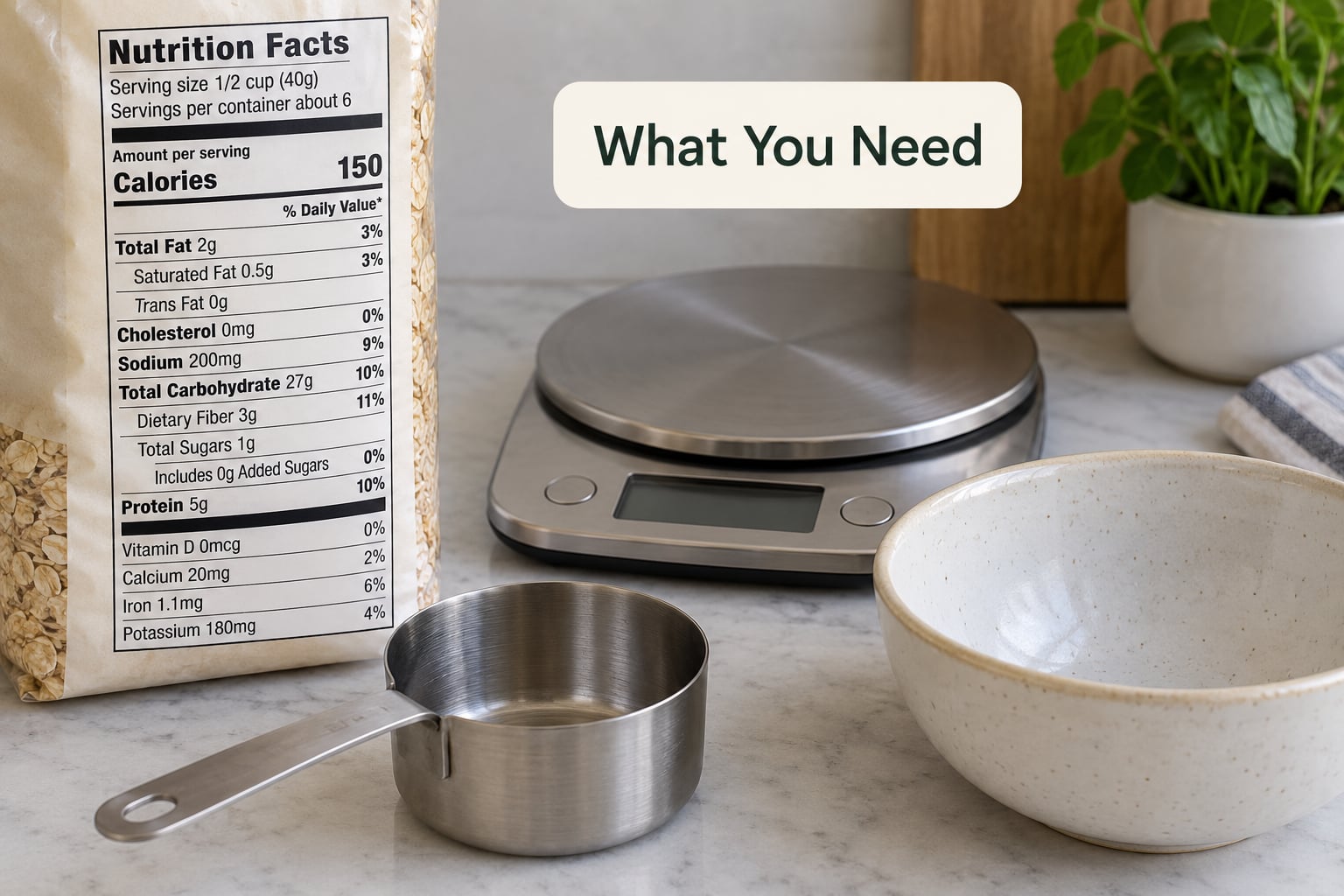
The only thing you strictly need is the panel itself, and on most packaged food it is on the back or the side rather than the front. Find five fields first: serving size, servings per container, calories, the macronutrient lines with their percent daily values, and the ingredient list printed just below the panel.
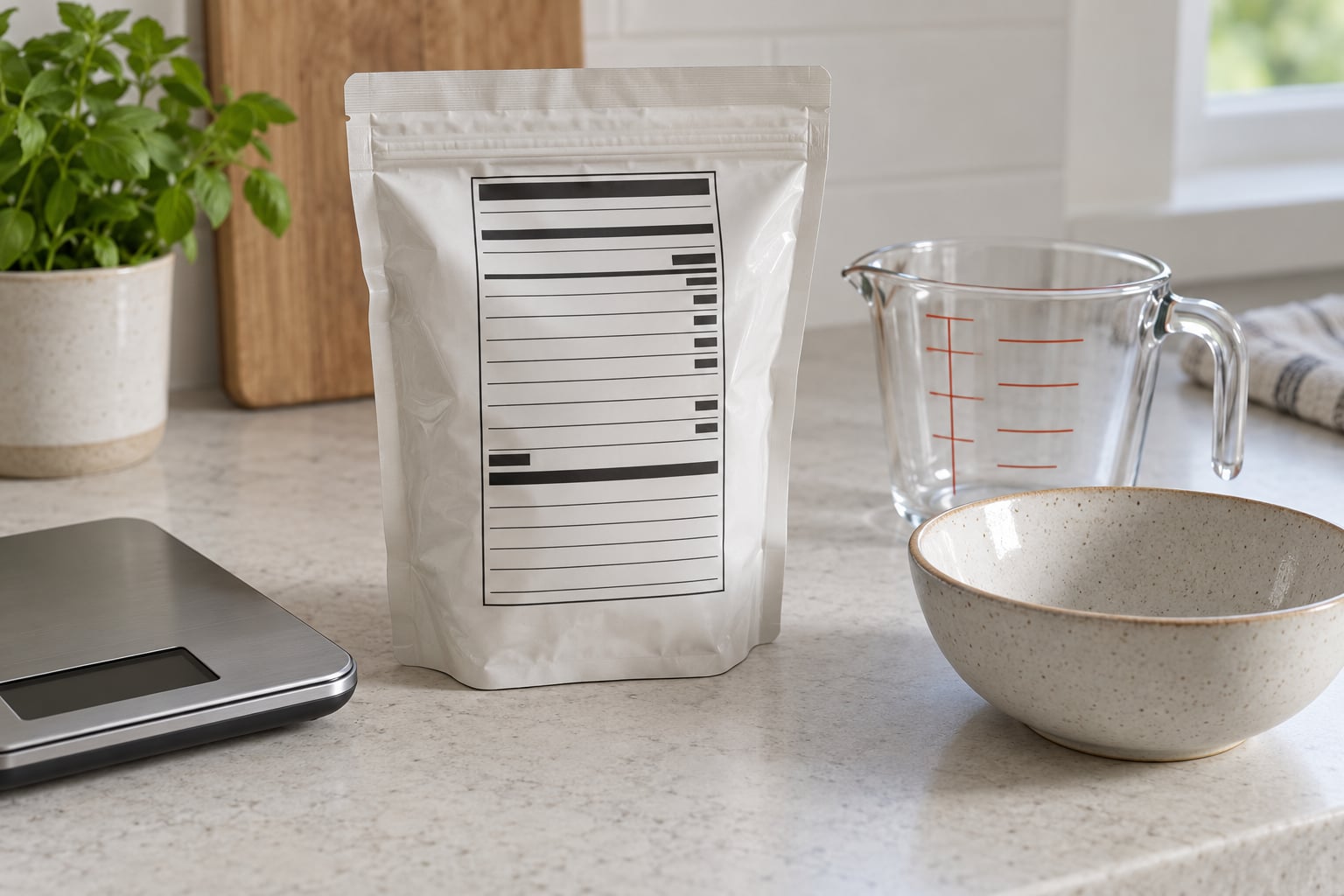
A few tools make the arithmetic faster rather than changing the answer. A kitchen scale lets you weigh an unfamiliar portion once so you know what one serving looks like in your own kitchen. A measuring cup or tablespoon does the same job for cereals, oils and nuts. Your phone calculator handles the multiplying when you eat more or less than the printed serving.
It also helps to have your own targets written somewhere you will see them, because the daily values on the package are based on a generic 2,000-calorie diet and are not calculated for you. If a dietitian has given you a calorie number or a fiber target, keep it next to the label and compare like with like.
Step-by-Step
Check the Serving Size First
Every number on the panel belongs to the serving size, and that serving size is a unit of measure rather than a suggestion about how much you should eat. The top of the panel states the serving size in grams or milliliters, and directly under the calorie line it tells you how many servings are in the container.
Here is the arithmetic, because this is the step people skip. A 20-ounce drink lists 80 calories per serving and states there are 2.5 servings in the container. Drink the whole bottle and you have logged 200 calories, not 80. Eat half a tub of yogurt with 150 calories and two servings per container and you have eaten 150 calories. The math is simply multiplication or division by the amount you ate.
Serving sizes are also set by regulation rather than by appetite, so a serving of cereal can be a cup of one brand and a cup and a half of another. If two products are going head to head, convert both to the same basis. Comparing 150 calories per 40 grams against 110 calories per 100 grams means you have to do the second conversion first, and the first product wins on a per-serving basis and loses once you normalize it.
Look at Calories in Context
Calories are worth reading first, and worth reading fast. They give you the size of the portion and nothing else, so two foods with identical calories can leave you completely differently depending on what the rest of the panel says.
Weight loss works on a simple arithmetic principle, which is eating slightly less energy than you use over time. Calories are the only number on the panel that speaks directly to that principle, so they are not a trap. They become a trap when they are used as the whole decision, because 200 calories of a food that keeps you full and 200 calories of a food that does not produce completely different days.
Two label rules are worth knowing here. A product can call itself calorie-free only if it has fewer than 5 calories per serving, and FDA rules allow calorie values to be rounded, so the number on the panel is an estimate rather than a measurement to the single calorie. Manufacturers may also use values from a nutrient database for some items rather than laboratory testing. Nobody is hiding anything, but a logged number should be treated as close to correct rather than exact.
Review the Nutrients That Matter Most
Dietary fiber, protein, added sugars, saturated fat and sodium cover most of what a reader trying to build a balanced plate needs. Fiber and protein are the two you want more of: fiber slows digestion and adds bulk, protein supports fullness and helps preserve lean mass while you eat less, and both blunt the blood sugar swings that create hunger between meals.
The limit numbers work the other way. Total sugars include what comes naturally from fruit and milk, while added sugars are the ones put in by a manufacturer. It is added sugars you would cut first. Saturated fat is the fat type most associated with raising LDL cholesterol, and sodium above roughly 2,300 milligrams a day is the general ceiling the Dietary Guidelines for Americans use.
| Nutrient | 5% DV or less | 20% DV or more | For weight loss |
|---|---|---|---|
| Dietary fiber | Low in fiber | High in fiber | Aim higher |
| Protein | Low | High | Aim higher |
| Added sugars | Low | High | Keep lower |
| Saturated fat | Low | High | Keep lower |
| Sodium | Low | High | Keep lower |
| Calcium, iron, vitamin D | Low | High | Worth noticing, but %DV is a floor |
Two quick shortcuts save a lot of reading. If the fiber grams are at or below one tenth of the total carbohydrate grams, the food will not fill you up for its calories. And if the sodium milligrams come in at more than double the calories, that combination usually signals a heavily processed product rather than a whole one.
Compare Similar Foods Before Choosing
Comparison is where label reading earns its keep. Take two fictional snack bars with identical serving weights and read them line by line.
| Label field | Bar A | Bar B |
|---|---|---|
| Serving size | 40 g | 40 g |
| Calories | 190 | 200 |
| Total carbohydrate | 22 g | 30 g |
| Dietary fiber | 5 g | 1 g |
| Protein | 8 g | 2 g |
| Added sugars | 2 g | 14 g |
| Sodium | 120 mg | 420 mg |
On calories alone these look like the same product, and a ten calorie difference is noise. Bar A carries 5 grams of fiber against 22 grams of carbohydrate, which is a ratio of 4.4 to 1 and comfortably passes the ten to one test. Bar B carries 1 gram of fiber against 30 grams of carbohydrate, a ratio of 30 to 1. Its sodium at 420 milligrams also comes in at more than double its calorie count, the processing signal described above. Same calories, very different appetite effect, and the panel told you that in about fifteen seconds.
Use the Panel to Build a Balanced Plate
A label describes one food, not a meal. A 200 calorie packaged item that comes with 2 grams of fiber is a starting point rather than a plate, so pair it with something you do not need a label for: a piece of fruit, a handful of vegetables, a portion of beans or lentils, or a piece of fish, chicken or tofu.
This is where people underestimate most, because produce, plain meat, nuts and grains rarely carry a Nutrition Facts panel at all. FDA rules exempt single-ingredient whole foods like raw fruit, plain coffee, unseasoned spices and plain roasted nuts, so the absence of a label is usually a good sign rather than a gap in the information.
Restaurant and delivery menus need a different habit. Portion reporting there describes an average serving, not the bowl that arrives at your door, and restaurant dishes are frequently assembled from several labeled components. Look for the published calories per item, then scale for what you actually order. A salad with dressing, a side and a protein will read very differently once each piece is added to the running total.
Common Mistakes
- Treating calories as the whole story. The fix is to read fiber and protein immediately after the calorie line, before deciding anything.
- Counting one serving for a multi-serving package. The fix is to multiply every number by the number of servings you actually ate, using the servings per container line.
- Reading %DV as your personal requirement. Daily values come from a general 2,000-calorie reference diet and represent a floor designed to prevent deficiency, not an optimum. Hitting 100% DV of a vitamin does not mean more is better, and a 40% DV does not mean you personally need 40%.
- Trusting front-of-package claims. Words like light, low fat, natural, multigrain, made with and only 100 calories per serving tell you what a manufacturer chose to highlight. The FDA sets strict rules for reduced, low, high and free claims, but high fiber means 20% DV and light can mean far more than what most people picture.
- Reading calories per serving as calories per package. Bottles, tubs, boxes and bags frequently hold two or more servings, and the reason is written on the panel in a small line that most people skip.
One more piece of math belongs here, because it explains why the panel can disagree with a simple calculation. Carbohydrate and protein are counted at 4 calories per gram and fat at 9. Multiply a label’s grams by those numbers and you often land within 10 or 20 calories of the printed figure, and the gap is usually rounding or fiber, which is counted at fewer calories per gram than the full 4.
Frequently Asked Questions
How many calories should I eat to lose weight?
There is no single number for everyone. Your needs depend on your age, sex, size, activity level, health and any medications you take, which is exactly why the 2,000-calorie figure on a label is a reference and not a target for you. Use labels to count accurately rather than to guess a number. A registered dietitian can work out a realistic range and pace for you.
Is a low-calorie food always healthy for weight loss?
No. A low calorie count says something about portion size and nothing about what is in the food. A 90-calorie item with 1 gram of fiber and 12 grams of added sugar will not satisfy you the way a 180-calorie item with 6 grams of fiber and 12 grams of protein will. Check the fiber, protein and added sugar lines before you decide anything.
What does 5% or 20% mean on a nutrition label?
Percent daily value is how much of a daily reference amount a single serving provides. 5% DV or less counts as low and 20% DV or more counts as high, which is the rule that lets you scan a shelf quickly. The reference is a general 2,000-calorie diet, so %DV describes the food rather than your personal requirement.
Are zero-calorie and zero-sugar foods good for weight loss?
They can fit a plan, but read the panel first. Calorie-free only means fewer than 5 calories per serving, and sugar-free means less than 0.5 grams of sugars. Many of these products compensate elsewhere, sometimes with saturated fat, sodium or non-nutritive sweeteners, so the ingredient list tells you more than the front of the package does.
How do I compare nutrition labels for different brands?
Match the serving sizes first, then match the columns, then compare the number that matters to your goal. Normalize to calories per 100 grams when the serving sizes differ. Two brands with nearly identical calories can differ by 5 grams of fiber and 12 grams of added sugar, and that difference decides which one you will still be thinking about at four o’clock.
Do nutrition labels account for the entire package?
No, they account for one serving, which is why the servings per container line matters so much. If the container holds 2.5 servings and you eat all of it, multiply every number by 2.5. Single-ingredient whole foods such as raw fruit, plain coffee, spices and unseasoned nuts are exempt from carrying a panel at all.
Conclusion
Start with one habit: before anything else, look at serving size and servings per container, then adjust every number to what you will actually eat. That single step removes the most common tracking error, and the rest of the panel starts making sense once the numbers describe your portion rather than the manufacturer’s.
From there it is fiber, protein, added sugars, saturated fat, sodium and the 5% and 20% thresholds, in that order, every time. For calorie and nutrient targets that fit your own body and health history, talk to a registered dietitian or your doctor.