Learning how to eat 100 grams of protein a day is mostly arithmetic, not willpower: pick one protein-forward item per meal, give it a serving size, and count it. Most adults eat far less than that today, so the jump feels bigger than it is. Split the target into roughly 30 g at breakfast, 30 to 35 g at lunch, 30 to 35 g at dinner, and 15 to 20 g from snacks, and the whole thing takes about ten minutes of planning.
100 g sounds like a lot when you picture it as a stack of chicken breast. It is not. It is a can of tuna plus a cup of Greek yogurt plus four eggs, spread across a normal day of food you probably already eat. Below is the method I use: set per-meal targets, choose foods you genuinely like, check portions against labels, and adjust when real life gets in the way.
One note before we start. This is general nutrition information for adults. If you have kidney disease, are pregnant, are under 18, or take medication that changes how your body handles protein, talk to your doctor or a registered dietitian first, and skip the rest of this until you have.
Table of Contents
- What You Need
- Step-by-Step: How to Eat 100 Grams of Protein a Day
- Set a Protein Target for Each Meal
- Choose Protein Foods You Will Actually Eat
- Build Meals With Protein Plus Satisfying Extras
- Use Labels, Weights, and Portion Checks
- Adjust the Plan When Life Gets Busy
- Common Mistakes
- Frequently Asked Questions
- Is 100 grams of protein a day suitable for everyone?
- How can I eat 100 grams of protein a day without feeling full?
- What are easy plant-based ways to reach 100 grams of protein?
- Do I need protein supplements to hit 100 grams?
- How do I know how much protein is in a mixed meal?
- Should I increase my protein intake gradually?
What You Need
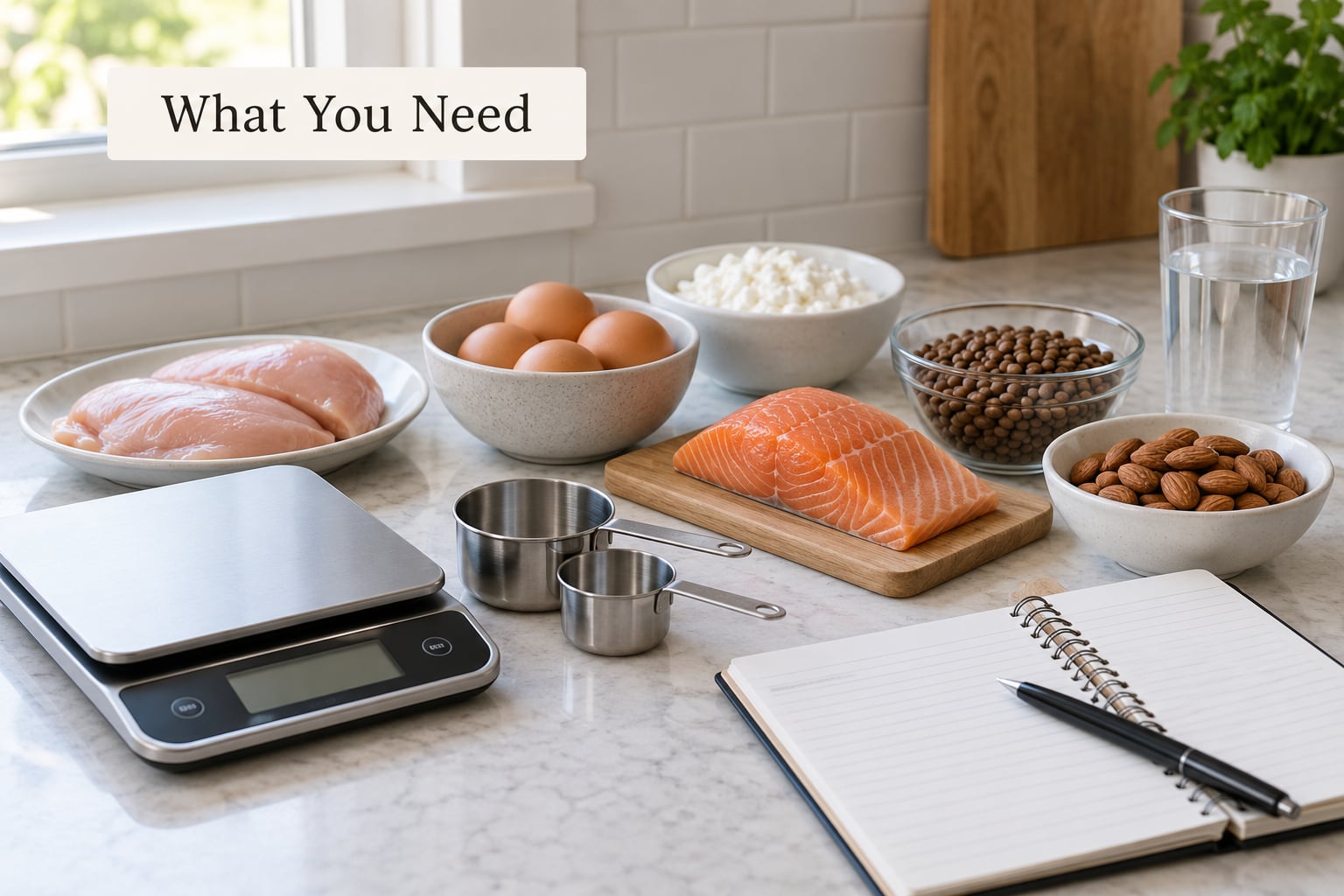
Three things, and two of them are optional.
A nutrition label or a reliable protein reference. Almost every packaged item in a grocery store prints protein per serving, and that number is the whole ballgame. If you eat mostly whole foods with no labels, keep a simple reference list of the foods you buy most (below) and learn maybe eight of those numbers by heart.
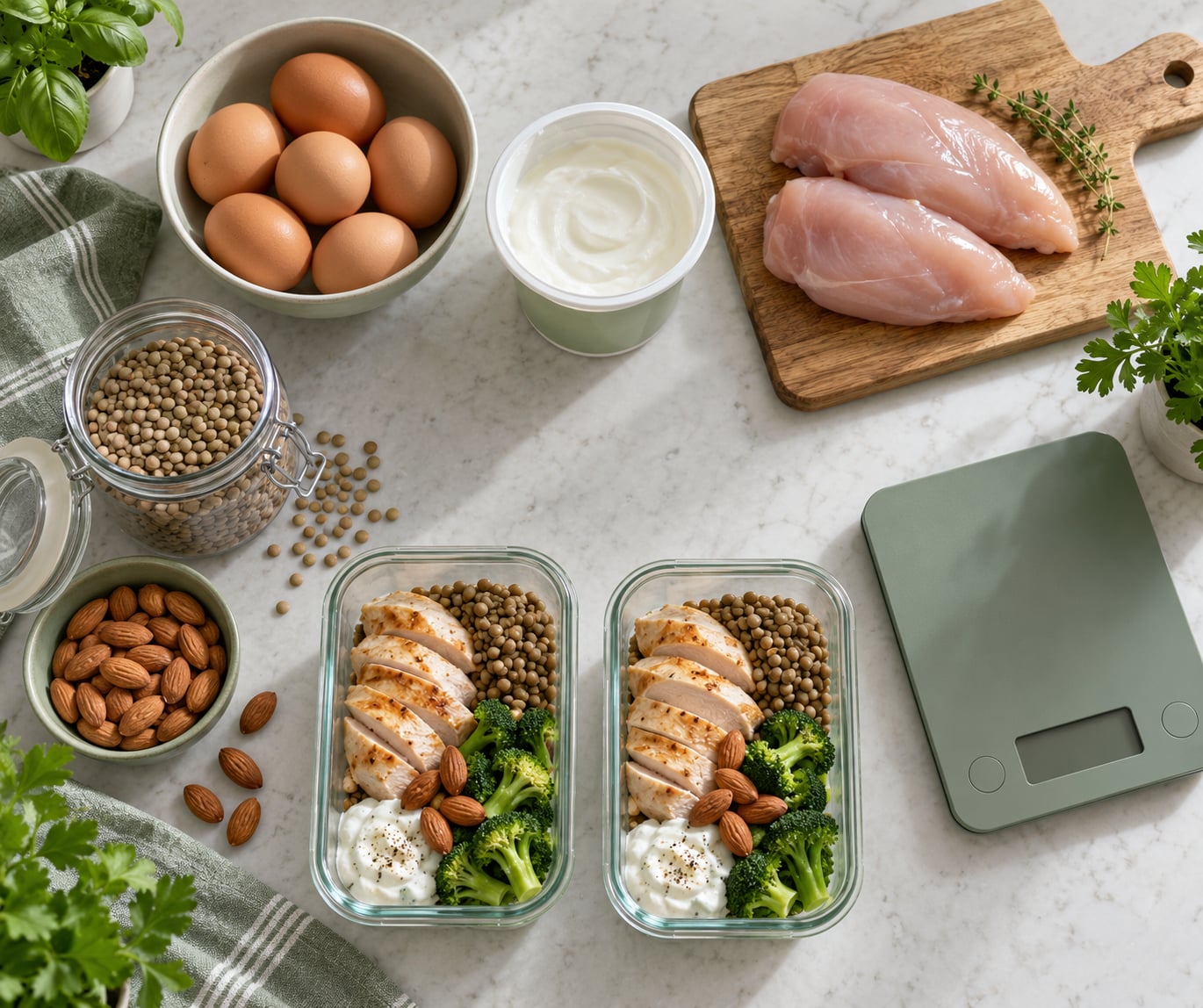
A kitchen scale or measuring cups. A cheap digital scale turns guessing into knowing, and it is the fastest way to learn what a 4 oz portion actually looks like on your plate. Hand portioning works fine too; it just takes a few weeks of calibration.
A meal-planning method. Nothing fancy. A note on your phone, a paper list, or ten minutes on a Sunday. The plan does not need to cover the week. Deciding what protein you are eating at dinner is usually enough to keep you from defaulting to toast.
And a rough sense of your own situation: your body weight, your budget, your appetite, and any dietary restrictions. Those four facts decide which foods land in your plan and which ones never will.
Step-by-Step: How to Eat 100 Grams of Protein a Day
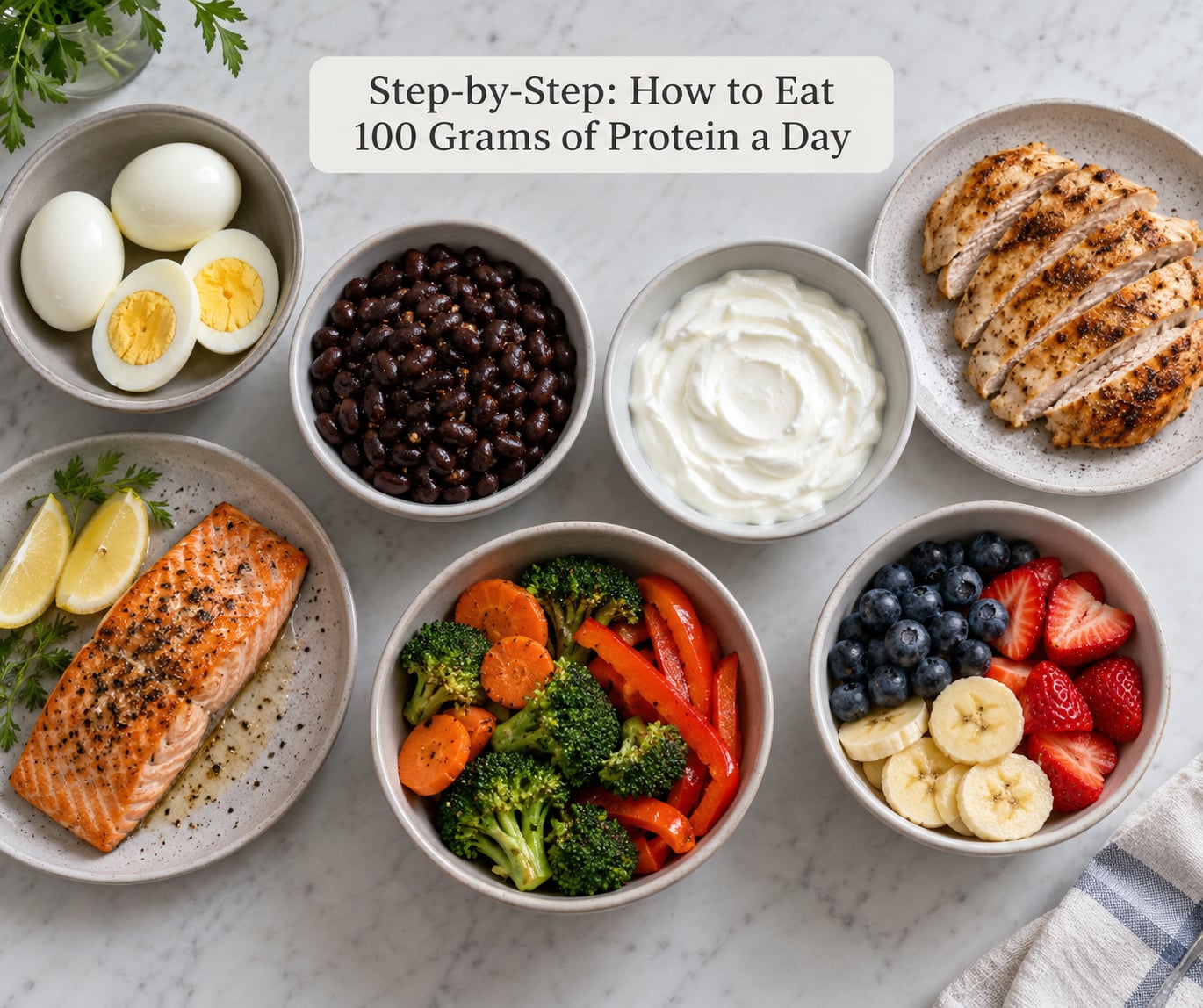
Five steps. Most people get through steps one and two and stall, so the later ones focus on the parts that actually need practice.
Set a Protein Target for Each Meal
Divide the total first, then pick foods. Doing it the other way around is how people end up at 70 g and slightly annoyed about it.
| Meal | Target | Two ways to hit it |
|---|---|---|
| Breakfast | 25 to 30 g | 1 cup Greek yogurt (about 20 g) plus 1 oz almonds (about 6 g); or 4 large eggs (about 24 g) |
| Lunch | 30 to 35 g | 4 oz chicken breast (about 25 to 30 g) over salad; or 1 cup cooked lentils (about 18 g) with 1/2 cup crumbled feta |
| Snack | 15 to 20 g | 1/2 cup low-fat cottage cheese (about 12 g) with a boiled egg; or 2 tbsp peanut butter (about 7 g) on an apple slice with a glass of milk |
| Dinner | 30 to 35 g | 3 oz lean beef (about 22 g) with potatoes; or 1 can tuna (about 42 g) on crackers with a side salad |
That adds up to 100 to 120 g depending on choices, which is where you want to be. The distribution is not sacred. Some people do better with two big meals and one small one, and if your schedule runs that way, run with it.
Choose Protein Foods You Will Actually Eat
This is the step that decides everything. Here are the workhorses, with the serving size and the grams, because that pairing is what you need when you are standing in a shop or a kitchen at 7 p.m.
| Food | Serving | Protein | Cost class |
|---|---|---|---|
| Chicken breast | 4 oz cooked | 25 to 30 g | Mid |
| Lean beef | 3 oz cooked | 22 g | Mid |
| Canned tuna | 1 can | about 42 g | Low |
| Salmon | 3 oz | about 19 g | Higher |
| Large egg | 1 | about 6 g | Low |
| Cottage cheese, low fat | 1/2 cup | about 12 g | Low |
| Greek yogurt, plain | 1 cup | 20 to 25 g | Mid |
| Milk | 1 cup | about 8 g | Low |
| Black beans | 1/2 cup cooked | about 7 g | Low |
| Lentils | 1 cup cooked | about 18 g | Low |
| Edamame | 1 cup | about 17 g | Mid |
| Peanut butter | 2 tbsp | about 7 g | Mid |
| Pumpkin seeds | 3 oz | about 16 g | Mid |
It helps to see the same target from one food, the way readers often ask about it. Reaching 100 g from a single item takes a lot of one thing, which is exactly why mixing sources works better.
| Food alone | Amount for 100 g of protein |
|---|---|
| Chicken breast | about 14 to 16 oz |
| Canned tuna | roughly 2 to 3 cans |
| Large eggs | about 16 |
| Low-fat cottage cheese | about 8 half-cup servings |
| Milk | about 12 cups |
| Canned tuna plus milk | 1 can plus 5 cups |
For context, the recommended dietary allowance for protein sits around 58 g a day for a typical adult, which is roughly what the average American eats. Going from there to 100 g is a normal, well-studied step, not an extreme one.
Build Meals With Protein Plus Satisfying Extras
A plate of chicken breast on its own is not a meal, and treating 100 g of protein as a protein-only task is how people get to day five and quit. Pair the protein with vegetables, some fruit or whole grains, and enough fat to make it taste good.
Protein is the most filling macronutrient per calorie, and it takes more energy to digest than carbohydrate or fat. That combination tends to help with satiety and with holding onto lean mass during weight loss. Protein also supplies the essential amino acids that build and repair muscle, which is the part everyone is really after.
Two habits help more than the rest. Eat the protein first, at the start of the meal, while you are hungriest. And get at least one vegetable into every main meal, because volume is what makes a high-protein plate feel normal rather than punishing.
Food safety basics still apply: cook poultry to 165 F (74 C), ground meat to 160 F (71 C), and whole cuts of meat and fish to 145 F (63 C). Refrigerate cooked protein within two hours, and use refrigerated leftovers within three to four days.
Use Labels, Weights, and Portion Checks
Reading a label takes about ten seconds. Find protein per serving, check the serving size, then check how many servings you are about to eat. If a tub of yogurt says 20 g per serving and the serving is 3/4 cup, then the whole tub is roughly 27 g. Multiply before you assume.
For loose foods, use a hand guide. A palm-sized piece of meat is about 3 to 4 oz. A fist of yogurt, cottage cheese, or beans is about 1 cup. Two eggs is a standard serving, not a serving for four.
Mixed dishes need one extra trick: count only the protein ingredients. A bowl of chili might have beans and ground beef carrying 20 g while the rice, peppers, and toppings carry almost none. A burrito bowl with chicken and black beans lands in the same range. You are not estimating total food weight; you are estimating the protein sources.
Then do a three-day check-in. Eat normally for three days and keep rough notes of your protein per meal, without weighing anything. Most people land somewhere between 60 and 80 g on day one, mostly because breakfast contributes nothing. That single number tells you exactly which meal to fix, which is faster than trying to change everything at once.
Adjust the Plan When Life Gets Busy
Real weeks are not tidy. Here is what to do about the common ones.
Busy mornings: keep shelf-stable protein where your hands already are. A handful of roasted nuts, a can of tuna, single-serve Greek yogurt, or hard-boiled eggs cooked on Sunday. Breakfast is where most people lose 20 g, and it is the easiest one to win back.
Low appetite or appetite suppression: shift volume to two meals instead of four, and make the protein part of foods you already enjoy, like a smoothie with yogurt and frozen fruit, or soup with shredded chicken or beans stirred in. If you take a GLP-1 medication, protein becomes more important for keeping muscle during weight loss, which makes sense to discuss with your prescriber.
Travel and eating out: grilled protein plus a side is your default order. Skip the bread basket and pick a protein-forward appetizer. Tuna salad, chicken soup, or a bean-based dish all move the number along.
Vegetarian or vegan: pairing works. Combining a grain with a legume at the same meal gives you the full set of essential amino acids, so beans with rice, tofu with rice, or lentils with whole-grain bread covers it. In practice the harder job is density: plant foods are more voluminous per gram of protein. If you keep hitting 80 g and plateauing, the fix is usually one denser add-on, like soy, extra tofu, peanut butter, edamame, or a scoop of pea protein powder. Whole foods get you close; a denser form closes the last gap.
Finally, check whether 100 g is even your number. A practical range is about 0.7 to 1.0 g of protein per pound of body weight, or 1.6 to 2.2 g per kilogram. The recommended dietary allowance of 0.8 g per kg covers most healthy adults, and higher figures come up in strength training and during weight loss.
| Body weight | 0.7 g per lb | 1.0 g per lb |
|---|---|---|
| 130 lb | about 90 g | about 130 g |
| 160 lb | about 112 g | about 160 g |
| 180 lb | about 126 g | about 180 g |
| 200 lb | about 140 g | about 200 g |
If your weight puts you above 100 g, that is information, not a bigger problem. Add a protein serving to lunch and dinner and you are there. But if you have kidney disease or a history of kidney problems, do not run the numbers up on your own; get personalized guidance from a doctor or registered dietitian first.
Common Mistakes
Here is what keeps people stuck, with the fix for each.
Counting only obvious meat. Most meals are built from carbohydrates, and a plate of pasta with vegetables can sit at 15 g without anyone noticing. Fix: at each meal, name the protein source out loud. If you cannot name it, there probably is not one.
A carb-heavy breakfast. Cereal, toast, and bagels can leave breakfast at 8 or 10 g and force dinner to make up 40. Fix: swap in Greek yogurt, eggs, or cottage cheese for two mornings a week before you change anything else.
Assuming protein powder is the shortcut. One shake is 20 to 25 g and does nothing for the other three meals. Powder plus a low-protein breakfast is a common reason people stay at 70 g. Fix: use powder as an addition to a day that already has three protein meals, not as the whole strategy.
Eating portions far bigger than you think. This runs both ways: restaurant portions silently double your protein estimate, and home portions are often smaller than the label serving. Fix: weigh three meals to calibrate your eye, then trust your hand.
Treating 100 g as a rule for everyone. A 130 g adult training for strength has different needs than a 250 g sedentary adult, and the weight table above settles that in seconds. Fix: pick your number from your own weight and goal, then treat 100 g as the starting point it usually is.
Raising intake overnight. Doubling protein at once tends to cause bloating and a bad first impression of the whole idea. Fix: add about 20 g per week, and increase fiber and water alongside it.
A few tips that smooth the rest of the way. Keep three staples always available: eggs, a canned protein, and yogurt or cottage cheese. Rotate your protein sources instead of eating the same chicken every night. And measure for a few weeks, not forever; once your eye is calibrated the scale becomes a sanity check rather than a chore.
Frequently Asked Questions
Is 100 grams of protein a day suitable for everyone?
No, it is a solid general target for most healthy adults, not a rule for everybody. Body weight, activity level, and goals change the number: roughly 0.7 to 1.0 g per pound is a common working range, and higher figures come up during strength training or weight loss. People with kidney disease, pregnant or nursing adults, and anyone under 18 should get personalized advice from a doctor or registered dietitian before raising protein.
How can I eat 100 grams of protein a day without feeling full?
Spread the target across four or five eating points instead of two big meals, and let protein fill the volume for you rather than sitting alongside everything else. Eating protein first in a meal, adding vegetables for bulk, and keeping fats moderate all help. If appetite is genuinely low, concentrate protein into two meals and shrink the rest of the plate.
What are easy plant-based ways to reach 100 grams of protein?
Lentils (about 18 g per cup), edamame (about 17 g per cup), tofu, tempeh, Greek yogurt, cottage cheese, peanut butter, and canned beans all count. Pairing a legume with a grain or wheat at the same meal gives you the full essential amino acid profile. Because plant foods are voluminous per gram of protein, many people add one denser item such as soy, peanut butter, or pea protein powder to close the last 10 to 20 g.
Do I need protein supplements to hit 100 grams?
For most people, no. Whole foods get you to 100 g on a normal eating pattern, and building the day around eggs, dairy, chicken, fish, beans, lentils, nuts, and seeds covers it. Powder can help when appetite is low, when you train hard, or when plant-based density is the obstacle, but it works best on top of three protein-forward meals rather than replacing them.
How do I know how much protein is in a mixed meal?
Count only the protein ingredients and ignore the volume of everything else. In a bowl of chili, the beans and ground meat carry the protein while the rice and peppers contribute almost none. For packaged foods, read protein per serving, then multiply by the number of servings you actually ate. This works for restaurant dishes too: grilled chicken and beans on a salad is protein-forward, the same salad alone is not.
Should I increase my protein intake gradually?
Yes. Adding about 20 g per week gives your digestive system time to adjust and makes the change far easier to keep. Increase fiber and water at the same time, since extra protein often arrives with extra vegetables and grains. Going straight from a typical intake to 100 g in one day is how people end up bloated and ready to quit the idea.
So: how to eat 100 grams of protein a day? Start tomorrow by fixing one meal, and make it breakfast, because that is where the missing 20 g usually hides. Add a protein source you already like to what you are already eating, check the label, and let the rest of the day stay the way it is. Revisit the total in a few weeks from your own body weight, and adjust from there.