Yes, you can lose belly fat after 50, and the plan that works is boring in the best way: build balanced meals, strength train two or three times a week, walk most days, sleep properly and stay with it for months rather than weeks. If you want to know how to lose belly fat after 50 without crash dieting or losing muscle, this six-step plan is the whole thing.
Here is the short answer, before the detail. Belly fat shrinks when you hold a modest calorie deficit while protecting muscle through resistance training and enough protein. You cannot pick the spot, so crunches alone will not move your waist. Most people see meaningful change in their waist between eight and twelve weeks, and slower change after that.
This is general information, not medical advice. If you have heart disease, diabetes, high blood pressure, recent joint surgery, osteoporosis or ongoing pain, talk to your doctor before changing your eating or activity, and ask a registered dietitian to size your calorie and protein targets.
Table of Contents
- What You Need to Lose Belly Fat After 50
- Step-by-Step: How to Lose Belly Fat After 50 in Six Steps
- Create a Balanced Plate at Meals
- Make Small, Sustainable Eating Changes
- Add Strength Training Two or Three Times Weekly
- Build Up Daily Movement to Lose Belly Fat After 50 Safely
- Prioritize Sleep and Stress Management
- Track Trends, Not Perfection
- Common Mistakes
- Frequently Asked Questions
- Can you really lose belly fat after 50?
- Can walking help me lose visceral fat?
- What are the best exercises to lose belly fat after 50?
- What shrinks belly fat the fastest?
- Will taking estrogen or hormone therapy reduce belly fat after menopause?
- When should I see a doctor before starting this plan?
- Conclusion: Start With One Sustainable Change
What You Need to Lose Belly Fat After 50
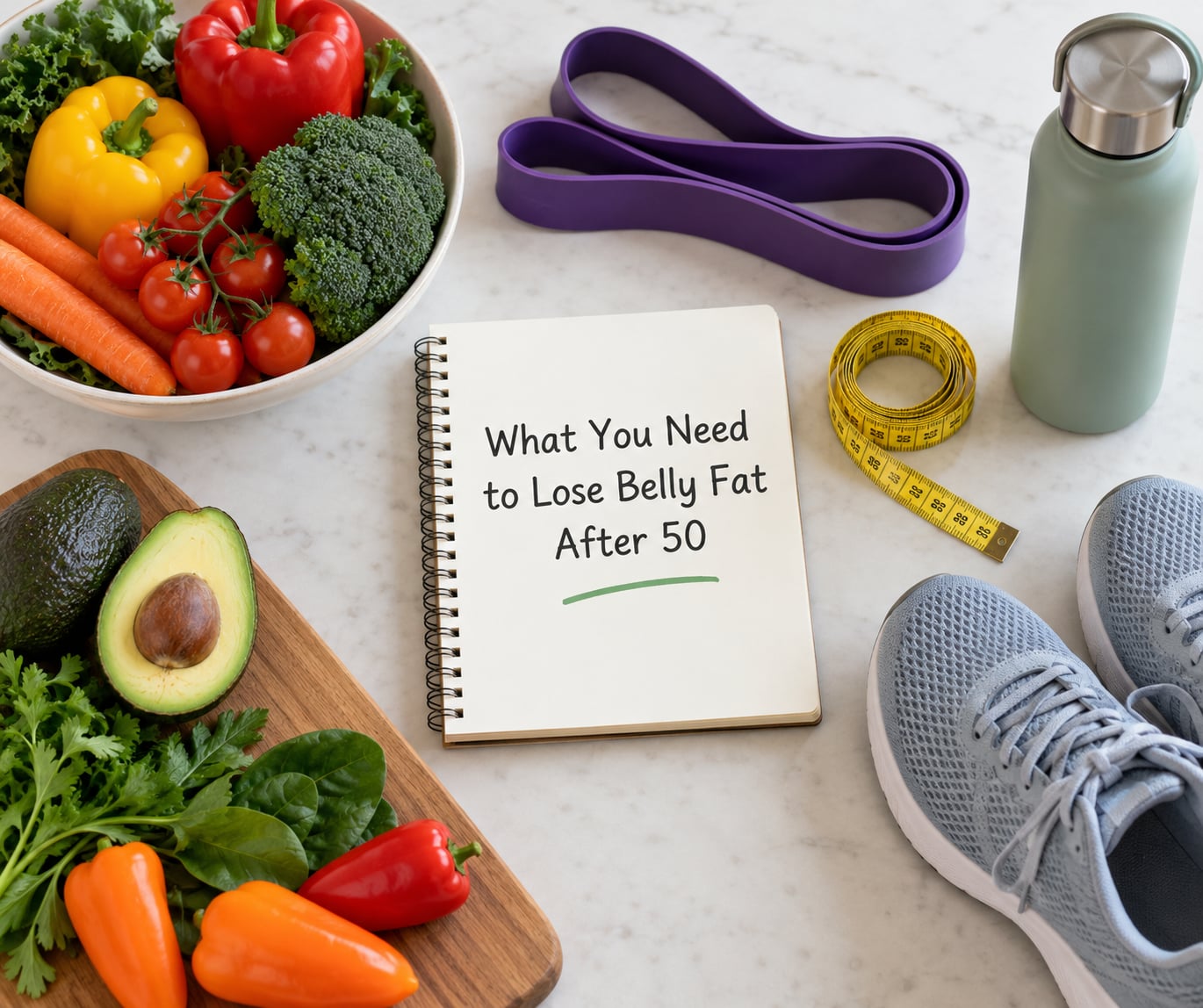
The equipment list is short, which is good news. Most people over 50 who quit did not quit because the plan was hard. They quit because it looked like something built for a 30-year-old.
You need five things, and four of them are free.
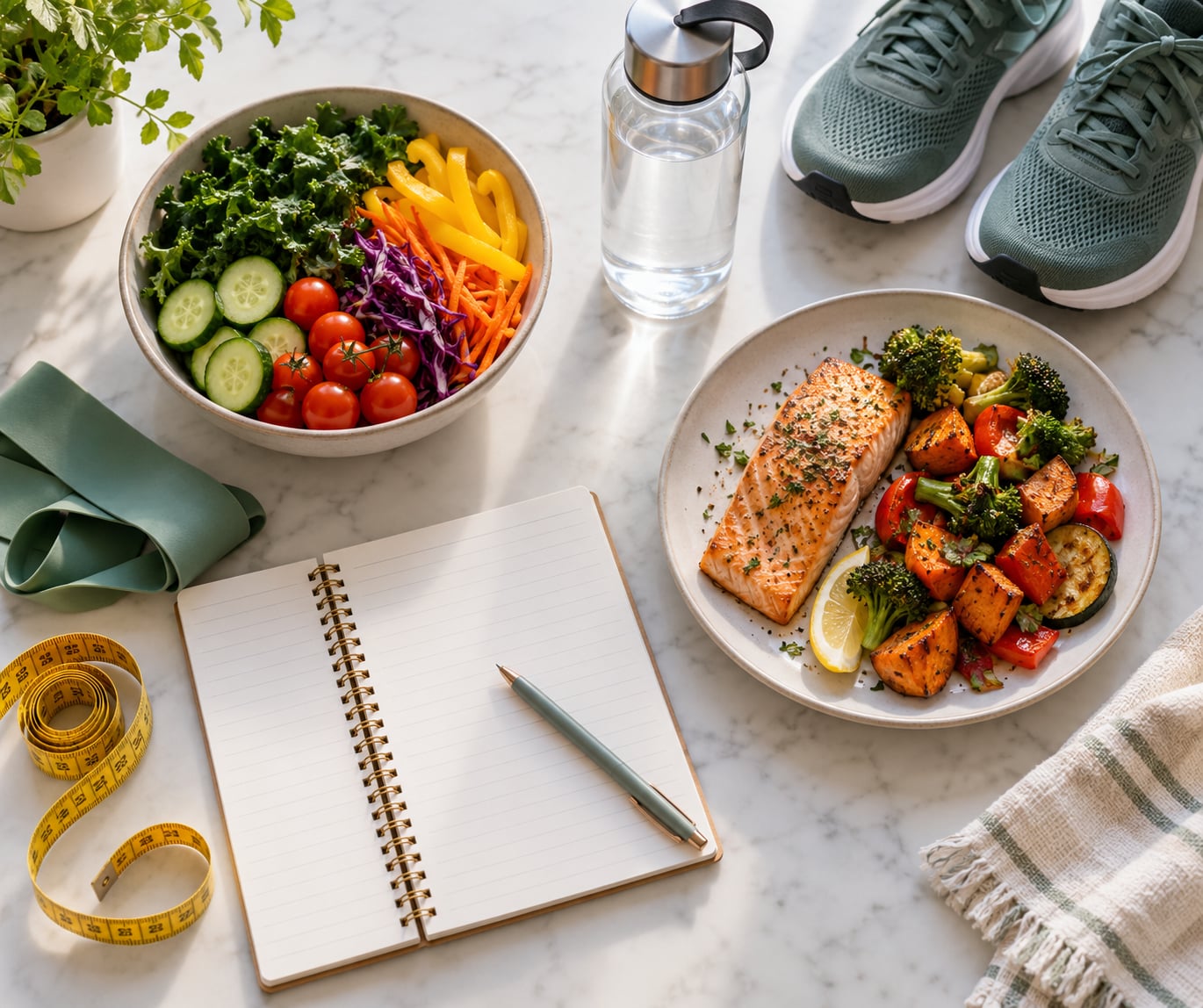
- A simple food-tracking method. A paper notebook, a phone note, or a printed tracker. The point is noticing portions, not hitting a perfect number every day.
- Comfortable walking shoes. If a shoe rubs, blisters or makes you walk shorter, it is the wrong shoe. Feet and knees give out before the plan does.
- Resistance bands or light dumbbells. Both are cheap. If you can sit and stand without help, you can start with a band.
- A measuring tape. Optional, and more useful than a scale, because waist circumference tracks the fat you actually care about.
- A place to log energy and progress. Same notebook. Energy level, sleep quality and how your clothes fit tell you things faster than weight alone.
What you do not need: a fancy program, an expensive supplement, a body fat scale you have to argue with, or a kitchen full of single-purpose ingredients.
Step-by-Step: How to Lose Belly Fat After 50 in Six Steps
Create a Balanced Plate at Meals
Build each main meal around four parts: a vegetable or fruit, a protein source, a satisfying carbohydrate, and a small amount of healthy fat. That structure does most of the work, because it makes portions obvious without weighing anything.
A bowl of bean and vegetable soup with a slice of whole-grain bread is a plate. Salmon with roasted vegetables and a spoon of olive oil is a plate. Greek yogurt with berries and a handful of walnuts is a plate if you are keeping it to a snack size.
The reason this works after 50 is protein. From your late 40s onward, people tend to eat less protein than they did younger, while muscle mass declines at the same time. That combination is the core problem behind the flat stomach that will not budge, and it is why protein deserves a number rather than a vibe.
| Situation | Rough daily range | Notes |
|---|---|---|
| Maintenance | About 1.0 to 1.2 g per kg of body weight | A sensible floor for adults over 50 |
| Losing fat while strength training | About 1.2 to 1.6 g per kg | Helps protect muscle during a calorie deficit |
| Example at 75 kg (about 165 lb) | 90 to 120 g | Roughly a 30 g serving at each meal plus breakfast |
These are general ranges for adults over 50, not prescriptions. Kidney disease, liver conditions and some medications change protein guidance, so check with a clinician before increasing it.
You will know the plate is working when meals stop leaving you hungry an hour later, and when you notice you are not grazing in the evening out of boredom.
Make Small, Sustainable Eating Changes
Adjusted nutrition is the single biggest lever, and you do not need a revolution. You need one or two changes you can still be doing in month four.
- Swap sugary drinks for water most days. Liquid calories do not register as satisfying, and this is often the fastest change to feel.
- Shrink portions slightly rather than skipping meals. A deficit of roughly 300 to 500 calories a day is enough. Crash dieting backfires because it costs you muscle, and muscle is your metabolism.
- Cut back on added sugars and refined carbohydrates. Most packaged snacks and sweetened drinks qualify. Whole grains in normal portions do not need to go.
- Watch alcohol. Drinks carry calories with little protein or fiber, and regular heavy intake tends to show up around the middle. Cutting back matters more than any “belly fat burning” drink.
- Eat more fiber. Vegetables, beans, lentils and whole grains help you feel full and keep digestion predictable.
There is no drink that burns belly fat on its own. Water, unsweetened tea and sparkling water are good defaults, and that is genuinely all the evidence supports.
How do you know this step is working? Your meals last longer without hunger, your clothes sit slightly looser at the waistband, and you are not thinking about food every hour of the day. If you are, the change was too aggressive.
Add Strength Training Two or Three Times Weekly
This is the step people skip, and it is the one that decides whether you keep your muscle. Resistance training after 50 does more than build strength; it preserves muscle mass, which supports your metabolic rate and makes stairs, groceries and getting out of a chair easier.
Start with two full-body sessions a week, 30 to 45 minutes each, with a day or two between them. A beginner sequence needs nothing but a chair and a band:
- Sit to stand from a sturdy chair, 2 sets of 8 to 12
- Band rows, 2 sets of 10 to 12
- Wall or counter push-ups, 2 sets of 8 to 12
- Step-ups on a low stair or step, 2 sets of 8 each leg
- Standing band rows or overhead press, 2 sets of 10
- Heel raises holding a counter, 2 sets of 12
Progress by adding a repetition or a small weight, not by adding hours. Most people need eight to twelve weeks before strength changes are obvious, which is another reason the timeline matters.
| If this hurts | Try this instead | Why it helps |
|---|---|---|
| Floor exercises on the knees | Seated or standing versions | Knee pressure drops sharply |
| Burpees or jumping jacks | Step touches and band walks | Protects ankles, knees and spine |
| Heavy barbell squat | Chair sit-to-stand or goblet squat with light weight | Easier to control range of motion |
| Overhead press standing | Seated band press or light dumbbell press | Better support for a weak core |
| Walking on concrete | Shorter sessions on softer ground or pool walking | Less jarring for sore joints |
Walk before you lift, not instead of it. A five-minute easy walk gets blood moving and warms up the joints. Anyone with a history of falls, osteoporosis or significant joint damage should get an individual program from a physical therapist or certified trainer first.
Build Up Daily Movement to Lose Belly Fat After 50 Safely
Walking is the most underrated fat-loss tool you already own. It is low impact, it is adjustable to almost any joint, and it burns calories without the recovery cost of hard intervals.
Start where you are now and add a little at a time. If you walk 10 minutes, aim for 15 to 20 minutes four or five days a week for two weeks, then add five more minutes. Building toward 150 minutes of moderate activity per week matches the widely used Physical Activity Guidelines for Americans, and you can reach it through walking alone.
On the talk test: you should be able to speak full sentences but not sing. If you cannot, slow down. Most people overestimating their pace is why their walking feels harder than it needs to.
How do you know it is working? Walking longer at the same pace, stairs that feel easier, and a waist measurement that drifts down over a month or two.
Prioritize Sleep and Stress Management
Sleep of 7 to 9 hours is not a nice-to-have for this goal. Poor sleep raises ghrelin and appetite, lowers the drive to train, and makes consistent eating harder. Cortisol, the stress hormone, does not by itself cause belly fat, but chronic stress and chronic sleep debt make the whole plan harder to run.
Practical habits that do not require a retreat:
- Keep a consistent wake-up time, weekends included
- Stop caffeine six to eight hours before bed if it keeps you awake
- Five minutes of slow breathing, four seconds in and six seconds out, once a day
- A short walk after dinner to mark the end of the day
- Write down the one thing you are carrying so your brain is not holding it overnight
The people in online communities who say sleep was their highest-leverage habit are mostly right. It is not glamorous and it is not on any product list, which is exactly why it gets skipped.
Track Trends, Not Perfection
Measure in a way that survives contact with a normal week. Once a week, same morning, same conditions, note your waist at the navel, your weight if you track it, your energy level, and one strength marker such as how many chair sit-to-stands you can do comfortably.
| Measure | Lower risk | Higher risk |
|---|---|---|
| Women | Under 31.5 in (80 cm) | Over 35 in (89 cm) |
| Men | Under 37 in (94 cm) | Over 40 in (102 cm) |
Thresholds vary by source and individual; the Mayo Clinic publishes these figures as general guidance. Your doctor can interpret your number for you.
Look for a trend line, not a single measurement. Water weight, salt, a new medication and constipation can all move the scale a few pounds in a day. If your waist is shrinking and your strength is holding, that is a good month even if the scale has not moved.
A realistic expectation for most people following this plan: some loss in the first four to six weeks, more visible change in the waist around weeks eight to twelve, and a realistic pace of roughly 1 to 2 pounds per week. Slower than that is normal and still counts, particularly if muscle is staying put.
Common Mistakes
Mistake 1: Believing in spot reduction. Crunches, sit-ups and leg lifts build the muscles under the fat, which is worth doing, but they do not pull fat from that area. Fix: train whole-body, and let eating and walking do the fat loss.
Mistake 2: Following an extreme diet. Very low calorie plans drop weight fast and take muscle with it, which slows your metabolism and makes the rebound worse. Fix: a modest deficit with adequate protein, kept for months rather than weeks.
Mistake 3: Increasing exercise too quickly. The most common forum complaint from people over 50 is knee and back pain in week three. Fix: add no more than about 10 percent more time or distance each week, and keep two strength sessions steady.
Mistake 4: Watching only the scale. Weight can stay flat while waist drops and muscle holds. Fix: track the waist weekly and strength monthly alongside it.
Mistake 5: Believing fat burners, belly wraps, detoxes or apple cider vinegar. None of them removes belly fat specifically. Fix: spend that money on better walking shoes and a couple of pounds of protein.
Mistake 6: Quitting before week twelve. Change at this age is slow and mostly invisible week to week. Fix: judge the plan at week twelve, not week three.
A short consistency list that helps: put strength sessions in your calendar like appointments, keep healthy meals pre-built for busy days, wear walking shoes indoors when it is cold, and aim for a plan you could still follow on a bad week rather than only on a good one.
Frequently Asked Questions
Can you really lose belly fat after 50?
Yes. Losing belly fat after 50 works at any age because the fat responds to a sustained calorie deficit, not to your birth date. What changes after 50 is muscle mass, hormone levels and recovery time, which is why strength training and enough protein matter more. Most people see first change around four to six weeks and visible waist change between eight and twelve.
Can walking help me lose visceral fat?
Walking helps, and it is often the most sustainable fat-loss tool after 50. Brisk walking for 30 to 45 minutes, four or five days a week, burns meaningful calories and supports heart health and joints with little recovery cost. On its own it usually plateaus once your body adapts, so pairing walking with two strength sessions a week gives better waist results than walking by itself.
What are the best exercises to lose belly fat after 50?
The three categories that matter most are full-body resistance training two or three times a week, brisk walking most days, and balance and mobility work. Resistance training protects muscle mass, walking burns calories steadily, and balance work reduces fall risk. No single exercise removes belly fat from one spot, so the goal is a routine you can repeat for months.
What shrinks belly fat the fastest?
A modest calorie deficit you can hold, combined with strength training and regular walking, shrinks abdominal fat fastest in a way that keeps your muscle. Nothing available burns belly fat on its own, and no crash diet produces a fast result you keep. If you want speed without harm, the best move is consistency over twelve weeks rather than intensity over seven days.
Will taking estrogen or hormone therapy reduce belly fat after menopause?
Hormone therapy is not a weight loss treatment and should never be started or changed for belly fat alone. Its risks and benefits depend on your personal and family history, and it is a conversation to have with your doctor. Menopause itself does shift fat storage toward the abdomen, so the plan of balanced eating, strength training, walking and sleep still applies whatever you decide about medication.
When should I see a doctor before starting this plan?
See a doctor first if you have heart disease, diabetes, high blood pressure, osteoporosis, a recent injury or surgery, or pain that changes how you walk. Stop and get advice if you feel chest pain, dizziness or unusual shortness of breath while exercising. A registered dietitian can also size your calorie and protein targets if you have kidney, liver or blood sugar conditions.
Conclusion: Start With One Sustainable Change
If you take one thing from this guide, make it the first two weeks of structure: build balanced plates with real protein at each meal, book two 30-minute strength sessions a week, add ten minutes of easy walking to most days, and protect seven to nine hours of sleep. That is how to lose belly fat after 50 in a way your body can hold onto.
Give it twelve honest weeks before you judge it, and track your waist rather than your mood. Individual medical needs, medications and warning signs deserve a conversation with your doctor or a registered dietitian, and for anyone over 50 that check-in is part of the plan, not an afterthought.