Sitting all day is not what adds weight. What adds weight is a workday that quietly removes hundreds of daily calories of movement while keeping calorie-dense food within arm’s reach for ten hours straight. So learning how to lose weight while working a desk job comes down to two levers you can actually control: a modest, repeatable calorie deficit, and putting movement back into hours that are currently spent in a chair.
Neither lever is dramatic, which is why the plan holds up on a week when meetings eat your lunch break. The whole thing fits into a normal workweek, needs no special equipment, and takes about 20 minutes to set up. Last reviewed for 2026, and built around the physical activity guidelines most adults are already meant to be hitting.
Table of Contents
- What You Need to Lose Weight While Working a Desk Job
- Step-by-Step
- Set a plan for how to lose weight while working a desk job
- Build meals that make desk work easier
- Reduce long periods of sitting
- Add enough activity to support weight loss
- Use sleep, stress, and consistency to support progress
- Monitor progress without obsessing over the scale
- Common Mistakes
- Frequently Asked Questions
- Can I lose weight by exercising at my desk?
- Do I need to count calories to lose weight while working a desk job?
- How quickly can I lose weight with a sedentary job?
- How often should I weigh myself if I work at a desk?
- Can I start losing weight without going to a gym?
- Conclusion
What You Need to Lose Weight While Working a Desk Job
You need five things, and four of them are free. A modest calorie deficit of roughly 300 to 500 calories a day, a source of protein at every meal, water within reach, comfortable shoes you can walk in, and one honest way to track what you are doing.
That is genuinely the list. No membership, no supplement, no meal-prep subscription, no formal exercise class. A standing desk is optional and, on its own, it is not a substitute for walking. People who try to lose weight while working a desk job tend to fail when they buy the equipment first and postpone the habits.
The practical version of this article assumes a deficit you can hold for months, not days. This is general information, not medical advice, and if you have a medical condition, take supplements, or are pregnant, talk to your doctor or a registered dietitian before changing how you eat.
Step-by-Step
Six steps, in the order that actually produces results for people who sit for a living. The order matters: plan first, then food, then sitting, then exercise, then sleep, then tracking.
Set a plan for how to lose weight while working a desk job
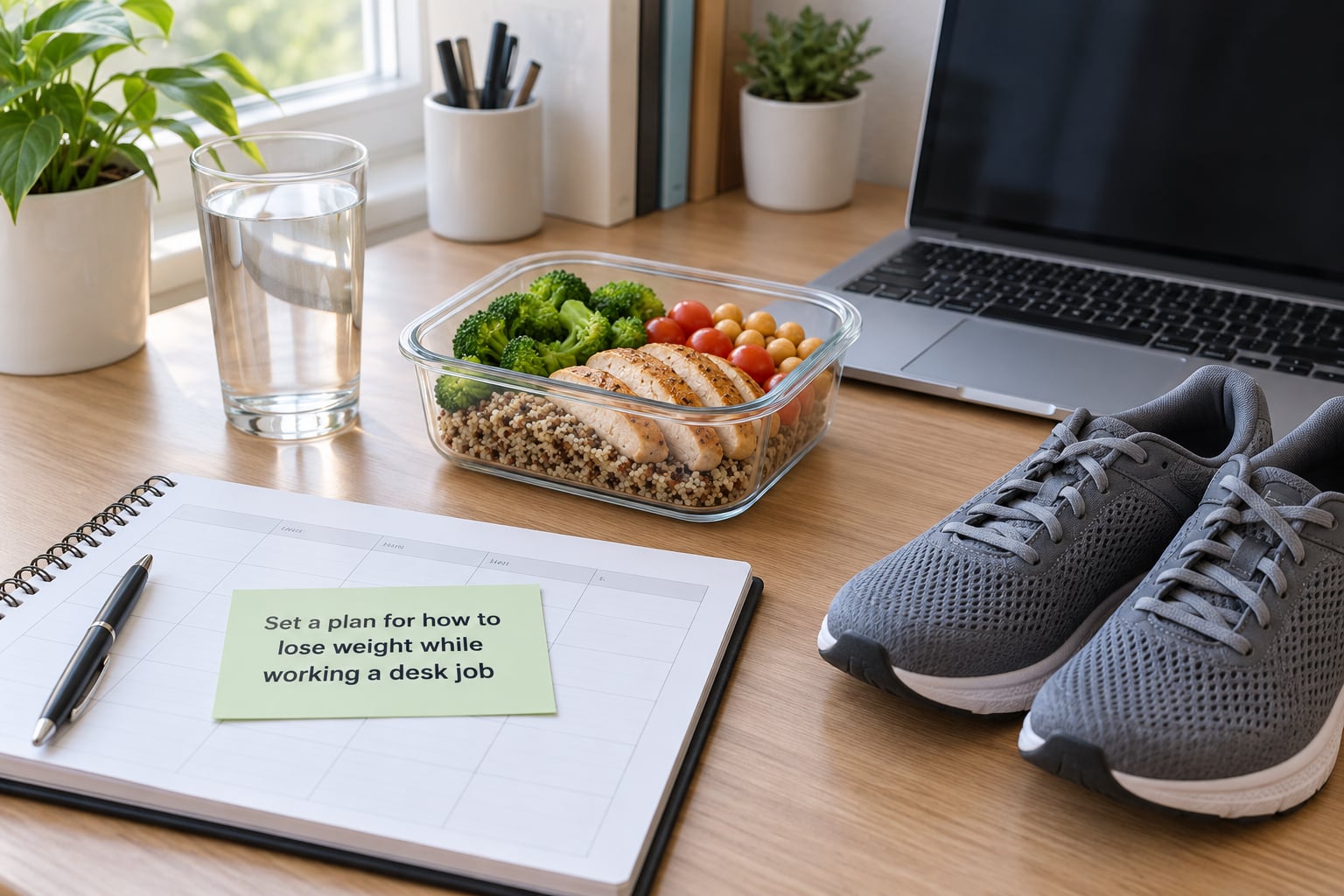
Start with one weekly goal, not a daily one. Mine is a 15-minute walk at lunch plus two 5-minute movement breaks in the afternoon, and that is the whole commitment for a normal week.
One goal works because you can repeat it. A goal like eat better fails because it is not measurable on a Tuesday. Write the walk into the calendar as a meeting with yourself, because a planned break survives a busy inbox far more often than an unplanned one.
Then set the three supporting pieces. Plan meals for the work week on Sunday, keep two movement breaks in the calendar, and pick a weigh-in schedule you can keep, such as every Monday morning after using the bathroom. Consistency at a low dose beats intensity in a burst every time.
Build meals that make desk work easier
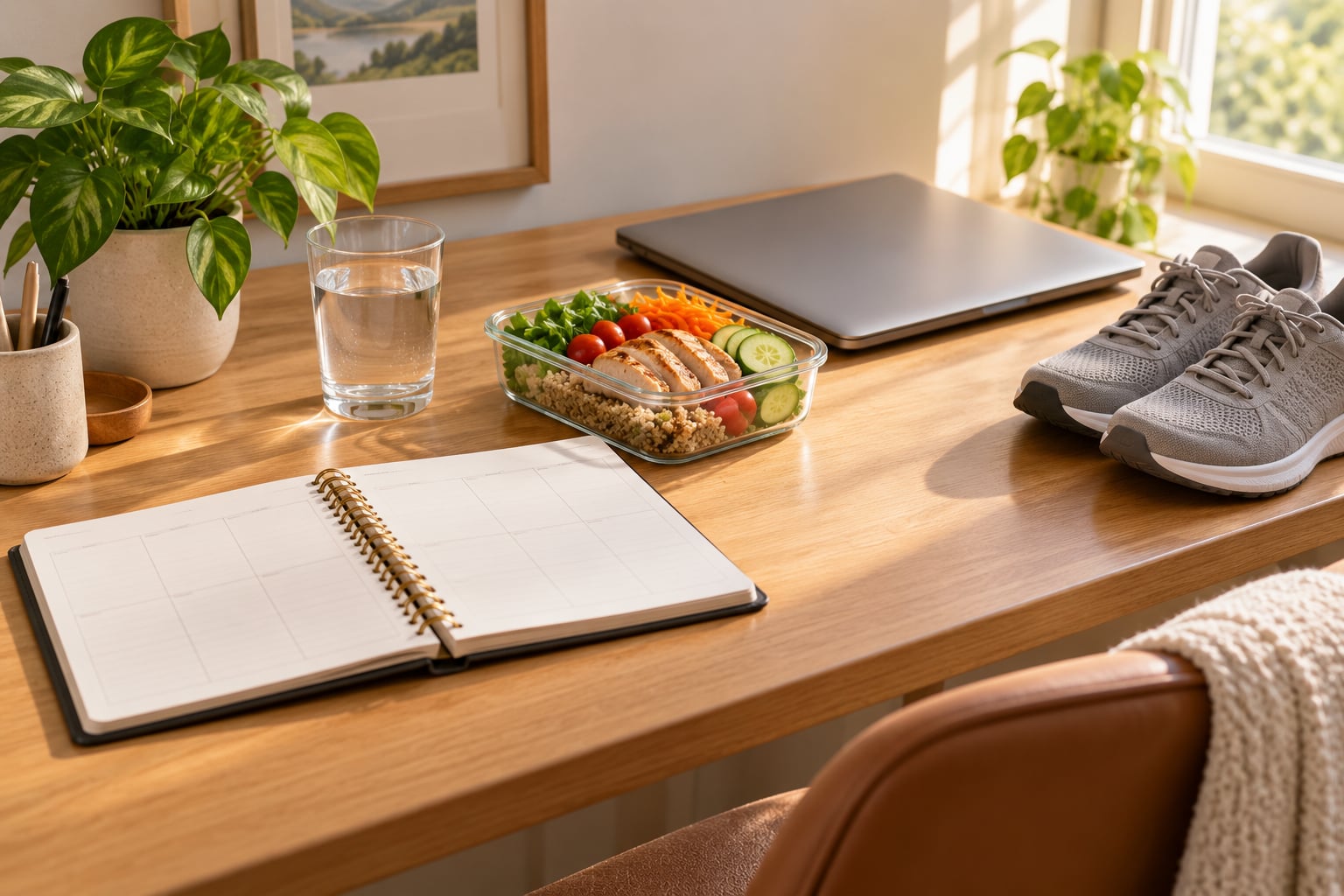
A desk-job lunch is protein plus a fiber-rich carbohydrate plus vegetables or fruit plus a measured amount of fat. That formula is flexible enough that you will not get bored of it by Wednesday, and each part does a specific job: protein and fiber create satiety, which is what stops the 3pm vending machine run.
Breakfast usually looks like eggs or Greek yogurt with berries and a spoon of nuts, or oats cooked with milk and a spoon of nut butter. Lunch is the build-your-own bowl: a palm-sized portion of chicken, beans or tuna, a scoop of quinoa, brown rice or a whole-grain wrap, a large handful of greens or roasted vegetables, and olive oil or avocado in a measured spoonful. Dinner repeats the same proportions at a normal plate size.
Snacks get planned too, which is the part most people skip. Keep two options at your desk that are not from the vending machine: a handful of nuts, a piece of fruit with cheese, plain yogurt, or roasted chickpeas. The goal is to arrive at your next meal mildly hungry rather than starving.
When hunger is the problem, eat before you are extremely hungry and drink a glass of water first. Thirst frequently wears the same shape as hunger, and a protein-heavy meal usually beats a sugary one at keeping you satisfied for the next three hours.
If you pack food, treat it with basic safety rules. Refrigerate anything perishable within two hours, keep cold items below 40°F with an ice pack, and reheat leftovers until they reach 165°F (74°C) — which is the temperature USDA guidance recommends for reheating packed lunches.
Reduce long periods of sitting
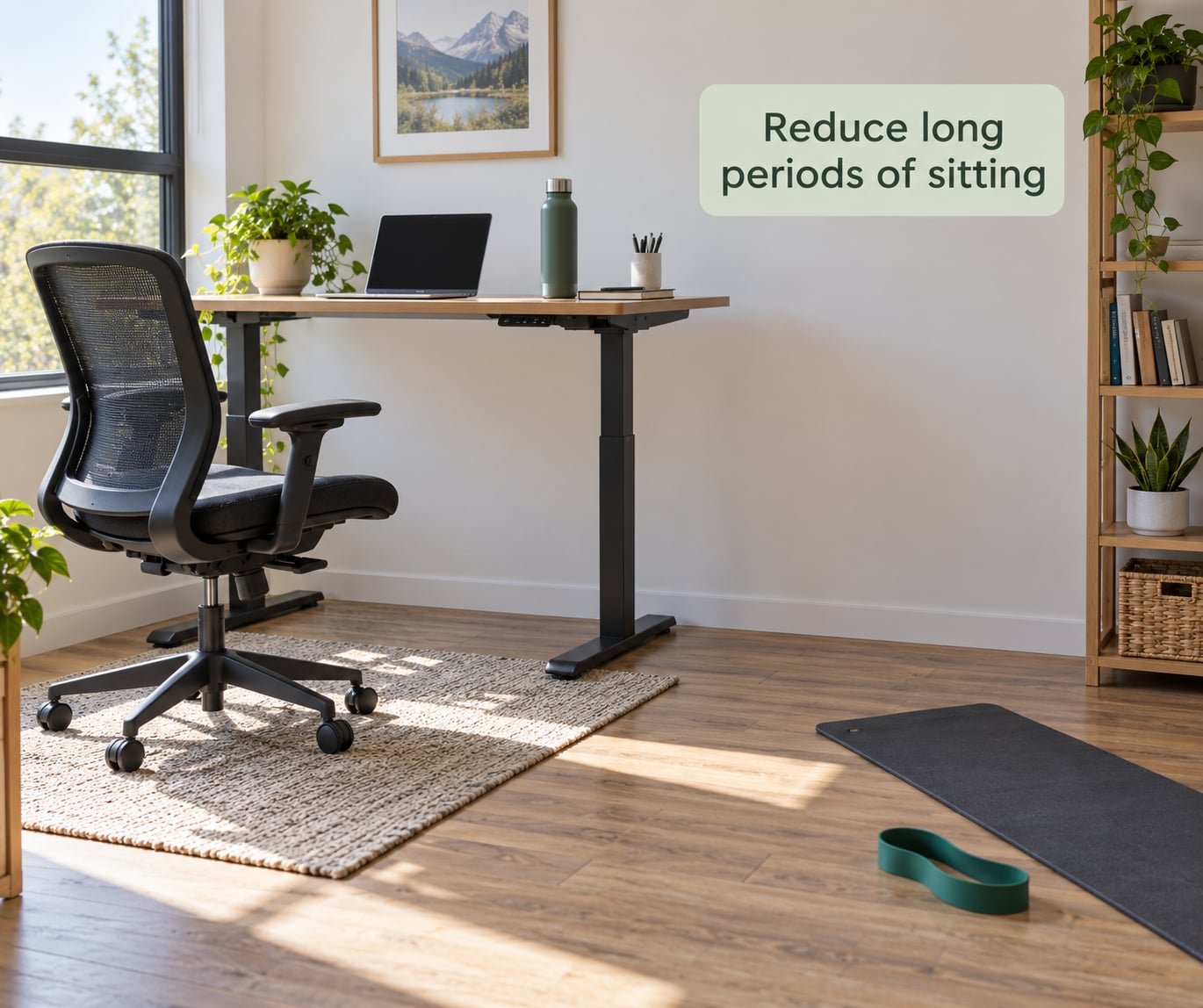
The single most effective change is an active break every 30 to 60 minutes: stand, change position, walk a lap, take the stairs. Five minutes at that cadence removes roughly an hour of continuous sitting from your day, and it does more for how you feel by mid-afternoon than most people expect.
Keep the breaks small enough that they survive a deadline. Stand up and touch both toes. Walk to the printer. Take phone calls standing or walking. Do one lap of the floor with your coffee before you open the laptop. Remote workers can do all of this in a hallway, and hybrid workers usually have the easiest time of anyone because the walk to the car counts.
Here is the honest answer about standing desks: standing is not exercise. Sitting burns roughly 80 calories an hour and standing about 88, so a full day upright adds only around 50 calories for most adults. A sit-stand desk is useful because it varies your position and eases back and neck discomfort, not because it burns fat.
Desk exercises fill the gaps. Try these five, each for two sets, twice a week: seated marching with straight legs, 20 alternating lifts; leg extensions to straight, 15 per leg; wall sits at 30 to 45 seconds; desk push-ups, 10 to 12; and calf raises with a light resistance band, 15 reps. They are small, but they are enough to interrupt a static posture.
Add enough activity to support weight loss
Movement has to come from two places: a daily baseline of walking and two or three short full-body strength sessions a week. The US physical activity guidelines recommend 150 to 300 minutes of moderate aerobic activity weekly plus muscle strengthening on at least two days, and strength work is what protects the muscle you would otherwise lose while you cut calories.
Walking is the easiest lever for a desk worker because it requires no plan. A 20-minute walk at a moderate pace runs roughly 100 to 130 calories for an average adult, so five workdays adds up to a meaningful chunk of the week. Build toward 10,000 steps by adding distance to the commute, parking further away, taking stairs, and walking one call a day.
Two full-body sessions a week of 20 to 25 minutes each is plenty to start. Squats, push-ups, rows with a resistance band or dumbbell, Romanian deadlifts with light weights, and a carry or plank cover the patterns that matter. Add reps or a little load every week or two, and stop adding when your form breaks down.
Beginners can do all of it at home with a pair of resistance bands and a clear floor, and remote workers should assume they need to build movement deliberately since no commute forces it.
Use sleep, stress, and consistency to support progress
Short sleep raises hunger and lowers the impulse control you need to skip the snack drawer. Sleep deprivation reliably increases ghrelin, the hormone that drives hunger, and disrupts leptin, the hormone tied to fullness, which is part of why under-slept workers eat more without intending to.
Pick a consistent wake time, more important than a consistent bedtime, and protect it seven days a week. If work runs late, a firm stopping point beats an open-ended evening. A ten-minute walk and no food in the room also helps people who wake up at 3am to stress-eat.
Stress is the other half of the same problem. Cortisol rises during a bad week and makes food feel like relief, which is how a deadline turns into weight gain. Build one non-food reset you can use between meetings: a short walk, five slow breaths, or a glass of water away from your desk.
Then be patient. Weight loss for sedentary people is slower and steadier than the dramatic numbers online, and a plan that removes 1 to 2 pounds a month for a year outperforms anything crashy by a wide margin.
Monitor progress without obsessing over the scale
Look at your weight once a week at most, and only compare it to the previous week. Day-to-day movement usually reflects water, glycogen and salt, not body fat, and reacting to it is how people quit before anything happens.
Track three other things that move more slowly and mean more: waist measurement at the navel, monthly, your energy through the afternoon, and how many of your planned breaks you actually took. If your waist is shrinking and your energy is steadier, the plan is working even when the scale is quiet.
Review everything every one to two weeks. If the trend is flat for three weeks, change one variable — usually food, since intake drives most of the result — rather than adding more exercise on top of an already full week.
Common Mistakes
Most stalled attempts come down to one of a handful of predictable errors, and each has a straightforward fix.
Swapping food for diet drinks and nothing else. Zero-sugar drinks are a useful swap for soda, but they do not create a deficit on their own. Fix it by keeping real protein and fiber in the meals they replaced.
Skipping lunch, then overeating at 3pm. The rebound is bigger than the meal you skipped. Fix it by eating a moderate lunch even on meeting days, and by packing a backup you can eat in two minutes without leaving your desk.
Sitting for the entire day. Two hours of walking in the evening does not fully cancel nine hours of sitting, though it is far better than nothing. Fix it by adding two or three active breaks into the workday itself.
Chasing an extreme deficit. Very low intakes are hard to sustain, and the drop you see in week one is mostly water and glycogen. Fix it by aiming for a moderate 300 to 500 calorie deficit you can still follow in a busy month.
Overdoing exercise on top of an inactive day. Stacking hard sessions onto a sedentary schedule often ends in injury or exhaustion. Fix it by adding daily walking first, then one or two strength sessions, and increasing gradually.
Having no snack plan. Hunger that arrives unannounced gets handled by whatever is nearest. Fix it by keeping two desk-drawer options on hand, and by eating a little before you are starving.
Reading normal fluctuations as failure. A single weigh-in tells you almost nothing. Fix it by comparing weekly averages over a month before deciding anything.
Never adjusting for real life. Travel, deadlines, illness and social occasions will happen. Fix it with a fallback: a convenience-store lunch, a 10-minute walk, or a protein bar and an honest restart the next meal rather than the next Monday.
Once weight settles, most of the maintenance work is keeping the habits rather than adding new ones: the lunch formula, the planned breaks, the weekly walk, and a weigh-in you still check. Plan a maintenance phase for yourself, because the weeks after you reach your target are where the plan usually goes to die.
Frequently Asked Questions
Can I lose weight by exercising at my desk?
No, not on its own. Desk exercises are useful for circulation, posture and breaking up long sitting, but they burn too few calories to drive weight loss by themselves. Most results come from eating and from walking. Use desk exercises as a supplement, not as the plan.
Do I need to count calories to lose weight while working a desk job?
You do not, but portions are where the calories hide. A desk worker who eats the same meals, cooked at home and portioned sensibly, usually out-progresses someone counting perfectly and eating packaged food. If you do track, a few weeks is enough to spot portion problems, then stop.
How quickly can I lose weight with a sedentary job?
A moderate, steady pace of about 1 to 2 pounds per month is realistic, and it varies with your starting weight and how much of the change is movement. Faster than that usually means too little food, which brings back hunger and lost muscle. Progress should show in your waist and energy too.
How often should I weigh myself if I work at a desk?
Once a week at the same time and conditions, such as Monday morning after using the bathroom, is enough. Daily weigh-ins create noise, not information, because weight swings with water and salt. Compare week to week and look for a trend across a month, not a number from yesterday.
Can I start losing weight without going to a gym?
Yes, and for most desk workers that is where results come from. A 20-minute walk on five weekdays plus two 20-minute full-body sessions at home, using a pair of resistance bands or a couple of dumbbells, is more than enough to start. Membership is optional, not required.
Conclusion
How to lose weight while working a desk job is not complicated, it is just unglamorous. Build lunch from protein, fiber-rich carbs and produce, take two or three active breaks, walk most lunchtimes, train twice a week, sleep on a schedule, and check the trend monthly rather than the number daily.
Start with one action this week. Write down what a normal workday looks like right now, change one meal so it follows the formula, and put two 10-minute walks in your calendar. That is enough to start, and it is enough to keep.