Collagen vs whey protein is really a question of which job you want done. Collagen is an incomplete protein high in glycine, proline and hydroxyproline that feeds skin, joints, bone and connective tissue. Whey is a complete protein high in leucine that drives muscle protein synthesis. Most people end up using both, stacked rather than swapped.
Last reviewed in 2026. This is general nutrition information, not medical advice. If you have kidney disease, a dairy allergy, are pregnant or nursing, or take regular medication, talk to your doctor or a registered dietitian before changing what you take.
Table of Contents
- Collagen vs Whey Protein: What Is the Difference at a Glance
- What Is Collagen?
- What Is Whey Protein?
- Collagen vs Whey Protein: Nutrition and Protein Content
- The amino acid difference that decides everything
- Collagen vs Whey Protein: Benefits for Skin, Joints, and Muscles
- Collagen vs Whey Protein: Digestion, Allergies, and Side Effects
- Collagen vs Whey Protein: Which Is Better for Your Goals?
- How to Choose a Collagen or Whey Protein Supplement
- Frequently Asked Questions
- Can you take collagen and whey protein together?
- Is collagen better than whey protein for weight loss?
- Does collagen contain complete protein like whey?
- Is whey protein better for muscle growth than collagen?
- What foods are high in collagen?
- The Short Version
Collagen vs Whey Protein: What Is the Difference at a Glance
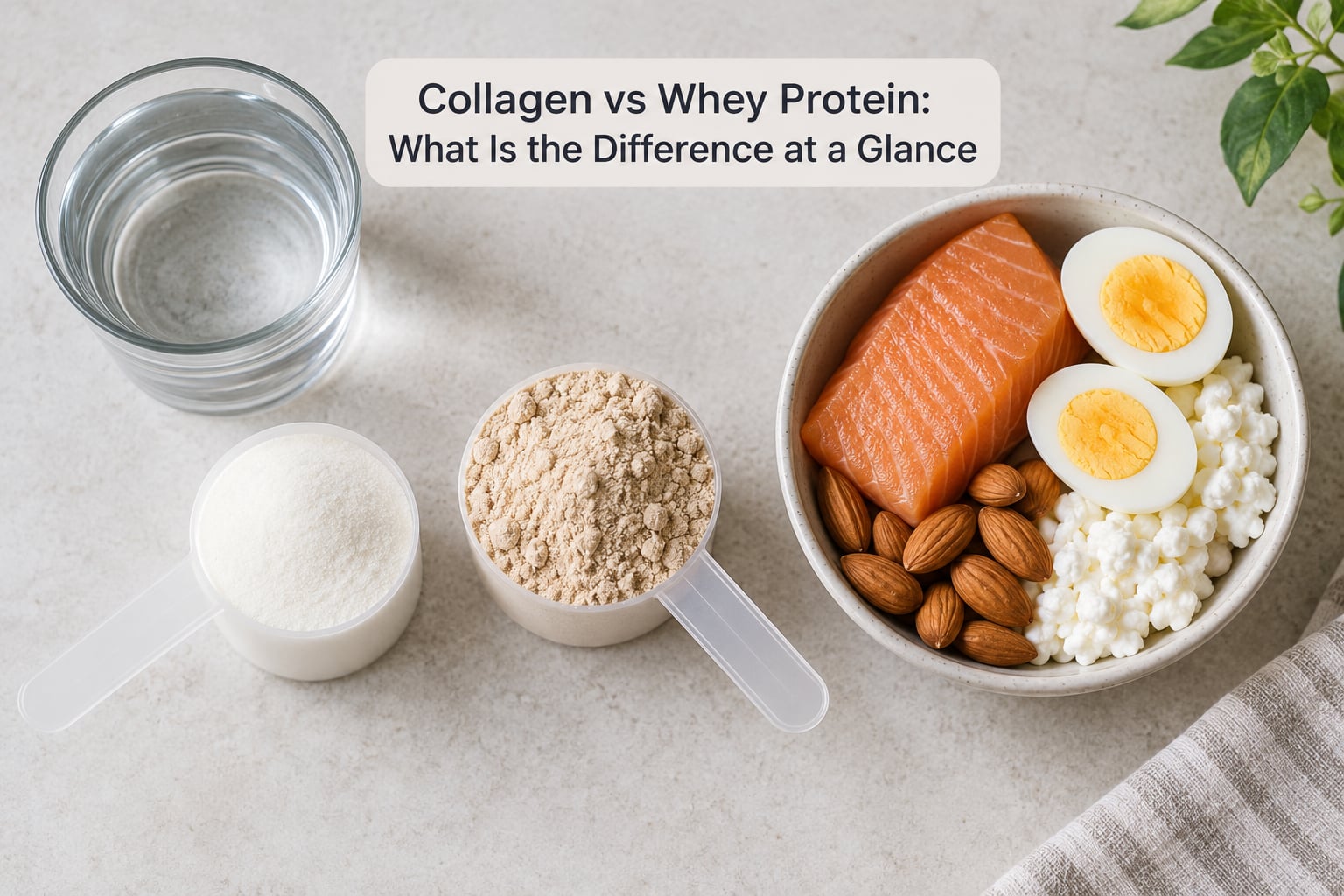
Five things separate the two, and once you know them you can pick in about ten seconds.
- Source. Collagen comes from animal connective tissue, mainly bovine hide and fish skin. Whey is the watery liquid separated out during cheesemaking, then dried into a powder.
- Protein type. Collagen is an incomplete protein missing tryptophan. Whey contains all nine essential amino acids.
- Leucine. Whey delivers a few grams per serving, which is what triggers muscle protein synthesis. Collagen delivers a very small amount.
- Dairy. Whey is a milk product, so lactose matters for many people. Marine and bovine collagen powders are dairy-free.
- Best fit. Whey for muscle and satiety. Collagen for skin, hair, nails, joints and bone-supportive nutrition as you age.
| Criteria | Collagen | Whey protein |
|---|---|---|
| Where it comes from | Bovine hide, fish skin and scales, chicken cartilage | Milk whey, a byproduct of cheesemaking |
| Type of protein | Incomplete, missing tryptophan | Complete, all nine essential amino acids |
| Signature amino acids | Glycine, proline, hydroxyproline | Leucine, isoleucine, valine (BCAAs) |
| Protein per typical serving | About 10 to 15 g | About 20 to 30 g |
| Main use | Skin elasticity, joints, bone, connective tissue | Muscle protein synthesis, strength, satiety |
| Contains lactose | No, when unflavoured | Often, especially concentrate |
| Taste | Nearly flavourless, dissolves clear | Milky, often sweet, mixes opaque |
| Best for | Healthy aging, skin, joints, dairy-free diets | Resistance training, protein targets, meal swaps |
Those figures vary a lot between brands, which is why the label matters more than the front of the tub.
What Is Collagen?
Collagen is the most abundant protein in your body. It is the structural scaffolding of skin, cartilage, tendons, bone and blood vessels, and the body makes it from amino acids rather than absorbing it whole.
That last point is the key to collagen vs whey protein thinking. Eating collagen does not send collagen to your face. Your body digests it into amino acids and rebuilds whatever collagen your tissues currently need.
Production peaks in your twenties and then tapers, commonly quoted at roughly 1% a year after age 30. That is the argument supplement brands make, and it is at least directionally plausible: your raw material supply shrinks as you get older.
The forms you will see:
- Hydrolyzed collagen peptides. Collagen broken into small peptides. This is the powder form, mixes clear in water or coffee, and is the most popular.
- Bovine collagen. From cow hide. Rich in glycine and proline, sold as powder or pills.
- Marine collagen. From fish skin and scales. Lower molecular weight, so it dissolves easily. Fish-allergic people should avoid it.
- Multi-type collagen. A blend of types I, II and III. Types I and III lean toward skin, hair and nails, type II toward joints.
- Bone broth protein. Food rather than supplement, with collagen alongside minerals and gelatin.
People tend to reach for collagen for skin elasticity, hair and nail strength, joint comfort and bone-supportive nutrition, especially after 40 or after an injury.
What Is Whey Protein?
Whey is the liquid portion of milk that separates during cheesemaking. Once dried, it becomes a powder, and because it dissolves in water it is the most popular protein powder on earth for good reason.
The three forms differ mainly in how much lactose and fat survive:
- Concentrate. Around 70 to 80 percent protein, with some lactose and fat. Cheapest per gram, easiest on the wallet, but the most likely to bother your stomach.
- Isolate. Filtered to around 90 percent protein with very little lactose or fat. The default choice for anyone who reacts to dairy.
- Hydrolysate. Partly broken down before you drink it. Absorbs fastest, costs more, tastes sweet. Rarely necessary.
Whey is what lifters use for muscle protein synthesis, strength, and staying full between meals. It is also the standard reference point for high-quality protein nutrition.
Collagen vs Whey Protein: Nutrition and Protein Content
Per scoop, whey usually wins on protein grams. A 30 g whey serving often gives you 22 to 25 g of protein. A 15 g collagen serving gives you roughly 10 to 12 g, and the rest of the powder is often flavouring, sweeteners or filler.
Calories follow a similar pattern. Whey isolate lands around 100 to 120 calories per serving with 1 to 3 g of sugar. Collagen peptides are lighter at roughly 40 to 60 calories, again depending on how much is added sugar.
The amino acid difference that decides everything
Whey is a complete protein. It contains all nine essential amino acids, including leucine, and leucine is the signal that switches muscle protein synthesis on. A whey serving can deliver 2 to 3 g of leucine; you need roughly 2 to 3 g to reliably trigger the response after resistance training.
Collagen is not a complete protein. It is missing tryptophan and low in the branched-chain amino acids, which is why it is a weak choice if muscle growth is the only goal. What collagen has instead is a huge share of glycine, proline and hydroxyproline, the amino acids used to build collagen fibres, cartilage and bone matrix.
That single distinction is the whole collagen vs whey protein argument. Different building blocks for different tissue.
Collagen vs Whey Protein: Benefits for Skin, Joints, and Muscles
People choose collagen for connective tissue. Skin hydration and elasticity, joint comfort in people who are already creaking, nail and hair strength, and general healthy-aging nutrition. Trials combining collagen peptides with resistance training have reported gains in fat-free mass, though the studies are small and short.
Collagen has also been studied for gut-lining support and for sleep. A few small trials link an evening collagen serving with better subjective sleep quality, which is interesting rather than settled.
Most people who lift already know whey is the muscle option. What is less often said out loud is how good it is at holding hunger off: it is one of the more satiating proteins available, which is why it turns up in weight-loss plans that are otherwise sensible.
Weight loss deserves a straight answer: neither powder burns fat. Whey helps because a high-protein hit cuts appetite. Collagen helps because it is low calorie and easy to drink without thinking about it. That is the entire mechanism.
Collagen vs Whey Protein: Digestion, Allergies, and Side Effects
Whey is where most digestive complaints come from. People report bloating, gas and cramping on concentrate, largely from lactose. Isolate and hydrolysate are far better tolerated. If you react to dairy rather than just lactose, an isolate may still cause symptoms, and a plant protein or collagen is the safer road.
Collagen is usually gentle. The odd complaints are fullness, a slightly thick texture in coffee, and an aftertaste people describe as fishy for marine sources.
Two practical cautions. First, some people with an intolerance to one animal protein report reactions to another, so introduce a new powder in a small serving. Second, collagen is an animal product, and heavy metals are the reason reputable brands publish third-party screening for lead, cadmium and mercury. Look for the test, not the marketing.
If you have kidney disease, are on a restricted protein diet, or are managing diabetes, get individual advice before adding any powder to your day.
Collagen vs Whey Protein: Which Is Better for Your Goals?
| If your goal is | Reach for | Why |
|---|---|---|
| Building muscle or strength | Whey, then a full diet | Complete amino acids and enough leucine to drive muscle protein synthesis |
| Losing weight and staying full | Whey isolate | High protein per calorie, reliably filling |
| Skin, hair and nails | Collagen peptides | Glycine, proline and hydroxyproline feed the raw material |
| Joint comfort | Collagen, type II if available | Cartilage-focused amino acid profile |
| Bone support after 50 | Collagen plus food sources | Complements calcium and vitamin D, does not replace them |
| Lactose-free or dairy-free eating | Collagen | No milk protein or lactose |
| A vegan routine | Neither, as a straight swap | Use a plant protein for muscle, collagen is animal-derived |
| A cheap meal replacement | Whey concentrate | Lowest cost per gram of protein |
| Recovery after surgery or injury | Both, plus your clinician | Whey for protein, collagen for tissue, advice over supplements |
| Healthy aging in general | Both, stacked | They cover different tissue with no real overlap |
On cost, whey wins on protein per gram and loses on a per-ingredient basis: collagen is a smaller dose doing a more specific job. People in r/30PlusSkinCare name price as the deciding factor for collagen more often than results.
And no, one is not a clean substitute for the other. Lifters on r/nutrition and r/Fitness are blunt about it: swapping whey for collagen means giving up the leucine you need for muscle. On the flip side, whey does nothing for joints or skin. That is why the usual answer from people who use both is to stack them rather than trade one for the other.
How to Choose a Collagen or Whey Protein Supplement
Five checks, in the order I would make them:
- Grams of real protein, not blend. The label should say grams of collagen or whey protein per serving. A “collagen blend” line often means a smaller active amount.
- Third-party testing and heavy-metal screening. Look for a named certifier such as NSF Certified for Sport, Informed Sport or USP. For collagen, ask where the test result is published.
- Added sugar and sweeteners. Flavourful powders in both categories are often mostly sugar. Collagen that dissolves clear into coffee lets you skip it.
- Form matching your tolerance. Isolate over concentrate for dairy sensitivity. Marine over bovine for mixing and lower molecular weight, unless you avoid fish.
- Cost per serving, not per tub. Divide the tub price by servings. Add vitamin C to collagen if your meals around it are low in fruit and vegetables, since your body needs it to build collagen fibres.
Dosing is simpler than the marketing suggests. Most collagen research uses 10 to 15 g daily, and an evening serving is a reasonable habit if you like one. Whey lands around 20 to 40 g, taken within a few hours after training or as a meal replacement. Take one or the other as your main protein, or both, as long as total protein from all sources reaches your target.
Frequently Asked Questions
Can you take collagen and whey protein together?
Yes, and it is the arrangement most regular users end up with. Collagen supplies glycine, proline and hydroxyproline for connective tissue, while whey supplies the complete protein and leucine you need for muscle. There is no known conflict between them, and no reason the two cancel each other out. Use whey as your primary protein and treat collagen as an addition, not a replacement.
Is collagen better than whey protein for weight loss?
Neither is better for weight loss on its own. Whey isolate usually wins because it delivers more protein per calorie and is reliably filling, and appetite control does more for fat loss than any supplement. Collagen is lower in calories and easy to drink, which makes it a good low-effort habit, but it is not a fat-loss product. Your overall food pattern and training matter far more than the powder you pick.
Does collagen contain complete protein like whey?
No. Collagen is not generally treated as a complete protein because it is missing tryptophan and is low in the branched-chain amino acids. Whey contains all nine essential amino acids, including about 2 to 3 g of leucine per serving, which is what triggers muscle protein synthesis. Collagen is rich in glycine, proline and hydroxyproline instead, which suits skin, joint and connective tissue goals rather than muscle growth.
Is whey protein better for muscle growth than collagen?
Yes. Whey has the clear advantage because it delivers a large serving of complete protein with enough leucine to switch on muscle protein synthesis after training. Collagen is low in leucine and missing tryptophan, so it does not do that job. That said, collagen is not useless around strength work, since connective tissue adapts alongside muscle and small trials have reported gains in fat-free mass when collagen is taken alongside resistance training.
What foods are high in collagen?
The richest natural sources are the connective-tissue parts of animals: bone broth made from bones with skin and tendon, chicken cartilage, beef tendon, fish skin and the tough connective tissue in a slow-cooked pot roast. Ordinary muscle meat is high in protein but contains very little collagen, because muscle is built from different proteins. Eating these foods occasionally is fine, though the amounts are impractical as a daily habit for most people.
The Short Version
Start with food. Most people can hit their protein target from meals, and supplements are an add-on rather than the foundation.
After that, the rule is simple. Training for muscle or chasing fullness means whey, usually isolate if dairy bothers you. Skin, joints, nails and healthy aging mean collagen peptides at 10 to 15 g a day. Most people over 40 who lift do better with both on the shelf, because they are feeding different tissue.