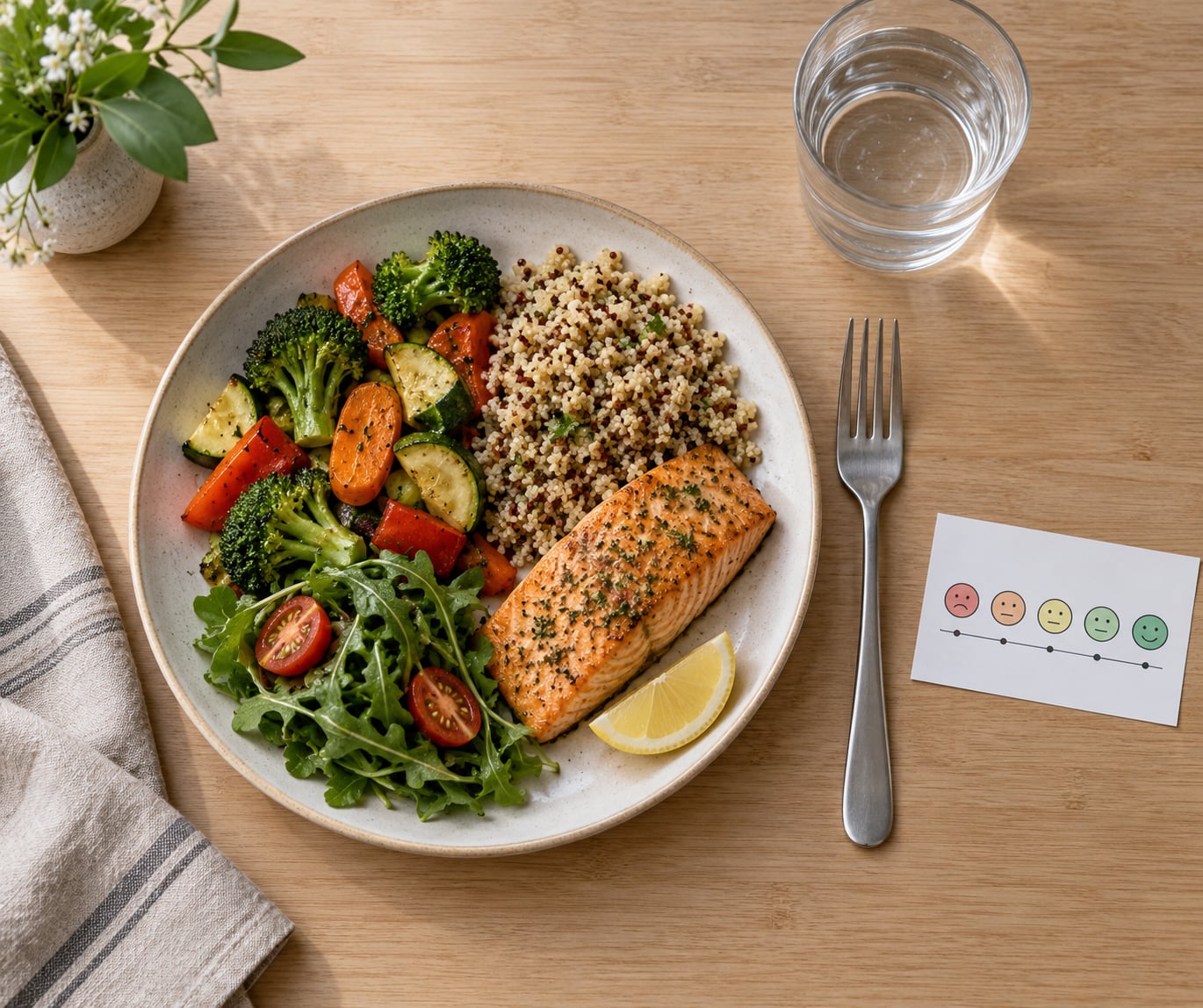
Practicing mindful eating at meals means eating with your full attention instead of on autopilot: notice your hunger before you start, slow down enough to taste what you are eating, pause partway through, and stop when you feel comfortably satisfied. It takes about 20 minutes for a normal plate, and it works for any food you already eat.
What makes this different from another diet is that nothing gets banned. You still eat cake, take the biggest portion if you want it, and go to restaurants. The only change is that you pay attention while you do it.
Table of Contents
- What You Need
- Step-by-Step: How to Practice Mindful Eating at Meals
- Set Up Your Meal Without Distraction
- Check In With Your Physical Hunger
- Slow Down and Notice Your Food
- Pause in the Middle of the Meal
- Choose What You Want Next
- Notice Your Fullness and Finish Comfortably
- Use Mindful Eating With Realistic Expectations
- Common Mistakes
- Frequently Asked Questions
- How long should I eat each meal mindfully?
- Does mindful eating mean eating very slowly?
- Can mindful eating help with weight loss?
- What if I do not feel full when I finish eating?
- How can I practice mindful eating when eating is rushed?
- Is mindful eating suitable for people with an eating disorder?
- Conclusion
What You Need
Mindful eating needs no special food, no supplements, and no expensive equipment. You do not have to cook from scratch or buy organic ingredients to do it well.
What you do need is an ordinary meal and a few minutes where nothing is asking for your attention. That is genuinely it. Most people find ten uninterrupted minutes at one meal a day is easier to keep up than twenty minutes at every meal, and it works just as well as a starting point.
The one optional tool is a hunger and fullness scale from 1 to 10. Some people draw it on a card, some keep it as a note on their phone, and some just track it in their head. It gives you a shared language for a feeling that is otherwise hard to pin down.
Step-by-Step: How to Practice Mindful Eating at Meals
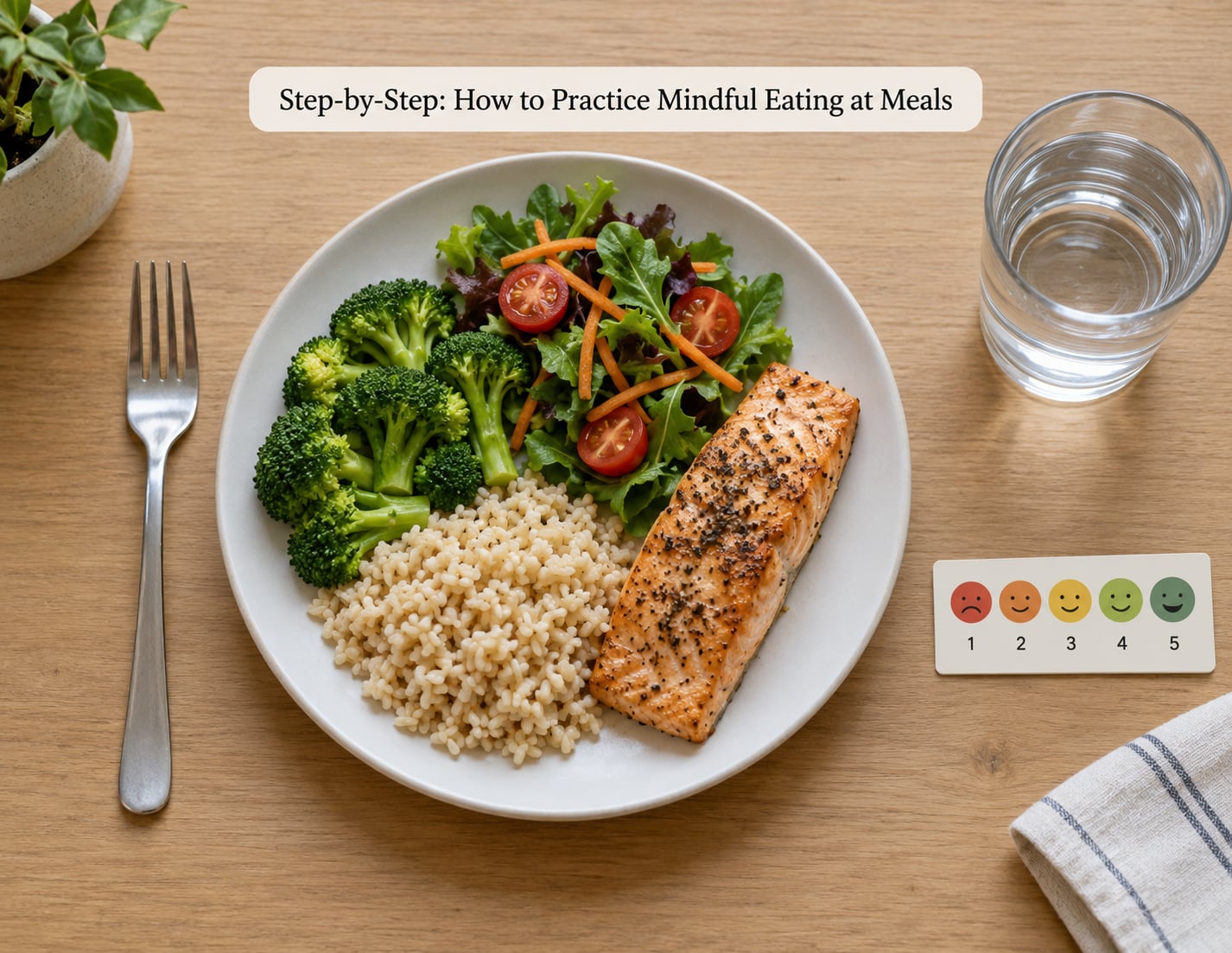
Here is the sequence that works, in order. You can follow it once through, then keep whatever parts feel useful and drop the rest. There is no prize for doing all eight perfectly.
Set Up Your Meal Without Distraction
Sit down somewhere other than the car or standing at the counter, and put your phone out of reach rather than face down on the table. Close the laptop tab, turn off the television, and give yourself enough time that finishing quickly will not cost you anything.
This step matters more than people expect. When your attention is split, the part of your brain that registers fullness gets less of the signal, and eating happens without you. You will know this step worked when you realise you have been standing for six minutes and finished a whole meal without registering a single bite.
Check In With Your Physical Hunger
Before you pick anything up, take ten seconds to rate your hunger from 1 to 10. One means no hunger at all and ten means starving. Most people start meals somewhere around a five or a six.
Try to describe what you feel in physical terms: an empty stomach, a hollow feeling, low energy, a gnaw in the stomach. That is physical hunger. A craving for something specific, an urge to nibble because the food is there, and the feeling that comes after a hard afternoon are different things, and naming them separately is most of the skill.
You are not trying to earn points for a high number. Eat when you are genuinely hungry, and skip or shrink the meal when you are not. There is no rule about how much that means.
Slow Down and Notice Your Food
Put your fork or spoon down between bites. This is the single trick people repeat most often in online discussions of mindful eating, and it works because it removes the momentum that carries you through a meal.
Chew until the food is actually blended before you swallow. Look at the plate before you start, notice the colours, and smell the food while it is still hot. Take one bite and stay with it for longer than feels natural.
You will know it is working when a familiar meal turns out to have more going on than you remembered. That is not a rule you have to enforce, just something to notice when it happens.
Pause in the Middle of the Meal
Roughly halfway through, stop and set your utensils down. Ask yourself four things: how hungry do I still feel, how satisfied do I feel, what is my body enjoying right now, and where did my attention just go?
This pause is the step most guides skip, and it is the most useful one you can add. Halfway through, you still have time to respond. By the time the plate is empty, you have no options left.
Give the pause ten seconds. If you notice you were on autopilot for the first half, that is information, not a failure. Start again from the pause.
Choose What You Want Next
At that checkpoint, decide based on what you actually want right now. More of the same, something else that sounds better, a slower pace, or stopping. Any of those is a legitimate choice.
The point is that the decision comes from you instead of from a rule you absorbed years ago. If a plate cleaned up in childhood still dictates how much goes on your plate now, you have something worth noticing. You do not have to act on it today.
Notice Your Fullness and Finish Comfortably
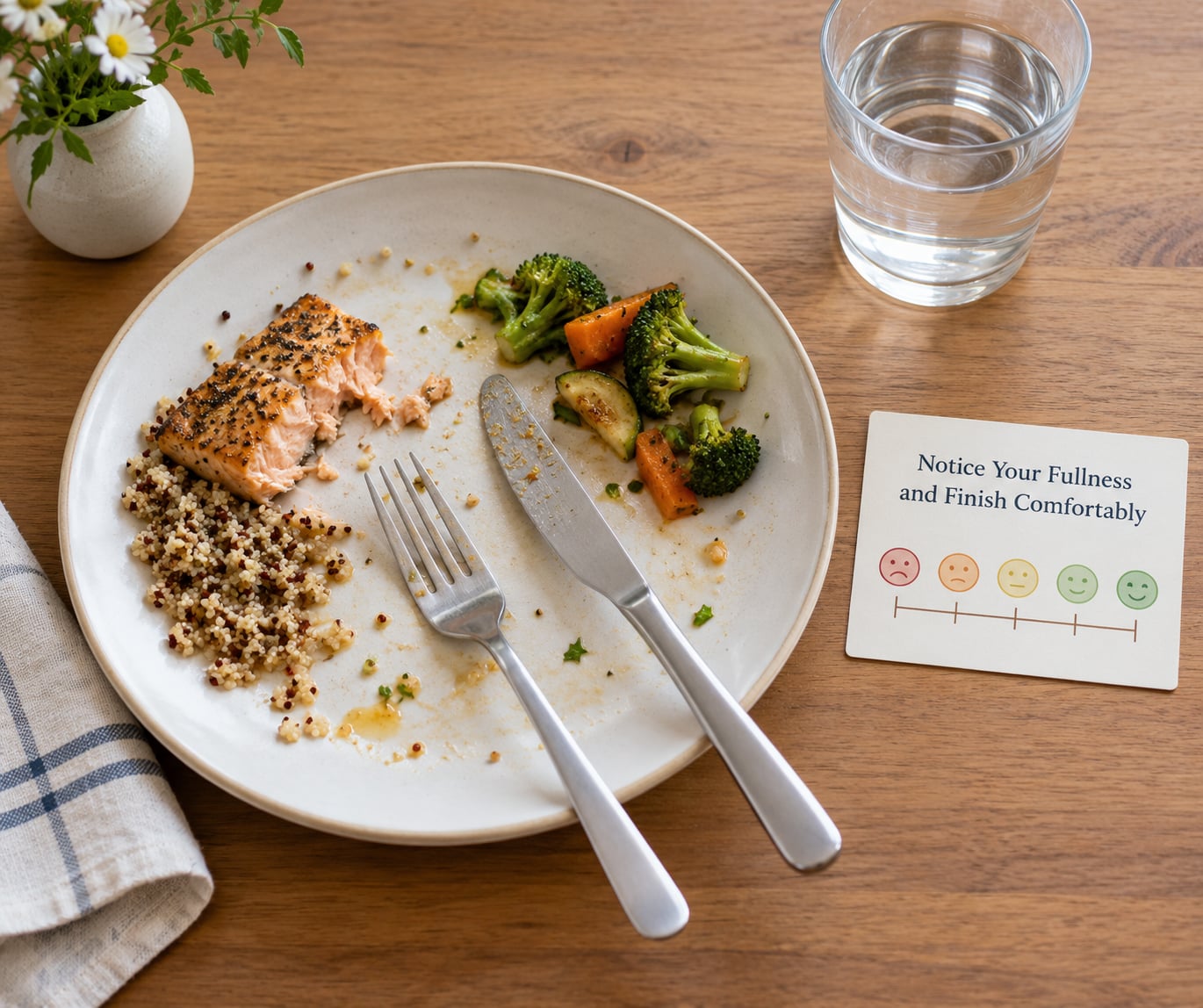
Comfortable fullness feels like satisfied and relaxed. It is not stuffed, not uncomfortable, and not still ravenous. It sits around a five or six on the same scale you used for hunger, and the strongest signal is the absence of any pull to keep eating.
Stop when you reach it, even when food is left on the plate. Then sit for another minute or two without clearing up. People often find the urge to eat more arrives a few minutes after stopping and then fades, which is worth experiencing once rather than reading about.
Skip the post-meal self-criticism. One meal eaten while scrolling is not a verdict on you or your progress, and treating it that way is what turns a practice into a punishment.
Use Mindful Eating With Realistic Expectations
You will not do this at every meal. Weeknight dinner before the kids have homework is not the moment, and nobody does it perfectly. The realistic goal is repeated moments of attention rather than perfect control.
Most people see the change in what they notice rather than in how much they eat. A meal eaten fast on a busy day is fine. One meal fully in your attention tells you more than a week of half-hearted attempts.
Common Mistakes
- Turning it into another diet. Mindful eating does not come with a food list. If you start ranking foods or calling meals good and bad, you have rebuilt the restriction you came here to escape. Fix it by keeping every food in the rotation and noticing your reactions without grading them.
- Confusing discomfort with fullness. Bloating, gas, and pain are not the same as being satisfied, and treating them as such pushes you to eat less than you need. Pay attention instead to the calm, relaxed feeling that arrives after enough food.
- Going for the smallest possible portion. Serving yourself a token amount to look disciplined is restriction wearing a new outfit. Serve what you would normally serve and use the pause to decide whether you want more.
- Skipping the food you enjoy. People sometimes give up dessert or take-out while practising this. Enjoyment is part of eating, and the practice is built around noticing pleasure rather than removing it.
- Judging the moments when attention is unrealistic. Celebrations, road trips, and deadlines exist. Notice that your attention was elsewhere and move on rather than treating the slip as proof the method does not work.
If you have a history of restrictive dieting, disordered eating, or an eating disorder diagnosis, this kind of practice can bring uncomfortable sensations to the surface. Talking through it with a registered dietitian or therapist who specialises in eating disorders is a much better first step than working through it alone.
Frequently Asked Questions
How long should I eat each meal mindfully?
Aim for around 20 minutes for a regular plate. That is long enough to slow your pace, taste most of the food, and give fullness signals time to arrive, without turning the meal into an event. If twenty minutes is unrealistic on a work lunch break, ten focused minutes still counts. The habit matters more than the number, and a shorter meal eaten with attention beats a long one eaten while scrolling.
Does mindful eating mean eating very slowly?
No, slow is a tool rather than the goal. What matters most is the pause between bites and staying present, because those are what let you notice hunger and fullness in time to respond. Some people eat at a normal pace and simply chew thoroughly with the utensil down between mouthfuls, which is a perfectly good version of the practice.
Can mindful eating help with weight loss?
It can help, though indirectly. People who eat with attention tend to notice eating patterns they were not aware of, which often reduces eating past comfort without any calorie counting involved. The practice is not designed as a weight loss method, and results vary. Anyone with a history of disordered eating should approach it with professional support rather than as a weight loss tool.
What if I do not feel full when I finish eating?
Many people do not, especially if they grew up finishing plates or eating quickly. That is a learned habit rather than a body failure, and the signal usually returns with repetition. Keep a hunger and fullness scale for a few weeks to make the change visible. If you regularly cannot tell when you are satisfied, a registered dietitian can help you rebuild that awareness without restriction.
How can I practice mindful eating when eating is rushed?
Pick one part of the meal rather than trying to do the whole thing. The most common approach is to give full attention to the first few bites, with the phone away and the fork down between them. That single change is where people report the biggest difference. You can also stretch the meal by adding a short pause before starting, which buys time without slowing anyone else down.
Is mindful eating suitable for people with an eating disorder?
Mindfulness-based approaches are used in treating binge eating and other eating disorders, usually as part of a wider plan with a therapist or dietitian rather than on their own. For people with a current or past diagnosis, practising this alone can bring up difficult sensations around food. Get individual guidance from a registered dietitian or a therapist who specialises in disordered eating before starting.
Conclusion
Practicing mindful eating at meals comes down to a short sequence: set the table without distractions, check your physical hunger, slow down enough to taste what you are eating, pause halfway to decide, and stop when you feel comfortably satisfied. Nothing about it asks you to change what you eat.
Start with one action tomorrow: put your phone in another room for the first five bites of your next meal. That is small enough to actually do, and it is where most people find the practice begins to click.