You can make a filling protein smoothie without banana by replacing the three jobs a banana does: sweetness, creamy bulk and soluble fiber. Use a base formula of 1 cup liquid, 20 to 30 grams of protein, 1 tablespoon of fat such as nut butter, and a thickener like Greek yogurt, silken tofu, oats or chia. It takes about five minutes and no more effort than a banana version.
The reason most no banana smoothies turn out thin is that the banana was doing three jobs at once. Take it out, leave the rest of the recipe alone, and you get a watery drink with protein powder floating in it. Swap each job for something else and the drink thickens up and keeps you full.
That matters most for the people who need this version. If you have a banana allergy or a latex fruit sensitivity, or you are avoiding bananas for blood sugar reasons, most recipe lists online are dead ends. This one works around all of it.
Table of Contents
- What You Need
- What can I substitute for a banana in my smoothie?
- Step-by-Step
- How to Make a Filling Protein Smoothie Without Banana
- Choose Your Protein and Thickening Ingredients
- Blend for the Right Texture
- Common Mistakes
- Tips for Making the Smoothie More Filling
- Frequently Asked Questions
- Can I make a protein smoothie without a banana?
- What can I use to thicken a smoothie instead of banana?
- What fruit to substitute for bananas in a smoothie?
- What can I put in a protein shake instead of banana?
- Why is my no banana smoothie thin?
- Do you need a banana for a smoothie?
- Conclusion
What You Need
Four parts, every time. Once you know which part each ingredient covers, you can swap freely and still land on a filling result.
- Liquid base. 1 to 1.25 cups of milk, oat milk, almond milk, coconut milk, cold brew coffee, cold green tea or a mix. This is what you adjust last to fix thickness.
- Protein source. 1 scoop of protein powder (about 20 to 25 grams per scoop), 3/4 to 1 cup plain Greek yogurt, 1/2 cup skyr, 1/2 cup cottage cheese, or 3/4 to 1 block of silken tofu. Read the label, because protein per serving varies a lot between products.
- Fat source. 1 tablespoon of almond butter, peanut butter, cashew butter or tahini. Fat is what slows the drink down and keeps it satisfying rather than sweet and empty.
- Thickener. 1/4 cup of rolled oats, 2 tablespoons of chia seeds, 1/4 cup of silken tofu, 3/4 of an avocado, or 1/4 cup of Greek yogurt if you have not already used it as your protein.
- Fruit or vegetable. 1 to 1.5 cups of frozen berries, 3/4 cup of frozen mango, a handful of spinach, or a couple of Medjool dates if you want the banana’s sweetness back.
- Optional flavor. Cocoa powder, cinnamon, vanilla extract, matcha, a pinch of sea salt. A pinch of salt is the cheapest fix for a flat tasting blend.
You need nothing more than a blender. A high speed blender gives you a smoother result with seeds and flax, but any blender works if you soak the chia and give the thick ingredients a head start. A glass with a spatula and a set of measuring spoons is genuinely useful, because the fat and fiber quantities are what hold the drink together.
What can I substitute for a banana in my smoothie?
Match the substitute to the job you need filled. Dates and maple take over sweetness. Greek yogurt, silken tofu, avocado, oats and chia take over creamy bulk. Nut butter takes over fat and satiety. Here is how the common options compare.
| Banana substitute | Job it does | Texture result | Best flavor pairing |
|---|---|---|---|
| Greek yogurt | Protein plus creaminess | Thick and creamy, holds ice | Any berry, honey, vanilla |
| Silken tofu | Creaminess and neutral bulk | Very smooth, almost custard-like | Berries, cacao, matcha |
| Avocado | Fat plus creamy bulk | Thick, mild, no added sweetness | Cocoa, mango, mint |
| Rolled oats | Fiber and body | Smooth and spoonable when soaked | Cinnamon, peanut butter, apple |
| Chia seeds | Fiber and gel texture | Thickens as it soaks, slight crunch if rushed | Everything, neutral flavor |
| Medjool dates | Sweetness and sticky bulk | Smooth, syrupy, dessert-like | Chocolate, peanut butter, date |
| Almond or peanut butter | Fat and staying power | Thickens and emulsifies | Chocolate, banana-adjacent berry blends |
| Frozen mango | Sweetness and bulk | Thick, tropical, sweet | Coconut, turmeric, lime |
| Ground flaxseed | Fiber and omega fats | Slight thickness, must be ground | Neutral, use for fiber |
| Steamed sweet potato or parsnip | Neutral bulk | Very smooth, mildly earthy | Cinnamon, ginger, vanilla |
Frozen fruit counts as the thickener too, so if you are blending mango or berries with less liquid than usual you can leave out the oats or chia entirely. Avocado is the most recommended creamy replacement in smoothie forums, and Greek yogurt is the most recommended thickener, usually about 1/4 cup, because it adds thickness and protein at once.
Step-by-Step
Five steps, roughly five minutes, and the same order every time. The order matters more than most recipes admit: soft and soaked ingredients first, frozen fruit and liquid last.
- Soak the thickener. If you are using chia, flax or oats, stir them into about half a cup of liquid and leave them for 5 minutes. Skipping this is the number one cause of a grainy or gritty blend.
- Load the liquid. Pour in 1 cup of milk or your milk of choice with the protein powder and any sweetener. Blend for 15 seconds so the powder dissolves before anything thick hits the blades.
- Add the thickener and the fat. Drop in the soaked oats or chia, yogurt, tofu or avocado, plus 1 tablespoon of nut butter. Blend again.
- Add the frozen fruit last. Fruit goes on top so it stays frozen long enough to freeze everything around it. Add it in two batches if your blender is small.
- Blend, then judge. Pulse 5 or 6 times to break up the fruit, then blend on high for 30 to 45 seconds. The finished drink should coat the back of a spoon and hold a soft peak when you tilt the jar.
How to Make a Filling Protein Smoothie Without Banana
The base ratio is 1 cup liquid to 20 to 30 grams of protein to 1 tablespoon of fat to 1/4 cup of thickener, plus fruit for flavor. Here it is as an actual drink.
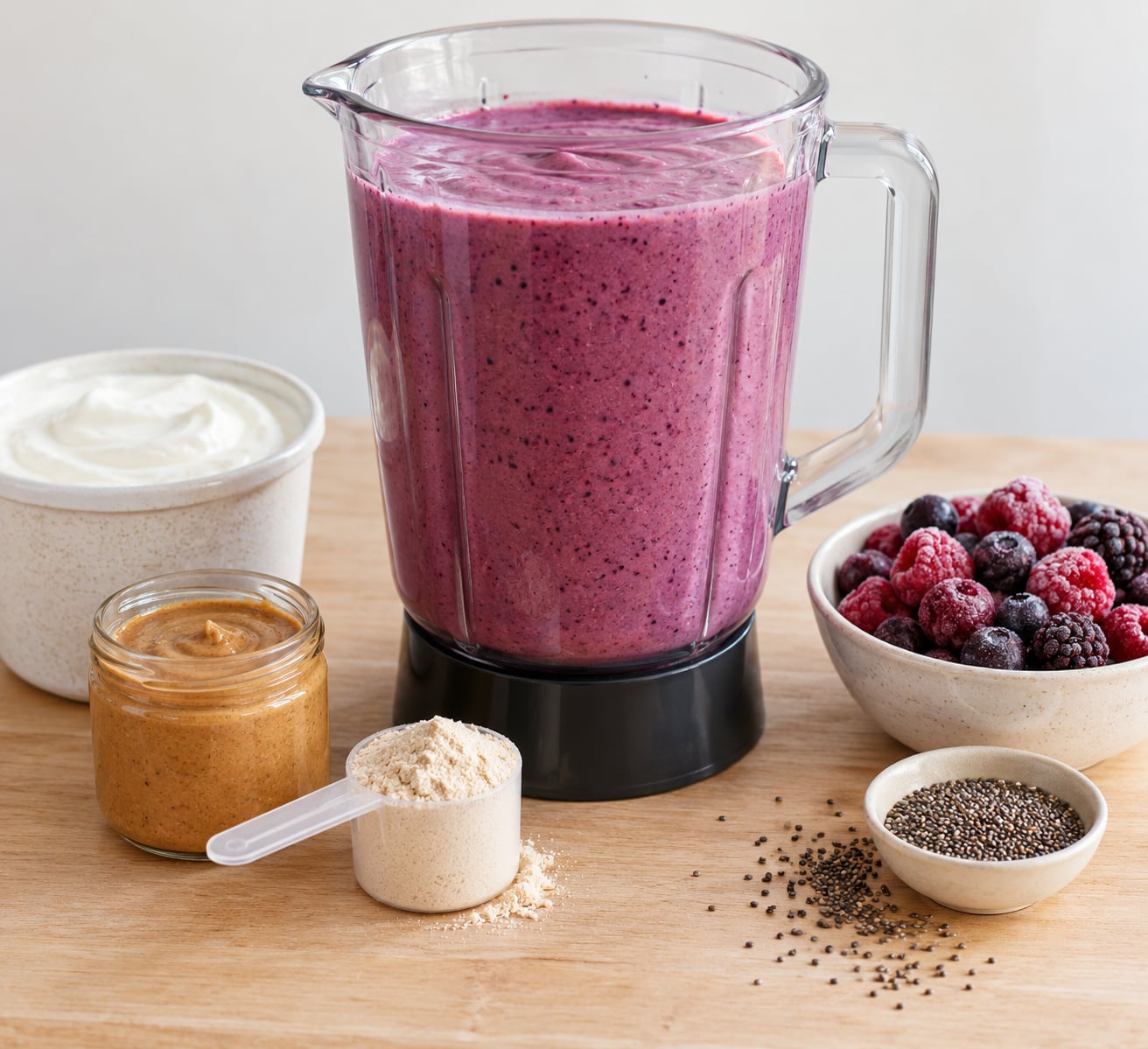
Put 1 cup of oat milk in the blender with 1 scoop of vanilla protein powder and 1 tablespoon of maple syrup. Add 3/4 cup of frozen mixed berries, 2 tablespoons of chia seeds, 1 tablespoon of almond butter and a handful of spinach. Blend for 45 seconds and add ice one cube at a time until it pours like thick yogurt.
That is about 30 grams of protein in a 16 ounce serving, depending on the powder and how much yogurt is in the blend. It stays full for a couple of hours because the fiber, protein and fat are doing separate jobs. A smoothie with only protein powder and fruit leaves you hungry in about 40 minutes.
The sweetening is the part that takes adjusting. Start with one Medjool date, torn and soaked in warm water for ten minutes if you have time, then taste. If your fruit is ripe enough, leave the date out entirely.
Choose Your Protein and Thickening Ingredients
Your protein choice sets both the protein grams and the texture, and the two are linked. Greek yogurt and skyr blend smooth and thicken the drink as they go, while a plant based protein powder adds protein without body. Cottage cheese is thick and mild and blends to a sorbet texture when it is nearly frozen.
Silken tofu is the vegan answer to all three. About three quarters of a block gives you a custard texture that hides chalky powder better than dairy does. Nut butter adds 7 or 8 grams of protein in a tablespoon along with the fat that keeps you full, so it counts as a protein source, not just a flavor.
One practical note: check the nutrition label before you plan the macros. Protein per scoop ranges from about 15 to 30 grams across the powders on the shelf, and a flavored powder can sweeten a blend that has dates in it. If your powder is already sweet, drop the maple.
Blend for the Right Texture
Liquid goes in first, frozen fruit last. That sequence keeps the blades moving, dissolves the powder without clumps, and lets the fruit chill the whole jar rather than sitting warm in it.
If the mixture is too thick to move, stop the blender and add 2 tablespoons of liquid, blend again, then repeat. Loosening in small steps is much easier than trying to fix a watery blend, which you cannot thicken once the ice has melted.
If a seed or flax blend looks grainy, you used whole seeds or you rushed the soak. Run it 30 seconds longer and it usually clears up. For a genuinely smooth oat smoothie, soak the oats in the liquid for at least 10 minutes instead of 5.
The cue for done: tilt the jar and the surface should slump slowly and hold a soft ridge for a second before sliding. If it runs flat like milk, add a thickener. If it stands in a peak, add liquid.
Common Mistakes
These are the failures people hit most often, and none of them need a new recipe to fix.
- The drink is thin and watery. You removed the banana and left the liquid volume untouched. Cut liquid by a quarter cup first, then add 1/4 cup of yogurt, tofu or 2 tablespoons of chia.
- It tastes flat or slightly green. The banana was carrying sweetness and you gave the job to nothing. Add one date, a tablespoon of maple, or a cup of riper frozen fruit.
- Too much ice. Ice dilutes as it melts, so a smoothie that tastes right in the first minute tastes like water in twenty. Use frozen fruit instead, and use ice only to finish the texture.
- Not enough protein. Half a scoop of powder over a cup of fruit is a fruit drink with a hint of protein. Aim for 20 to 30 grams per serving and count everything, including the nut butter.
- You expected banana creaminess. No single substitute replicates all three of banana’s jobs. Two of them plus a fat gets you closer than one on its own.
- Grit or graininess. Whole chia and flax seeds do not grind down in a domestic blender. Use ground flaxseed, or give chia 10 minutes in liquid before blending.
Tips for Making the Smoothie More Filling
For more fiber, add 2 tablespoons of chia or ground flaxseed, a tablespoon of hemp hearts, or swap half your liquid for oat milk. For more staying power, move fat up to 2 tablespoons of nut butter or use full fat coconut milk in place of a thinner milk.
For volume without sweetness, a quarter avocado works and nobody tastes it once the fruit and cocoa are in. For flavor, a tablespoon of tahini behaves like nut butter but leans nutty, and powdered peanut butter carries more protein per tablespoon than the natural kind because the sugar is already in the powder.
If the smoothie stops feeling filling after an hour, the ice has melted and the drink has thinned. Blend it again with two or three fresh ice cubes, or hold the batch in the fridge and reblend. A chia seed base thickens further in the fridge, so a blend made with 2 tablespoons of chia keeps getting better over a few hours.
Going dairy free is straightforward: oat milk, almond milk or full fat coconut milk for the liquid, silken tofu or a vegan protein powder for the protein, and hemp hearts instead of Greek yogurt. Going nut free works the same way with sunflower seed butter, which has a similar fat content and emulsifies just as well. If you are working around a banana allergy or latex fruit sensitivity, check labels on everything, including protein powders, because banana and plant protein show up in more products than you would expect.
If you have a sensitive stomach or are avoiding high FODMAP foods, low FODMAP choices like avocado, firm tofu, chia, oat milk and frozen berries are the safest starting point. Apple, pear and mango are common triggers, so leave them out while you are testing.
Frequently Asked Questions
Can I make a protein smoothie without a banana?
Yes, and you will not have to sacrifice thickness. A banana provides sweetness, soluble fiber and creamy bulk, so replace each one separately: Medjool dates or maple for sweetness, Greek yogurt, silken tofu, avocado, oats or chia for bulk, and nut butter for fat. Use 1 cup liquid, 20 to 30 grams of protein, 1 tablespoon of nut butter and 1/4 cup thickener.
What can I use to thicken a smoothie instead of banana?
Greek yogurt, plain skyr and silken tofu are the three creamiest options and add protein as they thicken. For a neutral thickener that adds almost no sweetness, use 1/4 cup of rolled oats, 2 tablespoons of chia seeds or ground flaxseed. Half an avocado thickens with no added sugar at all. Add the thickener before the liquid, then blend and judge.
What fruit to substitute for bananas in a smoothie?
Frozen mango is the closest match because it is sweet, thick and creamy. Frozen mixed berries or strawberries work well and add fiber and acidity. Pineapple, sliced pear and overripe melon also work, but each is thinner and less creamy, so pair them with avocado, yogurt or nut butter. Medjool dates are the best substitute for banana’s sweetness alone.
What can I put in a protein shake instead of banana?
The highest protein swaps are a scoop of protein powder with 1/4 cup of Greek yogurt, 1/2 cup of cottage cheese blended smooth, or a block of silken tofu with a vegan powder. One tablespoon of peanut butter adds 7 to 8 grams of protein plus the fat that slows digestion. Add dates or maple separately, because removing the banana also removes the sugar.
Why is my no banana smoothie thin?
Almost always the liquid. A banana displaces roughly a third of a cup of the liquid in a typical recipe, so removing it without reducing anything else leaves an over diluted drink. Cut the liquid by a quarter cup, add 1/4 cup of Greek yogurt or silken tofu, or soak 2 tablespoons of chia in the liquid for 10 minutes before blending.
Do you need a banana for a smoothie?
No. A banana is a convenient thickener, not a required one. Once you add a protein source, a fat source and a dedicated thickener, the drink thickens and stays filling. Frozen fruit, ice, nut butter and yogurt can each hold the body on their own when the ratios are right.
Conclusion
Start with the simple version: 1 cup oat milk, 1 scoop of protein powder, 1/4 cup of plain Greek yogurt, 1 tablespoon of nut butter, 1 cup of frozen berries and a handful of spinach. Blend for 45 seconds, then add ice one cube at a time until it moves like thick yogurt.
From there, adjust one thing at a time. Too thin means add a thickener or cut liquid. Tastes flat means add one date or a tablespoon of maple. Not filling enough means move the nut butter to 2 tablespoons. Once you own the ratio, how to make a filling protein smoothie without banana stops being a recipe question and becomes arithmetic.